
Excess facial hair from PCOS (hirsutism) is driven by androgens — not just genetics or bad luck. Eflornithine 12% works directly at the hair follicle to slow that growth, regardless of the hormonal cause.
Cancel anytime · No hidden fees
Facial hair from PCOS is a medical symptom — not a cosmetic quirk. Understanding the mechanism helps you choose the right treatment approach.
PCOS disrupts normal hormonal signaling, leading to elevated androgen levels (testosterone and related hormones). This is the core driver of many PCOS symptoms.
Excess androgens bind to androgen receptors in hair follicles on the face — areas that are particularly sensitive to these hormones. This triggers the follicle to produce thicker, darker, faster-growing hair.
The result is hirsutism — the medical term for excess facial or body hair in women following a male pattern. It appears on the chin, upper lip, cheeks, and neck.
Eflornithine doesn't address androgens directly — but it doesn't need to. It blocks the enzyme hair follicle cells need to produce new hair, slowing growth at the local level regardless of the hormonal input driving it.
You can treat the symptom and the cause at the same time. Eflornithine addresses the hair directly. Other treatments like Spironolactone and Metformin address the underlying hormonal cause. Used together, they work at different points in the same process.
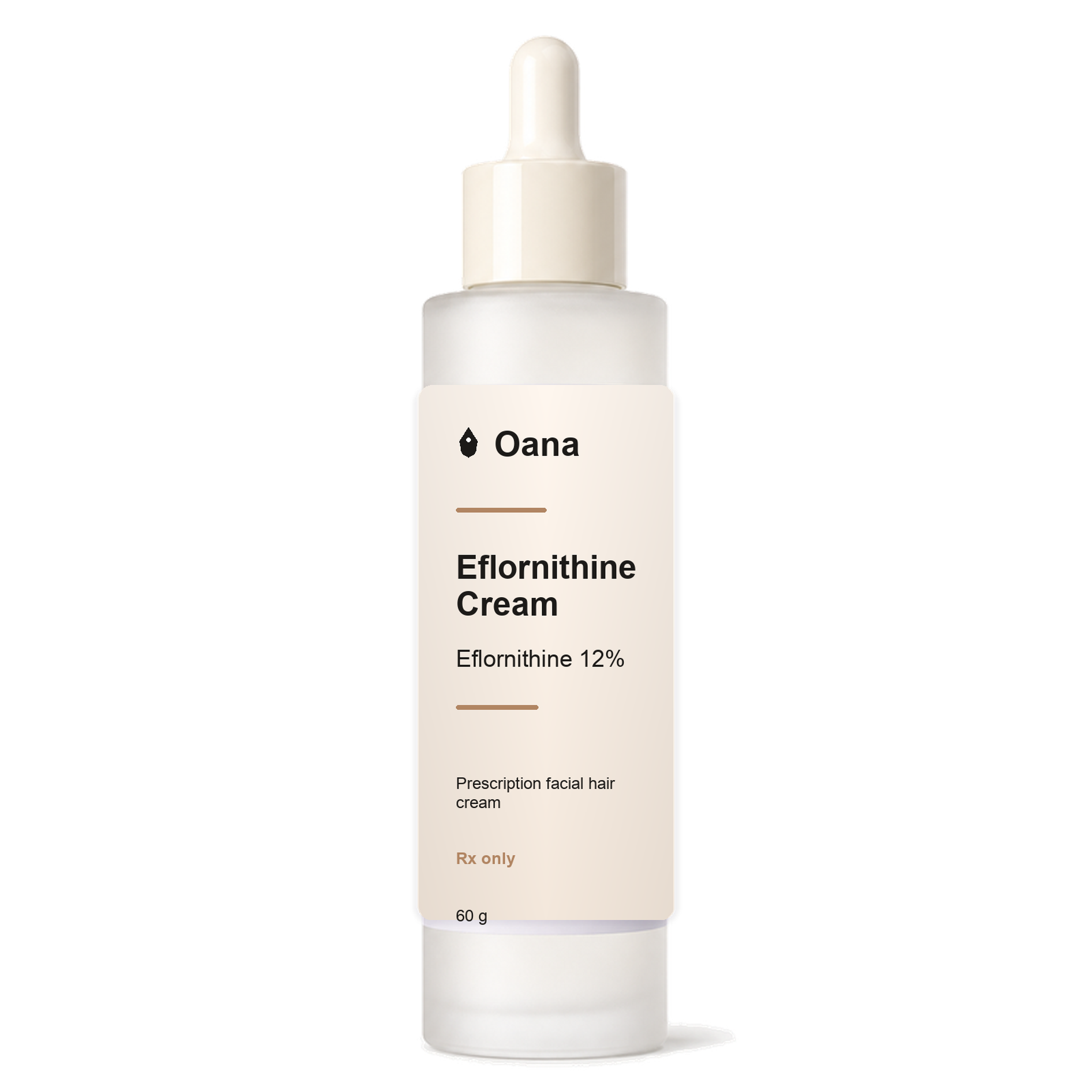
Eflornithine 12% is a compounded prescription topical cream containing the same active ingredient as Vaniqa, a brand-name prescription cream indicated for reducing unwanted facial hair in women. Eflornithine is widely used as a standard of care for hirsutism management. Compounded medications are not FDA-approved.
While hormonal treatments like Spironolactone work by reducing androgen levels (addressing the cause), eflornithine works locally at the follicle itself — blocking the enzyme (ODC) that hair follicle cells need to divide. This slows the physical growth process at its source, regardless of the hormonal environment driving it.
This makes it an effective standalone option and an ideal complement to hormonal PCOS treatments: Spironolactone or Metformin may gradually normalize androgens, while eflornithine actively slows the hair that's growing now.
Get Started — $119/mo →Eflornithine targets the growth mechanism locally at the follicle — effective regardless of whether hair growth is driven by PCOS, hormones, or genetics.
Eflornithine irreversibly inhibits ornithine decarboxylase (ODC), an enzyme essential for polyamine synthesis — the cellular building blocks required for rapid hair follicle cell division.
Without sufficient ODC, hair follicle cells — even those overstimulated by androgens — can't divide as rapidly. The growth phase slows, producing hair that emerges more slowly.
Each successive growth cycle produces thinner, softer, less coarse hair. Over weeks of consistent twice-daily use, PCOS-driven facial hair becomes progressively less noticeable.
If you're on Spironolactone, Metformin, or birth control for PCOS, eflornithine is fully compatible. It operates at the follicle level, independently of how your hormones are being managed.
Different options work at different points in the PCOS hair growth pathway. Here's how they relate.
The most effective approach combines treatments. Eflornithine treats the hair directly, while hormonal options like Spironolactone address the underlying androgen excess driving PCOS symptoms. Many women manage both simultaneously for faster, more comprehensive results.
Eflornithine is FDA-studied specifically for facial hair reduction — including in women with hirsutism from hormonal causes like PCOS.
Eflornithine works gradually. Here's a realistic week-by-week timeline for women with PCOS-related facial hair.
The cream begins working at the follicle level. Continue your normal hair removal routine. Some women notice skin feels smoother between removals even before visible hair changes.
Hair begins growing back more slowly after removal. Women with PCOS often notice this phase clearly because their baseline regrowth rate was noticeably fast. The intervals between shaving or waxing start to stretch.
Hair grows in noticeably finer and less frequently. The coarse, dark hair typical of PCOS hirsutism becomes less prominent. Many women also report less time spent on daily facial hair management.
Maximum benefit typically reached by 24 weeks. Hair growth is significantly slowed. If you're also on hormonal treatments for PCOS, you may see complementary improvements from both approaches by this stage.
Wash and dry the areas where you'll apply the cream. If you've just removed hair (shaving, waxing, etc.), wait at least 5 minutes before applying to minimize stinging.
Apply a thin layer to the affected areas of the face, chin, and adjacent areas under the chin. Rub in thoroughly. A little goes a long way.
Apply twice a day, at least 8 hours apart. Most women apply once in the morning and once in the evening for best results.
Avoid washing the treated area for at least 4 hours after application. You can apply sunscreen or makeup over the cream once it has absorbed (a few minutes).
Eflornithine targets the hair directly. Oana also offers treatments that address the hormonal root cause of PCOS — so you can tackle both at once.
Targets: the hair itself
Slows facial hair growth directly at the follicle level. Works regardless of the hormonal environment. Results visible within 4–8 weeks. Best for: anyone with unwanted facial hair, with or without PCOS.
Get Started — $119/moTargets: androgen activity
A prescription medication that blocks androgen receptors — reducing the hormonal signal that drives hirsutism in PCOS. Addresses the root cause, not just the symptom. Can be used alongside eflornithine.
Learn about Spironolactone →Targets: insulin resistance & androgen production
Improves insulin sensitivity in PCOS, which can lower androgen production over time — potentially reducing hirsutism as part of broader PCOS management.
Learn about Metformin →Yes. Eflornithine works by blocking an enzyme in hair follicles — it doesn't depend on the hormonal environment driving growth. Whether your facial hair is from PCOS, elevated androgens, or idiopathic hirsutism, the follicle-level mechanism is the same. Clinical trials include women with hirsutism from hormonal causes.
They work differently and aren't directly comparable. Eflornithine works locally and quickly — you may see results in 4–8 weeks. Spironolactone reduces the androgen levels driving hirsutism but takes longer (often 6–12 months) to show visible hair changes. Many women with PCOS benefit from both: eflornithine for faster visible improvement, Spironolactone for long-term hormonal management.
Yes. Eflornithine is a topical cream — it's minimally absorbed into the bloodstream and works locally at the skin. It doesn't interact with Spironolactone, Metformin, birth control, or other PCOS medications. Always confirm with your provider, but combination use is generally considered safe and often recommended.
Eflornithine is FDA-studied specifically for facial hair — the face, chin, and adjacent areas under the chin. It has not been well-studied for body hair on other areas. For other hirsutism symptoms (body hair, scalp, etc.), hormonal treatments that address androgen levels systemically may be more appropriate.
Yes — eflornithine slows growth only while you use it. If you stop, hair gradually returns to its previous rate within about 8 weeks. This doesn't mean it has 'worn off' — it simply means the treatment requires ongoing use. If you're also managing PCOS hormonally and androgens normalize, you may find you need eflornithine less over time.
Yes. Oana offers Eflornithine for facial hair, Spironolactone for androgen-driven symptoms, and Metformin for insulin resistance and PCOS management. You can complete separate consultations for each treatment. Many of our patients manage multiple aspects of PCOS through Oana.
Yes — the chin and adjacent areas under the chin are areas where eflornithine has been clinically studied. Chin hair is one of the most common concerns for women with PCOS hirsutism, and it's exactly what this treatment is designed for.
Supplements marketed for PCOS hair (like spearmint, saw palmetto, or inositol) have limited and inconsistent clinical evidence. Eflornithine is a prescription medication studied in clinical trials for reducing unwanted facial hair. The mechanism is well-understood and supported by robust clinical evidence. Oana's eflornithine 12% is a compounded preparation and is not FDA-approved.
Complete a 5-minute online consultation. A licensed provider will review your information and — if appropriate — write your prescription within 1–2 business days.
Get Started — $119/monthAlready have a prescription? Check refill eligibilityFree shipping · Cancel anytime · No hidden fees