
AI in Hair Loss Apps: What You Need to Know
AI hair loss apps are transforming how people monitor and manage hair thinning and scalp conditions. These tools use advanced image analysis to detect early signs of hair loss, track progress, and provide personalized recommendations. Here's what you need to know:
- How It Works: Apps analyze smartphone photos using computer vision and machine learning to measure hair density, follicle size, and patterns of thinning.
- Who Benefits: Women with hormonal hair loss, such as PCOS-related thinning, can use these apps to identify subtle changes and track treatment effectiveness.
- Features: Common tools include guided photo capture, progress tracking, and visual comparisons like heatmaps and charts.
- Limitations: Accuracy can vary due to lighting, hair type, or incomplete datasets. These tools supplement, not replace, professional medical care.
- Privacy Concerns: Apps collect sensitive data, so secure storage and clear policies are crucial.
AI apps, paired with telehealth services, offer a convenient way to monitor hair health and improve treatment adherence. However, they should always be used alongside professional medical advice.
Onballa UK - a new app designed to support people with alopecia areata

How AI Works in Hair Loss Apps
How AI Hair Loss Apps Work: From Photo Capture to Analysis
AI Technology Basics for Hair Loss Apps
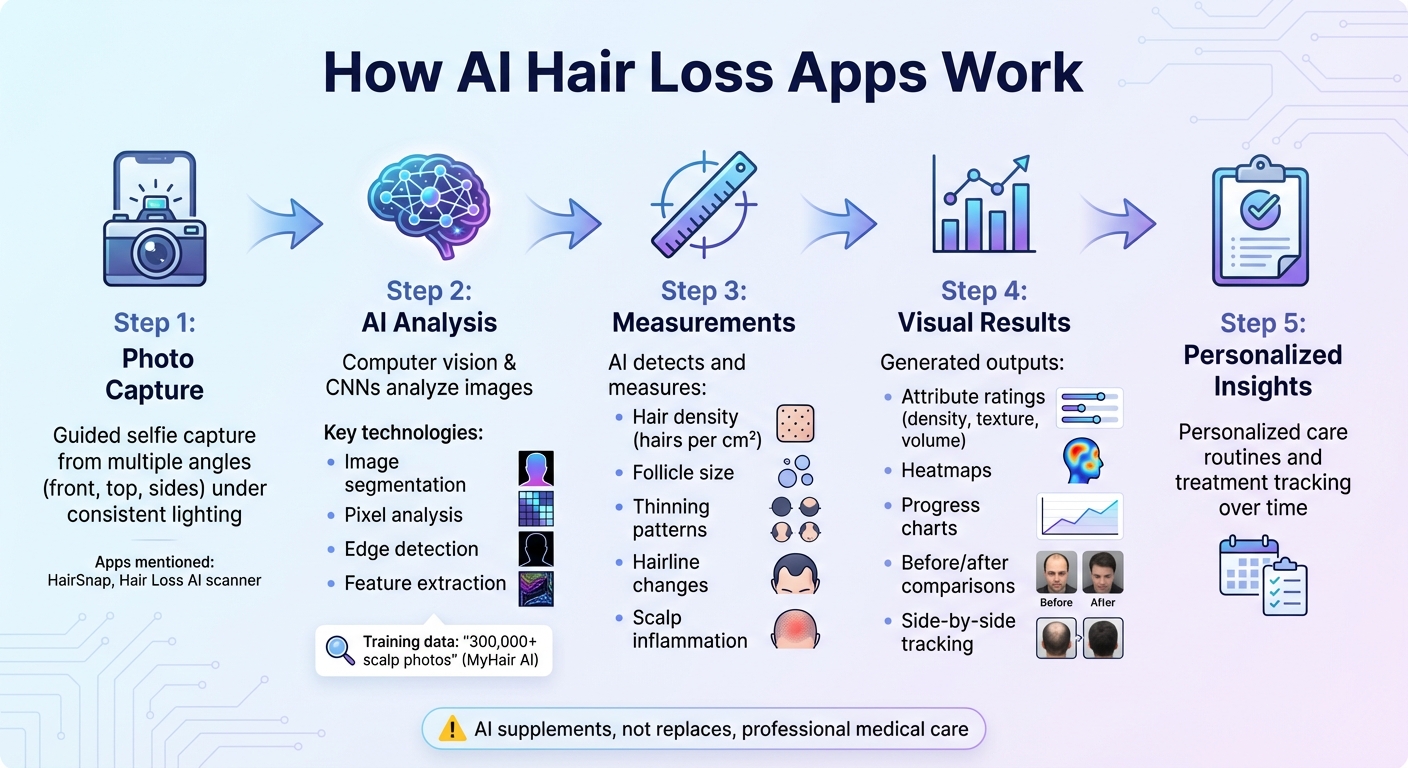
Hair loss apps rely on computer vision and convolutional neural networks (CNNs) to analyze smartphone images and provide diagnostic insights. These advanced algorithms are trained on extensive datasets - like MyHair AI's model, which is built on over 300,000 scalp photos - to identify patterns such as thinning, follicle miniaturization, or receding hairlines. By analyzing scalp images, the app can measure hair density (hairs per square centimeter), follicle size, and even detect scalp issues like inflammation. Techniques like image segmentation, pixel analysis, edge detection, and feature extraction ensure accurate results, even when lighting and angles vary.
Apps such as HairSnap and Hair Loss AI scanner guide users through capturing standardized selfies from multiple angles - front, top, and sides - under consistent lighting conditions. The AI then processes these images to uncover subtle changes, such as early thinning or shifts in the hairline, that might not be noticeable to the naked eye. Some platforms boast high accuracy levels when their results are compared with clinical evaluations. Unlike generic language models, specialized apps like MyHair AI use custom-built models tailored specifically for hair analysis, improving their ability to detect conditions like androgenetic alopecia.
These detailed measurements form the basis for tracking hair health over time, helping users monitor progress and adjust treatments as needed. Many apps also include intuitive tools to make it easier to visualize and track changes, ensuring users stay engaged with their hair care journey.
Common Features in AI Hair Loss Apps
AI hair loss apps are designed to simplify tracking and monitoring by incorporating user-friendly features powered by sophisticated algorithms. One key feature is guided photo capture, which prompts users to take selfies at specific angles and distances. This ensures consistency between sessions since even minor differences in lighting or positioning can affect results.
After uploading photos, the app generates attribute ratings for factors like hair density, texture, and volume, often presented as scores or visual markers. Progress tracking is another essential feature, where the app uses machine learning to compare current images with baseline photos. For instance, Hairly excels at creating side-by-side comparisons and allows users to filter photos by angle to evaluate treatment outcomes. MyHair AI goes a step further by tracking hair loss trends over time and offering personalized care routines based on detected changes.
These apps also provide visual tools - such as charts, heatmaps, and before-and-after sliders - that make it easy to see changes at a glance. These visualizations not only offer clear evidence of progress but also help users decide when to tweak their approach or seek professional advice.
Research on AI for Hair Loss Management
AI and Androgenetic Alopecia: Study Results
Research into how AI can assist with hair loss has primarily focused on androgenetic alopecia, examining factors like hair density, follicle miniaturization, and scalp health. These AI systems analyze hair shaft diameter, density per square centimeter, and distribution patterns over time to identify androgen-driven miniaturization and thinning along the midline. This forms the groundwork for both clinical and technological applications.
One example is MyHair AI, which uses a model trained on large image datasets to detect baldness and measure hair density. Other tools, such as RemedAI and Hairalyze, claim diagnostic capabilities on par with traditional methods, though peer-reviewed studies confirming their accuracy are still limited. Experimental approaches, like combining acoustic scattering with deep learning, have achieved approximately 90% accuracy in classifying hair type and moisture levels, hinting at the potential for more advanced multi-modal diagnostic tools in the future.
At Washington State University, researchers developed an AI pipeline to automate hair quantification using microscope slides. Meanwhile, commercial platforms like Canfield's HairMetrix and Becon utilize trained models to assess conditions such as early thinning or established baldness. These tools also track progression by analyzing standardized images over time. For consumers, similar methods have been adapted into smartphone apps, which allow users to take photos and monitor changes in hairline, density, and coverage through progress charts.
For women experiencing androgenetic alopecia related to PCOS, AI models are tailored to detect female-specific patterns, such as diffuse thinning at the crown while preserving the frontal hairline. These tools enable targeted treatment strategies for hormonal hair loss. Apps designed for this purpose often guide users to take standardized scalp photos, allowing the AI to track changes in density and coverage. This data can help evaluate the effectiveness of treatments like topical minoxidil, oral anti-androgens, or lifestyle adjustments.
Limitations of AI in Hair Loss Studies
While the potential for AI in hair loss management is promising, there are several limitations that affect its current effectiveness. A major challenge lies in the data and validation processes. Many AI models are trained on datasets that primarily feature men with androgenetic alopecia and lighter skin and hair types. This can lead to reduced accuracy for women, individuals with tightly coiled hair, and those with darker skin tones. Additionally, commercial tools often depend on photo quality, lighting, and angles, which can introduce errors - especially when hair is styled, dyed, or cosmetically thickened.
Another issue is the lack of robust clinical validation. Many tools are promoted through startups or tech outlets rather than peer-reviewed dermatology studies. Their performance is often not benchmarked against gold-standard methods like in-person examinations, dermoscopy, or biopsies. This can be particularly problematic for conditions like hormonal hair loss in women, where overlapping issues - such as telogen effluvium combined with androgenetic alopecia - require careful interpretation.
Self-reported data, such as information about shedding, stress levels, or treatment adherence, is another weak point. These inputs are often inconsistent, making it harder for the AI to connect visual changes with treatment outcomes. Furthermore, variations in photo capture - such as differences in lighting, camera distance, or hair parting - can distort the appearance of density, complicating trend analysis.
Privacy concerns are also significant, as these apps collect sensitive facial and scalp images along with health-related data. Experts stress the importance of anonymization, secure storage, and clear data usage policies to build user trust. Users should be aware that AI assessments are probabilistic tools and not definitive diagnoses. Additionally, the limitations of training data can affect accuracy, particularly for women and individuals with less-represented hair types. In the U.S., these concerns intersect with regulatory frameworks like HIPAA and FDA oversight, especially when these tools are marketed as medical diagnostics instead of wellness aids.
sbb-itb-6dba428
Benefits and Risks of AI Hair Loss Apps
Benefits for Hormonal Hair Loss
AI-powered hair loss apps are proving to be game-changers for women dealing with hormonal hair loss. Apps like MyHair.ai and HairSnap can detect subtle changes - like thinning, receding hairlines, or follicle miniaturization - long before the damage becomes severe. This early detection means women can take action when treatments are most effective, potentially preventing further loss.
These apps also simplify treatment tracking. By analyzing regular scalp photos, they create progress charts, measure hair density, and provide visual comparisons over time. For women using treatments such as minoxidil or hormonal therapies, this kind of tracking can help determine if a treatment is working or if adjustments are needed. MyHair.ai, for instance, has already analyzed over 300,000 scalp photos and supports more than 200,000 users as of November 2025.
Another major perk is improved treatment adherence. These apps offer personalized care plans, suggest products tailored to individual needs, and even send reminders to keep users on track. One user shared their experience (designerwbraids, February 11, 2025):
The technology in this app is absolutely incredible! ... completely transformed how I take care of my hair.
While these benefits make managing hair loss more accessible, it's important to acknowledge the risks and ethical concerns that come with such technology.
Risks and Ethical Concerns
Despite their advantages, these apps come with their share of challenges. Privacy is a major concern, as users often upload sensitive scalp photos to cloud systems. Without strong encryption measures, this data could be vulnerable to breaches.
Another issue lies in the algorithms themselves. Many AI models are trained predominantly on male data, which can lead to inaccurate diagnoses for women. While MyHair.ai’s dataset of 300,000 images is a step forward, it remains an exception. Broader concerns around limited data diversity and lack of transparency in AI models further complicate trust in these tools.
Perhaps the most significant risk is over-reliance on these apps without consulting medical professionals. Even though some AI models boast about 90% accuracy in detecting thinning, they cannot replace a thorough medical evaluation. For instance, apps might misclassify temporary shedding as severe loss or recommend unproven products. Women with conditions like PCOS could face delays in addressing underlying hormonal imbalances if they depend solely on AI for answers. Additionally, the lack of transparency in how some "black box" AI models operate raises ethical questions about their reliability and accountability.
Using AI Apps with Telehealth Services
Combining AI's diagnostic tools with telehealth services opens up new possibilities for improving clinical care and decision-making.
AI as a Support Tool for Medical Care
AI apps complement telehealth by collecting standardized scalp images and detailed symptom logs for clinical analysis. Acting as the "entry point" for telehealth consultations, these tools gather data that clinicians can review before or during virtual visits. In the U.S., patients benefit from HIPAA-compliant data transfers and consistent imaging standards.
Metrics such as hair density and shedding frequency play a key role in guiding treatment plans. Clinicians rely on AI-generated trend graphs to assess changes in hair density over three- to six-month intervals, which align with natural hair growth cycles. If the data reveals stagnation or worsening density despite good treatment adherence, providers might adjust oral minoxidil dosages, introduce topical therapies, check for iron deficiency, or refine hormonal treatments. For instance, MyHair AI collaborates with specialists and clinics, offering a platform that has analyzed over 300,000 scalp photos to aid in faster, more informed clinical decisions.
For women experiencing PCOS-related hair loss, tracking patterns like acne, irregular periods, weight fluctuations, and unwanted facial hair - alongside hair data - provides a broader hormonal context. This helps clinicians determine whether additional endocrine testing is necessary. Structured photo archives created by AI apps are far more reliable than inconsistent patient selfies during virtual assessments. However, it’s crucial to remember that AI tools are meant to support clinical decisions, not replace thorough medical evaluations. These integrations pave the way for personalized telehealth services, such as those offered by Oana Health.
Oana Health: Personalized Telehealth for Hair Loss

Oana Health integrates AI app data into its telehealth services, offering tailored solutions for women managing PCOS-related hair loss and other hormonal conditions. The process starts with a quick five-minute online visit to collect medical history and health goals. From there, patients receive evidence-based prescription treatments delivered directly to their homes, with free shipping included.
New patients are encouraged to upload AI app reports and scalp photos during their digital intake. Clinicians then cross-reference AI-generated hair density trends with menstrual history, androgen-driven symptoms (like acne or unwanted facial hair), weight changes, and lab results. This helps differentiate androgen-related hair loss from other potential causes. During follow-ups, Oana Health providers review AI-based progress tracking every three to six months to assess whether PCOS treatments are stabilizing or reversing hair loss trends.
Medications like oral minoxidil (starting at $25/month) and spironolactone (starting at $14/month) are commonly prescribed for female-pattern and PCOS-related hair loss. AI measurements provide a tangible way to quantify regrowth and weigh benefits against potential side effects discussed during telehealth visits. If progress is strong, providers may maintain the current treatment plan. If results plateau, they might adjust the dosage or explore combination therapies, such as adding topical treatments or optimizing hormonal management - all within evidence-based guidelines.
Conclusion
The integration of AI with telehealth is reshaping the way hair loss is managed, offering new possibilities for early detection and personalized care. AI-powered platforms, like MyHair AI, utilize computer vision and machine learning to analyze smartphone photos, identifying early signs of thinning and tracking hair density over time. These tools show how everyday technology can complement clinical diagnostics for conditions such as androgenetic alopecia.
However, the use of AI in this context comes with responsibilities. Privacy safeguards and regulatory oversight are essential to ensure these tools are used responsibly. While AI provides valuable data and insights, it cannot replace a professional diagnosis or prescribe treatments. Instead, its role is to enhance care by standardizing data collection, monitoring progress, and assisting licensed clinicians in making informed decisions.
The combination of AI and telehealth is particularly impactful for personalized care. For women experiencing hormonal hair loss due to PCOS, AI apps can track hair density changes alongside symptoms like irregular periods, acne, and weight fluctuations. This creates a more comprehensive picture for clinicians during virtual consultations. For example, Oana Health uses AI-driven insights to tailor treatments, offering evidence-based therapies like oral minoxidil (starting at $25/month) and spironolactone (starting at $14/month), which are conveniently delivered to patients' homes.
Looking ahead, advancements in predictive modeling and collaborations with clinics will take personalization in hair loss care even further. AI makes initial diagnostics and progress tracking more accessible, while telehealth ensures accurate diagnoses, appropriate treatments, and continuous adjustments based on individual needs. Together, they offer a data-driven, patient-centered approach to managing hair loss - blending technological innovation with expert medical care.
FAQs
How reliable are AI-powered apps for identifying and managing hair loss?
AI-powered hair loss apps are proving to be quite useful, offering initial assessments, tracking changes over time, and giving general insights into what might be causing hair loss. They can be a helpful starting point for understanding your condition.
That said, these apps might not always catch more complex or rare conditions with complete accuracy. For a deeper evaluation and a treatment plan tailored to your specific needs, consulting a licensed medical professional remains the best course of action.
How do AI hair loss apps protect my personal information?
AI hair loss apps take your privacy seriously, employing robust security measures like data encryption, secure storage, and compliance with stringent data protection laws such as HIPAA in the United States. These steps are in place to ensure your sensitive information, including health-related data, is kept safe and confidential.
Moreover, these apps restrict data access exclusively to authorized personnel, adding an extra layer of protection. By following these practices, they aim to deliver services that are both effective and secure for their users.
Can AI-powered hair loss apps take the place of seeing a dermatologist?
AI-driven hair loss apps can assist in spotting patterns, monitoring changes, and offering potential treatment ideas. That said, they should never replace professional medical guidance. For more serious or complicated cases, it's crucial to consult a dermatologist or a licensed healthcare provider to get an accurate diagnosis and personalized care.