
Electrolysis for PCOS: Key Research Findings
Electrolysis is the only FDA-recognized method for permanent hair removal, making it a reliable option for addressing PCOS-related hirsutism. PCOS can cause excessive hair growth due to elevated androgen levels, leading to thick, dark hair in areas like the face and abdomen. Unlike temporary methods or laser treatments, electrolysis destroys hair follicles permanently and works for all skin tones and hair colors.
Key points:
- Effectiveness: 93% of women in studies showed improvement.
- Sessions: Typically, 8–12 sessions are required over 1–1.5 years.
- Cost: $50–$180 per session in the U.S.
- Safety: Minimal side effects when performed by certified professionals.
- Comparison: Electrolysis is more precise and permanent than laser, which only reduces hair growth and may trigger paradoxical hypertrichosis in some cases.
- Combination Therapy: Pairing electrolysis with hormonal treatments like spironolactone or oral contraceptives enhances results by addressing the underlying hormonal imbalance.
Electrolysis offers a long-term solution for PCOS-related hair growth, especially when combined with medical therapies to manage hormone levels.
How Electrolysis Works for PCOS
The Mechanism of Electrolysis
Electrolysis involves a certified electrologist inserting a fine probe into the opening of the hair follicle. An electric current is then delivered to the base of the follicle, targeting the hair root and its growth cells for destruction. This process can be performed using one of three techniques:
- Galvanic Electrolysis: Utilizes a direct current to create sodium hydroxide, which breaks down the hair-producing cells.
- Thermolysis: Employs a high-frequency alternating current to generate heat, which cauterizes the follicle.
- The Blend: Combines galvanic and thermolysis for a dual-action approach.
"The hair follicles' growth cells are irreversibly destroyed by electrolysis, so the hair cannot regrow." – Belinda Zhai, myChway
This permanent destruction of the follicle is key to managing the persistent hair growth associated with PCOS.
Why PCOS-Related Hair Growth is Difficult to Treat
PCOS-related hair growth presents unique challenges due to the hormonal imbalances that drive it. Elevated androgen levels in women with PCOS awaken dormant follicles, converting fine, soft vellus hair into thicker, coarser terminal hair. Additionally, hormonal fluctuations can continue to stimulate new growth even after successful hair removal. While pharmacological treatments like antiandrogens or oral contraceptives may help, they often take months to show results. Temporary methods, such as tweezing, can further irritate the follicles and exacerbate the problem.
Electrolysis offers a solution by permanently destroying the ability of each follicle to regenerate hair, regardless of ongoing hormonal stimulation. For best results, it is often paired with medical therapies that address the underlying hormonal causes.
Electrolysis Works for All Skin and Hair Types
Unlike laser hair removal, which relies on the contrast between hair and skin pigments, electrolysis targets the hair follicle directly. This makes it effective for all hair colors - including blonde, red, and gray - and suitable for all skin tones, including darker skin, where laser treatments can sometimes cause pigment changes. For individuals with PCOS, this adaptability is particularly important, as electrolysis eliminates the risk of paradoxical hypertrichosis - a condition where laser treatments may unintentionally stimulate more hair growth. Its precision also allows for safe and effective hair removal in delicate areas like the chin, upper lip, and jawline.
"Electrolysis permanent hair removal treatment carries no risk of stimulating more hair growth, and permanently eliminates each hair's stem cells." – AEM Electrolysis
These attributes make electrolysis a reliable and precise method for addressing the challenges of PCOS-related hirsutism.
Research Findings on Electrolysis for PCOS
Efficacy and Permanence
Electrolysis has proven to be a reliable solution for managing PCOS-related hirsutism, delivering permanent results. In a four-year study involving 281 women, 93% showed clinical improvement. Another study, conducted between 2021 and 2025 with 203 women, found that electrolysis outperformed laser hair removal for permanent facial hair removal. This was especially true for hormonally sensitive areas like the chin, cheeks, and upper lip, where laser treatments often fall short.
During each session, 15% to 50% of hairs in the active growth phase are destroyed. Since hair follicles cycle through different growth stages, multiple treatments are essential to achieve complete removal. Electrolysis remains the only FDA-recognized method for permanent hair removal, unlike laser treatments, which are classified as "permanent hair reduction".
This effectiveness highlights the commitment required to complete the treatment process.
Treatment Duration and Session Requirements
While the results are permanent, achieving them requires a consistent and structured treatment schedule. Women with PCOS typically undergo 8 to 12 sessions, which can total anywhere from 8 to over 30 hours of treatment over a period of up to 1.5 years.
Because hormone-driven hair growth tends to be more persistent and dense, women with PCOS often need more sessions compared to those without hormonal imbalances. Success depends on targeting hairs in their active growth phase, which is why weekly or bi-weekly sessions are recommended. Practitioners also suggest shaving the treatment area one to five days before each session to improve outcomes.
With clear treatment expectations, it’s important to also consider the safety and potential side effects of electrolysis.
Safety and Side Effects
When performed by a skilled professional, electrolysis is generally safe and carries minimal risks. Common short-term side effects include redness, swelling, and mild irritation, which usually resolve within a few hours to two days. Temporary skin tone changes may occur as melanin production increases during the healing process.
"Scarring does not occur with properly performed electrolysis." - PubMed Abstract, 10751839
Permanent side effects are rare, especially when treatment is handled by a Certified Professional Electrologist (CPE) using modern equipment like needle-type epilators. For PCOS patients, electrolysis is considered safer than laser treatments, which have been linked to paradoxical hypertrichosis - a condition where hair growth increases in hormonally sensitive areas following treatment. Additionally, electrolysis can improve skin issues like acne and folliculitis by eliminating the need for tweezing and waxing, which often lead to irritation and ingrown hairs.
While the safety profile is reassuring, the financial aspect of electrolysis is another important factor to evaluate.
Cost Considerations in the U.S.
Because of the multiple sessions required for lasting results, electrolysis represents a significant financial commitment. On average, a 60-minute session costs between $90 and $180 in the United States. For smaller areas like the chin or upper lip, 30-minute sessions typically range from $50 to $100.
| Session Length | Average Price Range |
|---|---|
| 15 minutes or less | $40 – $60 |
| 30 minutes | $50 – $100 |
| 45 minutes | $75 – $150 |
| 60 minutes | $90 – $180 |
Most insurance companies classify electrolysis as a cosmetic procedure, meaning it’s usually not covered. However, exceptions might be possible if a physician provides a letter stating that the treatment is "medically necessary" for a diagnosed condition like PCOS (CPT code 256.4). This documentation could allow patients to pursue reimbursement through third-party providers. Costs can also vary based on factors like geographic location, practitioner expertise, and hair type. Urban and coastal areas tend to have higher prices, and while Certified Professional Electrologists may charge more, their efficiency can reduce the overall hours required for treatment.
4 Year Update: recap of my ENTIRE 170 hour electrolysis facial hair removal journey, PCOS Hirsutism
sbb-itb-6dba428
Comparing Electrolysis with Other Hair Removal Options
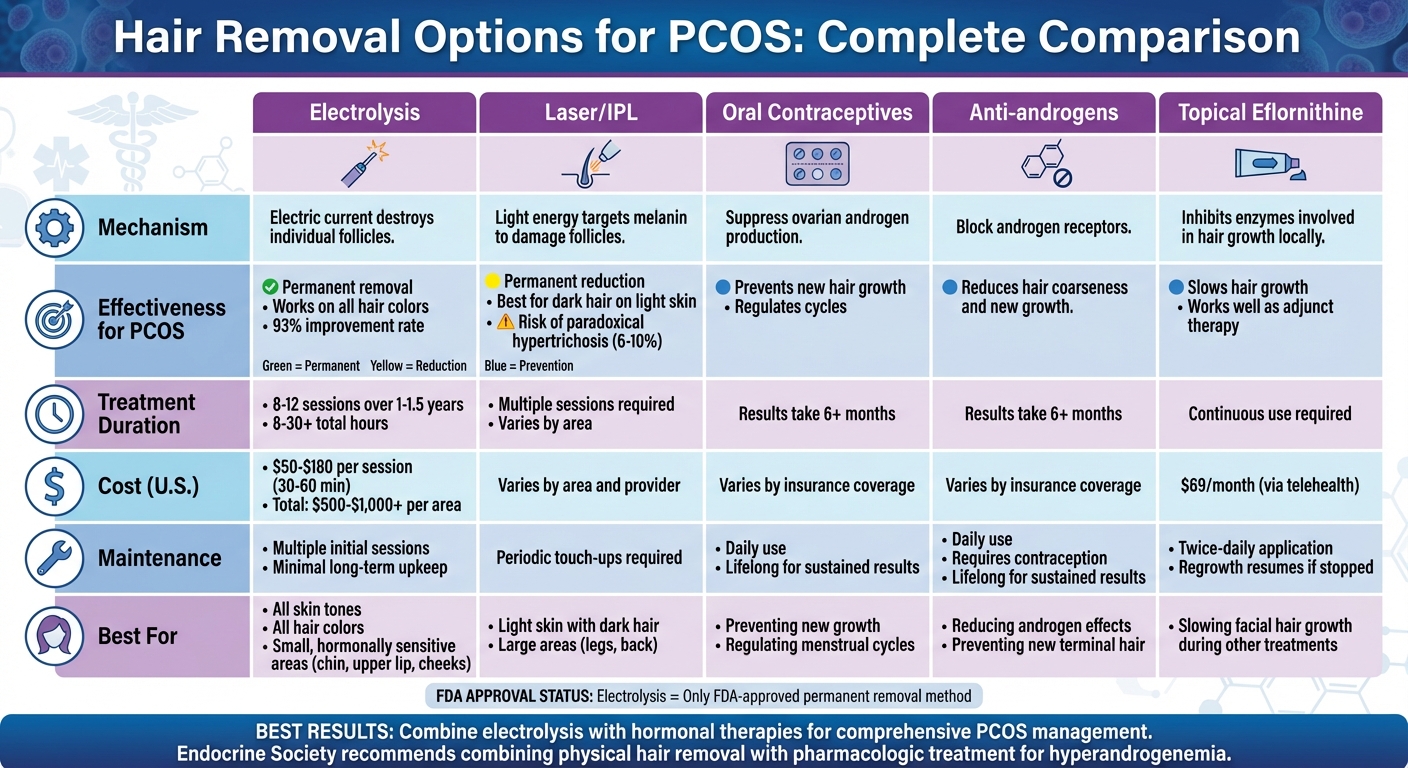
Electrolysis vs Other Hair Removal Methods for PCOS: Effectiveness, Cost and Maintenance Comparison
Electrolysis vs. Laser and IPL
Electrolysis stands out as the only FDA-approved method for permanent hair removal, while laser and IPL are approved for permanent hair reduction and require ongoing maintenance sessions to sustain results.
The choice between these methods often depends on hair and skin type. Electrolysis is effective for all hair colors - including blonde, white, and gray - and works on all skin tones. In contrast, laser and IPL rely on melanin in the hair to target follicles, making them most effective for darker hair (auburn, brown, or black) on lighter skin. While laser treatments can be safe for women of color, they require specialized equipment like Nd:YAG or diode lasers and proper cooling techniques to reduce the risk of pigmentation changes.
"For women who choose hair removal therapy, we suggest photoepilation for those whose unwanted hair is auburn, brown, or black, and we suggest electrolysis for those with white or blonde hair." – Endocrine Society Clinical Practice Guideline
Laser and IPL are ideal for treating large areas such as the legs or back, as they can target multiple follicles simultaneously for quicker sessions. Electrolysis, however, is better suited for smaller, hormonally sensitive areas like the chin, upper lip, and cheeks - common trouble spots for PCOS-related hair growth. Women of Mediterranean or Middle Eastern descent should exercise caution with facial laser treatments, as they face a higher risk of paradoxical hypertrichosis (unexpected hair growth after treatment). For these women, electrolysis provides a safer and more consistent option.
These distinctions highlight how electrolysis can complement medical therapies for a well-rounded approach to managing PCOS symptoms.
Combining Electrolysis with Medical Therapies
Electrolysis offers a targeted, permanent solution for existing hair growth, making it an excellent partner to medical therapies aimed at managing PCOS. Addressing both hormonal imbalances and hair removal creates a more effective long-term strategy. Medications like oral contraceptives, spironolactone, and topical eflornithine cream work by reducing androgen levels or blocking their effects, which helps prevent the development of new terminal hair follicles. Electrolysis, meanwhile, permanently destroys the follicles already producing hair, tackling the problem from both ends.
"For women with known hyperandrogenemia who choose hair removal therapy, we suggest pharmacologic therapy to minimize hair regrowth." – Endocrine Society Clinical Practice Guideline
Pharmacological treatments can take 6–12 months to noticeably reduce hair growth. During this time, electrolysis can address coarse hair that medications alone may not eliminate. Topical eflornithine cream (Vaniqa) can further enhance results by slowing hair growth through enzyme inhibition within the follicles, offering quicker visible improvements. Additionally, for women with PCOS linked to obesity, even a modest weight loss of 5% can lower androgen levels and improve treatment outcomes.
It’s worth noting that pharmacological treatments for hirsutism often require lifelong use to maintain their benefits. Anti-androgens like spironolactone must be paired with reliable contraception due to the risk of birth defects, and while insulin-lowering drugs like metformin are helpful for other PCOS symptoms, they have not been shown to significantly improve hirsutism when used alone.
Comparison Table of Hair Removal Options
| Method | Mechanism | Effectiveness for PCOS | Cost in U.S. $ | Maintenance Needs |
|---|---|---|---|---|
| Electrolysis | Electric current destroys individual follicles | Permanent removal; suitable for all hair colors | Varies by provider | Multiple initial sessions; minimal upkeep long-term |
| Laser / IPL | Light energy targets melanin to damage follicles | Permanent reduction; best for dark hair on light skin | Varies by area/provider | Periodic touch-ups often required |
| Oral Contraceptives | Suppress ovarian androgen production | Prevents new hair growth; regulates cycles | Varies by insurance | Daily use; results take 6+ months |
| Anti-androgens | Block androgen receptors | Reduces hair coarseness and new growth | Varies by insurance | Daily use; requires contraception |
| Topical Eflornithine | Inhibits enzymes involved in hair growth locally | Slows hair growth; works well as an adjunct | Varies by insurance | Twice-daily application; regrowth resumes if stopped |
Combining Electrolysis with Hormonal Management and Telehealth
Tackling Hair Removal and Hormonal Imbalance
For individuals with PCOS, addressing both the external signs and internal hormonal imbalance is key. Electrolysis works best when paired with hormonal therapies. While electrolysis permanently destroys existing hair follicles, medications like oral contraceptives and anti-androgens such as spironolactone help reduce androgen levels or block their effects. This combination not only removes unwanted hair but also prevents new terminal hairs from forming.
Since hormonal treatments often take months to show results, electrolysis provides a quicker cosmetic solution that medications alone cannot achieve. The Endocrine Society's clinical guidelines emphasize combining medical treatments with hair removal methods for women dealing with hyperandrogenemia.
Without addressing the hormonal causes, cosmetic treatments alone offer only temporary relief, as high androgen levels will continue to stimulate new hair growth. Starting hormonal management at least six months before or alongside electrolysis sessions can slow the development of new hair and enhance the long-term success of permanent hair removal.
This comprehensive approach benefits from the coordination and accessibility that telehealth services bring to the table.
The Role of Telehealth in PCOS Care
Telehealth bridges the gap in PCOS treatment by enabling remote consultations to assess symptoms, prescribe necessary medications, and monitor progress - all while patients attend in-person electrolysis sessions. This model is particularly effective since nearly half of the women seeking treatment for unwanted facial hair are eventually diagnosed with PCOS.
Through telehealth services, patients may also gain access to topical treatments like eflornithine hydrochloride (13.9%), which slows facial hair growth during the electrolysis process.
"Unless metabolic and underlying endocrinal disturbances are corrected and simultaneous life-style modification is adopted, cosmetic treatment would give only temporary relief." – Shalini Gainder, Department of Obstetrics and Gynaecology
Oana Health’s Contribution to PCOS Management

Oana Health plays a pivotal role in delivering personalized telehealth solutions for women managing PCOS symptoms. Oana Health connects patients with licensed professionals who offer prescription-based treatments tailored to their needs. For example, medications like spironolactone (starting at $14/month) and eflornithine ($69/month) work alongside electrolysis to minimize new hair growth.
Beyond hair removal, Oana Health also addresses other PCOS-related issues, such as insulin resistance with metformin ($22/month) and weight management, ensuring a well-rounded approach to treatment.
"In order for cosmetic removal of hair to be successful, it has to be done with hormonal treatment; the problem causing the hair growth has to be managed." – Supersmooth HQ
Conclusion: Key Takeaways on Electrolysis for PCOS
Electrolysis stands out as the only FDA-recognized method for permanent hair removal, making it a highly effective option for managing PCOS-related hirsutism. A clinical study involving 281 women over four years revealed that 93% of patients experienced improvement with electrolysis treatments. Unlike laser or IPL options, electrolysis works on all skin tones and hair colors and avoids the 6–10% risk of paradoxical hypertrichosis associated with laser treatments. This positions electrolysis as a key component in a broader treatment plan that combines cosmetic and hormonal therapies.
For the best long-term results, research highlights the importance of pairing electrolysis with hormonal management. While electrolysis permanently destroys active hair follicles, it cannot stop high androgen levels from activating dormant follicles or turning fine vellus hairs into thicker terminal hairs. To address this, the Endocrine Society advises combining physical hair removal with pharmacologic treatments for women dealing with hyperandrogenemia.
Patients typically need about 10–14 sessions of electrolysis, with costs ranging from $500 to $1,000+ per area. Since hormonal therapies, such as spironolactone or oral contraceptives, often take at least six months to reach full effectiveness, electrolysis offers immediate cosmetic relief while these medications work on balancing hormones.
Telehealth has also emerged as a valuable tool in integrating cosmetic and medical care. Remote hormone testing, prescription management, and progress tracking help patients tackle both the visible symptoms and the underlying hormonal causes of PCOS-related hair growth. Platforms like Oana Health provide access to licensed professionals who prescribe treatments such as spironolactone (starting at $14/month) and metformin ($22/month), streamlining the process for patients.
Viewing hirsutism as a medical condition rather than merely a cosmetic issue ensures more effective and lasting results.
FAQs
What are the differences between electrolysis and laser hair removal for managing PCOS-related hair growth?
Electrolysis is often seen as a more reliable option than laser hair removal for addressing PCOS-related hirsutism, especially when permanent results are the goal. Research has shown that electrolysis can achieve permanent hair removal across all skin types, including hormonally sensitive areas. In comparison, laser treatments have occasionally been less effective and, in rare cases, have even led to paradoxical hypertrichosis - a condition where new hair growth is triggered. Although electrolysis may require more sessions initially, it offers lasting results without the need for continuous upkeep.
Laser hair removal, by contrast, tends to be less effective for people with darker skin tones or lighter hair colors. Its results are often temporary, and there’s a small chance - around 6–10% - of it causing unwanted hair growth, particularly in individuals with darker skin tones.
If you’re looking for a permanent solution, Oana Health’s licensed clinicians can guide you through electrolysis and other PCOS treatment options, ensuring a plan tailored to your specific needs.
How much does electrolysis cost for treating PCOS-related hirsutism in the U.S.?
Electrolysis prices in the U.S. can differ based on a few key factors, such as the size of the area being treated, the expertise of the electrologist, and how many sessions you'll need. Here's a general idea of what you might expect to pay:
- $40–$60 for a 15-minute session
- $50–$100 for 30 minutes
- $90–$180 for a full hour
If you're targeting larger areas like your legs or back, the cost per visit can jump to anywhere between $200 and $700.
Because achieving lasting results usually requires multiple sessions, the total expense can add up to anywhere from a few hundred to several thousand dollars. To get a clearer picture of what your treatment might cost, it's a good idea to consult with a professional who can provide a personalized estimate tailored to your needs.
Can combining electrolysis with hormonal treatments improve hirsutism in women with PCOS?
Currently, there’s limited evidence to suggest that combining electrolysis with hormonal treatments like oral contraceptives or metformin directly enhances results for PCOS-related hirsutism. While hormonal therapies are commonly used to address the underlying hormonal imbalances of PCOS, their influence on the success of electrolysis hasn’t been thoroughly researched.
If you’re thinking about electrolysis or other options to manage unwanted hair caused by PCOS, it’s a good idea to consult a healthcare professional. They can help develop a personalized treatment plan tailored to your specific needs.