
Folate and PCOS: Benefits for Hormonal Health
If you have PCOS, folate (Vitamin B9) can play an important role in managing symptoms like hormonal imbalances, insulin resistance, and inflammation. Here's why:
- Hormonal Support: Folate aids ovulation and helps regulate menstrual cycles by reducing homocysteine levels, which can impact fertility.
- Insulin Sensitivity: It improves how your body processes insulin, addressing a common PCOS challenge.
- Inflammation Reduction: Folate lowers markers of inflammation and oxidative stress, which are often elevated in PCOS.
- Metformin Interaction: If you're taking metformin, folate supplementation can counteract its tendency to raise homocysteine levels and hinder B-vitamin absorption.
While folate is found in foods like leafy greens and legumes, supplements - especially in the active form (5-MTHF) - are often recommended for better absorption and higher therapeutic doses. Consult your doctor to determine the right dosage and form for your needs.
How Folate Supports Hormonal Health in PCOS
Folate plays a crucial role in regulating hormones, making it particularly helpful for women dealing with PCOS. By influencing genetic and metabolic processes, folate helps address the hormonal imbalances that often drive PCOS symptoms.
Folate's Role in Ovulation and Menstrual Cycles
Folate helps maintain egg DNA integrity and improves ovarian responsiveness to Follicle-Stimulating Hormone (FSH) by converting homocysteine into methionine. Elevated homocysteine levels can negatively impact fertility. For example, research indicates that pregnancies did not occur when follicular homocysteine levels exceeded 10.5 µmol/L.
In a study involving 3,602 infertile women with PCOS, taking 4,000 mg of myo-inositol and 400 mcg of folic acid daily for 2–3 months restored ovulation in 70% of participants and resulted in a pregnancy rate of 15.1%. Additionally, this supplementation nearly doubled the blastocyst rate, increasing it from 32% in the control group to 55%, while clinical pregnancy rates rose from 33% to 58%. These improvements in ovulation directly contribute to better hormonal balance.
Reducing Androgen Levels and Balancing Hormones
High androgen levels are responsible for common PCOS symptoms like acne and excessive hair growth (hirsutism). Folate indirectly helps lower androgen levels by improving insulin sensitivity. Elevated insulin levels can trigger the ovaries to produce excess testosterone and reduce the effectiveness of Sex Hormone-Binding Globulin (SHBG), a protein that regulates testosterone. By lowering insulin resistance, folate disrupts this cycle of excess testosterone production.
A study conducted at Cairo University Hospital involved 80 women with PCOS. It found that combining metformin and myo-inositol with folic acid and a B-complex supplement reduced homocysteine levels by 23% over 16 weeks. In contrast, the group using metformin alone experienced an 18% increase in homocysteine levels. Additionally, the combination therapy improved HOMA-IR scores (a measure of insulin resistance) from approximately 4.8 to 4.1. Dr. Iman Abdel Mohsen Khalil from Cairo University's Faculty of Medicine emphasized the importance of B-vitamin and folic acid supplementation for PCOS patients using metformin, as metformin can raise homocysteine levels.
Supplementing with 1 mg to 5 mg of folic acid daily for two months has also been shown to significantly reduce insulin levels and inflammatory markers like TNF-α and hs-CRP. These changes further support hormonal balance and contribute to managing PCOS symptoms.
sbb-itb-6dba428
Folate's Impact on Metabolic Health in PCOS
Folate does more than support hormonal health - it also plays a key role in improving metabolism for women with PCOS. This is particularly important, as between 40% and 80% of women with PCOS face challenges with insulin resistance. By addressing metabolic imbalances, folate may help reduce the risk of long-term complications like type 2 diabetes and cardiovascular disease.
Insulin Sensitivity and Homocysteine Levels
Folate contributes to better insulin sensitivity by regulating homocysteine levels. Women with PCOS typically have higher levels of circulating homocysteine compared to those without the condition, with a standardized mean difference of 0.82. Elevated homocysteine is closely tied to insulin resistance, higher body mass index, and increased blood pressure.
Here’s how folate helps: it acts as a cofactor in the conversion of homocysteine to methionine. When folate levels are insufficient, this conversion slows down, disrupting insulin signaling and increasing cardiovascular risks.
A study from Cairo University highlighted the importance of combining folate with metformin. While metformin alone raised homocysteine levels by 18% over 16 weeks, adding folate and B vitamins reduced homocysteine by 23%, helping to counteract cardiovascular risks associated with insulin resistance.
"Vitamin B-group and folic acid supplementation to PCOS women treated with metformin is essential when one considers the elevated levels of Hcy and the possible increasing effect of metformin on Hcy levels."
– Dr. Iman Abdel Mohsen Khalil, Faculty of Medicine, Cairo University
Folate also supports metabolic health through DNA methylation, a process that regulates genes tied to insulin receptor sensitivity and glucose metabolism. By providing methyl groups for S-adenosylmethionine (SAM) synthesis, folate may help address the epigenetic changes linked to insulin resistance in PCOS.
Tackling Inflammation and Oxidative Stress
Folate’s benefits extend to reducing inflammation and oxidative stress - two factors that worsen PCOS symptoms. It plays a role in producing glutathione (GSH), the body’s main antioxidant, which helps protect cells from damage.
A 2014 study conducted at Kashan University of Medical Sciences examined 69 overweight and obese women with PCOS, aged 18–40. Over 8 weeks, participants received either 1 mg/day or 5 mg/day of folate, or a placebo. The group taking 5 mg/day saw significant improvements: high-sensitivity C-reactive protein (hs-CRP), a marker of inflammation, dropped from 2.33 to 1.38 mg/L, and malondialdehyde (MDA), an oxidative stress marker, decreased from 2.54 to 2.22 µmol/L. Additionally, their total antioxidant capacity increased by 85.14 mmol/L. In contrast, the 1 mg/day group showed no meaningful changes.
Elevated homocysteine not only contributes to oxidative stress but also harms vascular health and cellular function. Studies even suggest that pregnancies are unlikely in PCOS patients with follicular homocysteine levels above 8 µmol/L, emphasizing the connection between oxidative stress and insulin resistance and fertility challenges.
"HHcy [Hyperhomocysteinemia] is also potentially deleterious because it acts as a powerful inhibitor of methylations and as a dangerous pro-oxidant."
– Journal of Assisted Reproduction and Genetics
For women taking metformin, folate supplementation becomes even more essential. Metformin can interfere with folate and vitamin B12 absorption, potentially increasing inflammation and oxidative stress despite its benefits for insulin sensitivity. Pairing metformin with folate and B vitamins helps sustain metabolic improvements while minimizing these side effects.
Folate’s ability to improve insulin sensitivity, lower inflammation, and combat oxidative stress makes it a valuable tool in managing PCOS-related metabolic challenges.
Dietary Sources of Folate vs. Supplementation
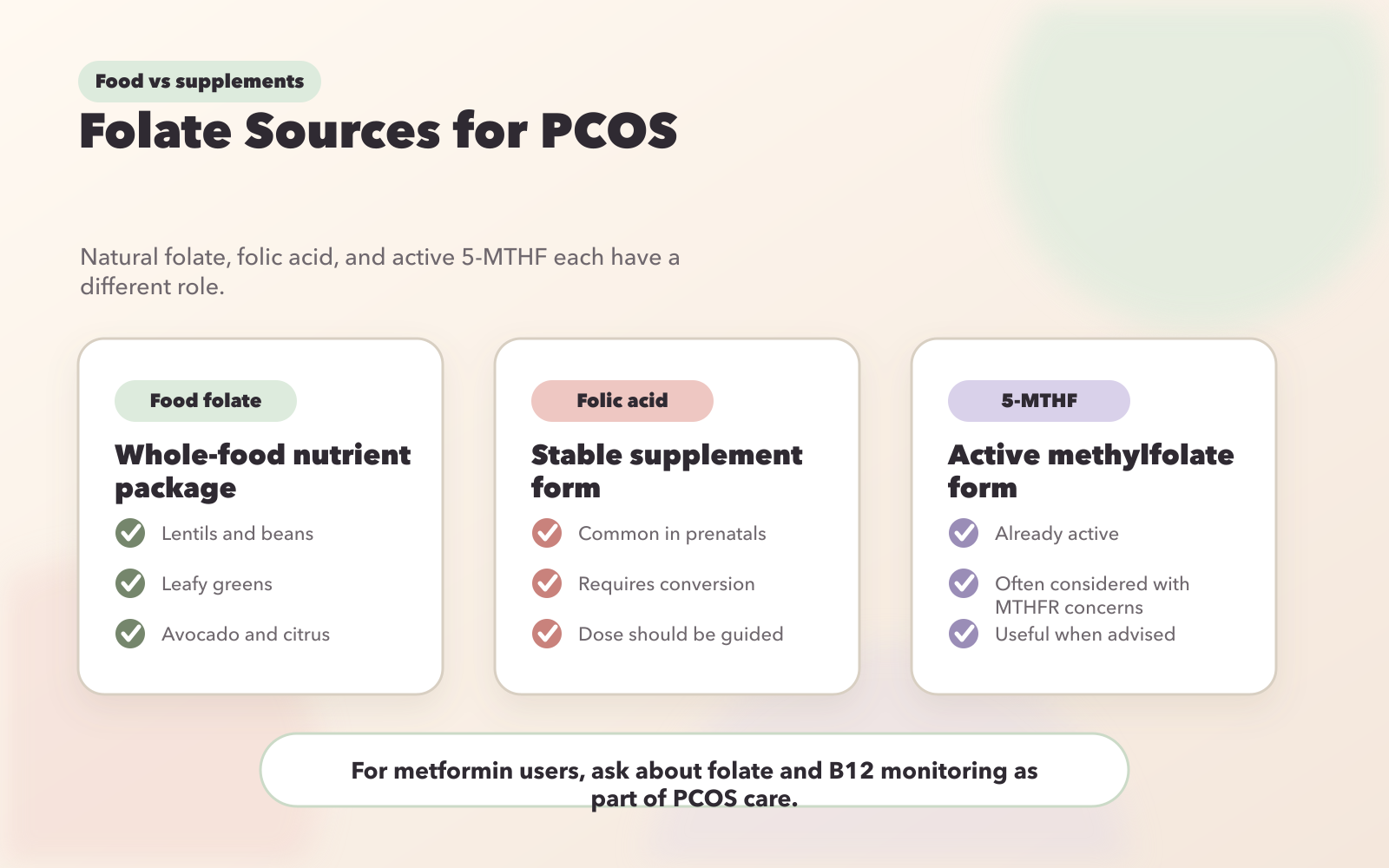
Folate Sources Comparison: Natural Foods vs Synthetic Folic Acid vs Active 5-MTHF for PCOS
Folate-Rich Foods and Bioavailability
Whole foods offer more than just folate - they're packed with nutrients that can help manage PCOS symptoms. Lentils are a standout choice, with one cup of cooked lentils providing 358 mcg of folate, which is about 90% of your daily requirement. Other great options include beef liver (212 mcg in a 3-ounce serving), cooked asparagus (134 mcg per half-cup), and kidney beans (131 mcg per cup).
That said, natural folate from foods like fruits and vegetables is only about 78% as bioavailable as synthetic folic acid, which is commonly found in fortified foods. This means your body absorbs less folate from vegetables compared to fortified cereals. For women with PCOS, this difference can be significant, especially when working to reduce high homocysteine levels or improve insulin sensitivity.
Active Folate Supplements and Recommendations
While eating folate-rich foods is essential, achieving therapeutic levels of folate through diet alone is very difficult. This is where supplements play a key role, particularly for women with PCOS who often need higher doses to address metabolic challenges.
Look for supplements labeled "5-MTHF" or "methylfolate" instead of synthetic folic acid. These active forms skip the liver conversion process, which is often inefficient for those with MTHFR genetic variations - a common issue that affects folate metabolism. For PCOS management or pregnancy preparation, a daily dose of 400 to 800 mcg is generally recommended.
Supplements are especially important for women taking metformin, as the medication can interfere with B-vitamin absorption. Additionally, combining active folate with inositol has shown potential for lowering testosterone levels and improving ovarian function more effectively than dietary changes alone.
| Feature | Natural Folate (Food) | Synthetic Folic Acid | Active Folate (5-MTHF) |
|---|---|---|---|
| Source | Leafy greens, legumes, avocados | Fortified foods, standard vitamins | Specialized supplements |
| Bioavailability | High quality, lower absorption | Requires liver conversion | Immediate (no conversion needed) |
| PCOS Benefit | General health support | May be less effective | Helps reduce homocysteine and insulin resistance |
| Genetic Barrier | None | Limited by MTHFR mutations | Overcomes MTHFR mutations |
This breakdown highlights the importance of both dietary folate and supplementation in managing PCOS, paving the way for tailored strategies to support metabolic and reproductive health.
Adding Folate to Your PCOS Treatment Plan
Incorporating folate into your PCOS treatment can offer hormonal and metabolic support, but it’s important to tailor the approach to your individual needs.
Personalized Dosing and Professional Guidance
Folate requirements vary from person to person, making professional advice crucial. For women of childbearing age, healthcare providers often suggest a daily intake of 400 to 800 micrograms. However, your specific dosage might depend on factors like your current folate levels, the severity of your PCOS symptoms, and whether you’re trying to conceive. A blood test can determine if your serum folate is below 7 nmol/L (3 mcg/L), which signals a deficiency.
If you have an MTHFR genetic mutation, your body may struggle to process synthetic folic acid into its active form, methylfolate. In such cases, supplements containing 5-MTHF, which bypass this conversion, can be more effective. Before starting high-dose folate, consult your healthcare provider, as excessive intake may hide a vitamin B12 deficiency.
Combining Folate with Other Nutrients
Folate works even better when paired with complementary nutrients. For instance, combining folate with vitamin B12 helps reduce inflammation by breaking down homocysteine. Similarly, pairing folate with vitamin D can improve insulin sensitivity and regulate menstrual cycles. Since up to 85% of women with PCOS are deficient in vitamin D, this combination is especially beneficial.
To make the most of these nutrient strategies, consider seeking expert advice to create a personalized plan.
The Role of Telehealth in PCOS Management
Telehealth platforms like Oana Health simplify access to customized PCOS care from the comfort of your home. These services connect you with experienced physicians who can review your health history and design a tailored treatment plan. Through virtual consultations, providers can coordinate folate supplementation alongside other treatments, such as Metformin ER for insulin resistance at $22/month or Spironolactone for managing androgen-related symptoms at $14/month. Medications are shipped free across 28 US states, with transparent pricing to ensure affordability.
Conclusion
Folate plays a crucial role in supporting hormonal and metabolic health for women with PCOS. By improving ovulatory function and regulating menstrual cycles, it addresses some of the core reproductive challenges faced by approximately 1 in 10 women of childbearing age. Additionally, folate helps lower elevated homocysteine levels (SMD: 0.82; 95% CI: 0.62–1.02), offering cardiovascular benefits and reducing the risk of pregnancy complications.
On the metabolic side, folate contributes to managing insulin resistance and hormonal imbalance, supporting weight management, and lowering the likelihood of developing type 2 diabetes.
For women with MTHFR genetic variations, choosing the right form of folate is essential. Active methylfolate, for example, bypasses the conversion process that some bodies cannot perform efficiently, ensuring better absorption and effectiveness. A daily dosage of 400 to 800 micrograms is generally recommended, though individual requirements may vary.
Pairing folate with other nutrients like vitamin B12 and vitamin D can further enhance hormonal and metabolic health. This is particularly important given that up to 85% of women with PCOS are deficient in vitamin D. Addressing these deficiencies as part of a broader nutritional strategy is key for effective management.
It's important to consult a healthcare provider to determine the right folate dosage and form for your needs. Some studies suggest that excessive folate levels may be associated with an increased risk of PCOS (OR = 2.92), so personalized guidance is essential.
Whether you're managing symptoms or planning for pregnancy, incorporating folate into your PCOS care plan can make a meaningful difference. Platforms like Oana Health offer convenient access to care, including folate supplementation and other evidence-based treatments, all tailored to your unique needs and delivered directly to your home.
FAQs
Should I take folic acid or 5-MTHF for PCOS?
Both folic acid and 5-MTHF can be helpful for women with PCOS, but which one to choose depends on individual circumstances. Folic acid plays a role in supporting fertility, metabolism, and ovulation. On the other hand, 5-MTHF might be a better option for those with MTHFR gene mutations, which can interfere with the body's ability to convert folic acid effectively.
If you don’t have these mutations, folic acid is generally enough. Always consult a healthcare provider to determine what’s best for your specific needs.
Can folate help if I’m on metformin?
Folate can play a role in supporting women taking metformin by aiding metabolic health and potentially reducing homocysteine levels. This can be especially helpful for addressing the hormonal and metabolic challenges often associated with PCOS.
What tests should I ask for before taking higher-dose folate?
Before beginning higher-dose folate, it’s a good idea to talk to your healthcare provider about testing your homocysteine, vitamin B12, and folate levels. These tests can give a clearer picture of your nutrient status, which is especially important for women with PCOS to make sure supplementation is both safe and effective.