
GLP-1 Medications and PCOS: Fertility Benefits
GLP-1 medications, originally developed for type 2 diabetes, are now showing promise in improving fertility for women with PCOS. They target insulin resistance, a key issue in PCOS, and help regulate ovulation, reduce androgen levels, and support weight loss. Here's what you need to know:
- Insulin Resistance: GLP-1 drugs improve how the body handles insulin, reducing androgen production and improving ovulation.
- Weight Loss: These medications curb appetite and reduce visceral fat, which can restore hormonal balance.
- Hormonal Regulation: They lower testosterone levels, increase SHBG (which binds excess androgens), and normalize ovulation cycles.
- Fertility Outcomes: Studies show increased natural pregnancy rates and more regular menstrual cycles with GLP-1 therapy.
Combination therapies, like GLP-1 with metformin, enhance these effects, offering better results in weight loss and cycle recovery. However, these medications should be stopped 2–3 months before pregnancy due to limited safety data during pregnancy. GLP-1 therapy provides a new avenue for managing PCOS-related fertility issues effectively.
How GLP-1 Medications Work for PCOS
What Are GLP-1 Receptor Agonists?
GLP-1 receptor agonists are medications designed to mimic the natural gut hormone GLP-1. This hormone plays a key role in regulating blood sugar by stimulating insulin release when glucose levels rise and suppressing glucagon secretion, which helps keep blood sugar under control. Medications like liraglutide and semaglutide, often administered through daily or weekly injections, are common examples. While these drugs were initially developed to manage type 2 diabetes, they’ve proven beneficial for women with PCOS by addressing the metabolic dysfunction that underpins the condition. Specifically, they target the insulin resistance at the heart of PCOS.
Improving Insulin Resistance with GLP-1 Therapy
GLP-1 medications tackle insulin resistance by increasing GLUT-4 levels in muscle and fat tissues, which boosts glucose uptake. They also slow gastric emptying, helping to prevent sudden blood sugar spikes.
"GLP-1 receptor agonists act to reduce insulin resistance by increasing glucose transporters, which in turn decreases inflammation, reduces oxidative stress, promotes insulin secretion, slows gastric emptying, and inhibits macrophage secretion of inflammatory cytokines."
– Mia Hudanich, Nova Southeastern University
One study spanning 26 weeks revealed that a daily dose of 1.8 mg liraglutide reduced visceral adipose tissue (VAT) by 18%. This is a big deal because visceral fat is highly active metabolically and a major contributor to insulin resistance in PCOS. By reducing this fat, GLP-1 medications improve insulin sensitivity. Additionally, they help lower chronic inflammation and oxidative stress, both of which can further disrupt insulin signaling.
Weight Loss and Hormonal Balance with GLP-1
Another benefit of GLP-1 therapy is its ability to aid weight loss by curbing appetite through its effects on the hypothalamus. This weight loss, in turn, leads to hormonal improvements. Studies have shown that it increases menstrual frequency, lowers androgen levels, and boosts SHBG (sex hormone-binding globulin) production, all of which promote regular ovulation. For instance, a 32-week trial found that 3 mg of liraglutide led to more frequent menstrual cycles and a reduction in the Free Androgen Index. Similarly, a study involving semaglutide at 1 mg resulted in an average weight loss of 5.2 kg over 16 weeks in obese women with PCOS.
Even losing just 5% to 10% of body weight can significantly improve hormonal balance and restore regular menstrual cycles in women with PCOS. Beyond these effects, GLP-1 receptor activity in ovarian granulosa cells has been shown to support oocyte maturation and reduce cell loss, directly enhancing reproductive health. Together, these metabolic and hormonal improvements create a stronger foundation for better fertility outcomes in women managing PCOS.
Can GLP-1 Medications Improve Fertility? Is Ozempic Safe If You Are TTC?
Fertility Benefits of GLP-1 Medications for Women with PCOS
GLP-1 medications are proving to be a promising tool for tackling fertility challenges in women with PCOS, offering several reproductive advantages.
Better Ovulation and Regular Menstrual Cycles
One of the standout benefits of GLP-1 receptor agonists is their ability to regulate ovulation. These medications interact with the hypothalamic-pituitary-gonadal axis, stimulating GLP-1 receptors in the hypothalamus. This helps normalize GnRH secretion, which is crucial for ovulation. Additionally, they address elevated luteinizing hormone (LH) levels - a common issue in PCOS caused by hyperinsulinemia - ensuring the proper LH surge needed for ovulation.
For example, a 12-week study found that combining liraglutide with metformin led to an 88% recovery in menstrual cycles, compared to just 52% with metformin alone. A meta-analysis also highlighted improvements in menstrual regularity (standardized mean difference of 1.72) and a higher likelihood of natural conception (risk ratio of 1.72).
"Losing 5 to 10 percent or more of body weight can help some women who aren't ovulating regularly achieve normal cycles and ovulation."
– Adam Evans, MD, Reproductive Endocrinology and Infertility Specialist, University Hospitals
Clinical evidence suggests that using GLP-1 therapies for at least 24 weeks can yield optimal results. Even a modest weight loss of around 5.7% with daily liraglutide has been shown to improve menstrual frequency and the free androgen index. These improvements in ovulation also positively impact ovarian and endometrial health.
Improved Ovarian and Endometrial Health
Interestingly, GLP-1 receptors are present in ovarian cells, where their activation supports follicle maturation by promoting granulosa cell proliferation and preventing cell death. This process is essential for selecting a dominant follicle.
"GLP-1/GLP-1R axis might directly act on ovarian MGCs [mural granulosa cells] to promote the follicular development in a dose-dependent manner, likely contributing to the oocyte maturation in PCOS."
– G. Pugliese et al., Review Authors
Research indicates that GLP-1 therapy can even reverse polycystic ovary morphology, characterized by numerous small follicles. In animal studies, liraglutide treatment restored regular estrous cycles in up to 40% of subjects.
The benefits extend to the uterine lining as well. GLP-1 receptor agonists, such as exenatide, help protect the ovarian and endometrial environments from oxidative stress, fibrosis, and chronic inflammation. These effects can create a more favorable environment for embryo implantation.
| Benefit Category | Impact |
|---|---|
| Ovarian Health | Improved follicle selection, reduced apoptosis, normalized morphology |
| Endometrial Health | Reduced inflammation and fibrosis; protection against oxidative stress |
| Conception | Enhanced egg quality and increased natural pregnancy rates |
| Menstrual Cycle | Increased frequency and regularity of cycles |
These improvements directly support fertility by enhancing egg quality and creating a more receptive uterine lining.
Reduced Hyperandrogenism Symptoms
GLP-1 therapy also plays a role in reducing hyperandrogenism, a hallmark of PCOS that contributes to symptoms like excess facial hair, acne, and hair loss. These medications lower testosterone, free testosterone, and androstenedione levels, effectively reducing the Free Androgen Index.
Additionally, GLP-1 treatments boost the liver's production of sex hormone-binding globulin (SHBG), which binds to excess androgens, reducing their activity. Some studies also suggest that GLP-1 therapy can lower Anti-Müllerian Hormone (AMH) levels, which are typically elevated in PCOS and linked to follicular arrest.
| Hormonal Marker | Effect of GLP-1 Therapy | Impact on Fertility |
|---|---|---|
| Testosterone | Decreased | Reduces hirsutism and acne; supports ovulation |
| SHBG | Increased | Lowers free (active) androgen levels |
| LH Levels | Normalized | Restores proper signaling for ovulation |
| Insulin (HOMA-IR) | Decreased | Reduces ovarian androgen overproduction |
| AMH | Decreased | Promotes dominant follicle development |
sbb-itb-6dba428
Clinical Evidence Supporting GLP-1 Therapy for Fertility
GLP-1 and Metformin Combination Therapy Results for PCOS Fertility
Recent Studies and Their Findings
Research has shown that GLP-1 receptor agonists significantly improve fertility outcomes in women with PCOS. A 2023 meta-analysis of 11 randomized controlled trials, involving 840 participants, revealed that these medications increased natural pregnancy rates by 1.72 times and improved menstrual regularity, with a standardized mean difference of 1.72.
Another key study conducted in July 2025 by researchers at the Second Affiliated Hospital of Chongqing Medical University further highlighted these benefits. This prospective randomized trial included 100 overweight and obese women with PCOS, comparing the effects of metformin (1,000 mg twice daily) to a combination of metformin and 1 mg semaglutide administered weekly. The results were striking: the combination therapy group achieved a 35% natural pregnancy rate compared to 15% in the metformin-only group. Additionally, the cycle recovery rate was 72.5% with the combination therapy, versus 42.3% with metformin alone.
The fertility improvements are attributed to a combination of reduced insulin resistance, weight loss, and lower androgen levels - key factors in restoring regular ovulation. Studies suggest that treatment durations of at least 24 weeks yield the best outcomes.
"The result of the GLP-1 therapy is not only a reduction of body weight but also an improvement in insulin resistance and a decrease in hyperandrogenaemia. It also seems that this treatment method increases spontaneous and in-vitro pregnancy rates."
– Agnieszka Baranowska-Bik, MD PhD, Department of Endocrinology, Centre of Postgraduate Medical Education
These findings pave the way for exploring the enhanced effects of combination therapies.
Combining GLP-1 and Metformin for Better Results
Building on the benefits of GLP-1 therapy, combining it with metformin has been shown to further improve both metabolic and reproductive outcomes. In the 2025 study mentioned earlier, women receiving the combination therapy experienced an average weight loss of 6.09 kg (about 13.4 lbs) over 16 weeks, compared to 2.25 kg (approximately 5.0 lbs) in the metformin-only group.
A meta-analysis also confirmed that combination therapy led to an additional weight reduction of 1.37 kg and increased SHBG levels by 10.04 nmol/L. These findings highlight the synergistic effects of combining GLP-1 receptor agonists with metformin, offering enhanced outcomes for women with PCOS. Below is a summary of the key results from the 16-week study:
| Outcome (16-Week Study) | Metformin + Semaglutide | Metformin Alone |
|---|---|---|
| Natural Pregnancy Rate | 35% | 15% |
| Cycle Recovery Rate | 72.5% | 42.3% |
| Weight Loss | 6.09 kg (13.4 lbs) | 2.25 kg (5.0 lbs) |
| Testosterone Reduction | Greater | Moderate |
These results underline how combination therapy can be an effective approach to addressing PCOS-related fertility challenges.
Using GLP-1 Medications for PCOS Management
Safety Considerations for GLP-1 Therapy
GLP-1 medications are designed to enhance metabolic health and support ovulation before pregnancy. However, they should be discontinued 2–3 months before conception due to limited safety data during pregnancy.
"The best recommendation is to have a washout period between taking GLP-1 agonists and getting pregnant. Because we just don't know yet exactly what the long-term outcomes are."
– Deidre McIntosh, MD, Ob/Gyn, Cleveland Clinic
It's also worth noting that GLP-1 medications might interfere with oral contraceptive absorption. To avoid this, consider switching to non-oral methods like an IUD, patch, or vaginal ring while on therapy. Additionally, focusing on sustainable habits - such as strength training and a high-protein diet - can help maintain weight loss after stopping the medication in preparation for pregnancy.
These safety measures are essential for creating a treatment plan that transitions smoothly into pregnancy-focused care.
How Oana Health Supports Women with PCOS
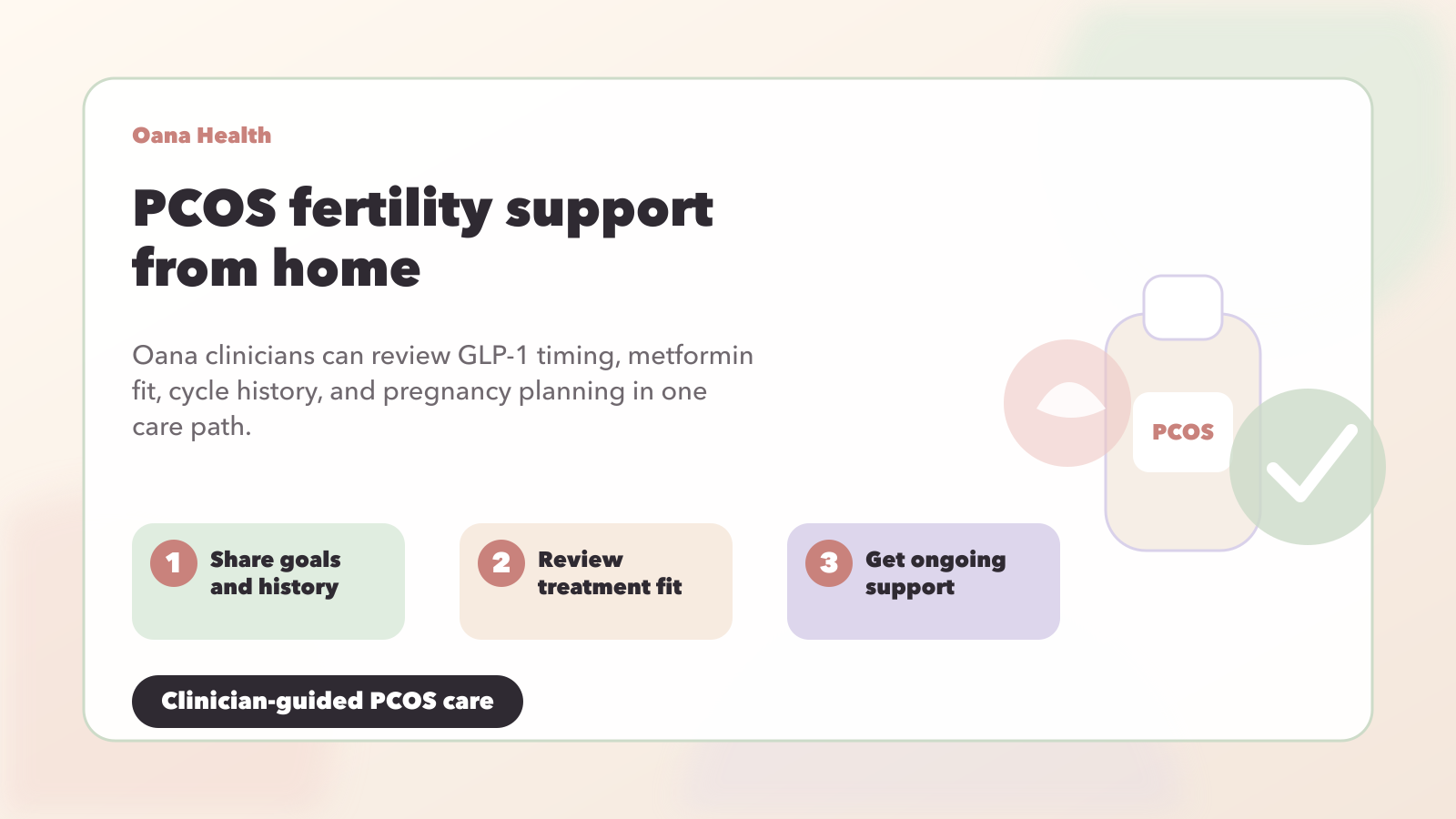
Oana Health specializes in personalized treatment plans for PCOS and fertility management. Through a quick online consultation with licensed physicians, women can receive prescriptions delivered straight to their door with no added shipping costs.
For those looking to improve fertility, Oana Health offers options like Oral Semaglutide GLP-1 and the Oral GLP-1 & Metformin plan. Research shows that combining these treatments can be more effective for weight loss and metabolic health than using either one alone. One study found that natural pregnancy rates were 43.6% with combination therapy, compared to 18.7% with Metformin alone.
Affordable and Convenient Oana Health Plans
Oana Health makes GLP-1 therapy accessible with straightforward monthly pricing. Both the Oral Semaglutide GLP-1 plan and the Oral GLP-1 & Metformin combination plan are available for $199/month [website]. For those needing Metformin-only options, the Oral Metformin ER plan is priced at $22/month, while the Metformin & Spironolactone combination plan costs $32/month [website].
All plans include free shipping and continuous telemedicine support to adjust treatments as needed. With around 70% of women with PCOS experiencing insulin resistance, affordable access to these therapies can play a key role in achieving regular ovulation and improving fertility outcomes.
Conclusion: GLP-1 Medications and Fertility Potential
GLP-1 medications offer a promising path to improved fertility for women with PCOS by targeting the underlying issues. These treatments disrupt the cycle of insulin resistance, obesity, and hormonal imbalances that impact millions across the United States. By enhancing insulin sensitivity and reducing visceral fat, GLP-1 therapies help restore hormonal balance, promoting more regular ovulation.
The evidence speaks volumes. Beyond aiding fertility, these medications improve overall hormonal health and address symptoms like acne and excessive hair growth.
"The result of the GLP-1 therapy is not only a reduction of body weight but also an improvement in insulin resistance and a decrease in hyperandrogenaemia. It also seems that this treatment method increases spontaneous and in-vitro pregnancy rates." – Agnieszka Baranowska-Bik, MD PhD, Department of Endocrinology, Centre of Postgraduate Medical Education
These advancements open the door to practical, tailored care options. Oana Health provides physician-guided treatment plans that combine GLP-1 therapy with complementary options like Metformin. With plans starting at $199 per month, including free shipping, evidence-based care is both accessible and convenient.
FAQs
How can GLP-1 medications help improve fertility in women with PCOS?
GLP-1 receptor agonists offer promising support for fertility in women with PCOS by tackling key challenges like insulin resistance and hormonal imbalances. These medications work by improving insulin sensitivity, which helps lower elevated androgen levels (male hormones). This reduction can lead to more consistent ovulation and a higher likelihood of conception.
Another benefit of GLP-1 treatments is their ability to encourage weight loss, which plays a crucial role in restoring hormonal balance and reducing inflammation - both essential for reproductive health. Some research even hints that these medications may have a direct impact on the hypothalamic-pituitary-gonadal axis, an essential system for regulating fertility.
For women exploring effective, prescription-based options for managing PCOS and its effects, Oana Health offers personalized telehealth services designed to meet individual needs.
Are GLP-1 medications safe to use when trying to get pregnant with PCOS?
When preparing for pregnancy, women with PCOS need to approach the use of GLP-1 receptor agonists (like Ozempic® or Wegovy®) with care. There isn’t enough data to confirm their safety during pregnancy, so current guidelines recommend stopping these medications as soon as pregnancy is confirmed or when actively trying to conceive, unless a healthcare provider advises otherwise.
Animal studies have raised concerns about potential risks, such as miscarriage or birth defects, when GLP-1 medications are used in very high doses. However, these doses are much greater than what is typically prescribed to humans. Early research involving humans hasn’t revealed major risks so far, but the available data is still limited, and further studies are needed to draw clearer conclusions.
To navigate this safely, it’s crucial to work closely with a healthcare provider who can help transition off GLP-1 medications and explore other options, like metformin or lifestyle adjustments. Services like Oana Health can offer expert support, monitor insulin resistance, and develop a personalized plan to promote fertility and overall well-being during this important phase.
Can GLP-1 medications be used with other treatments to improve fertility in women with PCOS?
Yes, GLP-1 receptor agonists can be used alongside other treatments like metformin or hormonal therapy to improve fertility outcomes in women with PCOS. Studies indicate that combining these treatments can help reduce insulin resistance, promote ovulation, and enhance overall fertility.
This combination works by tackling the hormonal and metabolic imbalances commonly associated with PCOS, offering a more targeted and effective treatment strategy. Be sure to consult a licensed healthcare provider to find the approach that’s right for you.