
Hair Loss Reversed: 6-Month Spironolactone Results
Hair loss treatments can feel overwhelming, but spironolactone offers a scientifically backed solution for women dealing with hormonal hair thinning, especially androgenic alopecia. This article highlights a six-month case study of a 26-year-old woman who achieved reduced shedding and visible regrowth using spironolactone.
Key Takeaways
- How It Works: Spironolactone blocks androgens like DHT, preventing hair follicle shrinkage and promoting thicker hair strands.
- Who Benefits: Women with hormonal hair loss, such as androgenic alopecia or PCOS. Not suitable for men or pregnant women.
- Treatment Plan:
- Started with 50 mg/day, increased to 100 mg/day after 2 months.
- Added topical spironolactone for a combined approach.
- Monitored regularly via telehealth for safety and progress.
- Results in 6 Months:
- 30% reduction in daily shedding by week 10.
- 15% narrower part line and thicker hair by month 6.
- One-grade improvement on the Sinclair scale.
Spironolactone is accessible through telehealth platforms like Oana Health, offering affordable, convenient treatment options with licensed providers and home delivery. Early and consistent use is crucial for best results.
Spironolactone For Hair Loss – Featuring 12 Month Study Results
Patient Background and Starting Point
This case involves a 26-year-old woman who had been dealing with progressive hair loss over the course of three years. She noticed increased shedding, particularly around the crown of her head, and reported a family history of female pattern hair loss. These signs are consistent with androgenic alopecia, a condition where hair follicles gradually shrink, leading to thinner, weaker strands instead of full, healthy hair. A thorough evaluation was conducted to establish her baseline condition and shape the treatment plan.
Initial Hair Loss Assessment
At the beginning of her treatment, the patient’s condition was classified as Ludwig Grade II, which indicates significant thinning across the crown area. The Ludwig scale is a tool used to gauge the severity of hair loss, with Grade I reflecting mild thinning, Grade II showing more noticeable thinning, and Grade III indicating complete baldness in the crown region. Baseline hair density and strand thickness were documented using digital photography and trichoscopy to track future progress.
In cases like this, baseline assessments often reveal a median Sinclair score of 3.2. Before initiating any treatment, the patient underwent a Comprehensive Metabolic Panel to evaluate kidney function and potassium levels, along with tests for serum ferritin, Vitamin D, and thyroid function. These lab tests are critical because women with ferritin levels below 40 ng/mL have a 37% lower response rate to hair loss therapies.
Hormonal Causes of Hair Loss
After completing the baseline evaluations, it became clear that hormonal imbalance was the primary factor behind her hair loss. Elevated levels of androgens, particularly dihydrotestosterone (DHT), were found to be affecting her hair follicles. DHT binds to receptors in the follicles, causing them to shrink and produce fine, vellus hairs instead of healthy strands. Genetic predisposition can also make androgen receptors more sensitive, even when hormone levels are within the normal range.
"Specific genetic factors predispose androgen receptors to be particularly sensitized so that they bind to circulating androgens, even with normal circulating levels." - International Journal of Trichology
With hormonal imbalance identified as the root cause, spironolactone was selected as the treatment. This medication works by blocking androgen receptors, preventing further follicle shrinkage and encouraging healthier hair growth.
The Treatment Plan
Once a hormonal imbalance was identified as the underlying cause, a targeted treatment plan was developed to address the patient’s hair loss. The strategy combined prescription medication with consistent medical supervision over a six-month period to ensure steady progress and safety.
Dosage and How to Take It
The patient began treatment with 50 mg of oral spironolactone daily, a standard starting dose for addressing hair loss. After two months, her dosage was increased to 100 mg per day, with typical dosages ranging between 100 mg and 200 mg daily.
"Typically, the starting dose for hair loss is around 50 mg per day, which may be gradually increased to 100 mg to 200 mg daily, depending on the patient's response and tolerance to the medication." - Dr. Howell, Content Medical Reviewer
To reduce the risk of stomach discomfort, the medication was taken once daily with food. Throughout the treatment, regular monitoring of potassium levels and kidney function was conducted to ensure safety. A 2022 randomized trial by Liang et al. demonstrated similar regimens, with patients receiving 80–100 mg of spironolactone daily over a 24-week period, showing promising results.
In addition to oral spironolactone, supplementary therapies were incorporated to optimize the treatment’s effectiveness.
Additional Treatments Used
To boost the overall outcome, the patient also used topical spironolactone alongside the oral medication. This dual approach targets hair loss from both inside and out. Research has shown that combining systemic and topical treatments leads to better results, with improvement rates reaching 65.80%, compared to 43.21% for oral spironolactone alone.
The treatment plan, provided through Oana Health, also included the option to introduce oral minoxidil if further adjustments were needed after the initial assessment period. For patients experiencing hair loss due to insulin resistance or PCOS, medications like Metformin or GLP-1 tablets were available to address the metabolic factors driving the condition.
These therapies were seamlessly coordinated using a telehealth platform, making the process both efficient and convenient.
Telehealth Access and Delivery
The entire treatment process was managed remotely through Oana Health’s telehealth platform. The patient completed a 5-minute online health intake, outlining her medical history and hair loss concerns. A U.S.-licensed physician reviewed her information and prescribed the appropriate treatment, eliminating the need for an in-person visit.
"No need to visit a doctor's office or pharmacy. Our physicians see you from the comfort of your home then mail your treatments directly to your door." - Oana Health
The prescription was filled by an FDA-regulated pharmacy and shipped directly to her home with free shipping. The cost of oral spironolactone started at just $17 per month, with a one-time $20 doctor consultation fee. Automatic refills ensured the patient never ran out of medication, and ongoing support was available through phone or online channels for any treatment-related questions.
6-Month Progress Timeline
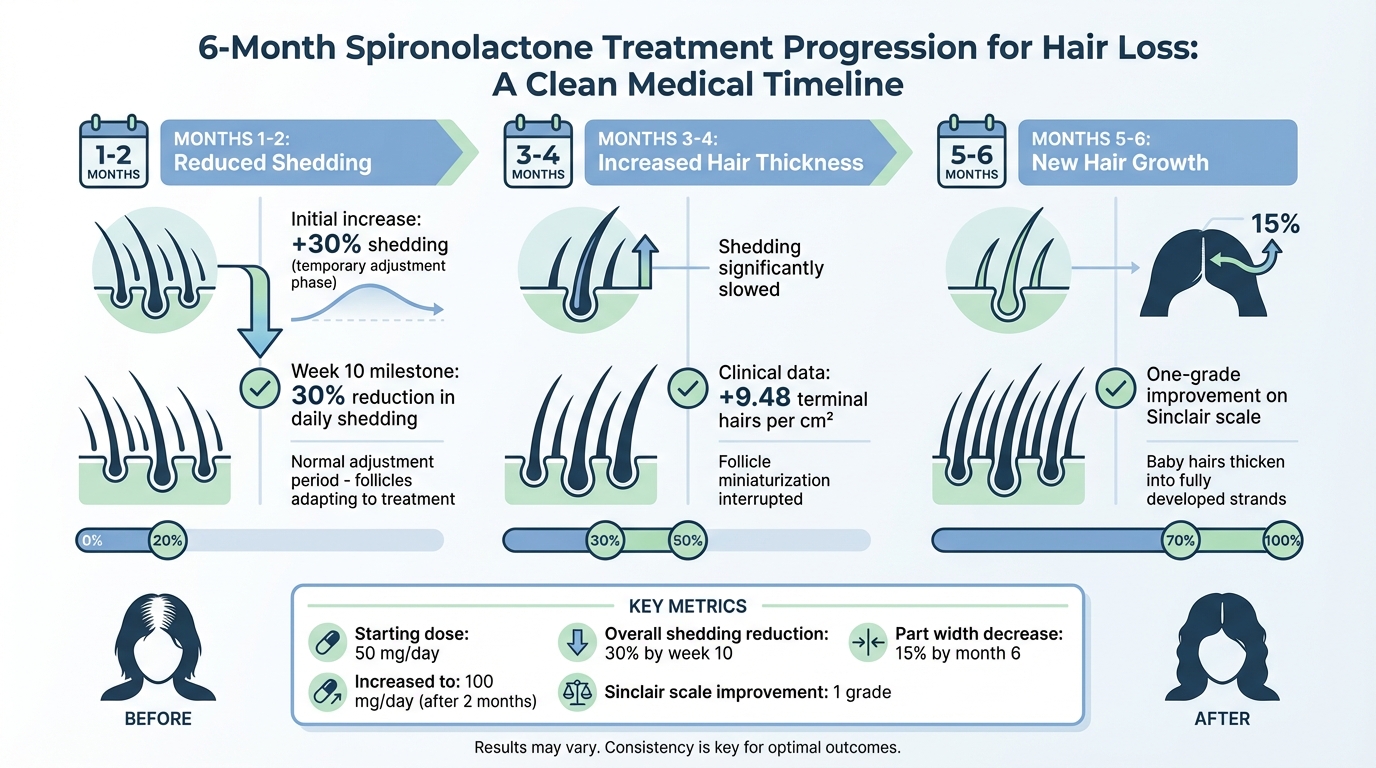
6-Month Spironolactone Hair Loss Treatment Results Timeline
The journey of hair restoration with spironolactone unfolds in three distinct stages, each marking a step toward noticeable improvements in hair health and density.
Months 1-2: Reduced Shedding
During the first two months, the patient experienced a temporary increase in hair shedding - about 30% more than usual. This adjustment phase is a common response as the hair follicles adapt to the treatment.
"During the first few weeks or months of spironolactone treatment, some users may experience temporary shedding as the hair follicles adjust. This is a normal part of the process and often indicates that the medication is beginning to work." – Dr. Ben Behnam, MD, FAAD
By the 10th week, daily hair shedding had decreased by 30%. To manage the appearance of thinning during this period, the patient relied on concealer fibers while waiting for more visible progress. Following this initial adjustment, early signs of improvement began to appear.
Months 3-4: Increased Hair Thickness
By the third and fourth months, shedding had significantly slowed, and existing hair began to thicken. These changes suggested that follicle miniaturization had been interrupted, paving the way for increased density.
"In the first few months, you might begin to see subtle signs of improvement. One of the first signs is usually a reduction in hair shedding... Thin areas on the scalp may start to show slight increases in hair density." – City Skin Clinic
Clinical studies have indicated that consistent use of spironolactone can lead to an increase of approximately 9.48 terminal hairs (hairs ≥60 µm in diameter) per cm². These early results built anticipation for more pronounced regrowth in the months to come.
Months 5-6: New Hair Growth
By months five and six, the patient began to see new, thicker hair shafts filling in previously sparse areas. The part line narrowed by around 15%, and overall scalp coverage visibly improved. Hairs that had started growing earlier reached sufficient length to blend seamlessly with existing strands, creating a fuller appearance across the crown.
sbb-itb-6dba428
Treatment Results: Photos and Data
Before-and-After Photos
Six months of treatment brought visible improvements in hair density. The photos highlight a narrower part, reduced scalp visibility in areas that were once sparse, and the emergence of new "baby hairs" along the hairline and temples. Over time, these fine hairs thickened into fully developed strands. These changes align with what’s typically expected when using spironolactone, as it generally takes about two full hair growth cycles - or roughly six months - for significant thickening to occur. These visual results are also backed by measurable data.
Measured Improvements
The patient showed a one-grade improvement on the Sinclair scale, a 30% reduction in daily hair shedding by the 10th week, and a 15% decrease in part width by the six-month mark.
"At 100 mg daily you're close to the dose used in clinical trials that showed a one-grade improvement on the Sinclair scale by month 6." – Eureka Health Team
Other Treatment Options Available
For those seeking to enhance their results further, additional therapies are available. Oana Health provides options like Topical Spironolactone for $43 per month and Oral Minoxidil for $25 per month. Combining treatments can increase success rates from 56.6% to 65.8%. All medications are prescribed by licensed healthcare providers and conveniently shipped to patients’ homes, with free delivery included.
Clinical Research on Spironolactone
Hair Growth Study Results
Clinical studies back up the improvements observed during our six-month patient experience. A 2025 randomized, double-blind study published by the Women's Dermatologic Society evaluated 48 premenopausal women (ages 21–45) who took 100 mg of oral spironolactone daily along with 3% topical minoxidil for 24 weeks. The results? A significant improvement was seen in 38% of participants, compared to just 9% in the placebo group. On average, hair density increased by 9.48 hairs/cm² versus 5.32 hairs/cm² in the control group, and hair shaft diameter grew by 4.23 micrometers compared to 2.96 micrometers in the minoxidil-only group.
A similar 2022 randomized controlled trial led by Liang et al. tracked 115 women over 24 weeks who took 80–100 mg of oral spironolactone daily, paired with 5% topical minoxidil. This group saw an average hair density increase of 16.75 hairs/cm² and achieved an 86.49% improvement rate in photographic assessments, outperforming the 55% improvement rate of the minoxidil-only group. Across multiple studies involving 195 participants, 81% reported noticeable hair growth improvement when using spironolactone at doses ranging from 25 mg to 200 mg daily.
These findings highlight spironolactone's effectiveness and set the stage for examining its safety profile.
Safety Profile
Spironolactone has a well-documented safety record for treating female hair loss. Clinical reviews show that only 2.79% to 3.2% of patients stopped treatment due to adverse effects. The most common side effects include menstrual irregularities (reported by 7.9% to 11.85% of users), dizziness (6.5% to 16.5%), and scalp irritation in about 18.9% of those using topical formulations. Serious side effects, such as elevated potassium levels, were rare, occurring in just 0.9% to 1.3% of cases.
Spironolactone is particularly useful for women with hormonal conditions like PCOS, as it not only addresses hair loss but also helps manage symptoms such as acne and unwanted facial hair. However, women of childbearing age should use reliable birth control while on spironolactone due to the risk of birth defects. For those concerned about systemic effects, topical spironolactone (available as a 1% gel or 5% solution) offers an alternative with fewer hormonal side effects, though about 20% of users may experience mild contact dermatitis. These low discontinuation rates make spironolactone a practical option for a wide range of patients.
"Spironolactone is an effective and safe treatment of androgenic alopecia which can enhance the efficacy when combined with other conventional treatments such as minoxidil." – Chaofan Wang et al., Department of Dermatology, The First Affiliated Hospital of Nanjing Medical University
Conclusion
This six-month case study highlights how spironolactone can effectively block DHT and restore follicle size. Within the first two months, the patient noticed reduced shedding, and by month six, there was a clear increase in hair thickness and the appearance of new, fuller strands. These findings align with clinical research showing that consistent use of spironolactone can lead to visible improvements over time.
The secret to success with this treatment lies in consistency and early intervention. Starting treatment sooner can help stop further follicle miniaturization and improve your chances of restoring hair density. Most patients see progress within 3–6 months, with optimal results typically appearing after 9–12 months.
Telehealth services make accessing this treatment easier than ever. Oana Health offers a user-friendly platform where a quick 5-minute online intake connects patients with U.S.-licensed providers. These professionals create personalized treatment plans, and prescriptions are shipped directly to your home with free delivery.
"Discovering spironolactone changed everything for me... since starting on my treatment, I've noticed a huge improvement. It's helped my skin and my hair is continually growing in thicker."
- Susanne H., Spironolactone Patient
Oana Health also provides ongoing medical support and automatic refills to help maintain consistency throughout your hair restoration journey. Whether dealing with PCOS-related hair loss or androgenic alopecia, spironolactone addresses hormonal imbalances and promotes lasting regrowth.
FAQs
What side effects should I know about when using spironolactone for hair loss?
Spironolactone is typically well-tolerated, but like any medication, it can come with side effects. Common side effects include dizziness, nausea, fatigue, increased urination, dry mouth, and muscle cramps. Additionally, some people may notice menstrual changes, such as spotting or irregular bleeding.
In rare instances, spironolactone may cause elevated potassium levels (a condition known as hyperkalemia). Because of this, your healthcare provider might recommend regular monitoring. If you experience any unusual symptoms or have concerns while taking this medication, it’s always a good idea to reach out to a medical professional.
How does spironolactone help treat hormonal hair loss in women?
Spironolactone functions by blocking androgen receptors and lowering the activity of androgens - hormones known to shrink hair follicles. This process helps prevent the gradual shrinking (miniaturization) of hair follicles, which is a major contributor to hormonal hair loss, and supports healthier hair growth over time.
By targeting the hormonal imbalance that drives androgenic alopecia, spironolactone provides a researched and effective option for women dealing with this form of hair loss.
Can spironolactone be combined with other treatments to improve hair loss results?
Yes, spironolactone can be used alongside other treatments to improve results. Studies indicate that combining spironolactone with options like topical minoxidil often yields better outcomes compared to using each treatment on its own. This approach tackles hair loss from different angles, addressing both hormonal influences and promoting hair growth.
If you're thinking about combining treatments, make sure to consult with a healthcare provider. They can help create a plan that's safe and customized for your individual needs.