
Hormonal Hair Loss: Treatments Beyond Minoxidil
If you're struggling with thinning hair, especially at the crown or along your part, you're not alone. Female Pattern Hair Loss (FPHL) affects millions of women, often tied to hormonal imbalances like increased sensitivity to androgens or conditions such as PCOS. While Minoxidil is the only FDA-approved treatment, it doesn't address the root hormonal causes. This article explores other options like anti-androgens (e.g., Spironolactone), insulin sensitizers (e.g., Metformin), and combination therapies that target the underlying issues for better results.
Key Points:
- Hormonal Triggers: DHT sensitivity, PCOS, menopause, and thyroid issues can lead to hair follicle miniaturization.
- Why Minoxidil Falls Short: It improves blood flow but doesn’t tackle hormonal imbalances, with effects often reversing after discontinuation.
- Alternative Treatments:
- Spironolactone: Blocks DHT and reduces androgen production.
- Metformin: Improves insulin sensitivity, helping reduce androgen levels in women with PCOS.
- Combination Therapies: Pairing treatments like Spironolactone with Minoxidil enhances outcomes.
- Other Options: Oral Minoxidil, low-androgen birth control pills, HRT, and non-drug approaches like PRP or laser therapy.
Quick Overview:
- Results typically take 6–12 months.
- Telehealth platforms like Oana Health offer tailored treatments delivered to your door.
- Consistency is key for maintaining progress.
Read on for a deeper dive into how these treatments work and which options may suit your needs.
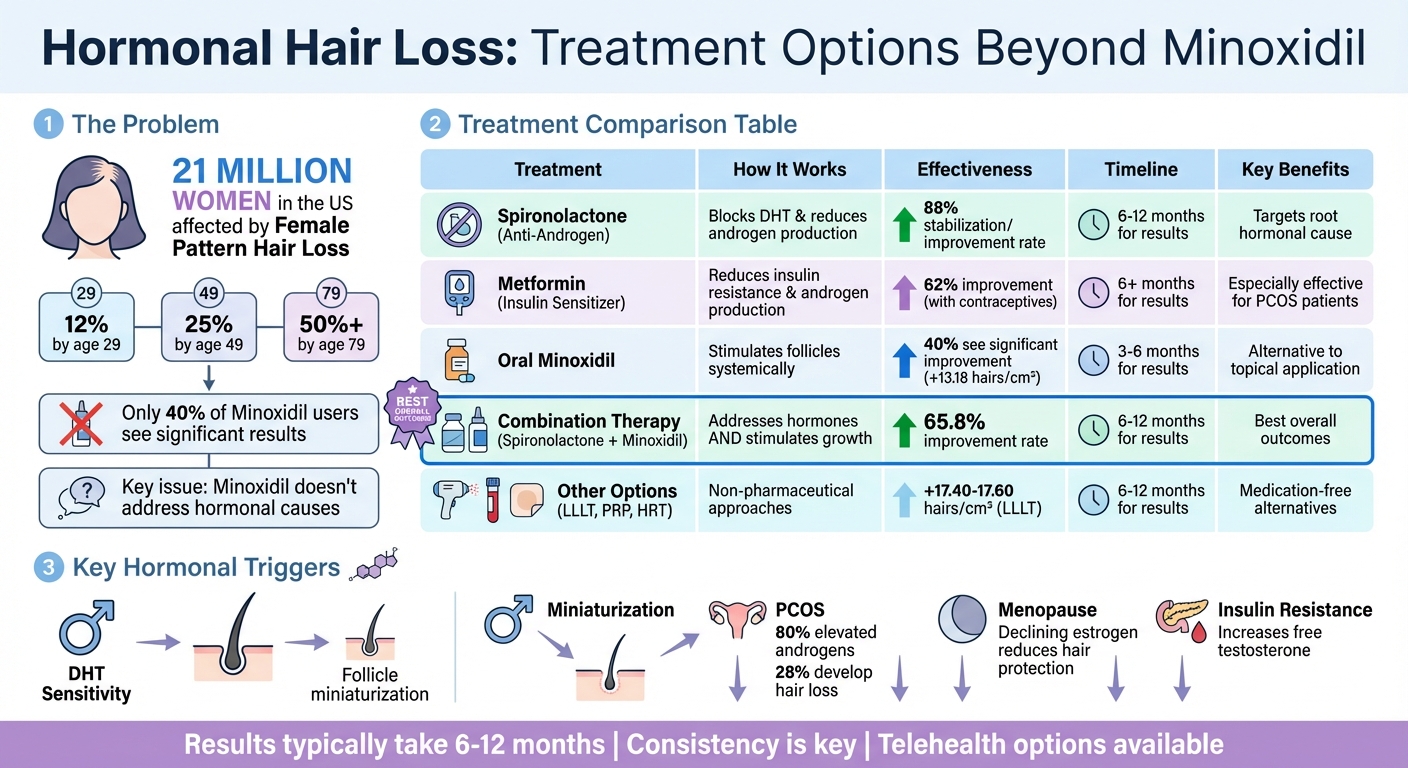
Hormonal Hair Loss Treatment Options Comparison Chart
What Causes Hormonal Hair Loss
What is hormonal hair loss?
Hormonal hair loss, often referred to as Female Pattern Hair Loss (FPHL) or androgenetic alopecia, impacts around 21 million women in the United States. This condition progresses as hair follicles gradually shrink, a process called miniaturization. Instead of producing strong, thick strands, these follicles start generating shorter, finer hairs - and eventually stop growing hair altogether.
Unlike male baldness, the pattern in women is distinct. Most women retain their frontal hairline but experience thinning at the crown and a widening center part, often forming a "Christmas tree pattern". Age plays a major role in its prevalence: about 12% of women experience it by age 29, 25% by age 49, and over 50% show some degree of hair thinning by age 79.
Hormones that trigger hair loss
The process of follicle miniaturization is heavily influenced by hormones, particularly androgens.
A key player is DHT (dihydrotestosterone), a potent androgen. While many women with FPHL have normal androgen levels in their blood, the issue lies in their hair follicles being genetically more sensitive to DHT. This sensitivity causes the follicles to shrink over time.
In women with PCOS (polycystic ovary syndrome), the situation becomes more complex. Insulin resistance leads to excess testosterone, which is then converted into DHT. As many as 80% of women with PCOS experience hyperandrogenism, and about 28% develop hair loss. The process unfolds like this: elevated insulin levels prompt the ovaries to produce more testosterone, which an enzyme called 5-alpha-reductase converts into DHT. Women with PCOS often have higher levels of this enzyme, making the problem worse. Low levels of Sex Hormone-Binding Globulin (SHBG) allow more free testosterone to circulate, further harming hair follicles. Additionally, irregular ovulation results in low progesterone levels, which would otherwise help block DHT conversion.
Perimenopause and menopause also contribute to hair loss. As estrogen levels drop, its protective effect on hair diminishes. Estrogen typically extends the hair growth phase, but without it, androgens gain the upper hand. Similarly, thyroid imbalances can lead to diffuse hair thinning, though through non-androgenic pathways.
Understanding these hormonal influences highlights the importance of treatments that go beyond simply increasing blood flow to the scalp.
Why Minoxidil may not be enough
Minoxidil is often prescribed to improve blood flow to hair follicles, but it doesn’t address the hormonal factors driving follicle miniaturization. This is why only about 40% of users see significant results after 3 to 6 months of use. Moreover, the benefits of Minoxidil fade once the treatment is stopped.
For women dealing with PCOS, insulin resistance, or other hormonal imbalances, Minoxidil alone is rarely enough. Addressing the root causes - like androgen activity or metabolic dysfunction - is essential. This is where treatments such as anti-androgens (e.g., Spironolactone) and insulin sensitizers (e.g., Metformin) come into play. These options target the underlying hormonal imbalances, offering a more comprehensive approach to managing hair loss.
Spironolactone and Anti-Androgens
How Spironolactone Works
Spironolactone tackles hormonal hair loss in two key ways: it binds to androgen receptors to block DHT and inhibits enzymes that produce androgens. For women with polycystic ovary syndrome (PCOS), who often have elevated androgen levels, spironolactone is commonly prescribed off-label. It helps manage not just hair loss but also related issues like acne and unwanted facial hair. However, visible improvements in hair density typically take 6–12 months of consistent daily use.
Research supports its effectiveness. A 2005 study reported that 88% of women taking oral anti-androgens like spironolactone experienced either stabilization or improvement in hair loss. Another study from 2015 found that 74.3% of participants saw no further progression of their condition while on the medication. When paired with other treatments, the rate of improvement rose to 65.8%.
Oral vs. Topical Spironolactone
Oral spironolactone remains the standard approach, with doses typically ranging from 25–200 mg per day. Because it has a diuretic effect, regular monitoring of potassium levels and kidney function is essential. Some common side effects include menstrual irregularities (reported in about 11.85% of patients) and dizziness caused by lowered blood pressure.
For those sensitive to oral medication, topical spironolactone offers an alternative. Applied directly to the scalp as a 1%–5% gel or solution, it targets hair follicles with minimal systemic absorption. This reduces the likelihood of side effects like menstrual changes or dizziness. Topical spironolactone can be used on its own or combined with oral treatments for potentially better results. For more information, you can explore Topical Spironolactone.
Other anti-androgens are also available, offering additional or complementary options.
Other Anti-Androgen Options
Finasteride is another option, working by inhibiting the enzyme responsible for converting testosterone into DHT. While it’s FDA-approved for men, it’s also prescribed off-label for post-menopausal women at doses of 2.5–5 mg daily. One study found that 81.4% of women showed improved hair density in photographs after 12 months of use. However, due to its teratogenic risks, women of childbearing age must use reliable contraception.
Low-androgen birth control pills, such as Yaz or Yasmin, can help regulate hormone levels, while 2% ketoconazole shampoo has been shown to improve hair density by 18% over six months.
For a personalized approach to hormonal hair loss management, consider visiting Oana Health for telehealth consultations and prescription options.
Metformin and Insulin Sensitizers
How Insulin Resistance Affects Hair Loss
Insulin resistance sets off a chain reaction that can contribute to hair loss. When the body becomes resistant to insulin, it compensates by producing more of it - a condition known as compensatory hyperinsulinemia. This excess insulin disrupts hormonal balances, particularly by stimulating ovarian theca cells to increase testosterone production through the enzyme P450c17α.
High insulin levels also lower the liver's production of Sex Hormone-Binding Globulin (SHBG), a protein responsible for binding testosterone and keeping it inactive. With less SHBG, more free testosterone circulates in the body, which can attach to hair follicles and lead to follicle miniaturization. This connects directly to the hormonal imbalances often seen in conditions like PCOS. Additionally, elevated insulin levels trigger the release of Insulin-like Growth Factor 1 (IGF-1), which further boosts ovarian testosterone production.
"The membrane cells of women with PCOS are more sensitive to the hyperandrogenic effects of insulin than healthy women." – Journal of Ovarian Research
For women with PCOS, this insulin-driven spike in androgen levels is a common issue. These women are also 4 to 7 times more likely to develop type 2 diabetes during their lifetime. Tackling this metabolic imbalance is crucial for managing hormonal hair loss.
How Metformin Can Help
Metformin is widely used to improve insulin sensitivity and reduce the effects of hyperinsulinemia. It works through the AMPK pathway, which helps regulate insulin levels and curb the overproduction of androgens. In the ovaries, Metformin inhibits specific enzymes, such as HSD3B2 and CYP17-lyase, that are involved in testosterone production. By lowering both insulin and IGF-1 levels, it reduces ovarian testosterone output.
Research supports Metformin's effectiveness when combined with other treatments. For example, a study found that 62% of premenopausal women experienced improvements in hair loss after taking 2.5 mg of Metformin daily alongside an oral contraceptive. Other clinical trials using doses of 1,500–1,700 mg per day over six months showed notable improvements in insulin sensitivity and reductions in testosterone levels for women with PCOS. However, Metformin is rarely used as a stand-alone treatment for hair loss. Its benefits are most pronounced when paired with anti-androgens or oral contraceptives as part of a broader treatment plan.
Improvements in hair density typically require at least six months of consistent treatment. Metformin is especially effective for women dealing with severe metabolic dysfunction or obesity, where insulin resistance plays a central role in PCOS symptoms.
Oral vs. Topical Metformin
Oral Metformin is the most common form of treatment, with typical doses ranging from 1,500 to 1,700 mg per day. However, gastrointestinal side effects like nausea and diarrhea are common and can lead some patients to stop treatment. For those who struggle with these side effects, topical Metformin offers an alternative.
Topical Metformin HCL lotion, available in a 20% concentration, is applied directly to the scalp. This method targets insulin resistance locally, minimizing systemic absorption and reducing the risk of digestive issues. At $43 per month, it can be used on its own or alongside oral treatments.
For those seeking a tailored treatment plan, Oana Health provides telehealth consultations with licensed medical professionals. They offer oral Metformin starting at $22 per month and topical formulations. Combination therapies, such as Metformin with Spironolactone (available for $32 per month), are also available and delivered directly to your door with free shipping.
Other Treatment Options Beyond Minoxidil
Oral Minoxidil
Oral Minoxidil is an off-label option often recommended for women who experience scalp irritation from topical solutions or find that foams interfere with their hair styling routine. Typically, the starting dose ranges from 0.25 mg to 0.625 mg.
When taken orally, Minoxidil undergoes conversion in the liver, which can enhance its effectiveness. Some women may find topical applications less reliable due to differences in follicular enzyme activity. Studies reveal that about 40% of patients notice significant improvements in hair density within 3 to 6 months, with an average increase of 13.18 hairs per cm² compared to placebo groups.
However, oral Minoxidil affects the entire body, not just the scalp. This systemic action increases the likelihood of side effects, including peripheral edema (swelling in the lower limbs), postural hypotension (dizziness when standing), and changes in heart rate. The most common issue is generalized hypertrichosis - excessive hair growth in areas other than the scalp. While oral Minoxidil has shown slightly better results in reducing hair shedding compared to its topical counterpart, it is associated with a higher rate of side effects.
Notably, a study combining oral Spironolactone with Minoxidil reported a 65.80% improvement rate, compared to 43.21% for Minoxidil alone. For those interested in oral Minoxidil, Oana Health provides prescriptions starting at $25 per month through licensed medical professionals, with free home delivery. This service offers a more accessible and convenient option for women seeking effective hair loss treatments.
Hormone Replacement Therapy (HRT)
Hormone Replacement Therapy (HRT) offers another avenue for addressing hair loss, particularly for women experiencing hormonal changes during menopause. By directly targeting hormonal imbalances, HRT can help reduce hair thinning while supporting overall hormonal health.
For menopausal women, HRT works by replenishing declining estrogen levels. This increase in estrogen boosts SHBG (sex hormone-binding globulin) production, which helps mitigate the effects of DHT on hair follicles. However, visible improvements usually take 6 to 12 months. Additionally, certain oral contraceptives can suppress gonadotropin secretion, further lowering androgen production.
Women experiencing hair loss due to estrogen deficiency may benefit from consulting a healthcare provider about HRT as a potential treatment option. It’s particularly effective when estrogen imbalance is the primary cause of thinning hair.
Low-Level Laser Therapy and PRP
Low-Level Laser Therapy (LLLT) and Platelet-Rich Plasma (PRP) are non-pharmaceutical approaches that can improve hair density. LLLT, which has received FDA 510K clearance as a medical device for hair loss, uses light energy to stimulate hair follicles. Research indicates that using a low-level laser comb can lead to a mean increase of 17.40 to 17.60 hairs/cm² from baseline.
PRP, on the other hand, involves using the patient’s own platelets to rejuvenate hair follicles. This method is particularly appealing for women who prefer to avoid medications or want to enhance their current treatment regimen. Both LLLT and PRP are most effective when combined with hormonal therapies like Spironolactone or Metformin, rather than being used as standalone treatments. These options are ideal for those looking to improve hair density without increasing medication doses, offering a well-rounded approach to hair restoration.
sbb-itb-6dba428
Combining Treatments for Better Results
Using multiple treatments together
Addressing hormonal hair loss often requires tackling the problem from multiple angles. By combining anti-androgens with topical treatments, you can address both hormonal imbalances and directly stimulate hair follicles. Research consistently shows that this combination approach outperforms single treatments in delivering noticeable results.
"Combining spironolactone with minoxidil... can amplify the results. While spironolactone tackles hormonal causes of hair loss, minoxidil works directly to stimulate hair follicles." - Dr. Sean Behnam
This two-pronged strategy not only prevents follicle miniaturization but also promotes new hair growth. Thanks to modern telehealth platforms, coordinating such treatments has never been more convenient.
How telehealth makes treatment easier
Telehealth simplifies access to combination therapies, making the process seamless and efficient. Instead of managing multiple in-person visits, you can complete an online consultation, receive a personalized treatment plan, and have medications delivered to your doorstep - often within just a few days.
During the consultation, providers assess your health history, hormonal symptoms (like those linked to PCOS or menopause), and any current medications to craft a tailored plan. Platforms like Oana Health offer a range of options, including oral Spironolactone, topical Spironolactone, and oral Minoxidil. They also provide unlimited messaging for questions about side effects or adjusting your treatment.
What to expect from treatment
Managing hormonal hair loss requires patience and consistency. Most people start seeing reduced shedding and thicker hair within 3 to 6 months of sticking to their treatment plan. Daily use helps stabilize hormone levels and maintain progress.
For those using oral Spironolactone, regular monitoring of potassium levels and kidney function is often recommended. These periodic check-ins ensure that the treatment remains safe and effective. However, stopping the treatment usually leads to a return of hair loss, making ongoing use essential to preserve results.
With about 40% of women experiencing some degree of hair loss by age 50, addressing hormonal imbalances through combination therapies offers a long-term solution. Collaborating with a healthcare provider ensures your treatment plan evolves with your needs, maximizing your chances of success.
HORMONES AND HAIR REGROWTH FOR WOMEN| DR DRAY
Conclusion
Hormonal hair loss often traces back to imbalances in hormones. When androgens like DHT persistently attack hair follicles, discontinuing treatments like Minoxidil typically leads to the resumption of hair loss.
Targeted treatments are essential to address the root cause. For instance, Spironolactone blocks androgen receptors and reduces DHT production, directly tackling the source of the problem. A study from 2005 found that 88% of women taking an oral anti-androgen saw their hair loss either stabilize or improve. Similarly, Metformin can help when insulin resistance contributes to hair loss, especially for women with PCOS, a condition where about 80% of cases involve elevated androgen levels.
Combining treatments often yields the best results. Pairing an anti-androgen like Spironolactone with a growth stimulant addresses both hormonal imbalances and the health of hair follicles. Most people begin to see noticeable changes within 6–12 months.
Platforms such as Oana Health make accessing tailored treatments simple. They connect you with licensed providers who can prescribe medications like oral Spironolactone, topical Spironolactone, and oral Minoxidil. With medications delivered straight to your door and ongoing support through unlimited messaging, managing hormonal hair loss becomes more convenient. Considering that nearly 40% of women experience hair loss by age 50, expert guidance ensures your treatment plan evolves with your needs.
FAQs
How does Spironolactone help with hormonal hair loss?
Spironolactone is a medication that helps address hormonal hair loss by targeting androgens - hormones like testosterone and dihydrotestosterone (DHT). These hormones can negatively affect hair follicles, leading to thinning or shedding. Spironolactone works by blocking these hormones from binding to receptors in the scalp. This can slow or even stop the shrinking of hair follicles, helping to reduce hair loss.
This treatment is especially useful for women dealing with hair loss linked to hormonal imbalances, such as those seen with conditions like PCOS. If you're considering Spironolactone, it's essential to consult a licensed healthcare provider to see if it's a good option for your situation.
Can Metformin help with hair loss caused by PCOS?
Metformin is widely used to help manage insulin resistance and metabolic issues linked to PCOS. That said, it's usually not enough on its own to tackle hair loss caused by PCOS.
To see better outcomes, treating hormonal imbalances often involves a mix of approaches customized to your individual needs. Consulting a healthcare provider is the best way to find the most effective treatment plan for your situation.
How can combining treatments improve results for hormonal hair loss?
Combining treatments for hormonal hair loss can deliver better results by tackling the problem from different angles. For instance, spironolactone helps block dihydrotestosterone (DHT), which can harm hair follicles, while minoxidil encourages hair growth by improving blood flow to the scalp. Together, these treatments can complement each other to support thicker, healthier hair.
Using multiple therapies also allows for lower doses of each, which can minimize side effects. For example, spironolactone's impact on blood pressure or the scalp irritation sometimes caused by high-strength minoxidil can be reduced. Additional options, like microneedling or low-level light therapy, can further enhance scalp health and promote hair regrowth.
Because everyone’s situation is different, Oana Health offers tailored, prescription-based treatment plans designed around your hormonal profile and lifestyle. With the added convenience of home delivery, Oana ensures you receive the right combination of treatments to achieve the best possible results.