
Cost Breakdown: Hormonal Treatments for Female Hair Loss
Hair loss treatments for women often require long-term use, with costs ranging from $14 to $375 annually depending on the medication and formulation. Options like Spironolactone and Minoxidil are widely used to address hormonal imbalances causing hair thinning, such as excess androgens in PCOS or estrogen decline during menopause. Here's a quick overview of their costs and benefits:
- Oral Spironolactone: $14/month via telehealth (e.g., Oana Health). Blocks DHT, with a 56%-65% improvement in hair growth. Side effects include fatigue and hormonal changes.
- Topical Spironolactone: $43/month. Less systemic risk but higher cost. Comparable effectiveness to oral.
- Oral Minoxidil: $25/month. Improves hair density (61%-86%) with fewer styling challenges than topical versions.
- Combination Treatments: Starting at $40/month for enhanced results by combining Spironolactone and Minoxidil.
Telehealth services lower costs by bundling consultations and prescriptions, making treatments more accessible. While affordability varies, consistency is key, as stopping treatments often leads to resumed hair loss within months.
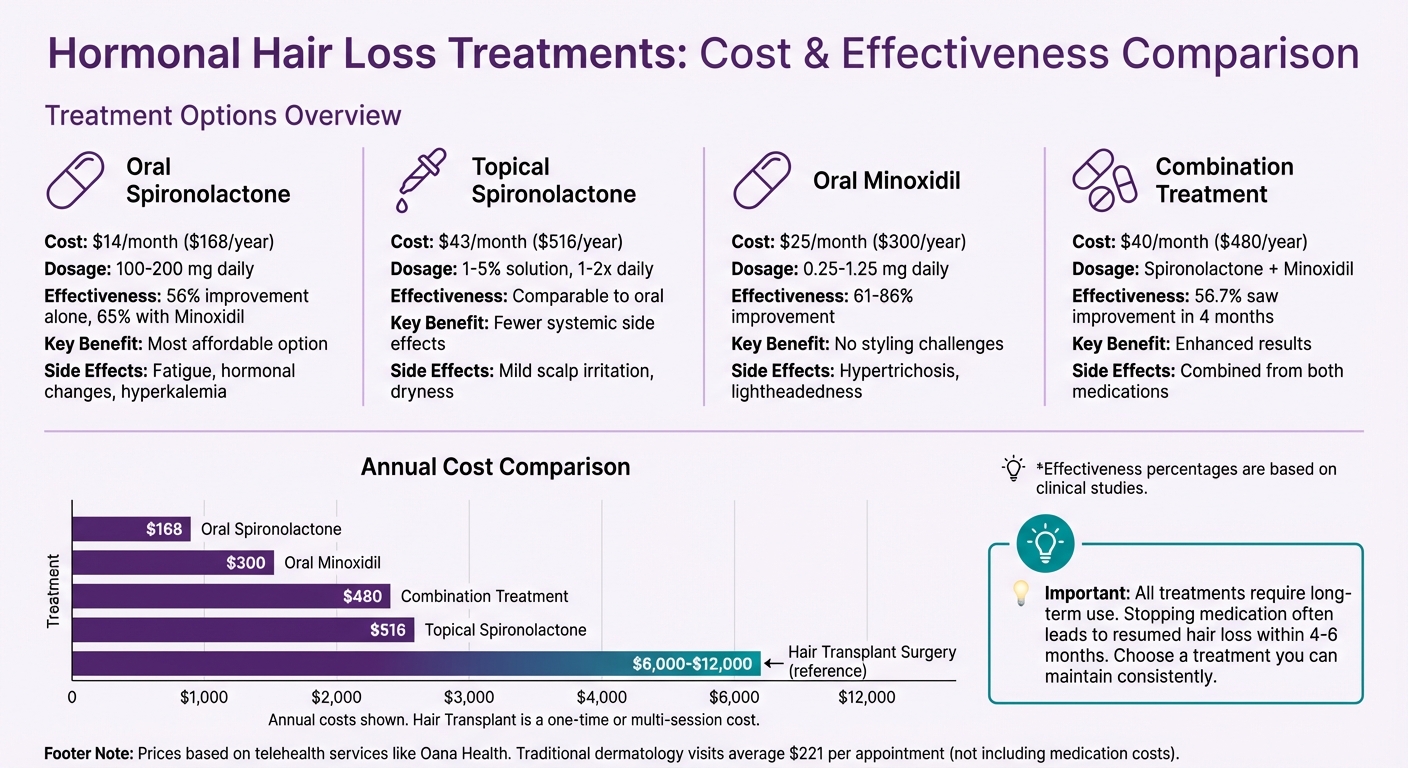
Cost Comparison of Hormonal Hair Loss Treatments for Women
HORMONES AND HAIR REGROWTH FOR WOMEN| DR DRAY
Spironolactone Costs
Spironolactone is a medication that blocks DHT at the hair follicle level, making it a popular option for managing hair loss in women. While its oral form is FDA-approved for treating high blood pressure, it’s also widely used off-label to address PCOS-related hair thinning and female pattern hair loss. Research shows that oral Spironolactone alone can lead to a 56% improvement in hair growth, which increases to 65% when combined with Minoxidil.
Telehealth services have made accessing Spironolactone easier and more affordable. For instance, Oana Health offers oral Spironolactone for just $14 per month, with free shipping and a one-time $20 consultation fee. This pricing is significantly lower than traditional dermatology visits, which often exceed $100 per appointment, not including medication costs. Below, we’ll break down the pricing and outcomes of both oral and topical Spironolactone options.
Oral Spironolactone: Pricing and Results
Oral Spironolactone is typically prescribed in daily doses of 100–200 mg for hair loss, with noticeable improvements usually appearing within 3–6 months of consistent use. It works by reducing androgen levels throughout the body, which can effectively address hair thinning. However, this systemic effect can also cause side effects such as elevated potassium levels (hyperkalemia), menstrual irregularities, breast tenderness, and fatigue.
Through Oana Health, oral Spironolactone costs $14 per month, amounting to $168 annually. It’s important to note that continued use is essential, as stopping the medication often leads to resumed hair loss within months.
Topical Spironolactone: Costs and Advantages
For those wary of systemic side effects, topical Spironolactone offers a more localized option. Oana Health provides a topical 1–5% solution at $43 per month, billed quarterly. This formulation is applied directly to the scalp once or twice daily, minimizing risks like hyperkalemia and hormonal changes.
Studies suggest that topical Spironolactone is just as effective as the oral version for treating androgenetic alopecia, with similar rates of hair regrowth. However, the higher cost reflects the custom compounding required for topical solutions, which are prepared in FDA-regulated pharmacies.
Oral vs. Topical Spironolactone Comparison
Here’s a side-by-side look at the costs, dosage, side effects, and effectiveness of the two formulations:
| Form | Pricing (Oana Health) | Dosage | Side Effects | Effectiveness |
|---|---|---|---|---|
| Oral | $14/month | 100–200 mg daily | Hyperkalemia, menstrual changes, fatigue | 56% improvement alone; 65% with Minoxidil |
| Topical | $43/month | 1–5% solution, 1–2x daily | Mild scalp irritation, dryness | Comparable to oral, with fewer systemic risks |
The choice between oral and topical Spironolactone largely depends on your budget and sensitivity to side effects. Oral Spironolactone is a cost-effective long-term solution, while the topical version offers a gentler option for those seeking to avoid systemic effects.
Oral Minoxidil Costs
Oral Minoxidil has gained traction as a convenient and cost-effective alternative to topical treatments. Unlike the over-the-counter topical versions, oral Minoxidil requires a prescription and is used off-label for hair loss in low doses, typically between 0.25 mg and 1.25 mg daily. These doses are significantly lower than the 10 mg to 40 mg approved for high blood pressure. Studies show that low-dose oral Minoxidil leads to clinical improvement in 61% to 86% of women with female pattern hair loss, with visible results often appearing within 3–6 months and full effects seen after 6–12 months of consistent use. With its proven efficacy, understanding the costs of this treatment is essential.
Oral Minoxidil: Pricing and Effectiveness
One of the biggest advantages of oral Minoxidil is its affordability. For example, Oana Health offers this treatment at $25 per month, with free shipping included.
"Oral Minoxidil is cheaper than the topical over-the-counter formulations",
notes Dr. Hassiel Aurelio Ramírez-Marín from Weill Cornell Medical College.
The simplicity of a once-daily pill eliminates the mess and styling challenges that often come with topical applications, improving adherence in the long run.
However, like any prescription medication, oral Minoxidil requires medical supervision to monitor for potential side effects. These may include lightheadedness, fluid retention, or unwanted body hair growth (hypertrichosis). A study involving 1,404 patients found that less than 2% discontinued treatment due to side effects when properly managed. Taking the medication at bedtime can also help reduce dizziness.
Oral vs. Topical Minoxidil Comparison
Here’s a quick side-by-side look at the key differences between oral and topical Minoxidil:
| Form | Pricing | Dosage | Side Effects | Effectiveness |
|---|---|---|---|---|
| Oral | $15–$25/month | 0.25–1.25 mg daily | Hypertrichosis, lightheadedness, fluid retention | 61%–86% improvement in women |
| Topical | $9–$15+/month (foam is often pricier) | 1 mL twice daily (solution) or half-cap daily (foam) | Scalp irritation, itching, dryness, texture changes | Clinically proven; effectiveness may vary |
While topical Minoxidil might seem cheaper at first glance, women often face a "pink tax." This means they pay about 40% more for identical 5% foam formulations compared to men - approximately $11.27 versus $8.05 per 30 mL.
"Women are paying significantly more than men for an identical medication",
as Dr. Mackenzie R. Wehner points out.
Oral Minoxidil bypasses this pricing disparity entirely. It also offers better absorption - around 95% through the gastrointestinal tract, compared to just 1.4% through the skin when using topical formulations.
For women looking to balance effectiveness with budget considerations, oral Minoxidil provides a practical, evidence-backed solution.
sbb-itb-6dba428
Combination and Custom Treatments
Taking hair loss treatments a step further, combination therapies and customized solutions offer increased effectiveness and a tailored approach to individual needs.
Combination Treatment Costs
Pairing Spironolactone, which blocks androgen receptors, with Minoxidil, known for boosting blood flow and prolonging the hair growth phase, creates a potent combination for tackling hair loss.
In a clinical trial, 56.7% of participants using the Minoxidil-Spironolactone combination saw noticeable improvement within four months. In contrast, none of the patients using a Minoxidil-Finasteride combination achieved similar results. Additionally, only 6.7% of patients on the Minoxidil-Spironolactone regimen experienced less-than-ideal outcomes, compared to 16.7% in the Finasteride group.
When it comes to cost, combination therapies generally fall between $59 and $69 per month through telehealth-compounded formulations. However, Oana Health offers its "Hair Plus Plus" treatment at a competitive $40 per month. While this is about twice the price of single-agent treatments, the added effectiveness often makes it worth the expense.
These combination treatments also serve as a gateway to even more personalized compounded solutions.
Compounded Treatment Options
Compounded medications offer a level of personalization that off-the-shelf products simply can’t match. These formulations can blend multiple active ingredients - like Minoxidil, Spironolactone, and Retinoic Acid - into a single topical or oral treatment. This not only simplifies your routine but may also improve adherence and reduce long-term costs compared to standard options.
"We leverage telemedicine and compounding pharmacy services to offer you affordable pricing", says Oana Health.
Compounding pharmacies provide impressive flexibility. For example, 93.5% can create Minoxidil solutions with higher-than-standard concentrations, 67.6% cater to sensitive scalps by using less than 10% alcohol, and 98.7% ensure delivery within a week.
Telehealth platforms make the process even easier. After an online consultation - typically costing between $30 and $59 for new patients - a licensed medical professional evaluates your case and prescribes a custom formula. This prescription is then delivered straight to your door, eliminating the need for multiple pharmacy visits.
Cost Analysis and Final Recommendations
When it comes to addressing female hair loss, hormonal treatments stand out as a practical and budget-friendly alternative to surgical procedures. For instance, generic oral spironolactone and minoxidil typically cost between $16 and $30 per month, with spironolactone showing visible results within six months. In comparison, surgical options can range from $6,000 to $12,000. These figures highlight why hormonal treatments are often the most economical first step.
How Telehealth Lowers Treatment Expenses
Telehealth services simplify the process by bundling consultations, prescriptions, and ongoing support into a single, predictable monthly fee. This model is particularly appealing when you consider that an in-person dermatologist visit for hair loss averages $221 without insurance. By eliminating per-visit charges, telehealth makes treatment more accessible.
Take Oana Health as an example. They offer oral spironolactone for $14 per month, oral minoxidil for $25 per month, and their Hair Plus Plus combination treatment for $40 per month, all with free shipping. This straightforward pricing structure is especially helpful since most insurance plans classify hair loss treatments as cosmetic and don’t typically cover them. Telehealth’s affordability and convenience make it an excellent option for those looking to manage costs while pursuing effective treatment.
Finding the Right Treatment for Your Budget
To maximize savings, start with generic options once your diagnosis is confirmed. If symptoms such as acne or irregular periods suggest hyperandrogenism, a hormone panel - priced between $180 and $231 - can help determine whether anti-androgens like spironolactone are suitable for you.
Consistency is key when it comes to hormonal treatments. These therapies need to be continued indefinitely, as discontinuation often leads to hair loss returning within four to six months. It’s wiser to choose a treatment plan you can maintain long-term rather than opting for an expensive option that might not be sustainable. For women dealing with female pattern hair loss, combining oral spironolactone with minoxidil strikes a good balance between effectiveness and affordability.
FAQs
What are the potential side effects of oral and topical Spironolactone for hair loss?
Spironolactone, whether taken orally or applied topically, can lead to side effects like dizziness, fatigue, irregular menstrual cycles, or occasional spotting between periods. In rare cases, it may cause hyperkalemia (higher-than-normal potassium levels), which typically improves with a dosage adjustment. Most side effects are mild, depend on the dose, and often diminish over time or after stopping the medication. If you notice persistent or severe symptoms, it's important to reach out to your healthcare provider.
How does telehealth help lower the cost of hormonal treatments for hair loss?
Telehealth has made addressing hormonal hair loss more budget-friendly by eliminating the need for in-person doctor visits and simplifying the treatment process. For example, medications such as spironolactone or finasteride can cost as little as $15 per month, while virtual consultations help save both time and money.
Through telehealth services, licensed medical professionals handle prescriptions, and treatments are delivered straight to your doorstep with free shipping. Features like automatic refills and customized care plans add to the convenience, making it an affordable and hassle-free option for managing hair loss.
Can I use Spironolactone and Minoxidil together for hair loss treatment?
Yes, using spironolactone alongside minoxidil can be a powerful combination for managing hair loss in women. Studies indicate that spironolactone, often prescribed at a daily dose of 100 mg, pairs effectively with topical minoxidil, delivering better results than either treatment on its own.
Spironolactone targets hormonal factors by lowering androgen levels, which play a role in hair thinning, while minoxidil stimulates hair regrowth by boosting blood flow to the scalp. Be sure to consult a licensed healthcare provider to create a treatment plan tailored to your individual needs.