
How to Interpret LH and FSH Ratios for PCOS
When it comes to understanding PCOS, the LH (luteinizing hormone) to FSH (follicle-stimulating hormone) ratio is a key indicator of hormonal imbalances. Typically, a ratio between 1:1 and 2:1 is normal. However, in PCOS, this ratio often exceeds 2:1 or even 3:1, signaling disruptions in ovulation and increased androgen production.
Key Points to Remember:
- LH and FSH Roles: FSH supports follicle growth, while LH influences ovulation and androgen production.
- In PCOS: Elevated LH levels and lower FSH levels contribute to irregular cycles, infertility, and symptoms like acne or excess hair growth.
- Testing Tips: Blood tests should be done early in the menstrual cycle (days 2–5) for accurate results.
- Limitations: The LH:FSH ratio alone isn’t enough for a PCOS diagnosis. It must be combined with other criteria like irregular cycles, high androgen levels, or ovarian cysts.
Understanding these ratios can provide insight into hormonal health, but always consult a healthcare provider for a complete evaluation.
Correlation of LH FSH ratio in fertility assessments - Dr. Teena S Thomas
Normal vs. PCOS LH to FSH Ratios
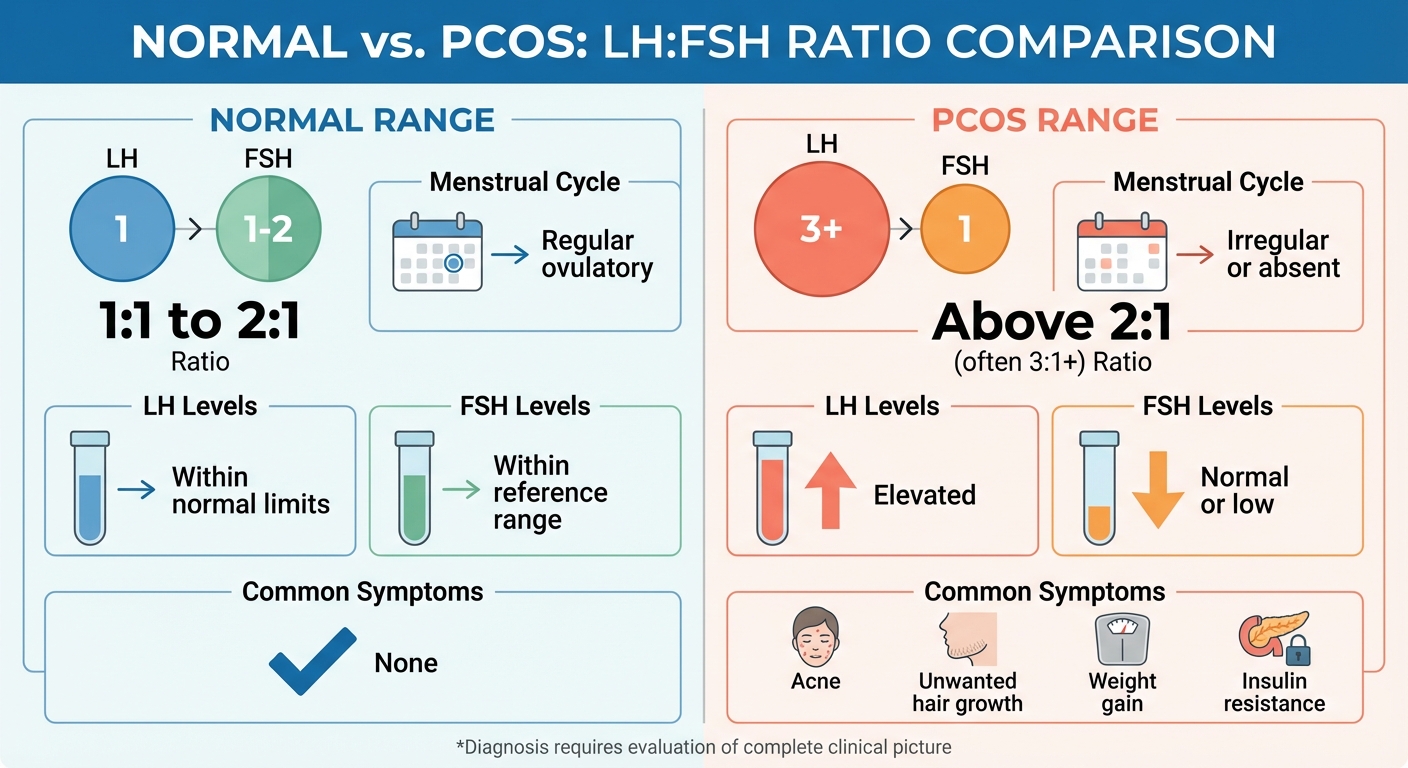
Normal vs PCOS LH:FSH Ratio Comparison Chart
Understanding the difference between normal and PCOS LH:FSH ratios can help make sense of your test results.
Normal LH to FSH Ratio Ranges
In a healthy menstrual cycle, the LH:FSH ratio typically falls between 1:1 and 2:1. This balance is essential for proper follicle development and timely ovulation. FSH encourages follicle growth, while LH triggers ovulation. When this harmony is disrupted, as seen in PCOS, it can lead to complications.
Elevated Ratios in PCOS
In cases of PCOS, the LH:FSH ratio often skews higher, exceeding 2:1 and sometimes reaching 3:1 or more. This imbalance results in increased LH relative to FSH, which drives up androgen production and interferes with the maturation of follicles.
"In healthy women, the ratio between LH and FSH usually lies between 1 and 2. In polycystic ovary disease women, this ratio becomes reversed, and it might reach as high as 2 or 3."
- Zaheera Saadia, MD, PhD, Department of Obstetrics and Gynecology, College of Medicine, Buraidah
The elevated LH levels in PCOS contribute to higher androgen levels, which can cause symptoms like acne and excessive hair growth (hirsutism). Meanwhile, lower FSH levels disrupt ovulation and may affect fertility. Body Mass Index (BMI) also plays a role, as obese individuals with PCOS may show slightly lower LH:FSH ratios compared to leaner individuals. These distinctions are crucial for interpreting test results accurately.
Comparison Table: Normal vs. PCOS Ratios
Here’s a quick overview of the differences:
| Feature | Normal Range | PCOS Range |
|---|---|---|
| LH to FSH Ratio | 1:1 to 2:1 | Above 2:1 (often 3:1+) |
| Menstrual Cycle | Regular ovulatory | Irregular or absent |
| LH Levels | Within normal limits | Elevated |
| FSH Levels | Within reference range | Normal or low |
| Common Symptoms | None | Acne, unwanted hair growth, weight gain, insulin resistance |
This table highlights how the hormonal shifts in PCOS differ from a typical cycle, laying the groundwork for understanding these test results.
How to Interpret LH and FSH Ratios: Step-by-Step
Here’s a straightforward guide to help you understand your test results.
Step 1: Confirm the Testing Phase and Units
Timing matters. Make sure your blood test is done during the early follicular phase, ideally between days 2 and 5 of your cycle, for the most reliable results. Also, double-check that both LH and FSH are reported in the same units, such as mIU/mL or IU/L. If your cycles are irregular or you’re using hormonal contraceptives, it’s best to consult your healthcare provider for guidance.
Step 2: Calculate the LH to FSH Ratio
To determine the ratio, divide your LH value by your FSH value (LH ÷ FSH = Ratio). For instance, if your LH is 15 mIU/mL and your FSH is 5 mIU/mL, the ratio would be 3:1 (15 ÷ 5 = 3). Typically, a single early-morning fasting sample is used for this calculation in most clinical settings.
Step 3: Compare Your Ratio to PCOS Indicators
Now, compare your calculated ratio to the typical thresholds. In healthy individuals, the LH to FSH ratio generally falls between 1:1 and 2:1. If your ratio is greater than 2:1, this could indicate polycystic ovary syndrome (PCOS). A ratio above 3:1 is considered an even stronger marker.
"A ratio greater than 2 generally indicates PCOS, but there are no exact cutoff values because many different assays are used."
It’s worth noting that around 94% of anovulatory PCOS patients exhibit an elevated LH:FSH ratio. However, not everyone with PCOS will have a high ratio - this is especially true for individuals with higher body weight. After assessing the ratio, it’s important to examine the absolute hormone levels for a more complete understanding.
Step 4: Evaluate Absolute LH and FSH Levels
Beyond the ratio, take a closer look at the individual hormone levels. This step helps rule out other potential conditions. For example:
- FSH levels above 35 IU/L combined with LH levels over 11 IU/L may point to ovarian failure rather than PCOS.
- LH levels below 7 IU/mL could suggest hypothalamic dysfunction.
Normal baseline levels for both hormones typically range between 5–20 mIU/mL. By reviewing these absolute values alongside the ratio, your healthcare provider can piece together a more accurate diagnosis.
sbb-itb-6dba428
Limitations of LH and FSH Ratios in PCOS Diagnosis
An elevated LH to FSH ratio can suggest PCOS, but it’s not enough to confirm the condition on its own. This ratio isn’t part of the widely recognized diagnostic criteria, such as those outlined by the Rotterdam, NIH, or AE-PCOS guidelines. Over time, medical practice has shifted away from focusing solely on gonadotropin ratios and now emphasizes a more comprehensive view that includes hyperandrogenism, ovulatory issues, and ovarian morphology.
"While an LH/FSH ratio >2 is strongly associated with PCOS, diagnosis requires consideration of the complete clinical picture including menstrual irregularity, hyperandrogenism, and ovarian morphology on ultrasound."
- Dr.Oracle Medical Advisory Board
It’s also important to take into account factors that can influence hormone levels, which may complicate the interpretation of these ratios.
Factors That Affect LH and FSH Levels
Several variables can impact hormone levels, making the LH to FSH ratio an unreliable standalone measure. For example, obesity can suppress LH secretion, potentially masking PCOS even when the ratio appears normal. If ovulation has occurred within the past 21 days, LH levels might temporarily normalize, further obscuring any underlying hormonal imbalance.
LH levels also fluctuate throughout the day, so a single blood draw might capture a peak or a dip rather than a true baseline. Stress, intense physical activity, and certain medications like valproate can also alter hormone levels. Additionally, chronic hypothyroidism can mimic PCOS symptoms, as TSH may interact with LH and FSH receptors.
Given these complexities, relying only on the LH to FSH ratio can lead to misdiagnosis. This is why healthcare providers need to consider broader diagnostic criteria.
Why PCOS Diagnosis Needs Multiple Criteria
Diagnosing PCOS requires more than just hormonal assessments - it’s a diagnosis of exclusion. Doctors must first rule out other conditions with similar symptoms, such as thyroid disorders, hyperprolactinemia, or nonclassic congenital adrenal hyperplasia. According to the Rotterdam criteria, at least two of the following three features are needed for a PCOS diagnosis: hyperandrogenism, ovulatory dysfunction, or polycystic ovaries visible on ultrasound.
Additional testing helps create a clearer diagnostic picture. For instance, 20–30% of women with PCOS have elevated DHEAS levels, an adrenal androgen that the LH/FSH ratio doesn’t reflect. Mid-luteal progesterone testing can verify whether ovulation is occurring, and testosterone measurement using liquid chromatography-tandem mass spectrometry (LC/MS-MS) is considered the most accurate approach. Alarmingly, up to 75% of PCOS cases may go undiagnosed, partly because some providers rely too heavily on isolated markers instead of using the full range of diagnostic tools.
Conclusion
Understanding your LH:FSH ratio can shed light on potential PCOS, but it’s just one piece of the puzzle. A proper diagnosis requires your healthcare provider to evaluate your overall clinical picture. This includes menstrual irregularities, signs of hyperandrogenism like acne or excessive hair growth, and imaging results from ultrasounds. Only by considering all these factors can a clear conclusion be reached.
It’s important to remember that PCOS is a diagnosis of exclusion. This means your provider must rule out other conditions that mimic its symptoms and assess any associated metabolic risks. Women with PCOS, for instance, face a fourfold higher risk of developing Type 2 diabetes. By taking a thorough and comprehensive approach, your provider can create a treatment plan tailored to your unique needs.
Oana Health: Personalized PCOS Support

The journey to effective care begins with an accurate diagnosis. If you’re dealing with a PCOS diagnosis or ongoing symptoms, Oana Health offers specialized telehealth services designed for hormonal health. Their licensed professionals craft science-based, personalized treatment plans that address the full range of PCOS symptoms, including insulin resistance, weight concerns, unwanted facial hair, and hormonal acne. Options like Metformin & Spironolactone ($32/month) or Eflornithine 12% ($69/month) are prescribed based on your individual needs and delivered straight to your door with free shipping.
Next Steps in PCOS Management
Once your diagnostic process is underway, be sure to prioritize a complete hormonal and metabolic evaluation. Aim to schedule hormone and metabolic tests during the early follicular phase of your cycle, and talk with your provider about lifestyle changes that may alleviate symptoms . Even modest weight loss - just 5% to 10% - can lead to noticeable improvements in both PCOS symptoms and overall metabolic health. Whether you choose to work with a local provider or explore telehealth options like Oana Health, effective PCOS management often combines lifestyle adjustments with targeted prescription treatments designed to address your specific hormonal imbalances.
FAQs
What does my LH:FSH ratio mean for PCOS?
An LH:FSH ratio of 2:1 or greater might indicate PCOS, particularly if LH levels are approximately three times higher than FSH. That said, this ratio by itself isn’t sufficient to confirm a diagnosis. Other factors, such as irregular menstrual cycles, increased androgen levels, and ultrasound results, play a critical role in the evaluation.
To get a clear diagnosis, it’s essential to consult a healthcare provider. They’ll assess your symptoms, hormone levels, and medical history to provide a thorough understanding of your results and develop a plan that’s tailored specifically to your health needs.
Why should LH and FSH levels be tested at the start of the menstrual cycle?
Testing LH (luteinizing hormone) and FSH (follicle-stimulating hormone) levels during the first few days of the menstrual cycle offers the clearest insight into hormonal balance. This timing falls within the early follicular phase, a point when hormone levels are steadier and easier to interpret.
When assessing for PCOS, the LH-to-FSH ratio serves as an important indicator, often shedding light on hormonal imbalances linked to the condition. Testing later in the cycle can be less reliable since hormone levels naturally fluctuate throughout the month.
What other factors are important besides the LH:FSH ratio when diagnosing PCOS?
While the LH:FSH ratio offers useful clues, it’s just one aspect of diagnosing PCOS. Other important considerations include:
- Signs of hyperandrogenism: This can appear as excess facial or body hair, persistent acne, or thinning hair on the scalp.
- Irregular ovulation: Often evident through missed or inconsistent menstrual cycles.
- Ultrasound findings: The presence of multiple small follicles on the ovaries can be a key indicator.
- Elevated antimüllerian hormone (AMH) levels: Higher levels may suggest disrupted ovarian function.
To get a clear and accurate diagnosis, a healthcare provider will typically evaluate a combination of these factors, ensuring a more comprehensive understanding of your health.