
Laser Hair Removal Costs: Clinic vs. At-Home Devices
Laser hair removal can be done professionally at a clinic or with at-home devices, each with its own costs, effectiveness, and convenience. Here's a quick breakdown:
- Clinic treatments: Cost between $1,000–$5,000 for 6–12 sessions. They use medical-grade lasers, offering up to 80–90% permanent hair reduction. Best for all skin tones and larger areas but requires scheduling and travel.
- At-home devices: One-time cost of $100–$1,000. Most use IPL (Intense Pulsed Light), which is less powerful than clinic lasers. Results are typically 50–70% hair reduction, requiring frequent maintenance. Best for light skin and dark hair.
- Long-term costs: Clinics may seem expensive upfront but require minimal maintenance. At-home devices are cheaper initially but need ongoing use and occasional replacements.
- Effectiveness: Clinics deliver better, longer-lasting results, while at-home devices are more convenient but less powerful.
Quick Comparison:
| Factor | Clinic Treatments | At-Home Devices |
|---|---|---|
| Cost | $1,000–$5,000 | $100–$1,000 (one-time) |
| Effectiveness | 80–90% permanent reduction | 50–70% reduction |
| Treatment Time | 6–12 sessions, every 4–8 weeks | Weekly or bi-weekly |
| Maintenance | Minimal (annual touch-ups) | Ongoing |
| Best For | All skin tones, larger areas | Light skin, dark hair |
Professional treatments are ideal for those seeking permanent solutions for unwanted facial hair and safety, while at-home devices suit those seeking a budget-friendly, DIY option.
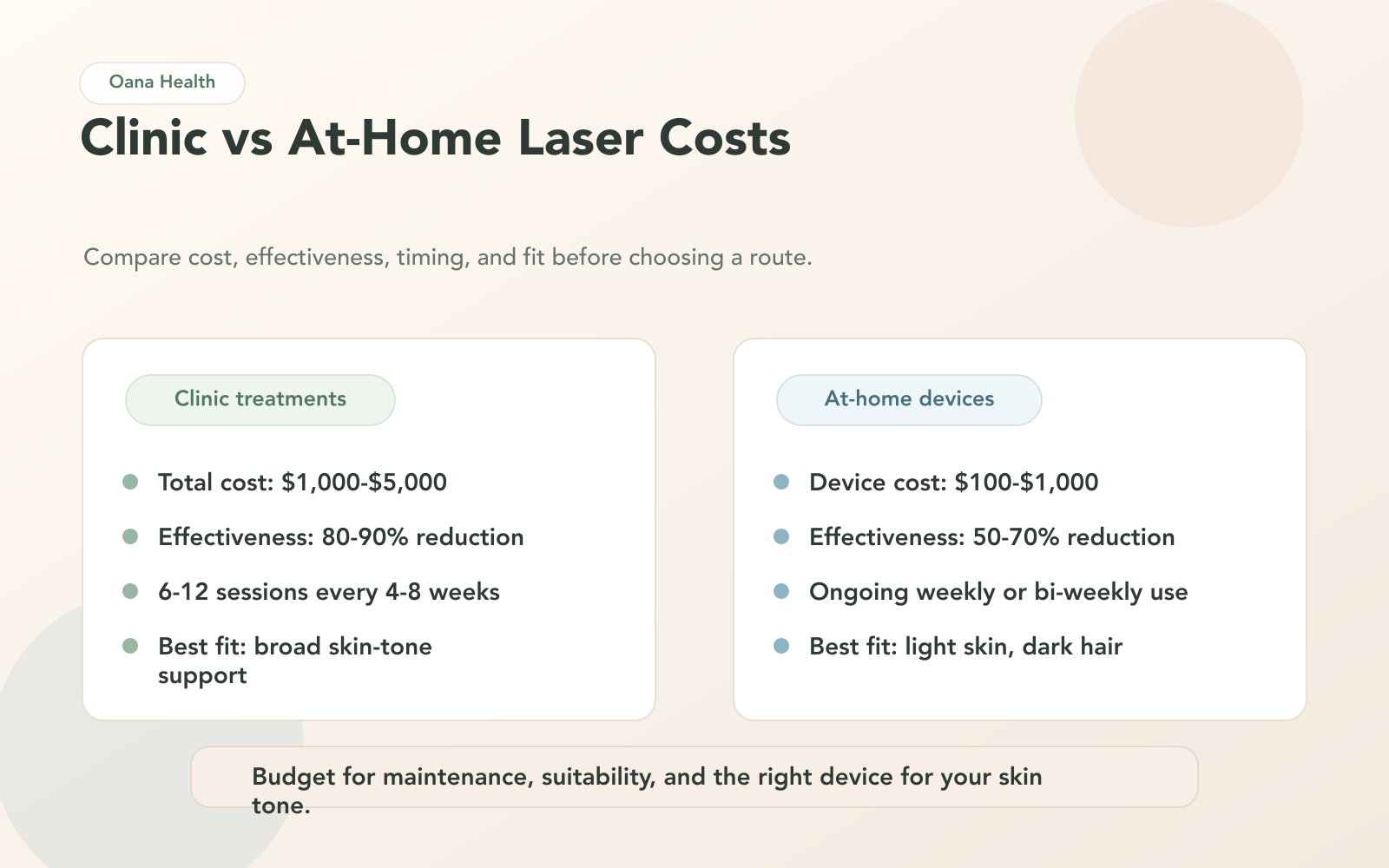
Clinic vs At-Home Laser Hair Removal Cost and Effectiveness Comparison
How Much Does Laser Hair Removal Cost?
Clinic Laser Hair Removal Costs
The cost of clinic laser hair removal depends on factors like per-session fees, the number of treatments needed, and additional charges. Here's a detailed look at what contributes to the overall expense.
Cost Per Session
The price for a single session depends on the treatment area. Smaller areas, like the upper lip or chin, can range from $60 to $250, while larger areas, such as the full legs or back, may cost between $300 and $1,200. On average, the session fee hovers around $697 in 2025. Clinics in cities like New York or Los Angeles often charge 10–25% more due to higher operational costs.
Advanced multi-wavelength lasers, which can treat a wider variety of skin and hair types, might push session prices higher but could reduce the overall number of treatments required. Many clinics offer package deals for 6 to 8 sessions, with discounts of 10–20% compared to paying per session.
"Since hair grows in cycles, the number of treatments varies by patient skin type, hair color, and hair coarseness. But it typically takes about six to eight treatments, spaced every four to eight weeks."
– Dr. Dennis Gross, Dermatologist
Number of Sessions Required
Most patients need 4 to 8 sessions for noticeable, long-lasting results. For smaller areas, like the chin, total costs can range from $450 to $1,200, while treating larger areas, such as the full legs, might cost anywhere from $2,400 to $6,000. Men often pay 25–30% more due to coarser hair and larger treatment zones. This is largely due to androgenic hair growth patterns driven by testosterone.
After completing the full treatment plan, patients typically see 70–90% hair reduction. However, areas prone to hormonal changes - like the face or bikini line - might need extra sessions to maintain results, especially when managing underlying conditions.
Additional Costs
Several additional expenses can impact your total investment:
- Consultation fees: $50–$150, though some clinics waive this if you purchase a package.
- Facility or overhead fees: $25–$80 per visit.
- Medical consumables: Items like laser handpiece tips or cooling gels can add $20–$60 per session.
Touch-up sessions, often needed once or twice a year, cost between $100 and $600, depending on the area treated. Other potential costs include topical numbing creams, post-treatment skincare products like sunscreen or soothing gels, and financing options. If you choose to finance, keep in mind that interest charges could increase your overall spending.
At-Home Laser Device Costs
Switching to an at-home laser device means a one-time expense with minimal ongoing costs, unlike the recurring fees of clinic treatments. To make an informed decision, it's important to weigh the upfront cost, maintenance, and lifespan of these devices.
Initial Device Price
At-home laser devices are typically grouped into three price ranges:
- Budget-friendly models: Devices like XSOUL or Innza are priced between $60 and $150.
- Mid-range options: Brands such as the Nood Flasher 2.0 (around $169–$199) or Ulike Air 3 (approximately $309–$349) fall within the $200 to $500 range.
- Premium professional-grade tools: High-end devices, including the Tria 4X ($599.99) or the Epilaser 808 ($995), range from $600 to $1,000.
The price differences often reflect the type of technology used. For instance, diode lasers are generally more expensive than IPL devices due to their focused laser technology. Some newer premium models, like the Braun Skin i-expert (priced between $400 and $600), offer advanced features such as Wi-Fi and Bluetooth connectivity, which allow users to sync with smartphone apps for tracking progress and customizing treatments.
"A laser that costs $500 is basically the same price as a professional hair removal session, and that in-office treatment won't last forever but you will continue using your at-home laser for years." – Women's Health
Once you've chosen a device, it's worth noting that maintenance is straightforward and affordable.
Maintenance and Replacement Parts
One of the perks of at-home devices is the low maintenance. Many devices come with unlimited or high flash counts, eliminating the need for replacement cartridges. However, some older or budget models may still require replacing light cartridges after the initial flash capacity is used up.
Aside from cartridges, the ongoing costs are minimal. Pre-treatment preparation typically involves basic shaving supplies like razors or a hirsutism treatment cream. Some devices, such as the Foreo Peach 2, recommend using cooling gels for added comfort during sessions. If you're using a cordless model, keep in mind that battery wear over time might limit its lifespan compared to corded options.
Device Lifespan and Value
At-home laser devices are built to last, with lifespans ranging from 15 to 30 years. This durability is largely determined by the device's flash capacity. For instance:
- A device with 200,000 flashes may last over 15 years.
- One with 400,000 flashes could last around 30 years.
- High-capacity models offering up to 999,999 flashes might theoretically last up to 75 years, depending on usage.
The Braun Skin i-expert, priced at approximately $500, breaks down to just $0.32 per treatment over its lifespan. For comparison, shaving can cost about $4,000 over 30 years, while professional waxing could exceed $20,000 during the same period. To sweeten the deal, many brands like Nood and RoseSkinCo offer perks such as 90-day money-back guarantees, 1-year warranties, and even free replacements if you reach the flash limit.
"With Braun at-home IPL device, you invest only once and can retouch anytime, if needed." – Braun US
Cost Comparison: Clinic vs. At-Home
Professional clinic treatments typically range from $1,000 to $5,000 per area, depending on the number of sessions required, while at-home devices involve a one-time cost of $400–$500. Clinics charge per session, with most individuals needing 6 to 12 sessions spaced 4 to 8 weeks apart for optimal results. These recurring fees can add up quickly, making it important to consider both upfront and long-term expenses.
At-home devices, on the other hand, follow a different pricing model. With an initial cost of around $400 to $500, there are no per-session fees, and the ongoing costs are limited to occasional cartridge replacements. This makes them more budget-friendly in the short term, though they come with limitations in terms of power and effectiveness.
"Professional hair removal usually gives you a bigger bang for your buck."
- Dr. Rachel Ward, Dermatologist, Cleveland Clinic
That said, at-home devices are less powerful than professional lasers. They often fall short of achieving complete hair removal and require continued monthly treatments to maintain results. By contrast, professional treatments can destroy up to 80% of hair in the treated area, offering more permanent results.
Comparison Table
| Cost Factor | Clinic Laser Hair Removal | At-Home Laser Device |
|---|---|---|
| Initial Cost | $100–$800 per session | $400–$500 (one-time) |
| Total 2-Year Expense | $1,000–$5,000 (area dependent) | $400–$600 (device + parts) |
| Treatment Frequency | Every 4–8 weeks | Monthly or more frequent |
| Number of Sessions | 6–12 sessions for full results | Ongoing/Indefinite |
| Long-Term Maintenance | $200–$600 for annual touch-ups | Replacement cartridges |
| Efficacy | High (up to 80% permanent reduction) | Moderate (hair reduction, rarely total) |
| Suitability | All skin tones (with proper technology) | Mostly light skin/dark hair only |
This breakdown highlights the financial and practical differences between clinic-based treatments and at-home devices, helping you weigh cost against long-term effectiveness and convenience.
sbb-itb-6dba428
Effectiveness and Long-Term Value
Results and Efficacy
Clinic lasers consistently outperform at-home devices when it comes to hair removal results. A study conducted between July and December 2022 at the Deluxe Laser Clinic Constantia in South Africa compared the MeDioStar® NeXT Pro Diode laser with the Silk'n™ Flash & Go home device. The study involved 15 women aged 20–30 and focused on underarm treatments. After six sessions, clinic treatments reduced hair growth by 85–88%, while at-home devices achieved only 46.3–52% reduction.
The gap widens further over a full course of treatment. Professional laser treatments can leave clients 95% or more hair-free after 7 to 10 sessions. In contrast, at-home IPL and diode devices typically deliver around a 70% reduction after three months of consistent use. Clinic treatments also target and destroy hair follicles, making the results longer-lasting.
Most at-home devices rely on Intense Pulsed Light (IPL) technology, which is inherently less powerful than true lasers. Even the Tria 4X, one of the few at-home devices that uses diode laser technology, is 90.1% more effective than other home IPL devices. However, it still falls short when compared to professional-grade equipment. At-home devices also tend to produce less consistent results, highlighting the clear advantage of professional treatments in terms of efficacy.
Long-Term Cost Efficiency
When comparing long-term costs, professional treatments, such as laser hair removal for PCOS, may initially seem more expensive but often prove to be the smarter investment. While clinic treatments typically cost around $4,200 for a full course, at-home devices are priced at $400–$600 per unit . However, the permanent results achieved through professional treatments, combined with minimal annual touch-ups, make them more cost-efficient over time.
After completing 7 to 10 sessions, professional treatments require little maintenance - usually just one or two touch-ups per year, if necessary. Some clinics even provide lifetime guarantees with unlimited touch-ups. In contrast, at-home devices demand frequent use to maintain results. Over a decade, many users end up buying 2 to 3 replacement devices due to battery degradation or the limited lifespan of light sources. Add to that the cost of replacement cartridges and the time spent on regular DIY sessions, and the "budget-friendly" option becomes less appealing.
"Professional hair removal usually gives you a bigger bang for your buck."
- Dr. Rachel Ward, Dermatologist, Cleveland Clinic
For larger treatment areas or individuals with darker skin tones, professional treatments are not only safer but also more economical. Most at-home devices are designed for light skin and dark hair, and they often carry a higher risk of burns or may even lock out users with darker complexions. This makes professional treatments the better choice for both safety and efficiency in the long run.
Safety, Convenience, and Suitability
Safety Considerations
When deciding between clinic-based and at-home laser treatments, safety is a key aspect to weigh alongside cost and effectiveness. Clinics use high-powered equipment that, when properly calibrated, minimizes risks like burns, scarring, permanent skin discoloration, blistering, and crusting. Trained professionals in clinics monitor your skin's reaction during the procedure, adjusting settings like fluence and cooling systems in real-time to ensure safety. Additionally, protective eyewear is mandatory for everyone in the treatment room to avoid accidental eye damage.
At-home devices, while operating at lower power levels, are generally safer for unsupervised use. However, improper use - especially on unsuitable skin tones - can still result in minor irritation or moderate burns. To ensure safety, it’s essential to choose devices with FDA clearance, as this certification confirms they meet established safety standards. At-home devices also come with usage restrictions: they should not be used near the eyes, over tattoos or moles, or in the genital area (though the bikini line is typically safe). These precautions not only ensure safety but also shape the overall ease and experience of using these devices.
Convenience and Accessibility
Clinic treatments require you to schedule appointments and travel to a facility. Since sessions are usually spaced about five weeks apart, this means committing to monthly visits over the course of your treatment.
On the other hand, at-home devices offer unmatched flexibility and privacy. You can perform treatments whenever it fits your schedule, without needing to leave your home. However, this convenience comes with its own challenges. These devices often have smaller treatment heads, making it time-consuming to cover large areas like legs or the back. As European Wax Center notes, maintaining the frequent treatment schedule required for results can be tough for many users, which may reduce the devices' effectiveness. Reaching areas like the back or the back of the legs can also be tricky, potentially leading to uneven results.
Suitability for Different Skin and Hair Types
The effectiveness and safety of laser treatments also depend on your skin tone and hair type, which impacts whether clinic-based or at-home treatments are a better fit. Clinics are the safest choice for all skin tones. Dr. Rachel Ward of Cleveland Clinic highlights: "The lasers we use in the dermatology office are more sophisticated and can be used in patients with skin of any color". For example, clinics often use Nd:YAG lasers (1064 nm) to safely treat darker skin tones by bypassing the melanin in the epidermis. They can also adjust settings on Alexandrite lasers (755 nm) for slightly lighter hair.
At-home devices are typically designed for individuals with lighter skin and darker hair - generally Fitzpatrick types I through IV. Many of these devices include skin tone sensors that prevent operation on skin that’s too dark, reducing the risk of burns. However, for those with Fitzpatrick types V or VI (brown to dark brown or black skin), at-home devices carry a higher risk of burns and hypopigmentation. Neither professional nor at-home lasers work effectively on white, gray, red, or very light blonde hair, as these lack the melanin required to absorb laser energy.
| Laser Type | Wavelength | Best For | Safe Skin Types |
|---|---|---|---|
| Ruby | 694 nm | Dark hair, light skin | I–III |
| Alexandrite | 755 nm | Lighter hair, light skin | I–III |
| Diode | 810 nm | Dark hair, medium skin | I–IV (some up to V) |
| Nd:YAG | 1064 nm | Dark hair, dark skin | I–VI (Safest for dark skin) |
| IPL (At-Home) | 500–1200 nm | Dark hair, light skin | I–III (Increased burn risk for IV+) |
Oana Health Treatments for Unwanted Hair
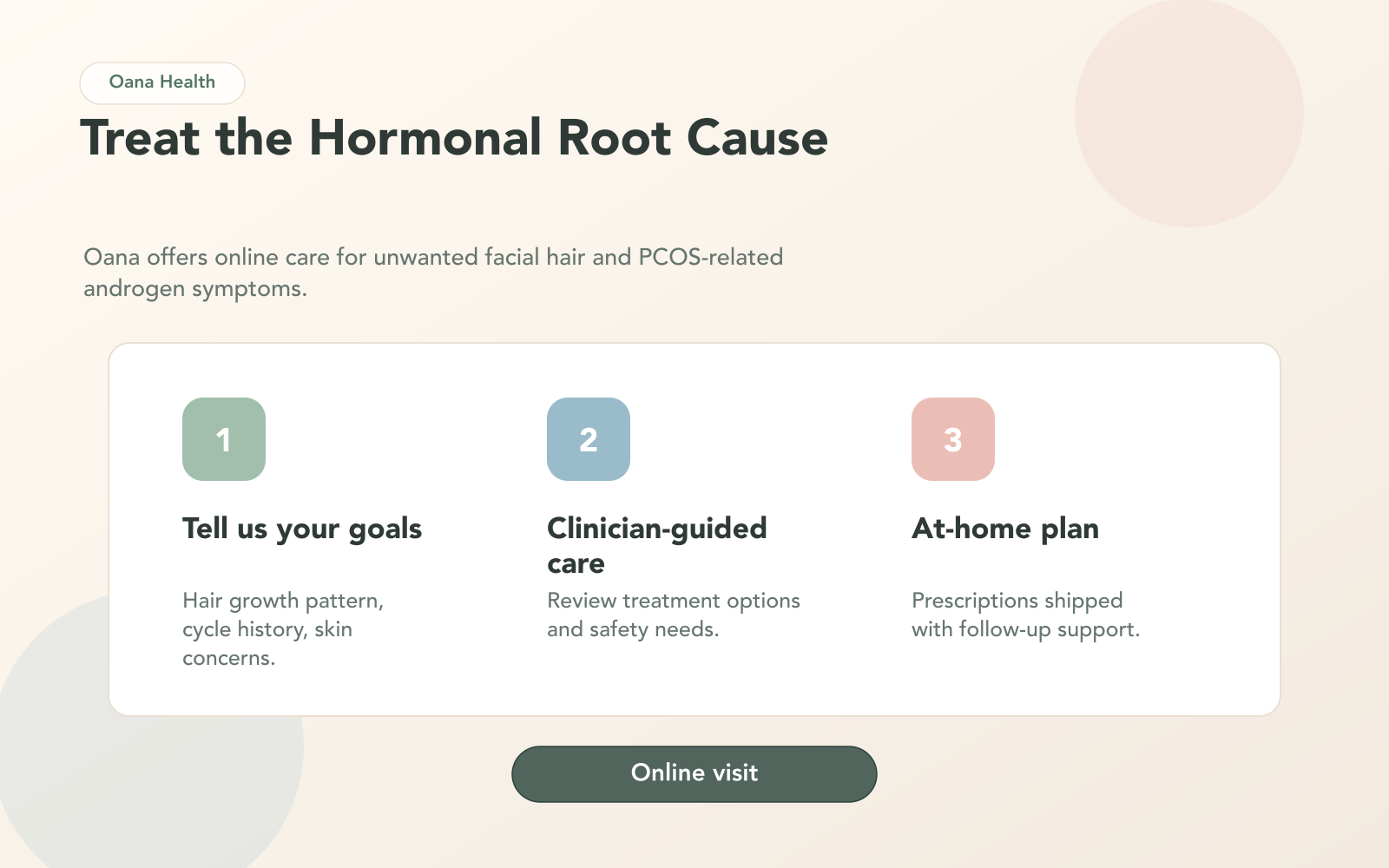
Oana Health offers more than just laser treatments for unwanted hair. By focusing on hormonal imbalances that often drive excess hair growth, they provide prescription therapies as a long-term, manageable alternative. While laser treatments come with higher upfront costs, prescription options offer a steady monthly expense, making them a practical choice for many.
Prescription Options for Unwanted Hair
For individuals dealing with hormonal conditions like PCOS or hirsutism, prescription treatments can be highly effective. Oana Health provides telehealth access to medications designed to address these underlying causes. One option is Spironolactone, an anti-androgen that blocks male hormones' effects on hair follicles. It’s available for just $14/month.
For a topical solution, Eflornithine 12% is offered at $69/month. This cream works by inhibiting an enzyme involved in hair growth. Another option, Hairless Hype, combines Eflornithine, Metformin, and Azelaic Acid in a compounded cream, also priced at $69/month. This formulation not only reduces hair growth but also addresses insulin resistance and its connection to PCOS. Clinical studies reveal that 81% of women see significant improvements within a year, with some noticing visible results in as little as 8 weeks.
"It's been a little over 5 weeks, and I've noticed a dramatic reduction in my facial hair growth. This has been such a relief for me."
– Allison L., Oana Health Patient
How Oana Health Addresses Hormonal Causes
Oana Health takes a comprehensive approach by tackling the hormonal imbalances behind unwanted hair growth. Unlike laser treatments, which focus solely on destroying hair follicles, their prescription options aim to resolve the root causes. Between 70% and 80% of individuals with PCOS experience hirsutism, and hormonal medications benefit 60% to 100% of women. However, achieving full results often takes six months or more of consistent use.
Medications like Spironolactone reduce testosterone levels, while Metformin - available in oral and topical forms starting at $22/month - improves insulin sensitivity. This helps lower the excess androgens produced by the ovaries, addressing a key factor in hormonal hair growth.
Benefits of Telehealth Services
Oana Health's telehealth platform makes these treatments accessible and convenient. Similar to at-home care, their services allow you to skip the hassle of in-person visits. A quick 5-minute online consultation, followed by a provider review within 1–2 business days, ensures that approved treatments are shipped directly to your door with free delivery. All prescriptions are filled by FDA-regulated pharmacies and overseen by licensed medical professionals who can adjust your treatment plan as needed.
"Oana's telehealth service is fantastic! It's helped manage my insulin levels and reduce excess hair growth I was experiencing due to PCOS."
– Victoria A., Oana Health Patient
For best results with topical treatments, apply the cream every evening after showering to maximize absorption. Oana Health also offers automatic refills and 24/7 support, ensuring your treatment plan stays on track.
Conclusion: Choosing the Right Option
When it comes to deciding between clinic treatments and at-home devices, the choice ultimately hinges on your budget, skin type, and hair removal goals. Professional treatments typically range from $1,000 to $5,000 per course and can deliver up to 88% hair reduction, while at-home devices involve a one-time cost of about $400–$500, achieving around 50% reduction.
For those with darker skin tones (Fitzpatrick types IV–VI), professional clinics are generally the safer route. On the other hand, at-home devices are better suited for individuals with light skin and dark hair but may pose higher risks for darker complexions.
"It depends on the person, but professional hair removal usually gives you a bigger bang for your buck." – Rachel Ward, MD, Dermatologist
If hormonal imbalances like PCOS are contributing to hair growth, prescription treatments from Oana Health may be worth considering. Options include Spironolactone at $14/month and Eflornithine 12% at $69/month, both targeting the underlying cause of excess hair growth.
Here’s a quick breakdown of what might work best for you:
- Clinic treatments: Ideal for long-lasting results, darker skin tones, or treating larger areas.
- At-home devices: Suitable for light skin, dark hair, smaller areas, and tighter budgets.
- Prescription treatments: Consider these if hormonal issues are a factor.
This comprehensive analysis highlights the importance of balancing cost, effectiveness, and safety to find the option that aligns with your individual needs and long-term goals.
FAQs
Which option is cheaper long-term: clinic laser or an at-home device?
When it comes to laser hair removal, professional clinic treatments often prove more economical in the long run compared to at-home devices. Clinics typically charge between $1,000 and $5,000 for a series of sessions. While the upfront cost is higher, these treatments usually deliver permanent results, eliminating the need for ongoing maintenance.
On the other hand, at-home devices range from $200 to $900. While they are more affordable initially, they require frequent use to maintain results, as their effects are not as lasting. Over time, the repeated effort and potential need for replacement devices can add up.
In short, while clinic treatments involve a bigger initial investment, their long-lasting results often make them the more cost-effective choice over time.
How can I tell if my skin tone and hair color are suitable for at-home IPL?
At-home IPL devices are generally most effective for individuals with lighter skin tones and darker hair. They tend to be less effective on tanned skin or hair that has been lightened by the sun. To ensure the best results, always review the device's guidelines to confirm it suits your specific skin tone and hair color.
If hormones (like PCOS) cause my hair growth, will laser results last?
Yes, laser hair removal can help reduce hair growth linked to hormonal conditions like PCOS. Research indicates it can lead to a 70–90% reduction in hair growth over time, particularly when paired with hormonal treatments. While individual results may differ, combining regular laser sessions with managing hormonal imbalances can enhance long-term effectiveness.