
Long-Term Side Effects of Spironolactone for Hair Loss
Spironolactone is commonly prescribed off-label for women experiencing hair loss caused by hormonal imbalances, such as elevated testosterone or DHT levels. While effective, its long-term use can lead to side effects like menstrual irregularities, breast tenderness, and fatigue. Regular monitoring of potassium levels and kidney function is essential to minimize risks. Women using this medication often see reduced shedding within 3–6 months, with visible regrowth taking up to a year. However, stopping treatment can reverse these benefits, so consistency is key.
Key points:
- Primary use: Blocks androgens to treat hair loss in women, especially with PCOS.
- Common side effects: Frequent urination, dizziness, breast tenderness, and menstrual changes.
- Risks: Elevated potassium and kidney issues, particularly in higher-risk individuals.
- Improvement timeline: Hair shedding slows in 3–6 months; regrowth visible after 6–12 months.
- Precautions: Not safe during pregnancy; requires contraception and regular lab tests.
Spironolactone can be combined with other treatments like minoxidil for better results. Gradual tapering is recommended when discontinuing to avoid abrupt hair loss.
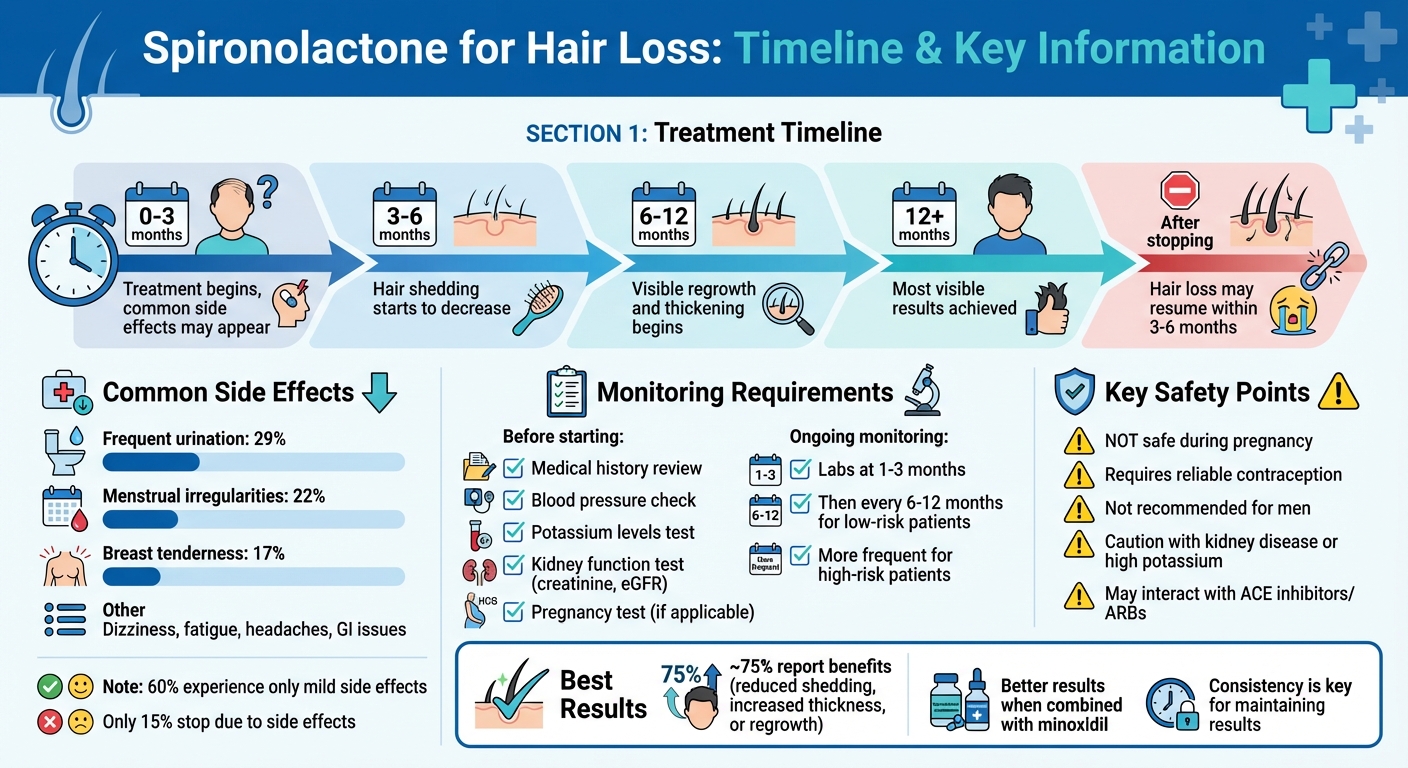
Spironolactone Hair Loss Treatment Timeline and Side Effects
Spironolactone for hair loss| Dr Dray
Long-Term Safety and Common Side Effects
When considering spironolactone for female hair loss, understanding its long-term safety is essential. Research in dermatology suggests that spironolactone is generally well tolerated. An eight-year observational study involving 91 women who used the medication for an average of 28.5 months found that about 60% experienced only mild side effects, such as lightheadedness or stomach upset. Importantly, no serious adverse events were reported, and only 15% of participants stopped using the medication due to side effects. Similarly, large reviews of women treated for female pattern hair loss highlight a favorable balance between benefits and risks when spironolactone is prescribed under medical supervision with proper monitoring. These findings provide a foundation for understanding the long-term effects, including hormonal and chronic impacts.
Common Chronic Side Effects
Women using spironolactone for hair loss most often report side effects like frequent urination (29%), menstrual irregularities (22%), and breast tenderness (17%). Other side effects may include fatigue, postural dizziness, headaches, and gastrointestinal issues such as nausea, stomach cramps, or diarrhea. These symptoms typically occur within the first few months of treatment and can often be managed by adjusting the dose or through simple strategies like taking the medication in the morning, staying hydrated, or standing up slowly. For more information on how spironolactone affects menstrual cycles, see the section below on hormonal mechanisms.
Electrolyte and Kidney Function Risks
As a potassium-sparing diuretic, spironolactone carries a low risk of hyperkalemia (elevated potassium levels) and kidney-related issues in healthy younger women without pre-existing kidney disease or heart failure. Dermatology studies show that serious potassium increases and kidney injuries are rare in this low-risk group when standard doses are used and baseline lab results are normal. However, guidelines recommend checking kidney function and potassium levels before starting treatment and periodically during use, especially for women over 45–50 years old, those on ACE inhibitors or ARBs, or anyone with potential kidney issues. For women at lower risk, healthcare providers often test these levels at the start of treatment, again after three months, and then every 6–12 months if results remain stable.
Hormonal and Reproductive Effects
Spironolactone's hormonal effects can influence reproductive health. Its anti-androgen and progestogenic properties may cause menstrual changes, such as irregular cycles, breakthrough bleeding, or missed periods, particularly at higher doses (e.g., 100 mg per day or more). Some women also report breast tenderness or enlargement, and less frequently, changes in libido. These side effects are generally dose-dependent and reversible, with symptoms often resolving within a few months after reducing the dose or stopping the medication.
Spironolactone is not safe for use during pregnancy due to the risk of feminization in male fetuses. Women of childbearing potential should use reliable contraception while on this medication and discontinue it immediately if they become pregnant or plan to conceive. After stopping spironolactone, its effects on reproduction do not linger, and fertility typically returns to normal.
Hair-Specific Effects of Long-Term Use
Scalp Hair and Body Hair Changes
For women using spironolactone to address hair loss, noticeable improvements often begin within the first 3–6 months. During this time, shedding tends to decrease. Between 6–12 months, many experience thickening and early signs of regrowth. The most visible results, however, typically take over a year to develop as the medication works to slow androgen-driven miniaturization of hair follicles. This allows the scalp hair to transition into longer growth cycles. Studies suggest that pairing spironolactone with other treatments, such as minoxidil, can amplify these effects, leading to even better outcomes.
Beyond its impact on scalp hair, spironolactone also helps reduce unwanted body and facial hair (hirsutism). By blocking androgen activity in hair follicles, it can diminish growth in areas such as the chin, upper lip, chest, and abdomen. Interestingly, improvements in facial hair often appear sooner than changes in scalp hair, making spironolactone particularly beneficial for women dealing with both hair thinning and excess body or facial hair. This dual benefit is especially useful for those with conditions like PCOS. Telehealth platforms like Oana Health provide tailored, prescription-based solutions for these interconnected hormonal issues.
These outcomes naturally raise questions about what happens when treatment stops.
What Happens When You Stop Taking Spironolactone
Once spironolactone is discontinued, its anti-androgen effects begin to fade, and androgen-driven hair loss typically resumes. Because hair growth cycles progress slowly, these changes often unfold over several months rather than immediately. However, women with more aggressive androgenetic hair loss patterns may notice increased shedding within 3–6 months of stopping. Similarly, unwanted facial and body hair may return - or even worsen - after discontinuation.
To minimize abrupt changes, many dermatologists in the U.S. recommend gradually tapering off spironolactone instead of stopping it suddenly. This approach allows the hair cycle to adapt more gradually to the resurgence of androgen activity, potentially reducing the risk of rebound shedding. A typical tapering strategy might involve reducing the dosage from 100–200 mg per day to 50 mg, then to 25 mg, before stopping completely. When spironolactone is part of a broader treatment plan, such as a combination with minoxidil, adjustments to other therapies during tapering can help manage the transition and reduce hair loss.
Combination Therapies and Topical Spironolactone
Combining oral spironolactone with minoxidil has been shown to improve outcomes for androgen-driven hair loss. Research indicates that approximately three-fourths of participants in various studies reported benefits such as reduced shedding, increased thickness, or visible regrowth when using spironolactone. These results were even more pronounced when spironolactone was paired with minoxidil, whether in oral or topical form. Common regimens in the U.S. often involve oral spironolactone alongside once- or twice-daily topical minoxidil. For patients who have reached a plateau with single-drug therapies, low-dose oral minoxidil combined with spironolactone may offer a more effective solution. Personalized telehealth services like Oana Health provide these combination treatments, offering both oral minoxidil and spironolactone with remote consultations and home delivery.
For those seeking alternatives to oral treatments, topical spironolactone offers a promising option. By delivering the medication directly to the scalp, topical formulations reduce the amount of the drug that enters the bloodstream, minimizing systemic side effects. A review of seven studies supports the potential of topical spironolactone to slow androgen-related hair loss with fewer hormonal or electrolyte concerns. However, long-term data on its use remain limited, and formulations can vary significantly. While experts see topical spironolactone as a valuable option for patients who cannot tolerate oral therapy, it is often used in combination with minoxidil or other customized topical treatments prepared by specialty pharmacies. For women interested in this approach, topical spironolactone is available through specialized telehealth platforms, offering a targeted way to manage hair loss while limiting systemic exposure.
sbb-itb-6dba428
Patient Safety, Monitoring, and Risk Management
Who Is a Good Candidate for Long-Term Use?
Long-term spironolactone works best for premenopausal women with androgen-driven hair loss who meet specific health criteria. Ideal candidates include those with normal kidney function, normal baseline potassium levels, no major cardiovascular issues, and who are under 45–50 years old. Additionally, they should not be pregnant, planning pregnancy, or unwilling to use reliable contraception, as spironolactone can lead to feminization of a male fetus and is strictly avoided during pregnancy. Women with conditions like PCOS, female pattern hair loss, acne, or excessive facial hair often see the greatest benefits.
This treatment is not typically recommended for men due to side effects like breast enlargement and reduced libido. It’s also unsuitable for individuals with chronic kidney disease, uncontrolled blood pressure, heart failure treated with ACE inhibitors or ARBs, or a history of high potassium levels. For those on medications that increase potassium - like ACE inhibitors, ARBs, or high-dose NSAIDs - careful evaluation is necessary before starting spironolactone.
Recommended Monitoring Practices
Once a suitable candidate is identified, consistent monitoring is essential to ensure safety. Before initiating spironolactone, a thorough evaluation should include medical history, current medications, blood pressure, serum potassium, creatinine, eGFR, and, where applicable, a pregnancy test.
For low-risk, healthy young women on moderate doses (≤100–150 mg/day) with stable lab results, follow-up labs are typically needed every 6–12 months after initial checks at one to three months. However, higher-risk individuals - such as older patients, those on higher doses, or those taking interacting medications - may require lab work every three to six months. Patients should monitor symptoms like dizziness, muscle weakness, heart palpitations, reduced urination, menstrual changes, or breast tenderness and report any concerning changes promptly.
Telehealth services, such as Oana Health, can simplify monitoring by offering remote lab services, symptom tracking questionnaires, and follow-up consultations with licensed clinicians.
Managing Side Effects and Adjusting Treatment
When side effects occur, adjusting the dosage can often help. Many women start with 25–50 mg/day and gradually increase to 100–200 mg/day based on their response and tolerance. Taking spironolactone with food or earlier in the day can alleviate nausea and reduce nighttime urination.
For menstrual irregularities, such as spotting or heavier bleeding, strategies include lowering the dose, splitting it into two smaller doses, or adding a combined oral contraceptive to stabilize cycles and enhance androgen suppression. Breast tenderness or enlargement is linked to dosage and may improve with a slight reduction, although persistent symptoms should be evaluated by a healthcare provider.
If lab results show abnormal potassium or creatinine levels, the first step is to confirm the findings with repeat testing. Then, review other medications and dietary potassium intake. Depending on the situation, the dose may need to be reduced or spironolactone temporarily discontinued. Once lab values stabilize, treatment can often resume at a lower dose. For patients who struggle with oral spironolactone, switching to topical spironolactone or combining it with other treatments like minoxidil can help maintain hair benefits while minimizing systemic side effects. These adjustments ensure the treatment remains effective while prioritizing patient safety.
Conclusion
Spironolactone offers a promising long-term solution for women managing hormone-related hair loss. Research highlights its safety profile, with side effects that are generally manageable. Studies show notable improvements in hair density and quality, with most women seeing the best results after 6–12 months of consistent use.
Effective treatment relies on regular medical oversight. Routine blood tests help monitor potassium levels and kidney function, while adjusting dosages or combining spironolactone with other treatments, like minoxidil, can enhance outcomes. Women who stick with the treatment for at least a year under medical supervision often see the most noticeable improvements in hair growth.
Consistency is key for maintaining results. Discontinuing treatment can gradually reverse progress, much like other hair loss therapies. This highlights the importance of a long-term commitment to achieve and sustain desired outcomes. For women with androgenic alopecia who haven’t found success with other options, spironolactone serves as an accessible, non-invasive alternative when used responsibly and under proper medical care.
If you’re considering this treatment, Oana Health offers remote consultations with licensed clinicians. They can assess your eligibility, prescribe the medication, and provide ongoing support - all with the convenience of medication delivered directly to your doorstep.
FAQs
What should I do if I notice side effects from spironolactone while treating hair loss?
If you notice any side effects while using spironolactone for hair loss, it’s important to contact your healthcare provider right away. They can evaluate your symptoms and decide if any changes to your treatment are necessary.
Don’t stop or alter your medication without consulting your doctor first. Doing so could interfere with your treatment plan. Always rely on the advice of a licensed medical professional to stay safe and achieve the best outcomes.
How can I stop taking spironolactone without losing the hair regrowth results?
If you're thinking about discontinuing spironolactone, it's crucial to work with a healthcare provider to do so safely. They might suggest tapering off the medication gradually to reduce the risk of side effects and to help preserve the progress you've made with hair regrowth.
During this transition, you could consider other options like topical treatments or different hormonal therapies to support your hair health. Staying on top of your progress with regular check-ins can go a long way in maintaining the results you've achieved.
Can I take spironolactone if I’m pregnant or trying to get pregnant?
Spironolactone is not recommended during pregnancy or when trying to conceive. This medication carries the risk of harming the fetus and falls under the pregnancy category C classification. If you are pregnant, planning to become pregnant, or think you might be, it’s essential to speak with your healthcare provider right away for advice specific to your needs.