
Metformin and Vitamin D: Synergies for PCOS
Metformin and Vitamin D together can help manage PCOS more effectively than using metformin alone. If you're dealing with PCOS, this combination targets key issues like insulin resistance, hormonal imbalances, and inflammation, which are common in this condition. Here's what you need to know:
- Metformin improves insulin sensitivity, lowers androgen levels, and helps with weight management. However, it often causes side effects like nausea or diarrhea.
- Vitamin D supports hormonal balance, reduces inflammation, and improves insulin function. It also helps with symptoms like acne and irregular periods, especially in women with a Vitamin D deficiency.
- Studies show that combining these treatments improves menstrual regularity by over 2x, reduces insulin resistance, and lowers testosterone levels more effectively than metformin alone.
For best results, typical doses include 1,000–2,550 mg/day of metformin and 2,000–4,000 IU/day of Vitamin D. Always monitor Vitamin D and B12 levels during treatment to avoid deficiencies or side effects like hypercalcemia. This dual approach can address both metabolic and reproductive symptoms of PCOS, offering a more comprehensive way to manage the condition.
Vitamin D: The ticket to PCOS relief?
PCOS Symptoms Addressed by Metformin and Vitamin D
Women with PCOS often experience a range of symptoms tied to insulin resistance and hormonal imbalances. Studies show that between 40% and 50% of women with PCOS struggle with impaired glucose control and elevated insulin levels, with about 10% eventually developing Type 2 Diabetes. Metformin and vitamin D both tackle these metabolic and hormonal challenges, though they work in distinct ways.
Metformin for Insulin Resistance
Metformin is widely recognized as the go-to medication for women with PCOS dealing with insulin resistance. Its primary role is to enhance insulin sensitivity, which helps reduce the excessive insulin production (hyperinsulinemia) that occurs when the body’s cells fail to respond properly to insulin. By lowering insulin levels, metformin also decreases androgen levels and BMI.
"Metformin has been the first-line treatment for patients with PCOS who have insulin resistance, but associated side effects such as abdominal pain, diarrhea, or headache are common." - Shan Guo, Department of Reproductive Medicine, Beijing Obstetrics and Gynecology Hospital
Interestingly, metformin’s benefits may extend beyond metabolic health. Emerging evidence suggests it could directly influence the endometrium, potentially improving reproductive health in women with PCOS. While metformin focuses on metabolic improvements, vitamin D offers a different set of benefits, particularly for hormonal balance.
Vitamin D for Hormonal Balance and Inflammation
Vitamin D plays a key role in hormonal regulation. Its receptors, found in reproductive tissues, allow it to directly impact ovarian function and hormone production. Supplementing with vitamin D has been shown to improve the LH/FSH ratio and lower circulating androgens, addressing symptoms like acne and unwanted facial hair.
Additionally, vitamin D increases SHBG (sex hormone-binding globulin) levels, which helps reduce the amount of active testosterone in the body. A 2024 meta-analysis highlighted significant improvements with vitamin D supplementation, showing reductions in testosterone (standardized mean difference of 0.707), LH (0.614), and increases in SHBG (0.330). Beyond its hormonal effects, vitamin D also helps regulate inflammation by influencing genes tied to insulin signaling and reducing inflammatory markers.
"Vitamin D improves glucose metabolism by increasing insulin production, insulin receptor expression and reducing pro-inflammatory cytokines." - Journal of Ovarian Research
How Metformin and Vitamin D Work Together
When used together, metformin and vitamin D offer a multi-faceted approach to addressing PCOS. Each targets different biological pathways, and their combined effects work to reinforce one another.
Combined Effects on Insulin Sensitivity
Metformin and vitamin D improve insulin sensitivity through distinct mechanisms that complement each other. Metformin boosts insulin sensitivity by enhancing insulin receptor activity, which activates key signaling pathways. It also increases glucose uptake in skeletal muscle by moving insulin-sensitive glucose transporters (GLUT) to the cell membrane. At the same time, it suppresses the liver's production of glucose by amplifying insulin's effects and counteracting glucagon.
Vitamin D, on the other hand, supports pancreatic β-cell function by regulating calcium levels, which helps the pancreas produce insulin more efficiently. It also influences genes involved in insulin signaling, directly improving how cells respond to insulin. A meta-analysis of nine studies showed that combining these two treatments significantly reduced HOMA-IR (a measure of insulin resistance), with a standardized mean difference of -0.23. Furthermore, vitamin D supplementation in PCOS patients led to decreases in fasting blood glucose (mean difference: -2.91 mg/dL) and insulin levels (mean difference: -1.98 µIU/mL).
"Vitamin D has anti-inflammatory effects, which may alleviate the negative impact of chronic inflammation on insulin function, an effect particularly beneficial in reducing insulin resistance." - BMC Endocrine Disorders
These improvements in metabolic function also help tackle chronic inflammation, a common issue in PCOS.
Reduced Inflammation
In addition to improving insulin sensitivity, metformin and vitamin D work together to reduce chronic inflammation - a major contributor to PCOS. Chronic low-grade inflammation is a hallmark of the condition. Metformin helps by suppressing proinflammatory responses, while vitamin D regulates the immune system to decrease persistent inflammation. Research has shown that vitamin D supplementation can lower serum levels of high-sensitivity C-reactive protein (hs-CRP), a key marker of systemic inflammation, with a standardized mean difference of -0.28.
Research Findings on Metformin and Vitamin D for PCOS
Research on Vitamin D and PCOS
Research shows that supplementing with vitamin D can help lower fasting plasma glucose (SMD: –0.34) and fasting insulin (SMD: –0.43) levels in PCOS patients who are vitamin D deficient. These improvements are most noticeable when baseline vitamin D levels are below 20 ng/ml.
"Vitamin D plays an important role in bone homeostasis and may increase insulin receptor expression by increasing insulin production and glucose metabolism, thereby reducing insulin resistance." – Middle East Fertility Society Journal
A 2017 randomized, double-blind, placebo-controlled trial led by F. Foroozanfard studied 90 insulin-resistant women with PCOS, aged 18–40. Participants received either 4,000 IU/day of vitamin D, 1,000 IU/day, or a placebo for 12 weeks. The group taking the higher dose saw reductions in serum insulin (–2.7 ± 2.7 µIU/ml) and HOMA-IR (–0.6 ± 0.6) compared to the placebo group (–0.1 ± 4.1 µIU/ml and –0.1 ± 0.9, respectively). Additionally, the high-dose group experienced a drop in triglycerides by 10.3 mg/dl and LDL cholesterol by 10.8 mg/dl, while the low-dose and placebo groups showed little to no change.
Vitamin D supplementation has also been linked to lower Free Androgen Index levels and higher Sex Hormone–Binding Globulin levels. Interestingly, some studies suggest that an 8-week intervention may lead to greater hormonal improvements than a 12-week regimen.
These results highlight the added benefits of combining vitamin D with metformin for managing PCOS.
Studies on Combined Treatment Results
Expanding on the individual benefits of vitamin D, researchers have explored its combined effects with metformin. A 2024 meta-analysis of nine trials found that this combination reduced insulin resistance (HOMA-IR, SMD: –0.23), body mass index (BMI, SMD: –1.86), and testosterone levels (SMD: –0.11).
"Our meta-analysis of nine trials demonstrates significant reductions in insulin resistance, BMI, and testosterone levels, along with increased serum vitamin D levels and improved menstrual cycle regulation after Metformin and vitamin D treatment." – Li Xiang, Researcher
The combined treatment also improved menstrual cycle regularity, increasing the likelihood by 2.11 times, and this effect was even stronger among infertile patients, where the odds rose to 2.37. The benefits were particularly notable in obese or insulin-resistant PCOS patients, with reductions in insulin levels and HOMA-IR observed in obese individuals. However, non-obese participants showed less significant changes.
sbb-itb-6dba428
Treatment Outcomes: Combined Therapy vs. Metformin Alone
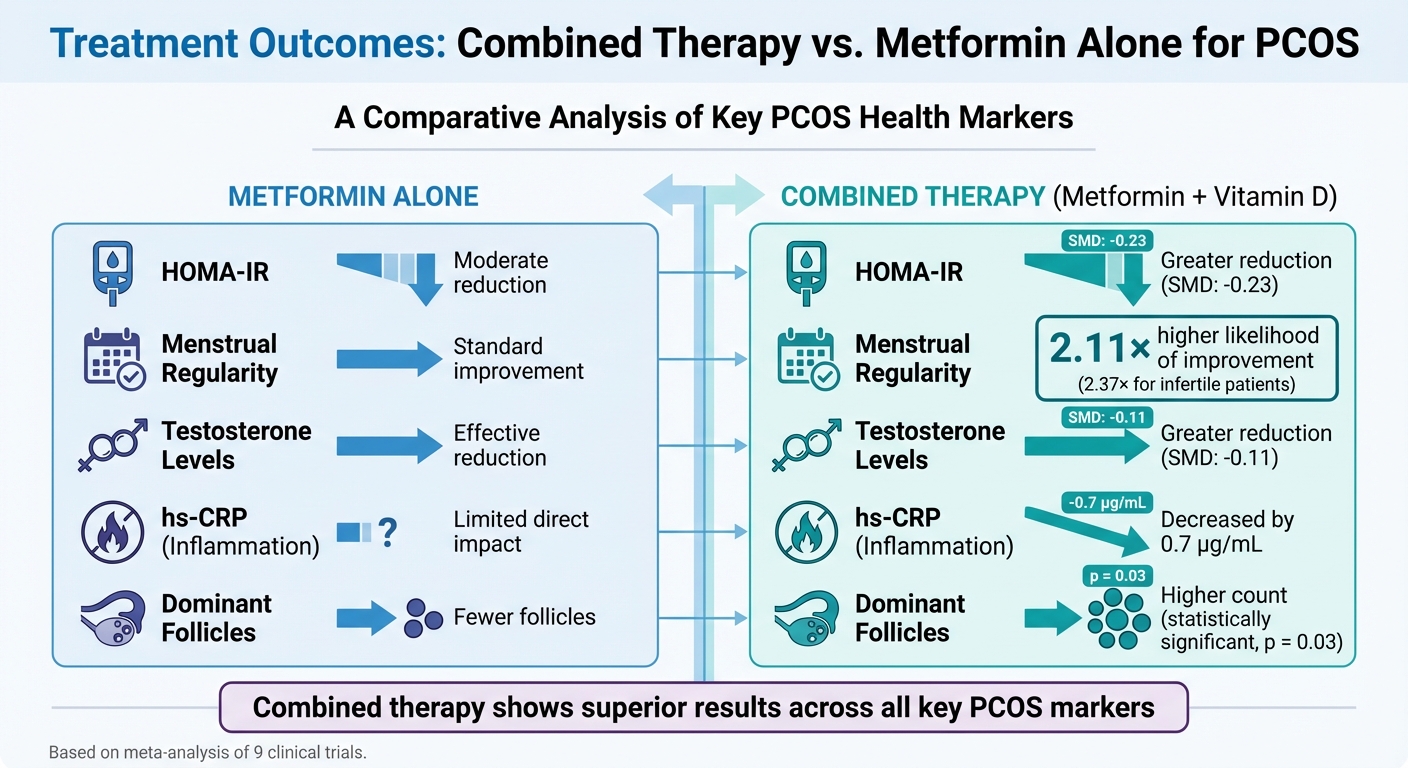
Metformin vs Combined Metformin and Vitamin D Treatment Outcomes for PCOS
When comparing combined therapy to metformin alone, the benefits become clear across various health markers. A meta-analysis of nine studies revealed that patients treated with both metformin and vitamin D had significantly lower HOMA-IR scores (SMD: -0.23) compared to those using only metformin. This improvement in insulin resistance sets the stage for better outcomes in other areas, including reproductive health.
One standout advantage of combined therapy is its effect on menstrual regularity. Women undergoing this dual treatment were 2.11 times more likely to experience improved menstrual cycles compared to those on metformin alone. For women struggling with infertility, the odds of improvement increased further, reaching an odds ratio of 2.37.
The addition of vitamin D also enhances hormonal regulation. While metformin alone effectively reduces testosterone, the combined approach achieves even greater reductions (SMD: -0.11). This dual action targets both the metabolic and hormonal imbalances commonly associated with PCOS.
Inflammation is another area where combined therapy shines. Vitamin D supplementation (50,000 IU biweekly) reduced hs-CRP levels by 0.7 μg/mL, while placebo groups saw an increase of 0.5 μg/mL. Since metformin primarily improves insulin sensitivity and has limited direct effects on inflammation, the inclusion of vitamin D fills this gap.
The combined approach also supports follicular development and ovulation. Clinical trials demonstrated that women receiving both treatments developed significantly more mature follicles (≥ 14 mm) within 2–3 months compared to those on either treatment alone (p = 0.03).
The table below provides a side-by-side comparison of key health markers:
| Health Marker | Metformin Alone | Combined Therapy (Metformin + Vitamin D) |
|---|---|---|
| HOMA-IR | Moderate reduction | Greater reduction (SMD: -0.23) |
| Menstrual Regularity | Standard improvement | 2.11× higher likelihood |
| Testosterone Levels | Effective reduction | Greater reduction (SMD: -0.11) |
| hs-CRP | Limited direct impact | Decreased by 0.7 μg/mL |
| Dominant Follicles | Fewer follicles | Higher count (p = 0.03) |
This evidence underscores the advantages of combining metformin with vitamin D, addressing PCOS from multiple angles, including metabolism, hormone levels, inflammation, and reproductive health.
Dosages and Safety Guidelines
Finding the right dosage and keeping an eye on side effects are key when combining metformin and vitamin D for managing PCOS. Here’s what you need to know to ensure safe and effective treatment.
Recommended Dosages for Combined Treatment
For metformin, clinical trials on PCOS often start with doses of 1,000 mg per day. A common approach is 500 mg twice daily or 850 mg once daily, with a maximum dose of 2,550 mg per day. Starting with lower doses can help minimize gastrointestinal side effects.
When it comes to vitamin D, effective doses usually fall between 2,000 and 4,000 IU daily, with benefits leveling off between 3,000 and 5,000 IU. Higher amounts beyond this range are generally unnecessary. Some studies have explored 50,000 IU weekly or biweekly pulses, but daily dosing has shown better results for improving insulin resistance markers.
Dosage needs can vary based on individual factors. Women with vitamin D deficiency (serum levels below 20 ng/ml) or insufficiency (20–30 ng/ml) often require supplementation, especially if levels are critically low. For those with obesity (BMI ≥ 30 kg/m²) or insulin resistance (HOMA-IR > 3.0), vitamin D supplementation may lead to more noticeable metabolic improvements. Regular monitoring of 25(OH)D levels is essential to adjust dosages as needed during treatment.
Now, let’s look at potential side effects and precautions to keep in mind.
Side Effects and Precautions
While proper dosing can reduce risks, it’s important to be aware of potential side effects. Metformin often causes gastrointestinal issues, such as abdominal pain, diarrhea, nausea, and gas. Taking it with meals can help ease these symptoms. If using extended-release tablets, they should be swallowed whole. Long-term use may lead to vitamin B12 deficiency or anemia, so routine monitoring is advised. A rare but serious side effect is lactic acidosis, which can manifest as sudden fatigue, muscle pain, or difficulty breathing - particularly in individuals with kidney or liver conditions. Additionally, women should note that metformin may trigger ovulation, which could increase the likelihood of pregnancy.
For vitamin D, excessive doses can lead to hypercalcemia (high calcium levels) and kidney stones. Insulin resistance may lower vitamin D bioavailability, meaning higher initial doses might be necessary to reach adequate levels. However, clinical trials have not reported any unique adverse reactions when combining metformin with vitamin D.
Lastly, if undergoing medical imaging with contrast dyes, patients should stop taking metformin at least 48 hours before the test, as these dyes can impact kidney function.
Conclusion
Using a combination of metformin and vitamin D proves to be more effective than metformin alone in managing PCOS symptoms. This approach significantly improves menstrual regularity - boosting the odds by 2.11 overall and 2.37 for infertile women - and leads to notable reductions in insulin resistance, testosterone levels, and BMI.
These results highlight the need for tailored treatment plans. Since PCOS presents differently in every individual, addressing its root causes - like insulin resistance and hormonal imbalances - requires a personalized approach. For instance, vitamin D supplementation is particularly helpful for those with a confirmed deficiency (levels below 20 ng/mL), while metformin is most effective for individuals dealing with insulin resistance. Factors such as your metabolic health, vitamin D levels, and reproductive goals should shape your treatment strategy.
"Vitamin D supplementation had beneficial effects on metabolic parameters in PCOS women, especially in women with obesity or insulin resistance." - Journal of Ovarian Research
Access to expert care is essential for achieving these outcomes. Platforms like Oana Health offer personalized PCOS treatment through telehealth services. Their licensed professionals design care plans that include metformin and vitamin D therapies tailored to your health needs. Options like Oral Metformin ER, starting at $22/month with free shipping, make it convenient to manage your symptoms from home.
To ensure safety and effectiveness, regular monitoring of vitamin D, insulin, and B12 levels is crucial. Collaborating with specialists who understand the complexities of PCOS can help you navigate your treatment options and achieve meaningful symptom relief.
FAQs
How can metformin and vitamin D work together to improve PCOS symptoms?
Metformin and vitamin D can complement each other in tackling the hormonal and metabolic challenges often linked to PCOS. Studies indicate that using these treatments together can help lower insulin resistance, a hallmark of PCOS, while also stabilizing blood sugar levels and promoting better metabolic function.
Vitamin D supplementation, when combined with metformin, has also been found to aid in regulating menstrual cycles, reducing androgen levels, and easing symptoms like acne and excessive hair growth (hirsutism). Research highlights that this pairing promotes improved hormonal balance and offers relief from various PCOS symptoms, presenting a promising option for managing the condition effectively.
What are the typical dosages of metformin and vitamin D for managing PCOS?
Metformin is usually introduced at a lower dose, like 500 mg once a day, and then gradually increased to 500 mg with each meal. The most noticeable benefits typically occur with daily doses ranging from 1,000 mg to 2,000 mg, tailored to individual needs and tolerance levels.
When it comes to vitamin D, supplementation often falls between 1,000 IU daily and 4,000 IU weekly. Research suggests these amounts can help improve PCOS symptoms. That said, it’s crucial to consult with a healthcare provider to find the dosage that’s right for you.
Can taking metformin and vitamin D together cause side effects?
When taken together, metformin and vitamin D are usually considered safe, but it’s worth noting a few potential side effects. Some people might experience mild stomach-related issues, like nausea or diarrhea. On rare occasions, taking too much vitamin D could result in hypercalcemia, which is an elevated calcium level in the blood. That said, these risks are quite low when the combination is monitored by a healthcare professional.
If you're thinking about using this combination to help manage PCOS, make sure to talk to your doctor. They can assess whether it’s the right option for your individual health needs.