
Metformin vs. Pioglitazone: Liver Benefits and Drawbacks
When it comes to improving liver health for women with PCOS and insulin resistance, Metformin and Pioglitazone are two commonly prescribed medications. Both reduce liver fat and improve liver function, but they work differently, with unique pros and cons:
- Metformin lowers glucose production in the liver and helps reduce liver fat. It is weight-neutral or may lead to slight weight loss. Rare risks include lactic acidosis, especially in those with advanced liver disease.
- Pioglitazone reduces liver fat and inflammation more effectively, even without weight loss, but is associated with weight gain and fluid retention. It also improves liver function more quickly.
Key Differences:
- Metformin takes about 4 months to improve liver enzymes, while Pioglitazone shows results in 2 months.
- Pioglitazone increases adiponectin (anti-inflammatory hormone), while Metformin does not.
- Pioglitazone is more effective for reducing liver fat but may cause weight gain.
Quick Comparison:
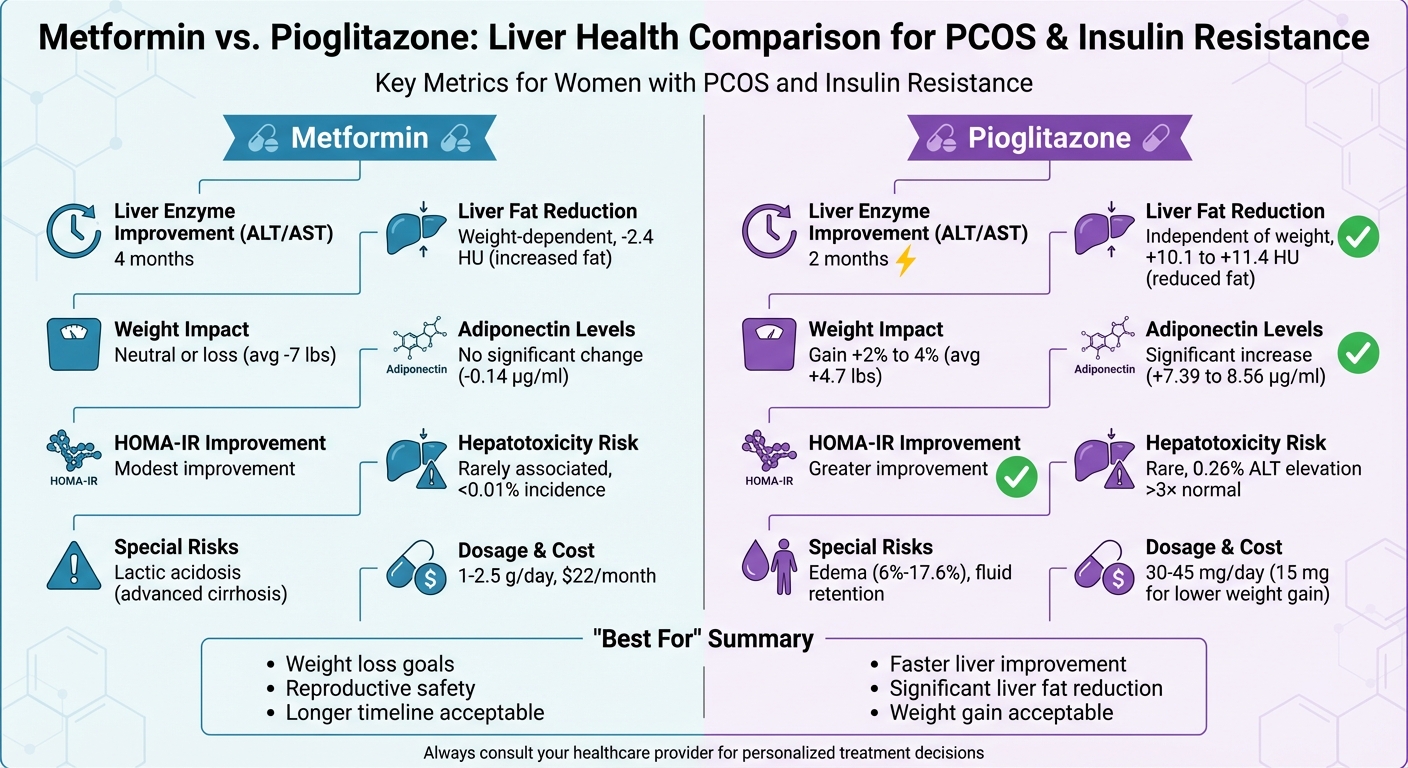
| Metric | Metformin | Pioglitazone |
|---|---|---|
| Liver Enzyme Improvement | 4 months | 2 months |
| Liver Fat Reduction | Weight-dependent | Independent of weight |
| Weight Impact | Neutral or loss | Gain (2%-4%) |
| Adiponectin Levels | No change | Significant increase |
| Rare Liver Risks | Lactic acidosis | Rare liver injury |
Choosing the right medication depends on your health goals, such as weight management or faster liver improvement. Always consult your doctor for personalized advice.
Metformin vs Pioglitazone for Liver Health in PCOS: Complete Comparison
How Metformin Affects Liver Health
Metformin primarily targets the liver to lower glucose production, a process known as hepatic gluconeogenesis. It achieves this by activating AMPK, which reduces fat production and increases fat breakdown. Additionally, it inhibits mitochondrial complex I and SRC-2, further decreasing gluconeogenesis. Metformin also influences gut microbiota, helping to protect the liver by strengthening the intestinal barrier and reducing inflammation. This is especially helpful for women with PCOS, where insulin resistance often leads to fat buildup in the liver.
With over 30 million prescriptions written annually in the United States, metformin is one of the most commonly used medications to manage insulin resistance and fatty liver disease. Its mechanisms of action explain its positive effects on liver health and the clinical outcomes observed in patients.
Liver Benefits of Metformin
Metformin has shown benefits in reducing liver fat and improving liver function tests. For instance, a clinical trial involving NAFLD patients reported significant reductions in liver fat and better ALT/AST levels. Another study found that adding metformin to diet therapy improved impaired fasting glucose in 86% of participants.
"Metformin does not appear to cause or exacerbate liver injury and, indeed, is often beneficial in patients with nonalcoholic fatty liver disease." - PubMed Abstract
In clinical trials, elevations in ALT levels - above three times the normal limit - were observed in only 0.26% of patients on metformin, closely matching the 0.25% rate in placebo groups. This data highlights that metformin not only avoids causing liver damage but can also help improve elevated liver enzymes, particularly in women with fatty liver disease. However, while these benefits are well-documented, there are rare but noteworthy risks associated with its use.
Liver Risks of Metformin
Although metformin is generally considered safe, rare but serious risks do exist. Metformin-induced liver toxicity is extremely uncommon, with an estimated incidence rate of less than 0.01%. A review spanning nearly three decades (January 1994 to February 2022) identified only 30 documented cases, even with widespread use. When liver injury occurs, it typically manifests within one to eight weeks of starting the medication, with a median onset of about four weeks.
The most serious liver-related concern is Metformin-Associated Lactic Acidosis (MALA), a rare but potentially life-threatening condition. This risk is primarily seen in patients with advanced cirrhosis, hepatic encephalopathy, or heavy alcohol use, as these factors increase the likelihood of arterial hypoxemia. For individuals with stable liver function, however, metformin remains a safe treatment option.
"Metformin-induced hepatotoxicity is a rare adverse reaction. Physicians and patients should be alert to metformin-induced hepatotoxicity." - Chunjiang Wang et al.
Routine liver enzyme monitoring specifically for metformin therapy is not typically necessary, as the drug rarely causes or worsens liver injury. That said, if you experience symptoms like jaundice, dark urine, fatigue, or pale stools - especially within the first month of treatment - seek medical attention immediately. In documented cases, liver function generally returns to normal within six weeks after stopping metformin.
How Pioglitazone Affects Liver Health
Pioglitazone, a PPAR-gamma agonist, plays a key role in improving insulin sensitivity across the liver, muscles, and fat tissue. It achieves this by encouraging fatty acid uptake into fat stores and boosting levels of adiponectin - a hormone with anti-inflammatory properties that helps regulate glucose and fatty acid metabolism. These processes collectively help reduce liver fat, even without changes in body weight. Below, we’ll explore how this medication impacts liver health.
Liver Benefits of Pioglitazone
Research has shown that pioglitazone is effective in managing fatty liver disease. For instance, one study found that it increased liver density by 10.1–11.4 HU, while metformin, by contrast, reduced it by 2.4 HU. Additionally, pioglitazone improved liver function test results within just two months, compared to four months for metformin.
"Pioglitazone can be used as a first-line therapy for NAFLD in the absence of FDA-approved pharmacological drugs for the treatment of T2DM patients with NAFLD, especially NASH." - Jingxuan Lian, Xijing Hospital of Air Force Medical University
A meta-analysis further highlighted pioglitazone’s benefits, showing it significantly reduced steatosis, inflammation, and hepatocyte ballooning. The risk ratios for these improvements were 1.78, 2.05, and 1.74, respectively. It also increased the likelihood of resolving NASH (nonalcoholic steatohepatitis) by 1.76 times compared to a placebo. For women worried about weight gain, lower doses of pioglitazone (15 mg/day) have proven effective in reducing liver fat and inflammation while minimizing weight gain - typically around 1% to 2% at low doses versus 2% to 4% at standard doses (30–45 mg).
Despite these positives, it's important to be mindful of the rare but serious risks to liver health that can occur, as outlined in the next section.
Liver Risks of Pioglitazone
Although pioglitazone generally supports liver health, there have been rare reports of acute liver injury, often occurring within one to six months of starting the medication. Documented cases of clinically significant liver damage are exceedingly rare - fewer than a dozen have been reported. In clinical trials, elevated ALT levels (above three times the normal limit) were observed in only 0.26% of patients using pioglitazone, comparable to 0.25% in placebo groups.
One notable case from 2002 involved a patient with type 2 diabetes who developed jaundice and mixed hepatocellular-cholestatic liver injury after six months on pioglitazone (15 to 45 mg daily). The patient’s bilirubin levels peaked at 10.4 mg/dL, and ALT reached 665 U/L. Fortunately, liver function normalized within six weeks of stopping the drug.
More frequently, concerns with pioglitazone revolve around fluid retention and weight gain rather than direct liver damage. Edema has been reported in 6% to 17.6% of patients, compared to 2.1% to 7% in placebo groups. Women should also be aware that pioglitazone can stimulate ovulation, potentially increasing the likelihood of pregnancy.
If you notice symptoms like fatigue, loss of appetite, discomfort in the upper right abdomen, dark urine, or jaundice, it’s important to seek medical attention quickly. Doctors often recommend liver function tests before starting pioglitazone and monitoring liver health during the first six months of treatment to catch any potential issues early.
Metformin vs. Pioglitazone: Side-by-Side Comparison
Understanding how metformin and pioglitazone work can help you have more informed conversations with your healthcare provider. Metformin primarily reduces glucose production in the liver, while pioglitazone functions as a PPAR‑gamma agonist, improving insulin sensitivity and encouraging fatty acid storage in fat tissue. This process helps reduce fat accumulation in the liver.
These medications also differ significantly in how they affect liver fat. A 16-week study conducted at the Pennington Biomedical Research Center showed that pioglitazone increased liver density by 10.1–11.4 HU, signaling a reduction in liver fat. In contrast, metformin decreased liver density by 2.4 HU, even with an average weight loss of 7 lbs. This suggests that pioglitazone reduces liver fat independently of weight changes, whereas metformin's effects are more closely tied to weight loss. This distinction highlights their differing impacts on liver function.
Timing is another important factor. A study conducted between January 2011 and January 2012 at Shahid Beheshti Kashan Hospital, led by Mohsen Razavizade, found that pioglitazone improved liver function tests (ALT, AST, and insulin resistance markers) within two months. Metformin, however, required four months to achieve similar results.
Another key difference lies in their effect on adiponectin, an anti-inflammatory hormone that protects the liver. Pioglitazone significantly increases adiponectin levels - by approximately 7.39 to 8.56 μg/ml - while metformin shows little to no change (around -0.14 μg/ml).
Comparison Table: Liver Health Metrics
| Metric | Metformin (1–2.5 g/day) | Pioglitazone (30–45 mg/day) |
|---|---|---|
| ALT Reduction | Significant after 4 months | Significant after 2 months |
| AST Reduction | Significant after 4 months | Significant after 2 months |
| Liver Fat Content | Variable; weight-dependent | Significant reduction regardless of weight |
| Liver Density Change | –2.4 HU (increased fat) | +10.1 to +11.4 HU (reduced fat) |
| HOMA‑IR Improvement | Modest improvement | Greater improvement than metformin |
| Adiponectin Levels | No significant change | Significant increase |
| Body Weight Impact | Weight loss or neutral | Weight gain (average +4.7 lbs) |
| Hepatotoxicity Risk | Rarely associated | Rare (0.26% ALT elevation >3× normal) |
| Edema Risk | Minimal | Occurs in 6%–17.6% of patients |
This table summarizes the key differences in liver health outcomes, providing a clearer picture for discussing treatment options with your healthcare provider.
sbb-itb-6dba428
What This Means for Women with PCOS and Insulin Resistance
For women dealing with PCOS, the way these medications affect the liver plays a big role in managing hormone levels, fertility, and overall metabolism. Since insulin resistance impacts the majority of women with PCOS, liver health becomes an essential part of the equation.
When liver health improves, it boosts the production of sex hormone-binding globulin (SHBG). This protein binds to free testosterone, helping to lower hyperandrogenism. The result? Relief from symptoms like unwanted hair growth, acne, and hair thinning.
In terms of liver function, one study found that pioglitazone showed improvements in liver function tests within just two months, compared to four months for metformin. This quicker response can make a difference for symptom relief and planning for conception. Additionally, for normal-weight women with PCOS, combining pioglitazone with metformin was more effective than metformin alone in improving SHBG and Anti-Mullerian Hormone (AMH) levels - without leading to weight gain.
Both medications can also help restore ovulation. However, if pregnancy isn’t part of your plan, it’s important to discuss contraception options with your healthcare provider.
Ultimately, the right medication for you will depend on your metabolic profile and treatment goals. Metformin is often weight-neutral and may even result in slight weight loss. On the other hand, pioglitazone offers faster liver enzyme improvements and reduces liver fat more effectively, though it carries a higher chance of weight gain.
For tailored advice on balancing hormones and managing PCOS, consider reaching out to Oana Health. They provide telehealth consultations with licensed professionals who specialize in PCOS and insulin resistance. Up next, learn how personalized treatment can fine-tune your approach to managing PCOS.
Oana Health: Personalized Treatment for Hormonal Health

Say goodbye to endless clinic visits while managing PCOS and insulin resistance. Oana Health offers telehealth services tailored to women's hormonal health, making care convenient and accessible.
Expanding on the earlier discussion about medication effects on liver health, Oana Health brings a personalized approach to treatment. The platform connects you with licensed medical professionals who specialize in conditions like PCOS, insulin resistance, and weight management. After an online consultation, they create a treatment plan designed specifically for you. This often includes Metformin, a key medication for addressing insulin resistance in women with PCOS.
Convenience is at the heart of Oana Health's service. All prescriptions come with free shipping. Pricing is straightforward: Oral Metformin ER starts at $22/month, combination therapies such as Metformin & Spironolactone are $32/month, and advanced treatments like Oral GLP-1 & Metformin are available for $199/month.
The service addresses a wide range of PCOS symptoms, such as insulin resistance, weight challenges, unwanted hair growth, hair thinning, acne, and even mental health concerns. By simplifying access to consistent care, Oana Health makes managing these symptoms less overwhelming.
This personalized telehealth model ties seamlessly into the liver health insights discussed earlier, empowering women to make informed decisions about their treatment. By aligning therapies with your unique metabolic needs, Oana Health helps you stay on track with the informed decision-making approach we've explored in this guide.
Conclusion
Both Metformin and Pioglitazone offer liver-related benefits for women managing PCOS and insulin resistance, though they work differently and come with unique considerations. Metformin helps by reducing hepatic glucose production and improving liver enzyme levels within four months, often accompanied by weight loss. This makes it a popular first choice for those who prioritize weight management. On the other hand, Pioglitazone directly targets liver fat, reducing steatosis and inflammation within two months, even without weight changes. However, it is often associated with weight gain and fluid retention.
The liver-related risks of these medications are minimal. Metformin has a rare risk of idiosyncratic liver injury and is not recommended for individuals with advanced cirrhosis due to the potential for lactic acidosis. Similarly, Pioglitazone has been linked to rare cases of clinically noticeable liver injury. In clinical trials, ALT elevations above three times the upper limit of normal were reported in only 0.26% of patients, nearly matching the 0.25% observed in placebo groups.
Choosing between these options depends on your overall health and treatment priorities. If weight loss and reproductive safety are key goals, Metformin is often the better fit. For those dealing with significant liver fat that hasn't improved with other treatments, Pioglitazone may be more effective.
Regular liver function monitoring is essential regardless of the medication. Platforms like Oana Health provide personalized telehealth consultations with licensed professionals who can evaluate your liver health, metabolic profile, and PCOS symptoms. With proper guidance and consistent monitoring, you can effectively manage insulin resistance while protecting your liver health.
FAQs
What are the differences between Metformin and Pioglitazone when it comes to liver health?
Metformin and pioglitazone influence liver health in distinct ways. Pioglitazone stands out for its ability to enhance liver insulin sensitivity more effectively, which helps lower glucose production and gluconeogenesis. Within just a few months, it can lead to noticeable improvements in liver enzyme levels - such as ALT, AST, and ALP - and significantly reduce liver fat content. Interestingly, these changes occur even without major weight loss.
Metformin, meanwhile, works at a slower pace when it comes to liver health. While it does help combat insulin resistance, its impact on liver enzymes and fat reduction is more subtle and takes a longer time to manifest compared to pioglitazone.
Overall, pioglitazone offers faster and more pronounced benefits for liver health, whereas metformin provides gradual and less dramatic improvements.
What are the liver-related risks of taking Metformin and Pioglitazone?
Both Metformin and Pioglitazone are generally considered safe for the liver, but there are specific risks to keep in mind, especially for women managing hormonal health.
Metformin is rarely linked to direct liver damage. However, in people with existing liver or kidney problems, it can increase the risk of lactic acidosis - a rare but serious condition where lactate builds up in the bloodstream. Because of this, healthcare providers carefully monitor liver function and usually avoid prescribing Metformin for individuals with severe liver disease.
Pioglitazone, known for improving insulin sensitivity, can occasionally cause elevated liver enzymes or, in rare cases, drug-induced liver injury. Additionally, it may lead to weight gain, which could worsen conditions like non-alcoholic fatty liver disease. To minimize risks, liver function tests are typically done before starting Pioglitazone and repeated during treatment. It’s not recommended for patients with active liver disease.
If you're concerned about how these medications might affect your liver, it's important to discuss your options with a healthcare provider to find the safest and most effective treatment for your needs.
Which medication is better for women with PCOS and liver health concerns?
For women managing PCOS alongside liver health concerns, pioglitazone might provide notable benefits for the liver. Studies suggest that pioglitazone can help reduce liver fat and improve liver density, even in the absence of weight loss. On the other hand, metformin tends to have a milder impact on liver fat but is often linked to weight loss or maintaining a stable weight.
However, pioglitazone does come with a potential downside: weight gain. For women who can manage this side effect and prioritize liver health, pioglitazone could be a preferred option. But for those focusing on weight control, metformin might align better with their goals. Discussing these options with a healthcare provider is essential to find the best fit for your individual needs.