
Minoxidil and Menopause: Hair Regrowth Challenges
Menopause can make hair loss worse, and treatments like Minoxidil don’t always work as well during this time. Hormonal changes, such as lower estrogen levels and relatively higher androgens, affect hair follicles, causing thinning and slower regrowth. Minoxidil, an FDA-approved treatment, can still help, but menopause often requires additional strategies for better results. Here’s what you need to know:
- Why Minoxidil may not work as well: Hormonal shifts reduce blood flow and metabolism in hair follicles, slowing results. Aging follicles also respond less effectively.
- Common challenges: Temporary shedding, slower regrowth, and limited improvement in older follicles.
- Solutions to improve outcomes:
- Oral Minoxidil: A low-dose alternative to topical treatments, offering more consistent results.
- Hormone Replacement Therapy (HRT): Combines estrogen and progesterone to address underlying hormonal imbalances.
- Topical Spironolactone: Blocks androgens locally to prevent further follicle miniaturization.
Starting treatment early and combining therapies can improve hair density and reduce shedding. Personalized plans, like those offered by telehealth platforms, can help address menopausal hair loss effectively.
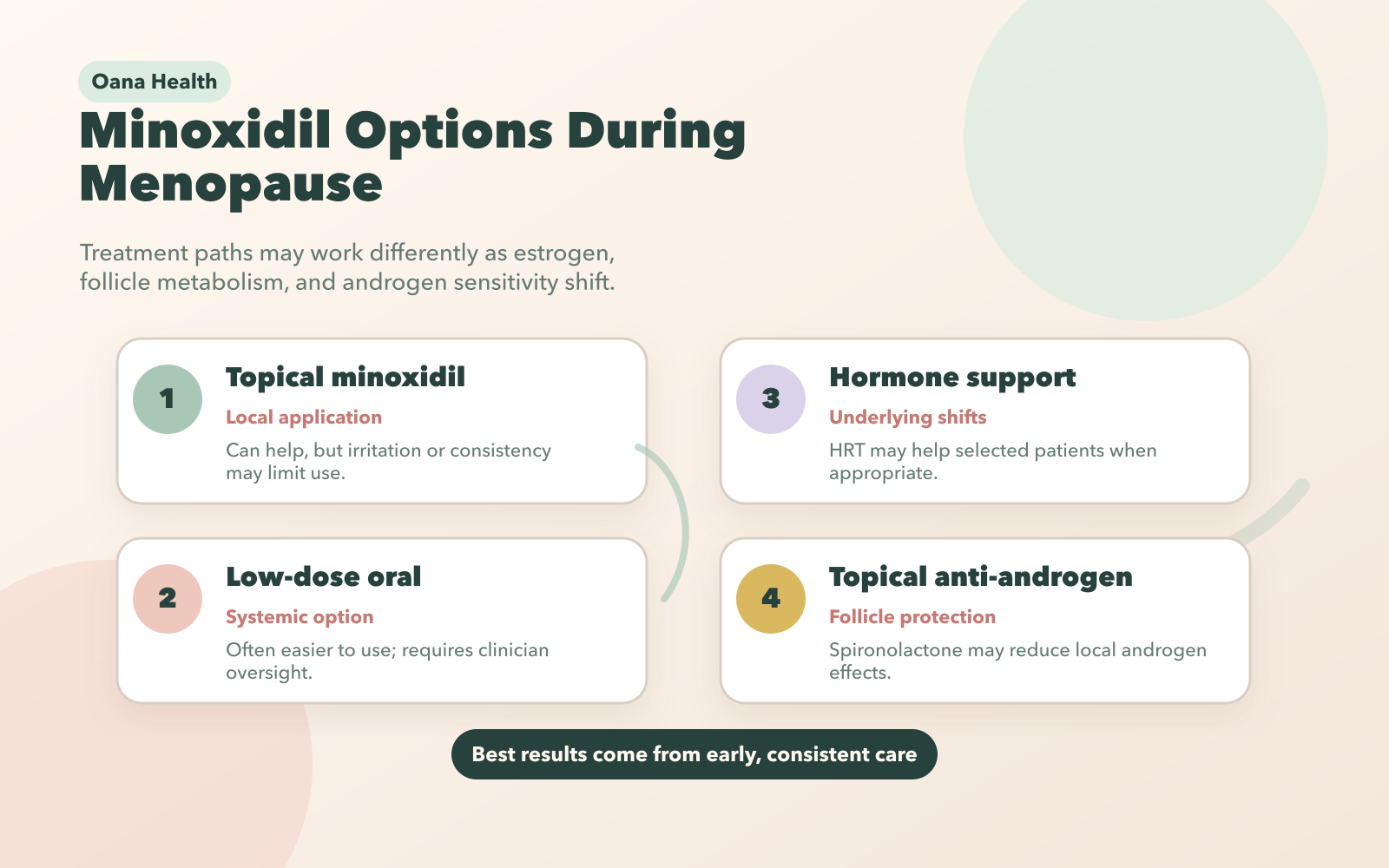
Minoxidil Treatment Options and Effectiveness During Menopause
Menopausal Hair Loss? Regrow Hair Before + After
Why Minoxidil May Not Work as Well During Menopause
Menopause presents unique challenges for hair regrowth treatments like Minoxidil. The hormonal changes that occur during this phase not only contribute to hair loss but can also interfere with how effectively Minoxidil works. This combination often requires a more customized approach to treatment.
Hormonal Changes and Reduced Effectiveness
Minoxidil promotes hair growth by extending the anagen (growth) phase of the hair cycle. However, during menopause, declining estrogen levels can naturally shorten this phase. Research highlights this connection:
"Loss of estrogen after the onset of menopause may lead to sub-optimal metabolic and vascular functioning of the follicular unit." - Maturitas
Reduced estrogen levels also affect blood flow and nutrient delivery to hair follicles, creating a less favorable environment for Minoxidil to work effectively. This diminished vascular support can limit the treatment’s ability to stimulate new growth.
Shedding and Slower Results
It’s common for Minoxidil users to experience increased hair shedding during the first 2 to 6 weeks of treatment, as dormant follicles transition into the growth phase. Approximately 18% of users report this temporary shedding. For women going through menopause, hormonal fluctuations can make this shedding phase last longer than usual.
While many people see new growth within 4 to 8 months, the full benefits of Minoxidil often take up to 12 months to appear. Menopause-related changes, such as slower follicular metabolism, can further delay this process, making the wait for visible results even longer.
Aging Follicles and Limited Response
As hair follicles age, they undergo miniaturization, which makes them less responsive to treatments like Minoxidil. The treatment works by acting as an epidermal growth factor on matrix cells, helping to slow down follicular aging. However, in older follicles - where the anagen phase is already significantly reduced - the potential for visible improvement is limited.
Studies show that starting Minoxidil treatment within five years of the onset of hair loss yields better results. Unfortunately, aging follicles also experience reduced enzyme activity, further diminishing their ability to respond. In fact, only about 40% of patients see noticeable improvement after using Minoxidil for 3 to 6 months.
These factors combined make menopause a particularly challenging time for effective hair regrowth, often requiring additional strategies to optimize results.
Other Treatments That Can Help
When Minoxidil alone doesn’t quite do the trick during menopause, combining it with other treatments can help tackle hormonal shifts and the effects of androgens.
Oral Minoxidil as an Alternative
For women experiencing overall thinning across the scalp, low-dose oral Minoxidil offers a convenient alternative to topical applications. While topical Minoxidil absorbs at a rate of less than 5% through the skin, the oral version ensures consistent delivery throughout the body - no mess, no daily scalp routine.
"Low dose oral minoxidil (LDOM), arbitrarily defined as doses ≤ 5 mg/day unlikely to affect blood pressure (BP) in most patients, has been utilized off-label to treat various types of hair loss." - Journal of the American Academy of Dermatology
This approach can be especially effective for women with lower levels of the sulfotransferase enzyme in their hair follicles. Typical doses range from 0.25 mg to 2.5 mg per day, offering a balance between results and minimal side effects. Only about 1% of users stop taking oral Minoxidil due to adverse effects. For $25 per month, Oana Health’s Oral Minoxidil provides an accessible option for women seeking a simpler, more reliable solution. For those who need hormonal support, pairing it with complementary therapies can further enhance its effectiveness.
Using Minoxidil with Hormone Replacement Therapy
Menopause brings dramatic hormonal changes, and combining Minoxidil with Hormone Replacement Therapy (HRT) directly addresses these shifts. HRT can significantly boost the effectiveness of Minoxidil by targeting the underlying cause of menopausal hair loss: declining estrogen levels. While Minoxidil works on the follicles to stimulate growth, HRT restores hormonal equilibrium.
Estrogen plays a vital role in keeping hair in the anagen (growth) phase longer and improves blood flow to the scalp, ensuring follicles receive the nutrients they need. Progesterone, another component of HRT, helps block the conversion of testosterone into DHT, a key factor in follicle miniaturization. For example, in a case study from December 2025, a perimenopausal woman in her late 40s used a combination of transdermal estrogen, micronized progesterone, and topical Minoxidil. Within 6 to 12 months, her hair shedding slowed significantly, and her hair appeared fuller.
"HRT helps to create a hormonal environment conducive to hair growth, while minoxidil acts directly on the hair follicles to encourage visible results. Together, they may offer a synergistic effect." - Winona Medical Review
Starting HRT early in menopause tends to yield the best outcomes for hair density.
Topical Spironolactone to Block Androgens
For a more localized approach, topical Spironolactone can help counteract the effects of androgens on the scalp. By blocking androgen receptors, it prevents the follicle miniaturization that leads to thinning hair. When used alongside Minoxidil, the two treatments work together: Spironolactone reduces hormonal damage to the follicles, while Minoxidil stimulates new growth.
This combination is particularly effective for women whose hair thinning is linked to increased androgen activity during menopause. A study on female pattern hair loss found that women using low-dose oral Minoxidil (2.5 mg) paired with Spironolactone (25 mg) experienced improved hair density and reduced shedding within 6 to 12 months. The topical version of Spironolactone delivers targeted results with minimal systemic exposure, focusing its anti-androgen effects directly on the scalp.
Oana Health’s Topical Spironolactone is available for $43 per month, providing a cost-effective way to add androgen-blocking support to your hair regrowth plan.
sbb-itb-6dba428
How to Get Better Results with Hair Regrowth Treatment
To get the most out of your hair regrowth journey, start early, stick to your routine, and work with a healthcare provider to create a plan that meets your specific needs.
Start Early and Stay Consistent
Timing matters when it comes to hair regrowth treatments. Minoxidil tends to deliver the best results when used in the early stages of hair thinning or shortly after hair loss begins. It works by extending the anagen phase - the part of the hair growth cycle where your hair actively grows. Keep in mind, a temporary increase in shedding during the first few weeks is completely normal. Around 60% of users report a 10–15% improvement in hair density with consistent use. However, stopping treatment can reverse these gains over time.
"In the battle against androgenic alopecia, remember that persistence with topical minoxidil can be the key to long-term success." – SOCAH Center
For best results, apply 1 ml (about six sprays) of the 2% solution twice a day or a half capful of the 5% foam once daily. Make sure your scalp is dry, and wait at least four hours before shampooing to ensure the treatment is fully absorbed. Consistency is key, but so is customization - this is where your healthcare provider comes in.
Get a Treatment Plan Tailored to You
A one-size-fits-all approach doesn’t work for hair regrowth. Customizing your treatment begins with diagnostic tests, including blood work to check for vitamin deficiencies, thyroid issues, and hormonal imbalances, as well as a scalp exam to pinpoint specific concerns. For example, during menopause, declining estrogen levels can lead to a relative increase in androgens, speeding up the miniaturization of hair follicles. In such cases, your provider might recommend adding androgen blockers to your regimen.
Low-dose oral Minoxidil (ranging from 0.25 mg to 2.5 mg daily) is another option, especially for those with diffuse thinning, as it’s easier to maintain compared to topical applications.
Platforms like Oana Health offer telehealth consultations with licensed professionals who create science-backed treatment plans tailored to menopausal hair loss. These plans are based on your hormonal profile and conveniently delivered to your doorstep. For example, combining Oral Minoxidil ($25/month) with Topical Spironolactone ($43/month) can address both hair growth stimulation and hormonal imbalances.
Track Progress and Adjust Treatment
Monitoring your progress is just as important as starting treatment. While initial results may appear after about eight weeks, most users see noticeable regrowth within three to four months. Hormonal changes, especially during menopause, might require tweaks to your treatment plan. Peak results are usually visible around the 12-month mark, with an average increase in hair density of 14–18%.
If you don’t see improvements after four months of consistent use, it’s time to consult your healthcare provider. They might suggest increasing the concentration, switching to a Minoxidil sulfate-based formula, or trying oral Minoxidil. Persistent shedding beyond six weeks is another reason to check in with your provider.
Telehealth check-ins can make it easier to stay on track, offering real-time advice and quick adjustments to your treatment plan.
Conclusion
Menopausal hair loss can make treatments like Minoxidil less effective. Hormonal changes during this stage often reduce how well hair follicles respond, with studies showing that 60% of people using topical Minoxidil see no improvement. However, there’s hope - combining treatments or exploring alternatives like oral Minoxidil or topical Spironolactone can lead to better outcomes.
Starting treatment early is key to maintaining follicle responsiveness. Pairing Minoxidil with hormone-balancing therapies targets the underlying cause of menopausal hair loss, not just the symptoms. For example, using low-dose oral Minoxidil alongside Spironolactone has been shown to boost hair density and reduce shedding. These strategies emphasize the importance of creating a plan tailored to your needs.
With a personalized treatment plan, guided by professionals, you can adapt as your hormones change. Oana Health provides telehealth consultations with licensed experts who design science-based plans for menopausal hair loss. Whether you’re considering Oral Minoxidil (starting at $25/month), Topical Spironolactone (starting at $43/month), or a combination of both, treatments are shipped directly to your door with free delivery. Expert guidance ensures you can adjust your plan as needed for ongoing results.
FAQs
Why is Minoxidil less effective for hair regrowth during menopause?
Menopause can interfere with how well Minoxidil works, largely due to the hormonal shifts that occur during this phase. When estrogen levels drop and androgen levels increase, hair follicles - highly sensitive to these changes - may produce finer hair, experience shorter growth cycles, and suffer from reduced blood flow. All of these factors can make it harder for Minoxidil to effectively stimulate hair regrowth.
On top of that, the decrease in estrogen can impair the follicles' ability to absorb nutrients and maintain proper circulation, further diminishing Minoxidil's impact. To counteract these challenges, women might see better results with customized treatments that specifically address hormonal imbalances. For instance, Oana Health provides telehealth services where licensed professionals assess hormonal health and recommend tailored solutions, such as combining hormone therapy with Minoxidil, to promote hair regrowth during menopause.
How does combining Minoxidil with Hormone Replacement Therapy improve hair regrowth during menopause?
Combining Minoxidil with Hormone Replacement Therapy (HRT) tackles two key factors behind menopausal hair loss. HRT helps regulate estrogen and androgen levels, which can prevent hair follicles from shrinking, while Minoxidil boosts scalp blood flow and prolongs the growth phase of hair follicles. When used together, these treatments encourage hair regrowth, reduce shedding, and support fuller, healthier hair.
Studies indicate that pairing HRT with Minoxidil can lead to quicker and more noticeable improvements in hair density. Beyond hair health, HRT also alleviates other menopausal symptoms like hot flashes and mood swings, offering a more all-encompassing solution.
For a more tailored experience, Oana Health offers telehealth consultations to design custom treatment plans featuring Minoxidil and HRT. These plans are conveniently delivered to your doorstep with free shipping.
How does oral Minoxidil help with hair regrowth during menopause?
Oral Minoxidil may help with hair regrowth during menopause by boosting blood flow to the scalp, which feeds and strengthens hair follicles. It also lengthens the anagen phase - the active growth stage of the hair cycle - while minimizing excessive shedding. Together, these effects can encourage thicker, healthier hair over time.
If menopause-related hair loss is a concern, it’s worth discussing oral Minoxidil with a licensed medical professional. They can assess your individual situation and recommend a treatment plan tailored to your needs.