
Research: Exercise and PCOS Fertility
Exercise can improve fertility in women with PCOS by addressing hormonal imbalances, insulin resistance, and weight management. This article explores how physical activity affects PCOS symptoms and offers practical tips for incorporating exercise into daily routines.
Key takeaways:
- Hormonal balance: Exercise reduces insulin resistance (up to 36.2%) and helps regulate ovulation.
- Weight loss: Even a 4.5% weight reduction can improve fertility outcomes.
- Mental health benefits: Regular activity lowers stress, anxiety, and depression, improving overall well-being.
- Types of exercise: Aerobic workouts, HIIT, and yoga are particularly effective.
For best results, combine exercise with dietary changes and medical treatments like Metformin. Regular physical activity not only boosts reproductive health but also improves quality of life for women with PCOS.
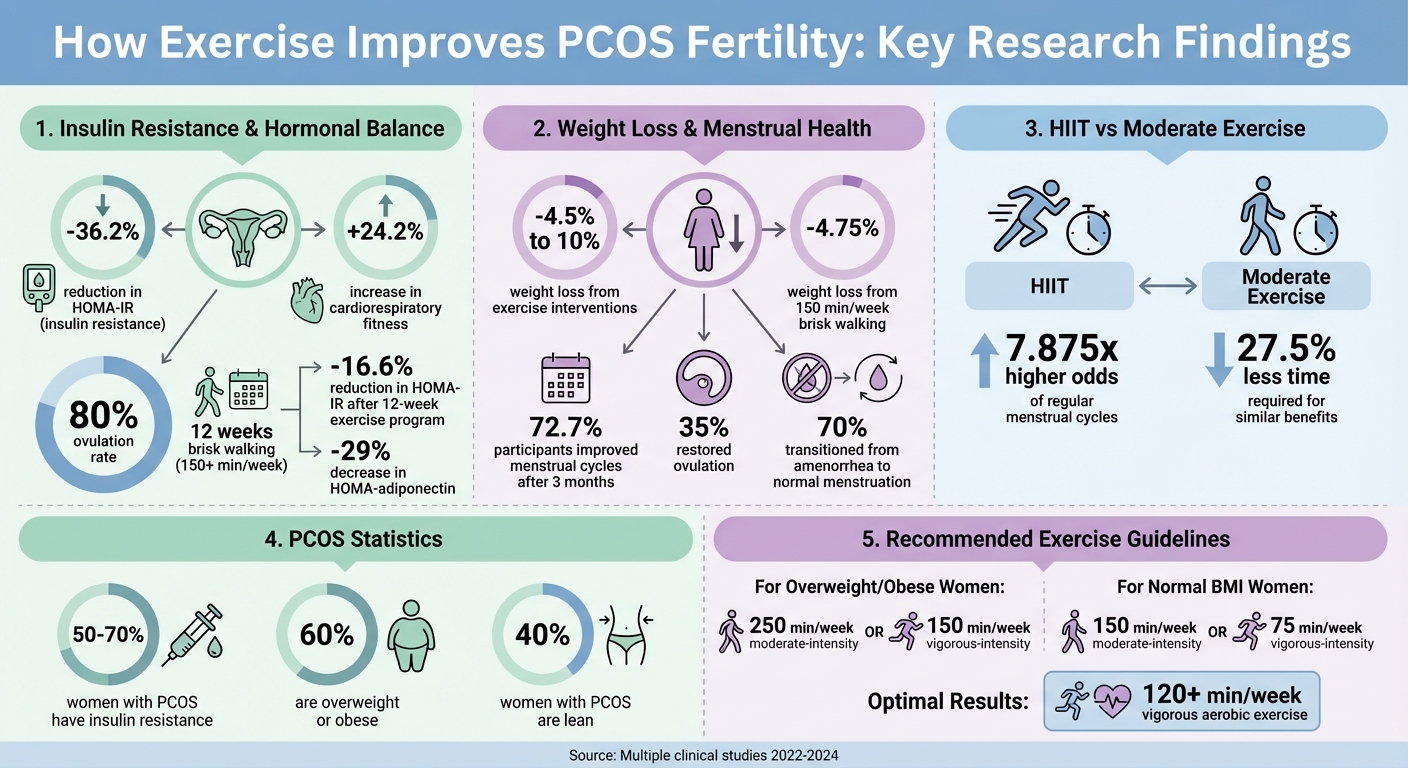
Exercise Benefits for PCOS Fertility: Key Statistics and Outcomes
Does Exercise Help Ovulation in PCOS?
How Exercise Affects PCOS and Fertility
Exercise plays a key role in improving fertility for women with PCOS by influencing critical biological processes like insulin regulation, hormone production, and stress management. These factors are essential for healthy ovulation and conception.
Better Insulin Sensitivity and Hormone Balance
Insulin resistance is a common issue in PCOS. When muscles don't efficiently use insulin, the pancreas compensates by producing more, which can trigger the ovaries and adrenal glands to overproduce androgens like testosterone. This hormonal imbalance disrupts egg maturation and ovulation. Vigorous exercise helps by increasing glucose uptake in muscles and reducing insulin resistance. In fact, studies show a 36.2% reduction in HOMA-IR, a measure of insulin resistance, following consistent exercise.
A 12-week study conducted in February 2024 tracked 143 women with PCOS who engaged in over 150 minutes of brisk walking per week. Results showed a 4.75% weight loss, a boost in adiponectin levels (a hormone that enhances insulin sensitivity), and an impressive 80% ovulation rate. Another program demonstrated a 16.6% reduction in HOMA-IR and a 29% decrease in HOMA-adiponectin after 12 weeks of exercise.
Exercise also helps regulate adipokines - hormones produced by fat cells - by increasing adiponectin and lowering resistin levels. This can reduce inflammation and metabolic issues tied to PCOS.
Weight Loss and Ovulation
Weight loss through exercise is another game-changer for managing PCOS. Shedding even a small percentage of body weight can improve how the brain and reproductive organs communicate, alleviating insulin resistance and hyperinsulinemia often linked with obesity. Studies show that exercise interventions lead to 4.5% to 10% weight loss in women with PCOS.
Exercise also has a direct impact on menstrual health. For example, a study found that 72.7% of participants experienced better menstrual cycles after three months of submaximal exercise, with about 35% restoring ovulation. Another trial revealed that 70% of women transitioned from amenorrhea to either oligomenorrhea or normal menstruation after starting regular exercise.
While moderate-intensity aerobic exercise is effective for reducing BMI, higher-intensity workouts may have even greater benefits. A 2022 randomized clinical trial compared moderate exercise to HIIT (high-intensity interval training) and found that HIIT led to better improvements in insulin sensitivity, free androgen index, and menstrual regularity. Beyond these physical benefits, exercise also helps manage stress, which further supports fertility.
Lower Stress Levels and Fertility Benefits
Women with PCOS often face higher rates of anxiety, depression, and mood disorders compared to those without the condition. Exercise provides a non-pharmacological way to improve mental health by reducing stress and boosting mood and self-esteem. These mental health benefits also help regulate the hypothalamic-pituitary-ovarian axis, a key system for fertility.
HIIT appears to be particularly effective in reducing symptoms of depression, anxiety, and stress when compared to moderate-intensity exercise. As highlighted in BMC Public Health:
"The reproductive functions of women with PCOS can be improved with physical activity. Furthermore, physical activity can also reduce infertility, as well as social and psychological stress among women."
Additionally, exercise enhances sexual function and body image for women with PCOS, helping to ease distress caused by hyperandrogenism and improving overall quality of life. These combined benefits set the stage for further clinical insights discussed in the next section.
Recent Research on Exercise and PCOS Fertility
Aerobic Exercise Results
Recent studies continue to shed light on how exercise impacts menstrual and metabolic health in women with PCOS. A 2023 systematic review revealed that submaximal aerobic exercise improved menstrual regularity, with 70% of participants regaining normal cycles and 35% achieving ovulation.
The intensity of aerobic workouts plays a critical role. Vigorous exercise has been shown to reduce insulin resistance by 36.2% and increase cardiorespiratory fitness by 24.2%. Researchers from Victoria University emphasized, “Improvements in health outcomes are more dependent on exercise intensity rather than dose”. Based on these findings, women with PCOS are encouraged to aim for at least 120 minutes of vigorous-intensity aerobic exercise per week.
For those short on time, High-Intensity Interval Training (HIIT) offers a time-efficient alternative. Studies suggest HIIT provides similar benefits to moderate-intensity continuous training in roughly 27.5% less time. One study even found that women who engaged in HIIT had 7.875 times higher odds of achieving regular menstrual cycles compared to those doing moderate-intensity exercise. While vigorous aerobic exercise is highly effective for metabolic health, incorporating mind-body practices like yoga can offer additional advantages.
Yoga and Mindfulness Studies
Yoga has proven particularly beneficial for women with PCOS, especially when it comes to mental health and hormonal regulation. Research shows that yoga helps improve insulin resistance, glucose levels, and lipid profiles, with noticeable effects in adolescent girls with PCOS.
Evidence indicates that yoga improves ovulation, hormonal balance, and metabolic markers essential for managing PCOS.
– West Tennessee Medical Group, GYN Specialists
Emerging studies also suggest yoga may help reduce androgen levels, though more research is needed to confirm this. These hormonal shifts are key to restoring ovulation and enhancing fertility. For many women, combining yoga or mindfulness-based practices with aerobic exercise can create a well-rounded fitness plan.
Exercise and Diet Combined
The benefits of exercise can be amplified when paired with dietary changes. While exercise alone improves insulin sensitivity and fitness, adding a calorie-restricted diet enhances weight loss and BMI reduction, both of which are crucial for regular ovulation.
In one study led by Thomson et al., 64 women with PCOS followed an energy-restricted, high-protein diet (1,200–1,400 calories per day) while engaging in moderate-intensity continuous training five days a week. The combination of diet and exercise significantly improved body composition and reproductive health markers.
For overweight or obese women with PCOS, guidelines recommend 250 minutes per week of moderate-intensity exercise or 150 minutes of vigorous-intensity exercise, alongside dietary adjustments. Women with a normal BMI should aim for at least 150 minutes of moderate-intensity exercise or 75 minutes of vigorous-intensity exercise weekly. This combined strategy is especially important since 50–70% of women with PCOS have insulin resistance, and around 60% are overweight or obese. Together, exercise and diet not only support weight management but also help restore ovulation, directly influencing fertility outcomes.
sbb-itb-6dba428
Research Limitations and Knowledge Gaps
While research on exercise and fertility in women with PCOS shows potential, it’s clear there are several challenges that limit the conclusions we can draw. One of the biggest issues is the small sample sizes in most randomized controlled trials - ranging from just 5 to 183 participants. In fact, only one study in a recent systematic review included over 100 women. Such small groups make it hard to apply findings to the broader PCOS population.
Another hurdle is the short duration of these studies. On average, exercise interventions last about 15 weeks, with most falling between 6 and 26 weeks. This timeframe often covers just a few ovulatory cycles, making it tough to evaluate long-term fertility outcomes or determine if any improvements are sustainable. One review sums it up well:
The available data were limited to fully concluding the beneficial effects of exercise on reproductive functions.
The variety in exercise protocols further muddies the water. Studies differ in the type of exercise they test - whether it’s aerobic, resistance training, high-intensity interval training (HIIT), or yoga - as well as in the intensity (moderate versus vigorous) and frequency of workouts. This inconsistency makes it hard to establish clear recommendations for women with PCOS. As Human Reproduction Update points out:
Studies vary considerably in design, intensity and outcome measures; therefore conclusive results remain elusive.
Adding to the complexity, many studies combine exercise with other interventions like dietary changes or medications. This makes it challenging to pinpoint the specific effects of exercise on reproductive health.
There are also methodological flaws to consider. Many studies rely on self-reported exercise logs instead of objective measures like heart rate monitors or supervised sessions, which can lead to inaccuracies in tracking whether participants actually followed the prescribed exercise regimens. Another issue is the lack of diversity in study populations. Few studies focus on groups like adolescents, unmarried women, or women with a normal BMI - even though about 40% of women with PCOS are lean.
To make real progress, future research needs to address these gaps. Longer studies (lasting more than 24 weeks), larger and more diverse sample sizes, and standardized ways to measure outcomes are essential. Researchers also need to explore how different PCOS phenotypes respond to specific types of exercise. On top of that, understanding the biological mechanisms - like how exercise affects hormones such as androgens and anti-Müllerian hormone (AMH) - remains an important area to explore. Filling these gaps will be key to creating more tailored and effective exercise strategies for improving fertility in women with PCOS.
Practical Tips for PCOS Management
Moderate Exercise Guidelines for Women with PCOS
Engaging in moderate exercise can play a crucial role in improving fertility for women with PCOS. Experts recommend aiming for 150–300 minutes of moderate-intensity aerobic activity or 75–150 minutes of vigorous-intensity exercise each week. Think of it as dedicating about 30 minutes a day to activities like brisk walking, cycling, or swimming - enough to get your heart rate up while still being able to carry on a conversation.
For those looking to achieve greater weight loss and fertility benefits, consider increasing your activity to at least 250 minutes of moderate-intensity or 150 minutes of vigorous-intensity aerobic exercise weekly. To further boost results, add strength training sessions twice a week on non-consecutive days. This helps improve insulin sensitivity and body composition, both of which are essential for managing PCOS.
Wondering if you’re hitting the right intensity? Use your heart rate as a guide. Moderate intensity typically ranges between 65% and 75% of your peak heart rate, while vigorous intensity falls between 77% and 93%.
Pairing these exercise routines with medical treatments can amplify their effectiveness in improving fertility outcomes.
Combining Exercise with Medical Treatments
For optimal results, combine regular exercise with medical treatments like Metformin or ovulation-inducing medications. This approach is especially helpful for women dealing with insulin resistance, a common issue in PCOS.
One option to consider is Oana Health, which provides tailored, prescription-based treatments to complement your fitness efforts. Their offerings include:
- Oral Metformin ER: Starting at $22/month, this helps manage insulin resistance.
- Metformin & Spironolactone pack: At $32/month, this targets both metabolic and hormonal imbalances.
- Oral GLP-1 & Metformin: For $199/month, this combination offers advanced PCOS management.
All treatments are prescribed by licensed medical professionals and delivered directly to your doorstep with free shipping. This makes it easier to stay consistent with both your exercise routine and medication plan, ensuring a more streamlined approach to managing PCOS.
Conclusion
Exercise plays a powerful role in improving fertility for individuals with PCOS. Research shows that regular physical activity helps restore menstrual cycles, boosts ovulation rates, and tackles the underlying issues of PCOS, such as insulin resistance and high androgen levels. From aerobic workouts to strength training and even yoga, incorporating consistent movement into your routine can lead to noticeable improvements in reproductive and overall health.
Pairing exercise with medical care can amplify these benefits. A combination of personalized treatments and a consistent fitness plan addresses both the hormonal and metabolic challenges of PCOS, giving you a better chance at conception.
If you're looking for tailored support on your journey, consider exploring services like Oana Health. They offer prescription-based treatments, including Metformin and advanced GLP-1 options, delivered straight to your door with free shipping. When combined with regular exercise, these treatments can help you take meaningful steps toward improving fertility and managing PCOS effectively.
FAQs
How long does it take for exercise to improve ovulation with PCOS?
Regular exercise has been shown to support improved ovulation in women with PCOS, often within 12 to 24 weeks of sticking to a consistent fitness routine. While results can differ based on individual circumstances, the key to seeing progress lies in maintaining regular physical activity over time.
What’s the best workout plan for PCOS if I’m not trying to lose weight?
For women with PCOS who aren’t prioritizing weight loss, regular, moderate-intensity exercise can be a game-changer for hormonal balance and reproductive health. Activities like brisk walking, cycling, swimming, or resistance training can help improve hormone regulation and boost fertility. The key is consistency - moderate exercises are easier on the body and more sustainable over time. Try to get in 30 minutes of movement most days of the week, focusing on activities you genuinely enjoy to make it a lasting habit.
Can I combine exercise with Metformin safely for PCOS fertility?
Combining exercise with Metformin is typically safe and can boost fertility outcomes for women with PCOS. Exercise plays a key role in improving metabolic health and promoting ovulation, while Metformin helps induce ovulation and may lower the risk of pregnancy loss. However, it's essential to consult your healthcare provider before adjusting your treatment plan to ensure it aligns with your specific needs.