
PCOS Immune Dysregulation: Future of Stem Cell Therapy
PCOS is more than just a hormonal issue - it’s an inflammatory condition linked to immune system dysfunction. This chronic inflammation disrupts normal ovarian function, causes insulin resistance, and makes pregnancy more difficult. Current treatments like birth control and metformin only manage symptoms, leaving the root cause - immune imbalance - untreated.
Emerging research suggests stem cell therapy, particularly using mesenchymal stem cells (MSCs), could address this immune dysfunction. MSCs release anti-inflammatory molecules, repair ovarian tissue, and improve fertility. Preclinical studies have shown promising results, including reduced inflammation, restored ovulation, and successful pregnancies in PCOS animal models.
Key insights:
- Chronic inflammation in PCOS involves elevated markers like IL-6, TNF-α, and CRP, which disrupt ovarian and metabolic health.
- Stem cell therapies, including MSCs and exosomes, target inflammation at its source, unlike traditional treatments.
- Early studies show MSC injections can lower androgen levels and repair ovarian damage.
- Challenges remain, including scaling production, ensuring safety, and transitioning from animal models to human trials.
While still in early stages, stem cell therapies could transform PCOS treatment by addressing the condition’s root causes rather than just its symptoms.
How Immune Dysregulation Drives PCOS
Inflammation and Ovarian Dysfunction
When mononuclear cells infiltrate the ovary, they ignite local inflammation that disrupts normal ovarian function. This inflammatory response pushes theca cells to produce excess androgens, while IL-6 inhibits aromatase, a key enzyme needed for estrogen production. The result? A worsening hormonal imbalance that fuels the cycle of dysfunction.
Meanwhile, elevated levels of TNF-α and IL-1β activate the NF-κB pathway and the NLRP3 inflammasome, leading to granulosa cell death. These granulosa cells are vital for egg development, so their damage directly hinders egg maturation. Wang Jingxuan, from the Reproductive Medicine Center at Renmin Hospital of Wuhan University, explains:
The inflammatory cascade may affect granulosa cell proliferation, inhibit oocyte maturation, and aggravate ovulatory dysfunction more severely.
On top of this, inflammation damages ovarian mitochondria, creating oxidative stress that depletes the energy eggs need to develop properly. This energy shortage leads to the "arrested" follicles characteristic of polycystic ovaries - follicles that grow partway but never fully mature or release an egg. These mechanisms form the foundation of immune imbalances that emerging therapies, such as stem cell treatments, aim to address.
Local vs. Systemic Inflammation in PCOS
While inflammation within the ovary plays a direct role, systemic inflammation adds another layer of complexity. This widespread inflammation often stems from visceral fat and insulin resistance, both common in PCOS. In nearly half of PCOS cases, obesity drives this systemic inflammation as fat tissue releases TNF-α, IL-6, and MCP-1, which not only worsen insulin resistance but also increase cardiovascular risks.
On the other hand, local ovarian inflammation occurs within the ovarian tissue and follicular fluid - the fluid surrounding developing eggs. Immune cells infiltrate this area, creating a toxic environment with elevated levels of IL-1β and IL-18, which are significantly higher in women with PCOS compared to those without. The ovarian immune profile also shifts, with an increase in pro-inflammatory M1 macrophages and a decrease in anti-inflammatory M2 macrophages, alongside a rise in inflammatory Th1 and Th17 cells.
These two types of inflammation - local and systemic - don’t operate in isolation. They interact through the ovary’s blood supply. Inflammatory cytokines from systemic circulation accumulate in the follicular fluid, where they spark inflammatory cascades in granulosa cells. This dysfunction is further compounded by low progesterone levels, a consequence of failed ovulation. Without sufficient progesterone, the systemic immune system can become overstimulated, even leading to the production of autoantibodies. The inflammation doesn’t stop at the ovaries - it also affects the uterine lining. Reduced uterine Natural Killer (uNK) cells and impaired endometrial function make it harder for the uterus to support a pregnancy.
This intricate web of inflammatory processes underscores the importance of developing treatments that target both local and systemic inflammation in PCOS.
sbb-itb-6dba428
Stem Cell Therapy for PCOS: Current Research
Mesenchymal Stem Cells (MSCs) for PCOS Treatment
Mesenchymal Stem Cells (MSCs) are gaining attention for their potential to address PCOS-related immune imbalances. These cells, sourced from bone marrow, adipose tissue, umbilical cords, and menstrual blood, release anti-inflammatory factors that help mitigate the immune dysregulation seen in PCOS.
In a July 2021 study, Dr. Hang-Soo Park and Dr. Ayman Al-Hendy explored the effects of injecting 500,000 bone marrow-derived MSCs into the ovaries of PCOS mice. They observed a reduction in CYP17A1 expression - a gene linked to androgen production - down to 0.56 times the levels in control mice. This was attributed to the secretion of IL-10, an anti-inflammatory cytokine.
"Our results suggest that BM-hMSC can reverse PCOS-induced inflammation through IL-10 secretion. BM-hMSC might be a novel and robust therapeutic approach for PCOS treatment."
- Ayman Al-Hendy, MD, PhD, University of Chicago
Each MSC source offers its own set of benefits:
- Bone marrow MSCs: Suppress genes involved in steroid production and restore fertility.
- Umbilical cord MSCs: Prevent granulosa cell death by blocking the NF-κB pathway.
- Adipose tissue MSCs: Enhance ovarian structure and increase oocyte numbers.
- Menstrual blood MSCs: Improve mitochondrial function, reduce oxidative stress, and boost estrogen levels.
Exosomes and Secretome Therapy
In addition to using whole cells, MSCs also pave the way for cell-free therapies. Exosomes, tiny vesicles released by MSCs, carry proteins, lipids, and RNA to damaged ovarian tissues. These vesicles have a lipid bilayer that protects delicate cytokines like IL-10, ensuring they reach their targets intact.
Preclinical studies on PCOS mice showed that MSC-derived exosomes significantly reduced testosterone levels from 63.0 ± 12.9 ng/dL to about 31.6 ± 8.6 ng/dL after intraovarian injections. Fertility outcomes also improved dramatically, with pregnancy rates jumping from 25% to 100%.
The method of delivery plays a critical role in outcomes. While intravenous injections may help address broader metabolic issues like blood sugar regulation, intraovarian injections have shown better results in restoring ovarian function and fertility. Compared to whole-cell therapies, exosomes are seen as safer, more stable, easier to store, and less likely to trigger immune responses.
"MSC-derived exosomes are expected to replace stem cells as a new therapeutic option for a regenerative as a cell-free approach."
- Hang-Soo Park et al., Department of Obstetrics and Gynecology, University of Chicago
As of mid-2023, the FDA approved a first-in-human phase 1 pilot trial (IND 28896) to test MSC-derived exosome therapy for premature ovarian insufficiency. This milestone hints at the possibility of similar trials targeting PCOS in the near future.
Induced Pluripotent Stem Cells (iPSCs) for Personalized Treatment
Induced pluripotent stem cells (iPSCs) offer another exciting avenue for PCOS treatment. These cells are created by reprogramming a patient’s own somatic cells - such as skin or blood - into a stem-like state. Because iPSCs are derived from the patient, they carry the individual’s molecular characteristics, minimizing the risk of immune rejection.
A groundbreaking use of iPSCs is the creation of "disease-in-a-dish" models. By differentiating iPSCs from PCOS patients into ovarian or adipose cells, researchers can study how immune dysregulation impacts specific tissues. This approach allows treatments to be tested on a patient’s own cells before being administered, paving the way for therapies tailored to individual hormonal and inflammatory profiles.
This shift from generalized treatments to personalized care could mark a turning point in how PCOS is managed.
Study Reveals New Stem Cell Therapy for Women with Ovarian Failure
Challenges and Future Research Directions
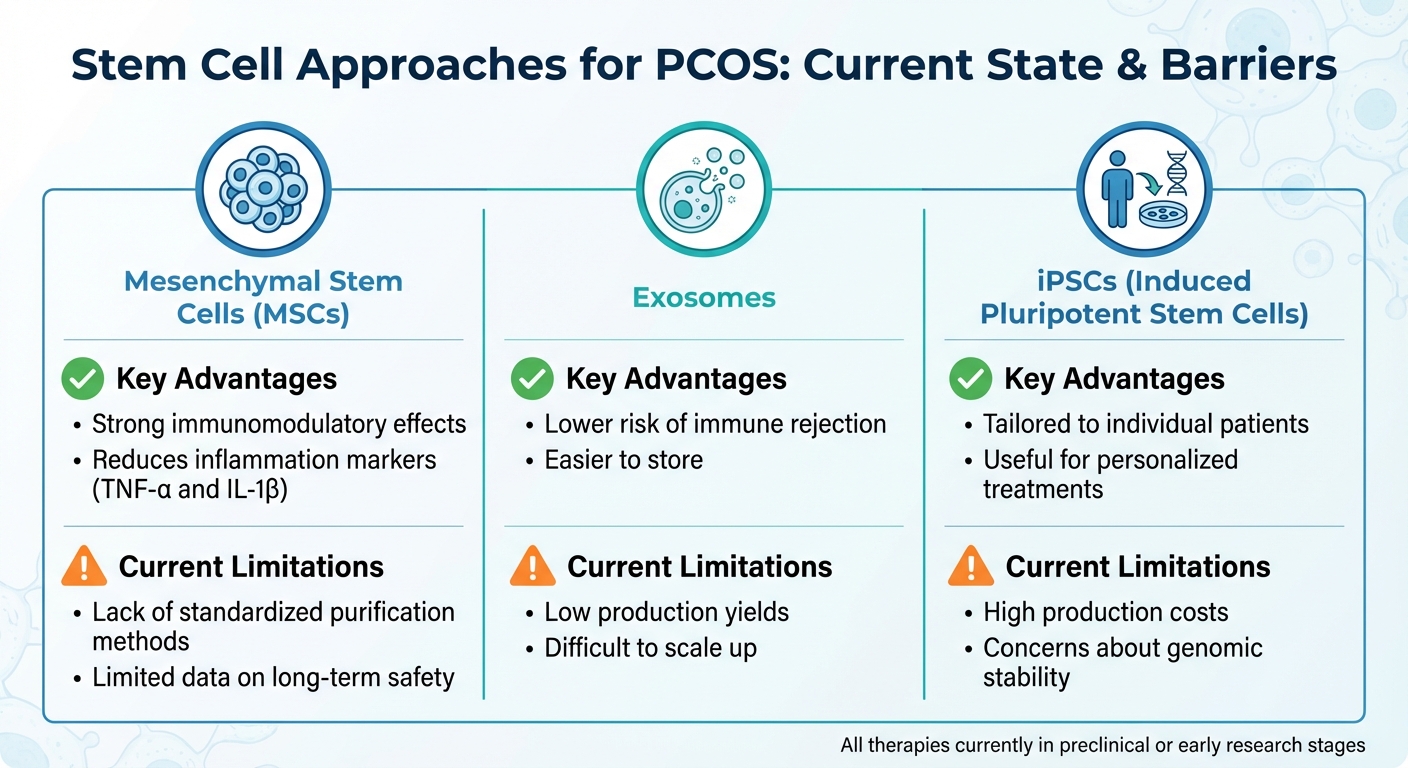
Stem Cell Therapy Types for PCOS Treatment: Advantages and Limitations
From Lab Research to Clinical Trials
A major hurdle in stem cell research for PCOS is moving from laboratory experiments to human clinical trials. While preclinical studies show promise, the shift to clinical applications faces procedural and safety challenges. Much of the research relies on animal models like letrozole-induced PCOS in mice or rats, which don’t fully mirror the complexities of the human ovarian environment or immune system irregularities.
One of the biggest issues is the absence of standardized protocols for handling stem cells - whether it’s purifying, identifying, storing, transporting, or administering them. This lack of uniformity makes it hard to compare results across studies and raises concerns about safety when scaling up for clinical use. Key safety risks include transplant rejection, potential tumor formation (especially with iPSCs), and ensuring long-term genomic stability.
"The successful translation of stem cell treatments from preclinical research settings to clinical practice requires a comprehensive understanding of the underlying mechanisms and methodological approaches."
Scaling up production is another major challenge. Producing large amounts of exosomes and extracellular vesicles is technically difficult, with low yields and high costs slowing commercialization efforts. These practical barriers make the journey from lab discoveries to patient treatments a long and complex one. However, emerging technologies are beginning to address these roadblocks, offering hope for more effective therapies in the future.
New Technologies Supporting Stem Cell Research
New technologies are helping researchers tackle these challenges head-on. For example, gene editing can modify stem cell-derived exosomes with microRNAs like miR-323-3p, which target cell death in cumulus cells and enhance cell growth - key for addressing ovarian dysfunction in PCOS. Similarly, engineered exosomes containing miR-21-5p can activate the IRS1/AKT pathway, improving liver metabolism often disrupted in PCOS.
Innovations like 3D bioprinting and ovarian organoid systems are also opening new doors. While these tools are primarily used for tissue regeneration in other fields, they could create controlled environments to test stem cell therapies on complex ovarian models before moving to human trials. This step would bridge the gap between animal studies and clinical applications.
Delivery methods are another area seeing refinement. Research suggests that intravenous administration works best for addressing systemic issues like blood sugar regulation, while direct injections into the ovaries are more effective for restoring ovarian function and fertility. Fine-tuning these delivery techniques is crucial for optimizing treatment outcomes. Despite these advancements, there’s still a lot to uncover before these therapies can be widely used in clinics.
Research Gaps and Timeline for Clinical Use
While progress is being made, there’s still much to learn about how stem cells interact with the immune and hormonal systems in PCOS. Researchers have identified some key pathways, such as IL-10 signaling and mitochondrial biogenesis, but the full picture remains unclear. Understanding these mechanisms is critical for ensuring safety and efficacy in clinical applications.
Recruitment for research also poses a challenge. Since about 75% of women with PCOS go undiagnosed until they reach reproductive age, assembling diverse and representative study groups is difficult. This diagnostic gap slows clinical research and limits the scope of patient populations included in studies.
Here’s a snapshot of the current state of different stem cell approaches and their barriers to clinical use:
| Stem Cell Type | Key Advantages | Current Limitations |
|---|---|---|
| Mesenchymal (MSCs) | Strong immunomodulatory effects; reduces inflammation markers like TNF-α and IL-1β | Lack of standardized purification methods; limited data on long-term safety |
| Exosomes | Lower risk of immune rejection; easier to store | Low production yields; difficult to scale up |
| iPSCs | Tailored to individual patients; useful for personalized treatments | High production costs; concerns about genomic stability |
The path to clinical use remains uncertain. While stem cell research for PCOS has gained traction since the early 2000s, most therapies are still in early development stages. Overcoming challenges like standardization, large-scale trials, and long-term safety monitoring could take years.
"Although more clinical trials are required in our future research, MSC-derived exosomes may offer PCOS patients a promising therapeutic option."
Conclusion
Key Takeaways
Stem cell therapies are reshaping how PCOS is treated, moving beyond symptom relief to tackling the condition at its source. Instead of relying on medications like metformin or birth control pills to manage symptoms, these therapies aim to address the underlying issues, such as chronic inflammation and immune dysfunction, that disrupt ovarian and metabolic health. For instance, Mesenchymal Stem Cells (MSCs) release anti-inflammatory cytokines that help regulate immune responses and support ovarian function. Meanwhile, cell-free approaches using exosomes are gaining attention for their potential safety and stability advantages over whole-cell therapies.
Preclinical research has shown promising results. One notable study, led by Dr. Ayman Al-Hendy in July 2021, demonstrated restored fertility in PCOS-afflicted mice. However, challenges like the risk of tumor formation and the lack of standardized manufacturing processes must be addressed before these therapies can reach clinical application. If these hurdles are overcome and human trials yield similar outcomes, it could revolutionize treatment options for millions of women worldwide.
Hope for Better PCOS Treatments
While the journey is far from simple, the progress being made offers hope for more effective, lasting treatments for PCOS. In 2023, Dr. Hang-Soo Park from the University of Chicago highlighted this shift in focus:
Our approach represents a paradigm shift from symptom management to treating the underlying causes. We hope this will prove more effective in the long term and allow patients to have children if they wish to do so.
The urgency for better solutions is clear, with PCOS affecting up to 20% of women of reproductive age and contributing to about 75% of anovulatory infertility cases. Personalized therapies, such as those using induced Pluripotent Stem Cells (iPSCs), could eventually allow treatments tailored to each individual's unique biological needs. Although widespread clinical use remains years away, ongoing research is steadily advancing our understanding of how stem cells influence immune and hormonal systems in PCOS, targeting both ovarian function and immune imbalances.
For those managing PCOS today, providers like Oana Health (https://oanahealth.com) offer personalized telehealth solutions backed by science. These services address common symptoms such as insulin resistance, unwanted facial hair, and weight management. Looking ahead, the goal is to develop therapies that not only ease symptoms but also restore ovarian health and address the immune dysfunction at the core of PCOS.
FAQs
When will stem cell therapy for PCOS be available?
Stem cell therapy for PCOS remains in the experimental stage. Early research suggests it holds potential, but it’s far from being a widely available treatment. Experts predict it could take another 15 to 20 years before it might gain approval. Ongoing studies are crucial to confirm its safety and effectiveness.
Are MSCs or exosomes safer for PCOS treatment?
Research suggests that mesenchymal stem cells (MSCs) and their secretomes, including exosomes, could play a role in managing PCOS. These therapies have shown potential in reducing inflammation and helping regulate hormonal imbalances. While MSCs are generally regarded as safe, the safety of exosomes is still being evaluated, though early findings seem encouraging. These developments may open up new possibilities for tackling immune system issues associated with PCOS.
Could stem cell therapy help PCOS-related infertility?
Stem cell therapy, especially involving mesenchymal stem cells and their exosomes, offers promise for enhancing ovarian function and fertility in individuals with PCOS. Studies, including those conducted on mouse models, indicate that these therapies could help alleviate inflammation and address metabolic issues - two significant contributors to infertility linked to PCOS.