
Regenerative Medicine for Hair Loss
Hair loss affects millions of women in the U.S., with hormonal imbalances like PCOS, menopause, and thyroid issues often playing a key role. Traditional treatments such as minoxidil and finasteride have limitations, but regenerative medicine offers new options to restore hair growth by targeting dormant follicles. Therapies like Platelet-Rich Plasma (PRP), stem cells, and exosomes are gaining traction for their ability to stimulate hair regrowth at the cellular level. These treatments are often paired with prescription options like oral minoxidil or topical spironolactone to address hormonal causes.
Key Takeaways:
- PRP Therapy: Uses growth factors from your blood to stimulate follicles; results show increased hair density by 30-45 hairs per cm².
- Stem Cell Therapy: Rejuvenates follicles using cells from adipose tissue or hair; studies report a 28–30 hair density increase per cm².
- Exosome Therapy: Delivers bioactive molecules to reactivate follicles; early trials show promising results for density and thickness.
- Prescription Treatments: Oral minoxidil enhances blood flow to follicles, while topical spironolactone blocks DHT, addressing hormonal hair loss directly.
Combining these therapies can yield better outcomes, especially for women experiencing thinning hair due to hormonal imbalances.
What You Need to Know About Stem Cell Hair Restoration, and the Treatments that Work
Hair Loss and Hormonal Imbalances
Hormones play a major role in maintaining healthy hair follicles. For the 1 in 10 women diagnosed with PCOS, elevated androgen levels disrupt the natural hair growth cycle. Specifically, high levels of Luteinizing Hormone (LH) encourage the ovaries to produce excess androgens. Studies show that about 75% of women with PCOS have elevated LH, and 94% exhibit a markedly increased LH/FSH ratio. This hormonal imbalance not only drives PCOS symptoms but also sets the stage for hair-related issues on the scalp.
Interestingly, androgens don't affect all hair in the same way. While scalp hair tends to thin, facial and body hair often grows thicker and longer - a condition known as hirsutism. This happens because androgens have localized effects: they can shrink scalp hair follicles while stimulating growth in other areas.
How Androgens Cause Hair Loss
The primary culprit behind androgen-driven hair loss is dihydrotestosterone (DHT), a powerful byproduct of testosterone. When DHT binds to androgen receptors in hair follicle cells, it triggers a process called follicular miniaturization. Over time, this process transforms thick, healthy hair into fine, barely visible strands. The enzyme 5-alpha reductase, particularly its Type 2 variant, converts testosterone into DHT. Balding areas of the scalp tend to have higher levels of both this enzyme and androgen receptors.
"When DHT binds to hair follicle cells, hair follicle miniaturization is initiated. Over time, this process damages hair follicles to the point where they cannot produce healthy hair."
– Lily Cai, Writer
DHT also disrupts the hair growth cycle. Normally, the ratio of active growth (anagen) to resting (telogen) phases is about 12:1. In androgenetic alopecia, this ratio drops to 5:1. The anagen phase, which usually lasts 2 to 6 years, becomes dramatically shorter, forcing hair follicles into dormancy far too soon. This leads to noticeable thinning and hair loss. However, not all women with female pattern hair loss have elevated androgen levels. Some may experience thinning due to genetic sensitivity or other factors, such as variations in aromatase activity.
Female Hair Loss Patterns
The way hair loss manifests in women differs from men. While men often develop receding hairlines and bald spots on the crown, women typically experience diffuse thinning across the top and crown of the scalp. The frontal hairline, however, usually stays intact. This creates a "Christmas tree" pattern, where thinning is most noticeable along the center part and becomes more pronounced toward the front.
"In women, the frontal hairline is typically spared with diffuse hair loss at the crown and top of the head, with loss often marked by a wider center part."
– Chin H. Ho, et al., StatPearls
Why does the frontal hairline remain unaffected? Women have higher levels of aromatase in their frontal hair follicles, an enzyme that converts testosterone into estradiol. This conversion helps protect follicles from androgen-related damage. This mechanism explains why complete baldness is rare in women, even those with significant hormonal imbalances. However, as estrogen levels drop during menopause, this protective effect diminishes. As a result, up to 42% of women experience some form of hair loss by age 70.
For women with PCOS-related hair loss, addressing the root hormonal imbalance is key. Treatments that reduce androgen activity, such as topical spironolactone or oral minoxidil, can help restore normal hair follicle function when paired with regenerative therapies.
Platelet-Rich Plasma (PRP) Therapy
PRP therapy has gained attention as a regenerative treatment for women experiencing hormonal hair loss. This process involves drawing a sample of your own blood, isolating a concentrated amount of platelets (usually 2–6× the normal level), and injecting them into the scalp. Once activated, these platelets release growth factors that can stimulate dormant hair follicles.
How PRP Encourages Hair Growth
The secret behind PRP lies in the growth factors stored in platelet alpha granules. When activated, over 95% of these growth factors - such as PDGF, VEGF, and IGF-1 - are released within an hour. These molecules target stem cells in the hair follicle’s bulge area, promoting new blood vessel growth and follicle rejuvenation.
For women with hormonal hair loss, PRP can counteract the effects of DHT by reactivating the Wnt/β-catenin pathway. This helps extend the anagen (growth) phase, reduces premature cell death in the dermal papilla, and speeds up the transition from resting to active growth. By improving blood flow to shrinking follicles, PRP supports thicker, healthier hair growth.
"PRP contains at least six different growth factors... [which] can increase the duration of the anagen, the growth phase of hair, and may increase the thickness of the hair shaft."
– Robert Haber, MD, FISHRS
Clinical Evidence for PRP
Research strongly supports PRP’s effectiveness in addressing female pattern hair loss. A meta-analysis involving 776 women across 16 randomized controlled trials and 26 observational studies confirmed that PRP significantly increases hair density. On average, patients saw an increase of 30.4 hairs per cm² after treatment. In one specific study of 20 participants, total hair density rose by 45.9 hairs per cm² after three treatment sessions.
Around 84% of studies on PRP for androgenetic alopecia reported positive outcomes. When combined with topical minoxidil 5%, the results were even better - patients gained an additional 21.81 hairs per cm² within three months compared to using minoxidil alone. PRP also improved hair shaft diameter, with a mean increase of 31.22. Results typically start to show around the third month, but ongoing maintenance is important since hair density may gradually decline 6 to 12 months after the final session.
These results highlight PRP’s role as an essential part of a broader hair restoration plan.
Who Benefits Most from PRP
PRP is most effective for women with thinning hair rather than complete baldness and those in the early stages of hair loss. Women dealing with PCOS-related hair thinning, postpartum shedding, or early androgenetic alopecia often see the best outcomes. Additionally, individuals with higher baseline platelet counts (150–450 per µL) may experience better results due to increased growth factor release.
A typical treatment plan includes three monthly sessions, followed by maintenance injections every 3–6 months. The cost per session ranges from $400 to $1,500. Since PRP uses your own blood, allergic reactions and immune rejection are extremely rare. The most common side effects are mild and temporary, such as pain, redness, or swelling at the injection sites.
However, it’s important to note that PRP doesn’t address the hormonal causes of hair loss. Women with elevated androgens should continue treatments like topical spironolactone or oral minoxidil alongside PRP to suppress DHT production. Combining PRP with hormonal therapies provides a well-rounded approach to hair restoration, targeting both follicle regeneration and hormonal imbalances for the best possible results.
Exosome and Stem Cell Therapies
PRP therapy has shown promise for hair restoration, but exosome and stem cell therapies take things a step further by addressing hair loss at its cellular roots. These advanced treatments focus on reactivating hair follicles and stimulating growth at the source.
Exosomes for Hair Follicle Activation
Exosomes build on the regenerative potential of PRP with a more targeted, cell-free approach. These tiny vesicles (30–200 nanometers) are released by cells to deliver proteins, lipids, and genetic material (like mRNA and microRNA) to dormant hair follicles. This process helps shift follicles from the resting (telogen) phase to active growth.
Exosomes are particularly effective because they activate the Wnt/β-catenin pathway, which is essential for hair follicle development. They also encourage dermal papilla cell proliferation and boost the expression of hair growth-related genes like ALP, VCAN, and LEF-1. On top of that, exosomes enhance blood vessel growth (angiogenesis) to improve nutrient delivery and reduce inflammation linked to hair loss.
Clinical studies back up these mechanisms. In 2024, a study led by Nadeem et al. tested adipose-derived exosomes combined with microneedling on 85 patients with androgenetic alopecia. After three sessions spaced four weeks apart, participants saw an average hair density increase of 35 hairs per cm² and a 13.01-micrometer improvement in hair thickness. Patient satisfaction scored high at 8.5 out of 10. Another trial using placenta-derived exosomes showed hair density rising from 96.5 to 163.5 hairs per cm² in just six weeks.
"Exosome therapy, particularly with MSC-derived sources, appears to be a new and safe treatment modality for hair restoration in AGA and other alopecias."
– Mohammed A. Al Ameer, Department of Dermatology, Aseer Central Hospital
Exosomes are seen as a "cell-free" alternative to traditional stem cell therapy, offering lower risks of immune rejection and easier storage and standardization for clinical use. Side effects are generally mild, such as redness, minor swelling, or irritation at the injection site. Treatments are often combined with microneedling and are typically administered every 2–4 weeks.
Stem Cell Therapy for Hair Loss
Hair follicle stem cells (HFSCs) play a key role in regenerating hair during the active (anagen) phase. These cells rely on signals from dermal papilla cells to stay active, but this communication can break down due to hormonal imbalances like high DHT levels, leading to shrinking follicles and reduced hair production.
Stem cell therapy takes two main approaches: directly transplanting stem cells into the scalp or using their natural release of growth factors like VEGF, PDGF, and IGF-1 to stimulate hair regrowth. Sources for stem cells include adipose tissue, bone marrow, umbilical cord blood, and even hair follicles themselves.
In a 2025 study spanning Italy, India, and Turkey, researchers used a device called Rigeneracons® to extract and deliver autologous hair follicle-derived stem cells. After 12 months, female participants gained an average of 28 ± 4 hairs per cm², while male participants saw an increase of 30 ± 5 hairs per cm².
"The reactivation of these hair follicle stem cells back to the anagen phase could reverse and regenerate the lost hair."
– Arjavon T. Talebzadeh, California Northstate University College of Medicine
Although stem cell therapy involves more complex procedures, such as harvesting cells through biopsies or lipoaspiration, the results can be especially impactful for women in the early stages of androgenetic alopecia or those with PCOS-related hair thinning. Emerging research also suggests that culturing stem cells in low-oxygen (hypoxic) conditions can enhance the release of growth factors like VEGF and PDGF, potentially improving outcomes.
These therapies are often combined with earlier regenerative techniques, creating more comprehensive treatment plans.
Current Research in 2026
Recent advancements are refining these regenerative therapies. One breakthrough includes genetically engineered exosomes. In May 2025, ImmVira Co., Ltd. introduced EX104, a designer exosome platform designed to overexpress growth factors like WNT10B, VEGFA, and FGF7. In DHT-treated mouse models, EX104 achieved over 70% hair coverage by day 15, compared to 40% in controls, and significantly boosted blood vessel growth around hair follicles.
"EX104 represents a promising and innovative strategy for AGA management and follicular regenerative therapy."
– ImmVira Co., Ltd.
Between September 2023 and July 2024, Services Hospital in Lahore, Pakistan, conducted a Phase 2 randomized clinical trial (NCT06239207) comparing the GFC CELL EXO SCALP KIT to PRP. This trial used 2 to 10 billion exosome particles per 5 mL, injected intradermally at 0.1 mL per cm². Additionally, a 2025 pilot study in Malaysia tested a formulation combining plant extracts like Ecklonia cava and Thuja orientalis with 10 billion exosomes. Over 12 weeks, participants saw a median hair count increase of 9.5 hairs, compared to just 1.5 hairs in the placebo group.
Systematic reviews of 298 patients across 11 studies confirm that exosome therapy consistently improves at least one hair growth parameter without serious side effects. However, experts emphasize the importance of standardized manufacturing and larger trials to establish universal protocols. Since many exosome products currently lack regulatory oversight, verifying FDA clearance for any treatment is crucial.
For women experiencing hormonal hair loss, these therapies are most effective when paired with options like topical spironolactone or oral minoxidil.
sbb-itb-6dba428
Topical and Oral Prescription Treatments
While advanced regenerative therapies are gaining attention, prescription medications remain a cornerstone of effective hair restoration. These treatments, such as oral minoxidil and topical spironolactone, are especially effective for women dealing with hormonal hair loss. Thanks to telehealth platforms, they’re now more accessible than ever.
Oral Minoxidil for Hair Regrowth
Oral minoxidil works differently than its topical counterpart. Once ingested, it’s converted in the liver into its active form - minoxidil sulfate - by sulfotransferase enzymes. This systemic transformation often results in higher concentrations at hair follicles, making it a viable option for individuals who don’t respond to topical minoxidil.
The medication promotes hair growth by opening ATP-sensitive potassium channels, which improves blood flow and nutrient delivery to hair follicles. It also shortens the telogen (resting) phase and extends the anagen (growth) phase. Low doses, typically between 0.25 mg and 1.25 mg daily for women, have shown noticeable improvements in 61% to 86% of patients.
"There are several practical advantages of OM over its topical formulation: enhanced cosmesis, cost-savings, and the possibility of co-therapy with other topical formulations."
– Hassiel Aurelio Ramírez-Marín, Department of Dermatology, Weill Cornell Medical College
Oral minoxidil is absorbed at a rate of 95% through the gastrointestinal tract, compared to just 1.4% absorption through the skin when applied topically. This makes it an attractive option for women who find topical treatments inconvenient or messy. The most common side effect is hypertrichosis (unwanted hair growth), affecting about 10% of patients at a 0.25 mg dose and more than 50% at a 5 mg dose. However, in a study of 1,404 patients, only 3.7% discontinued treatment due to this side effect, as many preferred to manage it with hair removal.
Oral minoxidil is widely prescribed, with about 67.9% of dermatologists recommending it for premenopausal women and 63% for postmenopausal women experiencing female-pattern hair loss. To minimize side effects like lightheadedness or low blood pressure, it’s best taken at bedtime. For women dealing with hormonal hair loss, it’s often combined with spironolactone to address potential fluid retention.
Topical Spironolactone for Hormonal Hair Loss
Topical spironolactone directly combats androgen-driven hair loss by preventing dihydrotestosterone (DHT) from binding to androgen receptors in hair follicles. This targeted approach helps counteract the miniaturization of hair follicles, a common issue in women with conditions like PCOS or elevated androgen levels.
Female-pattern hair loss affects nearly half of women over age 50. While oral spironolactone has an improvement rate of 56.60%, the topical version delivers antiandrogen effects directly to the scalp, avoiding systemic side effects such as menstrual irregularities or dizziness. Studies suggest that this treatment is most effective in patients with ferritin levels above 40 μg/L.
For optimal results, topical spironolactone is often paired with growth stimulants like minoxidil. This combination addresses both the hormonal causes of hair loss and stimulates regrowth, making it particularly effective for conditions like PCOS-related thinning and early androgenetic alopecia. These treatments complement regenerative therapies by focusing on the underlying hormonal imbalances.
Accessing Treatments Through Telehealth
Telehealth has made it easier than ever to access prescription hair loss treatments. Virtual consultations allow medical professionals to review your health history, perform hair analyses, and create personalized treatment plans. Medications are then shipped directly to your home.
For example, Oana Health offers prescription options like oral minoxidil and topical spironolactone tailored to women experiencing hair loss. After completing a virtual consultation, licensed professionals determine the most suitable treatment and ensure delivery at no extra cost. Pricing for a three-month supply ranges from $18 to $60, depending on the medication and dosage. Oana Health provides oral minoxidil starting at $25 per month and topical spironolactone at $43 per month.
Many telehealth platforms also offer ongoing support, including unlimited messaging with medical teams and follow-up consultations to monitor progress and adjust treatment as needed. Consistency is key - most patients notice improvements in hair thickness and reduced shedding within six months. However, discontinuing treatment often leads to resumed hair loss, so continuous use is necessary to maintain results. With nearly 40% of women experiencing some form of hair loss by age 50, accessible and affordable treatment options are increasingly important.
Comparing Regenerative Treatments
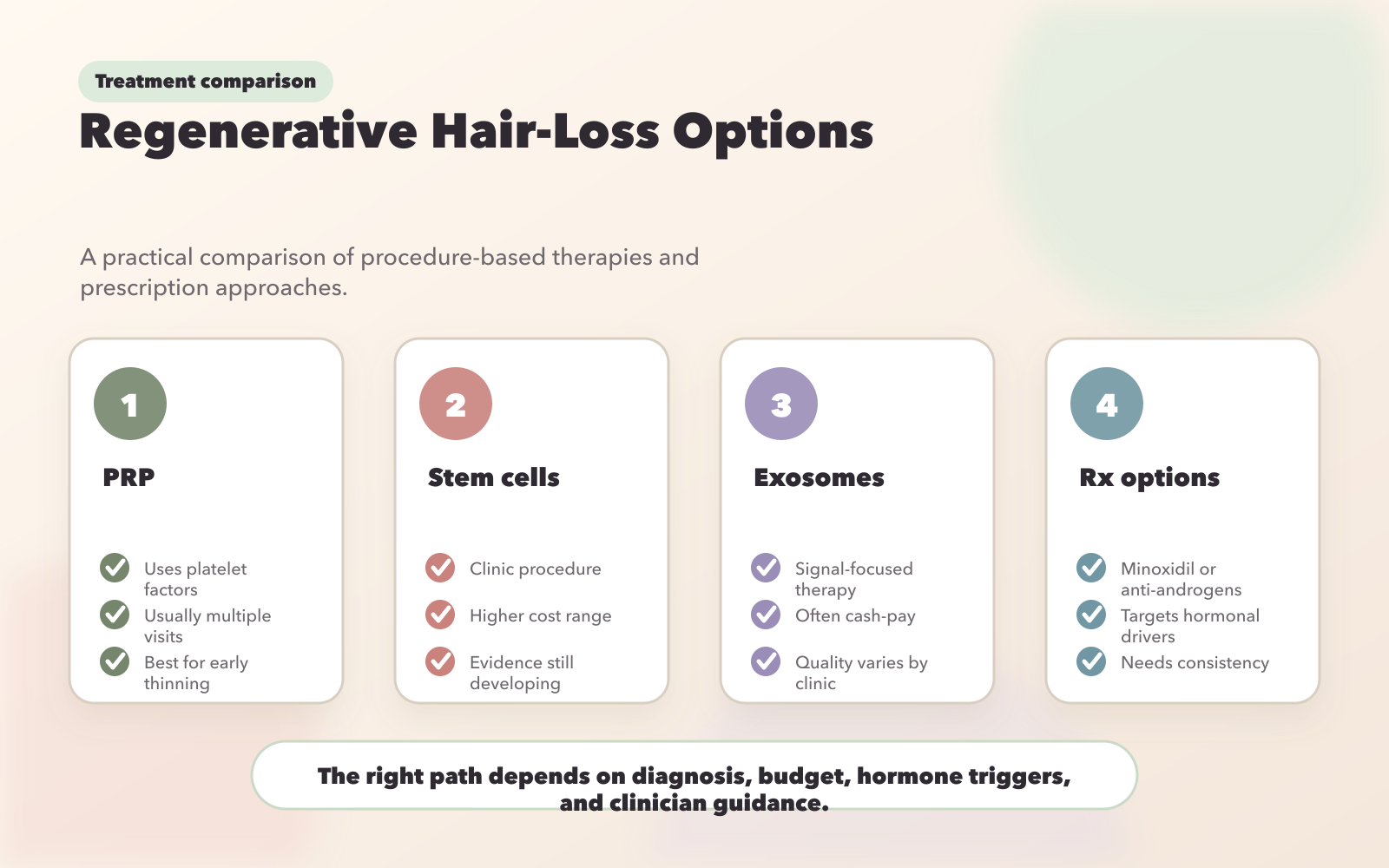
Regenerative Hair Loss Treatments Comparison: PRP, Stem Cells, Exosomes vs Prescription Options
Regenerative therapies and prescription treatments tackle hair loss from different angles. While regenerative therapies focus on reviving dormant follicles and enhancing the scalp environment, prescription treatments primarily address hormonal imbalances. Deciding which path to take depends on your specific needs, budget, and whether hormonal factors are playing a role in your hair loss.
Regenerative options like PRP (Platelet-Rich Plasma), exosome treatments, and stem cell therapy aim to stimulate follicle activity and improve scalp conditions. On the other hand, prescription treatments such as oral minoxidil and topical spironolactone work through distinct mechanisms. Minoxidil enhances blood flow and prolongs the hair growth phase (anagen phase) by opening potassium channels, while spironolactone blocks androgen receptors locally, preventing the miniaturization of hair follicles. Prescription treatments can act either systemically or topically to counter androgen effects, whereas regenerative therapies focus on follicle regeneration.
Regenerative Treatments: PRP, Stem Cells, and Exosomes
Among regenerative options, PRP therapy is the most extensively researched. Clinical trials have shown hair density improvements ranging from 23.1 to 49.4 hairs per square centimeter after six months. PRP utilizes concentrated platelets from your own blood, which release growth factors to stimulate hair follicles. Similarly, stem cell therapy has shown promise in restoring hair density by promoting follicle niche restoration and differentiation. Meanwhile, exosome therapy delivers bioactive molecules through nanosized vesicles, though it remains a newer option with limited safety data.
Prescription Treatments: Oral Minoxidil and Topical Spironolactone
On the prescription side, oral minoxidil has demonstrated impressive results. For instance, 90% of male patients showed clinical improvement after six months on a 5 mg daily dose. Women typically use lower doses, ranging from 0.25 mg to 1.25 mg, and oral minoxidil has been particularly beneficial for patients who don’t respond to its topical version. This is because the oral form bypasses the need for enzyme activation.
Topical spironolactone is another effective option, especially for women dealing with hormonal hair loss. It directly counteracts androgen activity at the scalp without causing the systemic side effects that can occur with the oral form.
"Low dose oral minoxidil yields a faster clinical response than other AGA therapies, including topical minoxidil and 5-alpha-reductase inhibitors."
– Michael Kaiser, Dr. Phillip Frost Department of Dermatology and Cutaneous Surgery
Treatment Comparison Table
| Treatment | Mechanism | Application Method | Best for Hormonal Hair Loss | Common Side Effects |
|---|---|---|---|---|
| PRP | Releases growth factors (PDGF, VEGF) | Subcutaneous injection | High (as adjuvant therapy) | Scalp tenderness, bruising, pain |
| Exosomes | Delivers bioactive molecules via vesicles | Injection or topical | Emerging | Limited safety data |
| Stem Cells | Promotes niche restoration and differentiation | Micrograft/injection | High | Pain at donor site, hematoma |
| Oral Minoxidil | Improves blood flow via potassium channels | Daily oral pill | General growth stimulant | Hypertrichosis (55.4%), pedal edema, headache |
| Topical Spironolactone | Blocks androgen receptors locally | Topical cream/solution | High (especially for women) | Local irritation, contact dermatitis |
Combining Treatments for Better Results
For many people, combining therapies can yield better outcomes. For example, pairing PRP with oral minoxidil or topical spironolactone can address both follicle activation and hormonal imbalances. Women experiencing hair loss due to hormonal conditions like PCOS may find this combination especially effective, as it tackles both androgen excess and follicle stimulation.
Future Developments in Hair Regeneration
The field of regenerative medicine for hair loss is advancing at a remarkable pace. Researchers are moving beyond simply stimulating existing hair follicles to creating entirely new ones, leveraging progress in areas like stem cell biology, gene editing, and bioengineering. These cutting-edge developments are paving the way for treatments tailored to individual needs.
Personalized Treatments for Hormonal Hair Loss
The future of hair regeneration lies in personalized medicine, especially for individuals with hormonal imbalances. Women dealing with conditions like PCOS or other hormonal disorders may soon benefit from therapies designed to align with their unique hormonal profiles. Instead of relying on generalized solutions, these treatments will analyze how specific levels of androgens and estrogens influence dermal papilla cells in the scalp. By combining hormonal profiling with regenerative therapies such as exosomes or stem cells, outcomes could be significantly improved. For instance, women experiencing hair loss due to excess androgens might see better results when regenerative treatments are paired with targeted hormonal interventions, creating an environment that encourages follicle activation and growth.
Advances in Cell-Based Therapies
In addition to personalized approaches, advancements in cell-based therapies are reshaping the possibilities for hair regeneration. One of the most promising developments involves Induced Pluripotent Stem Cells (iPSCs). Companies like Stemson Therapeutics are reprogramming adult cells into iPSCs, which are then differentiated into hair follicle components. These cells are integrated with synthetic scaffolds to form "follicular units" capable of directional hair growth.
"iPSCs offer a potentially unlimited source of cells for regenerative medicine and disease modeling."
– Poornima Sivamani et al., Regenerative Therapy
While iPSCs provide an unlimited supply of cells, cell-free therapies using exosomes are also gaining traction. Exosomes deliver essential growth factors and signaling molecules without the risks associated with live cell transplants, such as tumor formation or immune rejection. Interestingly, researchers estimate that up to 80% of the regenerative benefits of stem cell transplants come from these paracrine signals rather than the cells themselves. By 2026, these exosome-based therapies are expected to become more standardized, easier to store, and potentially available as off-the-shelf solutions.
Another exciting area of development is 3D bioprinting and supportive scaffolds, which aim to replicate the complex structure of natural hair follicles. Scientists are refining the use of hydrogel scaffolds made from materials like collagen and silk-gelatin. These scaffolds create a supportive environment, enhancing cell survival and guiding hair shaft growth in the correct direction. Additionally, techniques like hypoxic conditioning, where stem cells are cultured in low oxygen environments (1%–5%), are being employed to maintain cell potency and boost the secretion of critical growth factors like VEGF and PDGF.
Conclusion
Regenerative medicine is reshaping the way we approach hair loss, offering new hope, especially for those dealing with hormonal imbalances. One standout option is Platelet-Rich Plasma (PRP) therapy, which has shown encouraging results. Clinical studies report increases in hair density ranging from 23 to 49 hairs per square centimeter. Meanwhile, advanced treatments like stem cell and exosome therapies take things a step further by reactivating dormant hair follicle stem cells - cells that remain intact even when progenitor cells are damaged.
Clinical trials highlight the safety and effectiveness of these treatments. For example, autologous follicle stem cell injections have shown a 29% improvement in hair density, while adipose-derived stem cell therapies have boosted density by 31 hairs per square centimeter. These results are achieved through the release of growth factors such as VEGF, PDGF, and IGF-1, which extend the hair growth phase and counteract the effects of DHT.
In addition to regenerative therapies, prescription treatments can play a key role in hair restoration. Women experiencing hormonal hair loss due to conditions like PCOS or androgen excess now have access to convenient options like oral minoxidil and topical spironolactone. Companies like Oana Health make these science-backed treatments easily accessible through telehealth, eliminating the need for in-person visits.
Starting treatment early is crucial since regenerative therapies are most effective before hair follicles develop irreversible scarring or fibrosis. With androgenetic alopecia affecting 42–50% of women by age 70, these cutting-edge solutions offer a chance to take back control of your hair health. By combining advanced therapies with personalized care, women can regain both their confidence and their sense of control over their appearance.
FAQs
What’s the difference between PRP, stem cell, and exosome therapies for hair loss?
Regenerative treatments like PRP, stem cell therapy, and exosome therapy all aim to boost hair growth, but they take different paths to achieve this.
PRP (Platelet-Rich Plasma) involves taking a small sample of your blood, spinning it down to concentrate growth factors, and injecting it into your scalp. These growth factors work to wake up dormant hair follicles and improve blood circulation, which can encourage hair regrowth.
Stem cell therapy relies on regenerative cells, often sourced from your own fat tissue or donated materials. These cells are injected into the scalp and help repair and rebuild hair follicles, providing a more thorough regenerative effect compared to PRP.
Exosome therapy takes a different approach by using tiny vesicles derived from stem cells. These vesicles carry proteins and genetic instructions that signal your body to repair and regenerate hair follicles. Since this method doesn’t involve live cells, it may lower the risk of immune-related issues.
While PRP focuses on growth factors, stem cell therapy introduces regenerative cells, and exosome therapy uses cell-derived signals - all offering unique ways to support hair regrowth.
How do hormonal imbalances contribute to hair loss in women?
Hormonal imbalances play a significant role in hair loss among women. Shifts in estrogen and progesterone levels, particularly during perimenopause and menopause, can disrupt the hair's natural growth cycle. This often results in a shorter growth phase and noticeable thinning across the scalp. Additionally, higher levels of androgens, like testosterone and dihydrotestosterone (DHT), are linked to androgenetic alopecia - a common pattern of hair loss that many women experience by midlife.
Certain medical conditions, such as polycystic ovary syndrome (PCOS) or thyroid disorders, can also interfere with the hair growth cycle. These issues may cause hair follicles to shrink and lead to more frequent shedding. Emerging treatments in regenerative medicine, including stem cell-based therapies, aim to address these hormonal disruptions. By reactivating dormant follicles, these approaches seek to promote healthier and more consistent hair growth.
Can regenerative therapies be used alongside prescription treatments to improve hair growth?
Yes, treatments like PRP (platelet-rich plasma) or stem cell therapies can be paired with prescription medications such as minoxidil or finasteride to potentially improve hair growth. Studies indicate that using these methods together may provide enhanced results by tackling hair loss from different angles.
If you're thinking about combining treatments, it's crucial to consult a licensed medical professional. They can help create a tailored plan that suits your needs while ensuring both safety and effectiveness.