
Spearmint Oil for PCOS Hair Growth: Does It Work?
Spearmint oil is gaining attention for its potential to manage PCOS-related hair growth, but how effective is it? Here's the quick takeaway:
- PCOS and Hair Growth: Excess androgens in PCOS cause unwanted, coarse hair growth (hirsutism) in about 70–80% of affected women.
- Spearmint's Role: Spearmint may help lower testosterone levels, which could slow hair growth. Most research supports spearmint tea, not the oil, for this purpose.
- Animal Studies: Rat studies show spearmint oil can reduce testosterone and improve ovarian health, but these findings haven't been confirmed in humans.
- Human Research: Spearmint tea has been shown to reduce testosterone by 23–29% in a month, but visible hair reduction takes longer (3–6 months).
- Spearmint Oil Use: Topical application of diluted spearmint oil may provide localized effects, but no clinical studies directly support this for hirsutism.
If you're considering spearmint oil, be patient - results take time. For faster or more reliable outcomes, prescription treatments like Spironolactone or Eflornithine may be better options.
What Does the Research Say About Spearmint Oil for Hirsutism?
Animal Studies on Spearmint Oil and Hormones
Animal studies provide some of the most striking evidence regarding spearmint oil's effects. In a December 2017 study conducted at Shiraz University of Medical Sciences, researchers treated female rats with PCOS using spearmint essential oil for 20 days. The results were eye-opening: rats given a 300 mg/kg dose experienced a dramatic drop in testosterone levels. To put it in perspective, untreated PCOS rats had testosterone levels at 3.04 mIU/ml, but this fell to just 0.12 mIU/ml in the treated group - levels even lower than those in healthy controls.
Beyond hormone levels, the treatment also addressed ovarian health. Untreated PCOS rats averaged 10.50 ovarian cysts, while the treated rats had none. Additionally, Graafian follicles, which are critical for ovulation and absent in untreated rats, were restored in the treated group.
| Group | Testosterone Level (mIU/ml) | Ovarian Cysts | Graafian Follicles |
|---|---|---|---|
| Control (Normal) | 0.14 ± 0.02 | 0 | 0.16 ± 0.38 |
| PCOS (Untreated) | 3.04 ± 0.69 | 10.50 ± 4.50 | 0 |
| PCOS + Spearmint Oil (300 mg/kg) | 0.12 ± 0.01 | 0 | 0.14 ± 0.03 |
This data strongly suggests that high doses of spearmint oil can normalize testosterone levels and improve ovarian function in PCOS animal models. However, while these findings are promising, research on humans has primarily focused on spearmint tea rather than the essential oil.
Human Studies on Spearmint Tea and Facial Hair
When it comes to human studies, the focus shifts to spearmint tea rather than spearmint oil. While no trials have directly examined spearmint oil for reducing facial hair growth, clinical research on spearmint tea suggests it has anti-androgenic effects. Dermatologist Dr. Dray notes, "Topical application of spearmint essential oil, however, has not been examined in clinical studies for reducing facial hair growth in PCOS patients".
One notable human study, led by P. Grant in February 2010, involved 42 women with PCOS who drank spearmint tea twice daily for 30 days. The results showed significant reductions in both free and total testosterone levels (p < 0.05). Although measurable changes in hair growth weren't observed within the short study period, participants reported subjective improvements in their hirsutism. This aligns with what we know about hair growth cycles, which usually take 3–6 months to show visible changes.
Another shorter study conducted in Turkey explored the effects of drinking spearmint tea twice daily for just 5 days. In this trial, free testosterone levels dropped from 5.49 pg/mL to 3.92 pg/mL in women with hirsutism. These hormonal shifts reinforce spearmint's potential to reduce androgen levels, which could benefit women struggling with excessive facial hair.
Is it true mint helps in hair reduction in women with PCOS? - Dr. Chetali Samant
Spearmint Oil vs. Spearmint Tea: What's the Difference?
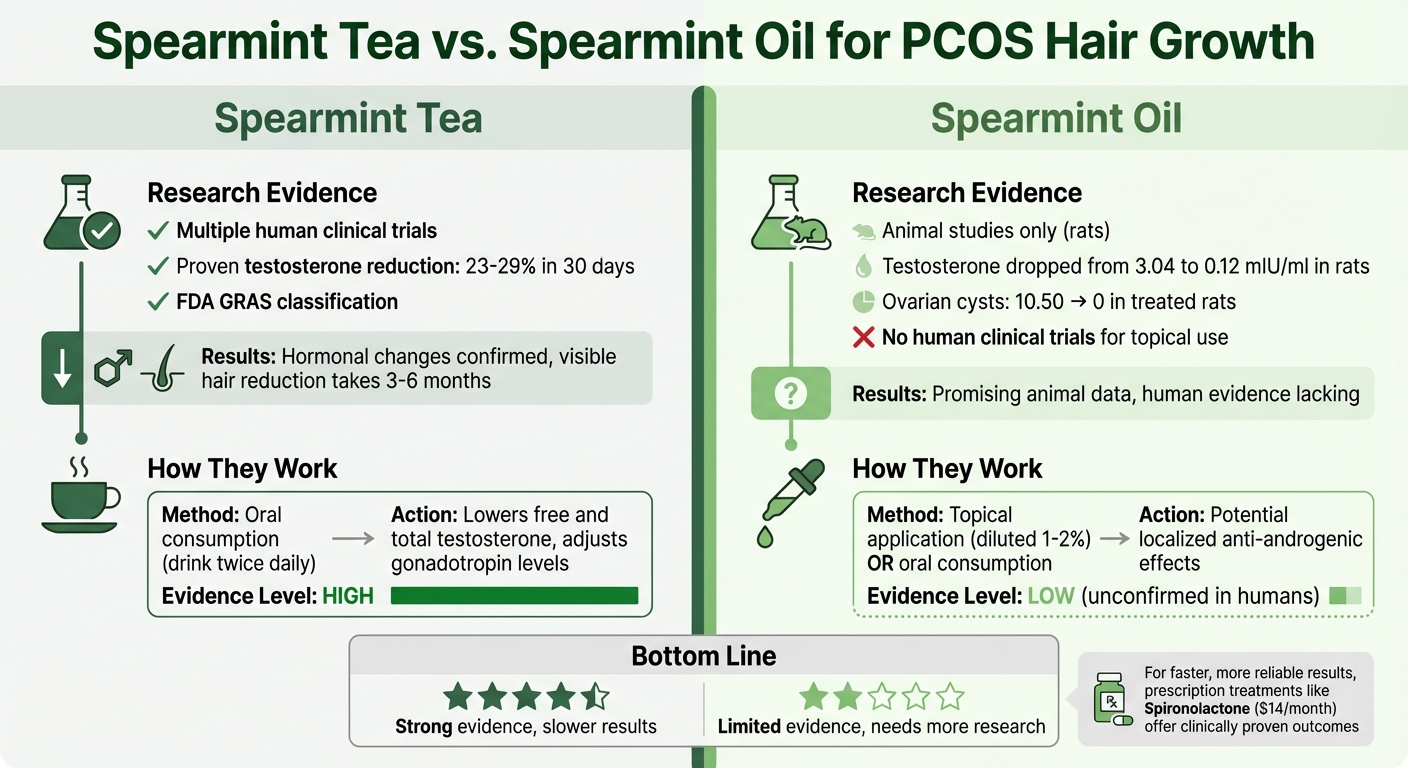
Spearmint Tea vs Oil for PCOS: Research Results and Treatment Comparison
Understanding how spearmint tea and oil function differently is key to assessing their potential in managing PCOS-related hirsutism.
How Do They Work Differently?
Spearmint tea, made by brewing dried spearmint leaves, helps lower free and total testosterone levels and adjusts gonadotropin levels, which can reduce circulating androgens. Animal studies show that consuming spearmint oil orally can reduce body weight, testosterone levels, and ovarian cysts, while also promoting follicular development. When applied topically, spearmint oil might provide localized anti-androgenic effects, although no clinical trials have confirmed this yet. Now, let’s dive into how these two compare.
Which One Has Better Evidence for Reducing Hair Growth?
Spearmint tea stands out with more robust evidence supporting its role in reducing hirsutism. Several trials have shown its ability to lower androgen levels, while there’s no clinical research validating spearmint oil - especially in its topical form - as a reliable treatment for reducing facial hair in PCOS.
"Spearmint has treatment potential on PCOS through inhibition of testosterone and restoration of follicular development in ovarian tissue"
This finding, however, comes from studies conducted on rats, not humans.
"The observed reductions in androgen levels following spearmint tea consumption underscore its promise as a complementary approach in managing androgen excess"
While hormonal benefits from spearmint tea are well-documented, achieving noticeable hair reduction may take consistent use over several months.
How to Use Spearmint Oil for PCOS Hair Growth
Getting the best results from spearmint oil requires careful application and consistency.
How to Apply Spearmint Oil Safely
Never apply undiluted spearmint essential oil directly to your skin - it’s highly concentrated and can cause irritation or burns. Instead, dilute it to a 1–2% concentration by mixing 1–2 drops of spearmint oil with 1 teaspoon (5 ml) of a carrier oil like jojoba, coconut, or almond oil. Alternatively, you can mix 2–3 drops into your favorite facial moisturizer for easier application.
Before using it more broadly, perform a patch test. Apply a small amount of the diluted mixture to your inner forearm and wait 24 hours. If you notice any irritation, discontinue use immediately.
When applying, focus on areas with unwanted hair, such as the chin, jawline, or neck. Use a cotton ball or clean fingertips to gently apply the oil, but steer clear of sensitive spots like the eyes, lips, nostrils, or any broken or irritated skin. If you feel stinging or see redness, stop using it and dilute the mixture further by adding more carrier oil.
How Often to Use It and What to Expect
Begin with 2–3 applications per week to see how your skin responds. If well-tolerated, you can gradually increase to using it twice daily. Many people prefer applying it at night, as this avoids interference from makeup or sun exposure.
Results take time. While some users notice thinner or lighter hair after about a month of consistent use, more noticeable changes often take 4–8 weeks. Full hair reduction may require several months of regular application. Consistency is key - sporadic use won’t yield the same effects.
sbb-itb-6dba428
Side Effects and Limitations of Spearmint Oil
Possible Side Effects
Spearmint oil, known for its anti-androgenic properties, is generally considered safe. The U.S. Food and Drug Administration (FDA) classifies spearmint as "Generally Recognized as Safe" (GRAS), whether used as a fresh herb or as an essential oil. Clinical trials involving spearmint tea for managing PCOS symptoms have reported no adverse effects over a 30-day period. Unlike prescription anti-androgens like Spironolactone, spearmint does not cause liver toxicity or diuresis.
That said, applying undiluted spearmint oil directly to the skin can lead to irritation or allergic reactions, such as rashes or contact dermatitis. To minimize this risk, always dilute spearmint oil with a carrier oil or mix it into a moisturizer before use.
Certain groups should avoid spearmint entirely. Men are advised against using spearmint for conditions like hirsutism, as its anti-androgenic effects could result in gynecomastia (breast tissue development). Pregnant women should also steer clear of consuming large amounts of spearmint due to potential risks to the uterus. Additionally, those with kidney problems, liver disease, or acid reflux should exercise caution, as spearmint could worsen these conditions.
These side effects, combined with individual differences, help explain why results can vary from person to person.
Why It May Not Work for Everyone
While spearmint oil shows promise, its effectiveness isn't guaranteed for everyone. Responses to herbal treatments often differ depending on the individual. Some studies highlight its ability to lower testosterone levels, but visible changes in hair growth may take longer to appear. As Dr. Grant from Eastbourne District General Hospital notes:
"The simple fact that this does not clearly translate into clinical practice is due to the relationship between androgen hormones and follicular hair growth and cell turnover time. Simply put, the study duration was not long enough."
Most research on spearmint's anti-androgenic effects focuses on spearmint tea rather than topical oil. The effectiveness of using spearmint oil directly on the skin to reduce hair growth remains less well-documented and requires further investigation. Additionally, factors like preparation methods, herb quality, and dilution ratios can lead to inconsistent results. Baseline hormone levels and the underlying cause of hirsutism - whether it's linked to PCOS or another condition - also play a significant role in how well spearmint works for an individual.
These variations underscore the importance of tailoring treatments to suit each person's unique needs, especially when dealing with PCOS-related symptoms.
Prescription Treatments for PCOS Hirsutism from Oana Health
When herbal remedies like spearmint oil deliver mixed results, prescription treatments offer a more reliable path to managing unwanted hair caused by PCOS.
Available Prescription Options
Prescription treatments take a more direct approach to addressing PCOS-related hair growth. Oana Health provides FDA-regulated options through its telehealth platform, where licensed medical providers review your health history and prescribe treatments tailored to your needs. These prescriptions are shipped directly to your home with free delivery.
- Spironolactone: This oral medication works as an androgen receptor antagonist, blocking excess testosterone responsible for unwanted hair growth. Unlike herbal solutions like spearmint tea, Spironolactone offers consistent dosing under clinical supervision, making hormonal management more predictable. It’s also budget-friendly at just $14 per month.
- Eflornithine 12%: This topical cream targets facial hair by inhibiting an enzyme essential for hair cell division, effectively slowing hair growth. Priced at $69 per month, it’s designed specifically for facial hair concerns.
- Hairless Hype: Combining prescription-grade ingredients, this treatment is formulated to address PCOS-related unwanted hair comprehensively. Like Eflornithine, it’s available at $69 per month.
Treatment Comparison and Pricing
Here’s a quick breakdown of the available treatments and their costs:
| Treatment | Monthly Price | Type | Focus |
|---|---|---|---|
| Spironolactone | $14 | Oral Prescription | Reducing androgen-driven unwanted hair |
| Eflornithine 12% | $69 | Topical Prescription | Slowing facial hair growth |
| Hairless Hype | $69 | Prescription Treatment | Reducing PCOS-related unwanted hair |
Each treatment requires an online health review by Oana Health’s licensed professionals to determine the most suitable option for your needs. The process is simple: complete an online consultation, receive personalized recommendations, and enjoy free delivery of your prescription right to your doorstep.
Conclusion: Does Spearmint Oil Work for PCOS Hair Growth?
Spearmint shows potential in managing PCOS-related hair growth, but it’s important to consider the nuances. Studies indicate that drinking spearmint tea can lower free and total testosterone levels by 28.9% and 23.5% within 30 days, respectively. However, these hormonal changes don’t immediately translate to visible hair reduction. Hair follicles grow at a slow pace, so even with significant hormonal adjustments, noticeable changes in hair growth may take several months. As researchers from Eastbourne District General Hospital observed, "The time taken for hirsutism to resolve is significant and a much longer future study is proposed". Additionally, while spearmint tea has strong human data supporting its effects, the evidence for topical spearmint oil remains sparse.
For those dealing with moderate to severe hirsutism, prescription treatments often provide more consistent and predictable results. Options like Spironolactone offer standardized dosing under medical supervision, making it a reliable choice for managing androgen-driven hair growth. At just $14 per month through Oana Health, it’s both accessible and clinically supported.
Spearmint can be a helpful addition to a broader treatment plan, but it’s unlikely to replace prescription options for more severe cases. If PCOS-related hair growth is a concern, working with licensed healthcare providers to explore evidence-based treatments is the most reliable way to achieve your goals. This approach emphasizes the importance of personalized care in effectively managing PCOS symptoms.
FAQs
Can spearmint oil help reduce unwanted hair growth caused by PCOS?
Spearmint oil has been explored for its potential to reduce androgen levels, which might help with unwanted hair growth in individuals dealing with PCOS. Some studies suggest that it could play a role in addressing hirsutism, a common symptom of PCOS linked to elevated androgen levels. While these initial findings offer hope, more in-depth research is needed to confirm its overall effectiveness.
If you’re thinking about incorporating spearmint oil into your PCOS management plan, it’s important to consult a healthcare provider. They can help you determine the safest and most suitable treatment options for your specific situation.
Is spearmint tea or spearmint oil better for managing PCOS-related hair growth?
Both spearmint tea and spearmint oil show promise in addressing PCOS symptoms tied to high androgen levels, but they work in different ways.
Spearmint tea has been shown in research to significantly lower testosterone levels - by as much as 29% after just 30 days of daily consumption. It helps reduce androgens while balancing hormones like LH and FSH, which can alleviate symptoms like excessive facial hair and hirsutism.
Spearmint oil, on the other hand, has less robust evidence. Early studies suggest that when applied topically, it may reduce localized hair growth and androgen activity. However, more research is needed to fully understand its effectiveness.
In summary, spearmint tea is better supported by scientific studies for overall hormonal balance, while spearmint oil may have potential for targeted, localized effects.
Are there any risks or side effects of using spearmint oil to reduce hair growth caused by PCOS?
Using spearmint oil as a natural approach to support hair growth, particularly for those dealing with PCOS, is generally considered safe for most individuals. However, it’s worth noting a few potential risks. Prolonged use might affect hormone levels, which could lead to side effects like gynecomastia (enlarged breast tissue) in men. That said, it’s reassuring that there’s no evidence linking spearmint oil to liver damage or excessive fluid loss - issues often associated with some pharmaceutical treatments.
As with any supplement or natural remedy, it’s always a smart idea to check in with a healthcare provider beforehand, especially if you have existing health conditions or are on other medications.