
Top 5 Androgen Blockers for PCOS: Adherence Comparison
Managing PCOS symptoms like acne, hirsutism, and irregular cycles often requires androgen blockers when lifestyle changes or birth control pills aren't enough. Here's a quick look at the top five options, their effectiveness, and adherence challenges:
- Spironolactone: Affordable and widely used. Effective for hirsutism and acne but requires potassium monitoring. Compliance drops significantly over time.
- Flutamide: Very effective for hirsutism but comes with liver toxicity risks and requires frequent dosing and monitoring.
- Finasteride: Convenient once-daily dosing with minimal side effects. Teratogenic, so reliable contraception is mandatory.
- Cyproterone Acetate (CPA): Strong anti-androgen effects but linked to blood clots and meningiomas. Not available in the U.S.
- Bicalutamide: Effective for severe hirsutism but limited PCOS-specific data and potential liver toxicity.
Quick Comparison
| Androgen Blocker | Dosing Frequency | Key Risks | Adherence Challenges | Monthly Cost (Generic) |
|---|---|---|---|---|
| Spironolactone | Once or twice daily | Potassium imbalance | Side effects like dizziness | ~$61 |
| Flutamide | Three times daily | Liver toxicity | Frequent dosing, liver tests | ~$140 |
| Finasteride | Once daily | Teratogenic | Mandatory contraception | ~$148 |
| Cyproterone Acetate | Once daily | Blood clots, meningiomas | Long-term safety concerns | Not available in U.S. |
| Bicalutamide | Once daily | Liver toxicity | Monitoring required | Data not available |
Each option has pros and cons, so consult your healthcare provider to find the best fit for your needs.
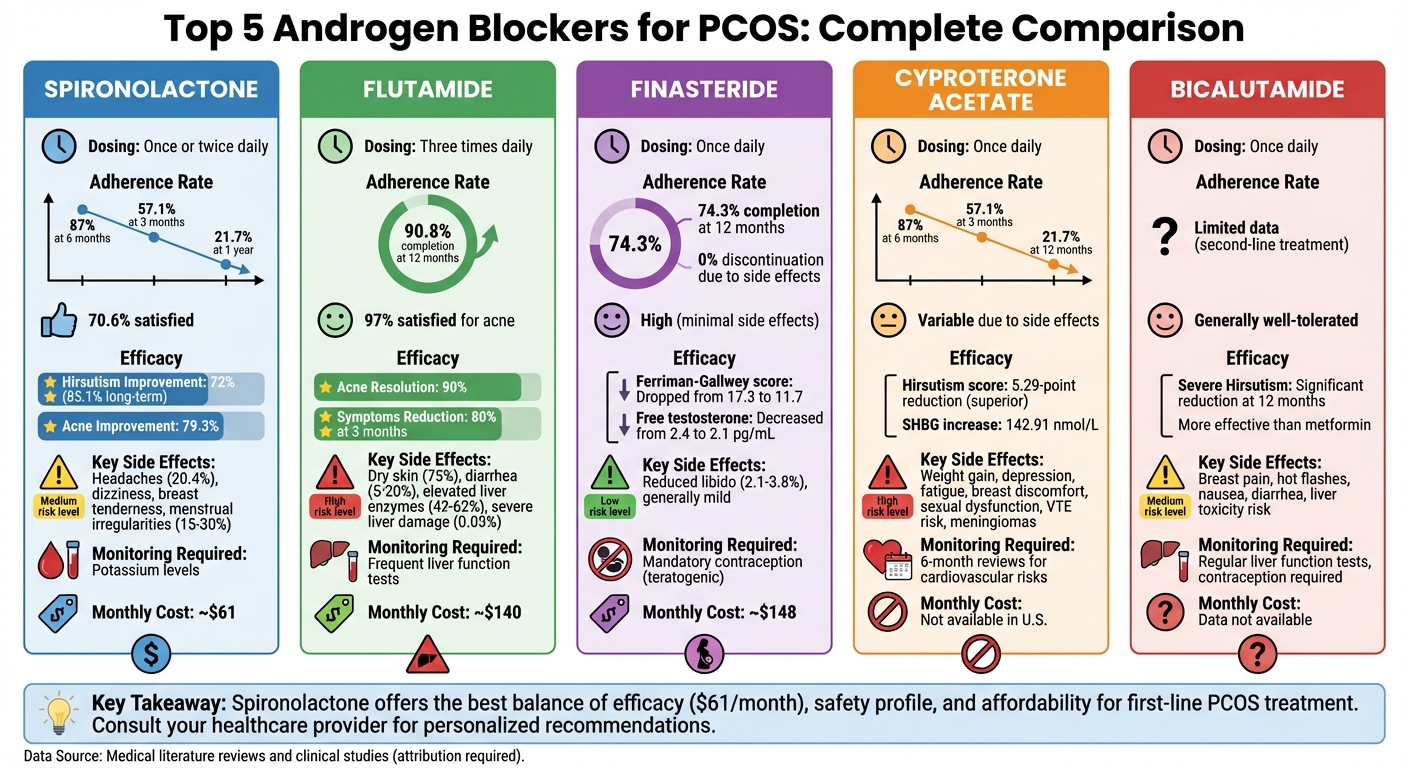
Androgen Blockers for PCOS: Adherence Rates, Efficacy, and Cost Comparison
1. Spironolactone
Adherence Rates
In a six-month study focusing on oral contraceptive (OCP)-based therapy that included Spironolactone, researchers found an impressive 87% compliance rate. However, persistence dropped significantly over time - from 57.1% at three months to just 21.7% at the one-year mark. Clinical trials also reported that 74% of participants maintained adherence levels above 80% over a 24-week period.
Patient Satisfaction
Long-term follow-ups highlight notable improvements in key areas: hirsutism (85.1%), menstrual function (82.7%), and acne (79.3%). When paired with oral contraceptives, hirsutism scores - measured using the modified Ferriman–Gallwey scale - improved by an average of 59.9%. Additionally, one trial revealed that 70.6% of participants were satisfied with their treatment, compared to only 43.1% in the placebo group.
"Successful treatment of hirsutism with combination OC+SPL requires at least 6 months of therapy, with the proportion of satisfied patients continuing to increase with treatment duration." – Ricardo Azziz, MD, MPH, MBA, State University of New York
Side Effects Impacting Compliance
Side effects such as headaches (20.4% vs. 12.0% with placebo), dizziness, breast tenderness, and menstrual irregularities (affecting 15–30% of users) are common but tend to diminish over time as the body adjusts to the medication. Simple measures - like taking the medication with food or standing up slowly - can help minimize these symptoms. Despite these challenges, Spironolactone remains a reliable option for managing hyperandrogenism symptoms.
Efficacy for Hyperandrogenism Symptoms
Retrospective data show that 72% of women experience improvements in hirsutism with Spironolactone, regardless of their age or how long they’ve had symptoms. For acne sufferers, Acne-Specific Quality of Life scores increased significantly, rising from 13.2 at baseline to 21.2 after 24 weeks of treatment. When combined with oral contraceptives, the reduction in hirsutism is even more pronounced compared to either treatment used alone. Consistent use for at least six months is typically required to see meaningful results, with benefits continuing to grow for up to five years.
2. Flutamide
Adherence Rates
In a 12-month clinical trial, 90.8% of participants (119 out of 131) successfully completed flutamide treatment. However, the drug’s short half-life - about six hours - necessitates three-times-daily dosing, which can make it harder for patients to stick to the regimen compared to once-daily alternatives.
Side effects also vary with dosage. At 125 mg daily, 12.5% of users experience side effects, but this increases to 17.3% at 250 mg and 21.2% at 375 mg. Additionally, the requirement for frequent liver function tests adds another layer of complexity to managing treatment. These monitoring demands may lead some patients to discontinue the medication. Despite these hurdles, overall patient satisfaction with flutamide remains high.
Patient Satisfaction
In a long-term study involving 230 women, an impressive 97% reported satisfaction with flutamide for acne management. This satisfaction is largely due to its effectiveness, as flutamide achieves a 90% resolution of acne, which far exceeds spironolactone’s 40% resolution rate. For many patients, the benefits outweigh the challenges of its dosing schedule and monitoring requirements.
"Flutamide at 125 mg daily during 12 months was the minimum effective dose to diminish hirsutism in patients with polycystic ovary syndrome or with idiopathic hirsutism." – Calaf et al.
Side Effects Impacting Compliance
While flutamide is effective, its side effects and dosing schedule can affect adherence. Dry skin, caused by reduced sebum production, is a common issue, affecting about 75% of users, though it can often be managed with moisturizers. Diarrhea impacts 5–20% of patients, leading 6% to discontinue treatment altogether.
The most serious concern is hepatotoxicity. Severe liver damage is rare, occurring in just 0.03% of patients (3 in 10,000), but elevated liver enzymes are more common, appearing in 42–62% of users. If jaundice develops or ALT levels double the upper limit of normal, the medication must be stopped immediately.
Efficacy for Hyperandrogenism Symptoms
Flutamide delivers rapid results. Within just three months, it reduces acne, seborrhea, and hair loss scores by 80%. For hirsutism, the medication brings levels close to normal within six months, significantly outperforming spironolactone, which achieves only a 30% reduction in the same time frame. The minimum effective dose for hirsutism treatment is 125 mg daily, offering a good balance between effectiveness and tolerability.
3. Finasteride
Finasteride stands out for its simplicity, requiring just one dose per day. This convenience makes it a popular choice compared to more complicated treatment plans.
Adherence Rates
Finasteride is well-tolerated, which plays a key role in its strong adherence rates. In a 12-month clinical study involving 70 PCOS patients, 74.3% (52 out of 70) completed the entire treatment, with no discontinuations due to side effects. Interestingly, the 18.6% dropout rate (13 out of 70) was attributed entirely to missed follow-up appointments, not adverse reactions to the medication. Its once-daily dosing schedule further supports adherence, especially when compared to treatments that require multiple doses throughout the day. This ease of use contributes to overall patient satisfaction, as explored below.
Patient Satisfaction
"According to Richard Sadovsky, M.D., Finasteride's minimal side effects make it a top choice."
Patients appreciate Finasteride for its dual benefits: lowering androgen levels effectively while also improving insulin resistance markers like HOMA-IR. Its mechanism of action - blocking the 5-alpha-reductase enzyme - prevents testosterone from converting into dihydrotestosterone (DHT), reducing scalp skin DHT levels by over 60%. These advantages combine to make it a reliable and highly favored option.
Side Effects Impacting Compliance
Finasteride’s side effects are generally mild. In PCOS-related clinical trials where participants took 5 mg daily for 6 to 12 months, no significant side effects were reported. When side effects do occur, they are usually short-lived and occur at rates similar to those seen with a placebo. However, one critical factor for compliance is the need for effective contraception. Finasteride is highly teratogenic and can cause feminization of a male fetus, so sexually active patients must use reliable contraception throughout treatment. Sexual side effects, such as reduced libido, are rare, affecting only 2.1% to 3.8% of users.
Efficacy for Hyperandrogenism Symptoms
Finasteride has shown significant results in managing hyperandrogenism symptoms over a 12-month period. In clinical studies, the Ferriman-Gallwey hirsutism score dropped from 17.3 ± 5.1 to 11.7 ± 5.2. Free testosterone levels decreased from 2.4 ± 0.6 pg/mL to 2.1 ± 0.5 pg/mL, and androstenedione levels fell from 3.8 ± 1.4 ng/mL to 2.6 ± 0.6 ng/mL. Patients should be aware that achieving optimal results typically requires consistent use for 6 to 18 months. Daily dosing has been proven more effective than intermittent use; for example, taking Finasteride every three days resulted in a weighted mean difference of –3.48 in hirsutism scores compared to daily dosing. Beyond addressing hair-related symptoms, Finasteride also improved insulin resistance, with HOMA-IR values dropping from 2.6 ± 0.6 to 1.2 ± 0.7 after 12 months of treatment.
4. Cyproterone Acetate (CPA)
Cyproterone acetate (CPA), when combined with ethinylestradiol (commonly referred to as co-cyprindiol), is known for delivering some of the strongest anti-androgenic effects in managing polycystic ovary syndrome (PCOS) symptoms.
Adherence Rates
Adherence to CPA treatment tends to follow patterns observed with oral contraceptive pills (OCPs). Initially, compliance rates are high but show a steady decline over time, often due to safety concerns. For instance, adherence rates start at 87% over six months, drop to 57.1% at three months, and further decline to just 21.7% at 12 months. To address these challenges, clinical guidelines recommend reviewing CPA treatment every six months. This regular review helps assess its effectiveness and monitor for potential long-term side effects, particularly cardiovascular risks. These adherence trends highlight the importance of balancing efficacy with tolerability when considering CPA.
Side Effects Impacting Compliance
CPA’s side effect profile plays a significant role in affecting patient compliance. Commonly reported issues include weight gain, depression, fatigue, breast discomfort, and sexual dysfunction. These everyday challenges often lead to dissatisfaction with treatment and, in some cases, discontinuation.
More serious risks associated with CPA include an increased likelihood of venous thromboembolism (VTE) compared to placebo. Additionally, prolonged use has been linked to the development of meningiomas. These safety concerns have prompted many international guidelines to reclassify CPA as a second-line therapy, especially for adolescents.
"Its use has recently declined, particularly in Italy, due to several safety concerns such as increased risk of meningioma development and growth as well as a higher likelihood of venous thromboembolism onset." - GREM Journal
Efficacy for Hyperandrogenism Symptoms
Despite these challenges, CPA remains highly effective in addressing hyperandrogenism symptoms, particularly hirsutism. In fact, CPA has shown superior results compared to several other treatments. A 12-month study demonstrated that CPA reduced the modified Ferriman-Gallwey hirsutism score by 5.29 points, significantly outperforming desogestrel (1.69-point reduction) and drospirenone (2.12-point reduction). The same study found that CPA increased sex hormone-binding globulin (SHBG) levels by 142.91 nmol/L and decreased the Free Androgen Index by 10.57.
When combined with ethinylestradiol, CPA also outperformed spironolactone at six months and finasteride at 24 months in reducing hirsutism symptoms. However, it’s worth noting that flutamide was found to be more effective than CPA at managing unwanted hair growth over a 12-month period in one study. For optimal results, patients are generally advised to use CPA consistently for at least 6 to 12 months to observe meaningful clinical improvements.
sbb-itb-6dba428
5. Bicalutamide
Initially approved for treating metastatic prostate cancer, bicalutamide is now used off-label for managing severe hirsutism in PCOS. It works by competitively blocking androgen receptors, setting it apart from other anti-androgens because it doesn’t interfere with other hormonal pathways.
Adherence Rates
There isn’t much data on adherence rates for bicalutamide in PCOS patients. Because of this, it’s typically considered a second-line treatment. It’s often prescribed when first-line options, like combined oral contraceptives, don’t work well or aren’t well-tolerated. This makes bicalutamide a fallback option in the treatment hierarchy.
Side Effects and Compliance Challenges
Bicalutamide is generally well-tolerated, with side effects like breast pain, swelling, hot flashes, nausea, diarrhea, and sleepiness being rare causes for stopping treatment. However, its potential to cause liver toxicity means patients need regular liver function tests, which can impact long-term adherence. Symptoms like upper abdominal pain, dark urine, or yellowing of the eyes should be reported immediately.
Another critical consideration: bicalutamide can lead to feminization of a male fetus. For this reason, effective contraception is required during treatment and for 130 days after the last dose.
Effectiveness for Hyperandrogenism
A 12-month double-blind study involving 70 PCOS patients showed that 50 mg of bicalutamide daily, combined with an oral contraceptive pill (OCP), significantly reduced severe hirsutism. This was confirmed through videodermoscopy and modified Ferriman-Gallwey scores.
Patients typically need at least six months of consistent treatment to see meaningful results. Compared to metformin, bicalutamide is more effective for addressing hyperandrogenism. However, it can increase total cholesterol and LDL levels, making regular monitoring essential.
Advantages and Disadvantages
When managing PCOS, each androgen blocker comes with its own set of strengths and limitations. Here's a summary of the main points, along with a table that outlines the key benefits, risks, and costs of each option.
Spironolactone is a widely-used and affordable first-line treatment, costing around $61 per month. It has shown high patient compliance in studies but requires regular potassium monitoring due to the risk of hyperkalemia. Some users may also experience mild side effects like breast tenderness or irregular bleeding.
Cyproterone Acetate (CPA) is highly effective for severe hirsutism because of its strong anti-androgen properties. However, it carries a higher risk of blood clots (VTE) and meningiomas, and it is not available in the United States.
Flutamide is another powerful option for addressing hirsutism but comes with a significant risk of liver toxicity, necessitating regular liver function tests. It is also more expensive, with a monthly cost of about $140.
Finasteride is effective for treating both hair loss and hirsutism, with the convenience of once-daily dosing. However, it is more expensive (approximately $148 per month) and is classified as Category X for pregnancy, meaning it poses serious risks of birth defects.
Bicalutamide offers targeted receptor blocking and is generally well-tolerated. However, concerns about liver toxicity and limited long-term data in PCOS make it a second-line option.
"Current evidence does not support the use of anti-androgens preferentially to COCPs to treat hyperandrogenism in PCOS. Anti-androgens could be considered to treat hirsutism... where COCPs are contraindicated, poorly tolerated, or present a sub-optimal response." – Alesi S, et al., eClinicalMedicine
The table below provides a concise comparison of these androgen blockers:
| Androgen Blocker | Key Advantages | Key Disadvantages | Monthly Cost (Generic) |
|---|---|---|---|
| Spironolactone | Well-studied; high compliance; affordable | Requires potassium monitoring; possible breast tenderness and irregular bleeding | ~$61 |
| Cyproterone Acetate | Potent anti-androgen effect | Increased VTE and meningioma risk; unavailable in the U.S. | Varies (not U.S. approved) |
| Flutamide | Highly effective for hirsutism | Severe liver toxicity risk; regular liver tests required | ~$140 |
| Finasteride | Effective for hair loss and hirsutism; convenient once-daily dosing | Teratogenic (Category X); higher cost | ~$148 |
| Bicalutamide | Targeted action; generally well-tolerated | Limited long-term PCOS data; potential liver toxicity | Data not available |
Choosing the right treatment requires balancing these pros and cons to suit individual patient needs. Personalized therapy remains essential for improving adherence and ensuring positive outcomes in clinical practice.
Conclusion
Spironolactone stands out as a top choice among androgen blockers for managing PCOS. Its reputation stems from its proven effectiveness, predictable safety record, and affordability, making it a trusted option for both patients and healthcare providers. Additionally, its antimineralocorticoid properties help reduce common side effects like water retention and bloating, often seen with other hormonal treatments.
Experts back its reliability:
"Low-dose spironolactone improves hirsutism in a majority of hirsute women, irrespective of age, severity or duration of hirsutism, menstrual status, or serum hormone levels." – Roger S. Rittmaster, M.D.
For noticeable improvements in hair growth patterns, consistent daily use over at least six months is essential. Studies show that sticking to a daily regimen yields significantly better results compared to intermittent dosing.
To make treatment more accessible, Oana Health provides telehealth consultations with licensed professionals who can prescribe Spironolactone. Medications are delivered straight to your door with free shipping, emphasizing the importance of convenience in maintaining adherence.
Ultimately, selecting the right androgen blocker means considering effectiveness, safety, and cost while addressing individual needs. Spironolactone’s strong track record, patient satisfaction, and ease of access make it a dependable first-line option for many women managing hyperandrogenic symptoms.
FAQs
What challenges affect sticking to androgen blockers for PCOS treatment?
Sticking with androgen blockers for PCOS treatment isn't always easy. Side effects like fatigue, weight gain, or hormonal shifts can make it tough for patients to stay on track. On top of that, treatments requiring frequent check-ins or juggling multiple medications can feel overwhelming, leading some to stop altogether.
Another key factor is patient satisfaction. If a medication doesn’t effectively manage symptoms like acne or excessive hair growth - or if the side effects become unbearable - patients are more likely to discontinue use. This is where personalized care and strong communication from healthcare providers can make a huge difference. Offering tailored guidance and ongoing support can help patients navigate these challenges and stick with their treatment plans.
How do side effects influence the choice of androgen blockers for managing PCOS symptoms?
When selecting an androgen blocker for PCOS, side effects play a major role in the decision-making process. These effects can directly influence how well someone sticks to their treatment plan, which is key to managing symptoms like acne, unwanted facial hair, or hair thinning.
Certain androgen blockers can come with risks, including hormonal imbalances or potential liver-related complications. These issues might lead patients to stop their medication or switch to another option. Striking the right balance between effectiveness and safety is vital, and healthcare providers often customize treatments based on individual needs and preferences to achieve the best possible results.
Why is spironolactone commonly used to treat PCOS symptoms like excess hair growth and acne?
Spironolactone is frequently prescribed to address symptoms of PCOS because it lowers elevated androgen levels. High androgens are often responsible for issues like excess facial or body hair (hirsutism) and acne. By blocking androgen receptors, spironolactone gradually helps reduce these symptoms, leading to improvements in both appearance and well-being.
For many individuals, spironolactone proves effective in managing hyperandrogenism over the long term, which is why it’s a common option recommended by healthcare providers for PCOS-related challenges.