
Top 5 Treatments for Androgenic Alopecia
Androgenic alopecia, or female pattern hair loss, is a common condition affecting millions of women. It’s driven by genetic and hormonal factors, particularly dihydrotestosterone (DHT). Hair gradually thins, especially on the crown, often impacting self-esteem. Early treatment is critical to prevent permanent follicle damage. Here are the top treatments:
- Spironolactone (Oral): Blocks DHT and reduces testosterone. Effective for regrowth, especially for women with PCOS. Common doses: 25–200 mg/day. Side effects: menstrual changes, dizziness, rare potassium issues. Cost: ~$14/month.
- Topical Spironolactone: Targets scalp androgen receptors with minimal systemic effects. Common forms: 1% gel or 5% solution. Side effects: mild irritation. Cost: ~$43/month.
- Oral Minoxidil: Boosts blood flow to follicles. Doses: 0.25–1.25 mg/day. Side effects: unwanted hair growth, fluid retention. Cost: ~$25/month.
- Topical Minoxidil: FDA-approved, extends hair growth phase. Available in 2% or 5% formulations. Side effects: scalp irritation, temporary shedding. Cost: ~$12/month.
- Combination Therapies: Pairing treatments (e.g., spironolactone + minoxidil) often improves results. Effective for PCOS-related hair loss. Costs vary (~$32/month).
Quick Tip: Consistent use is essential for long-term results. Consult a healthcare provider for personalized advice.
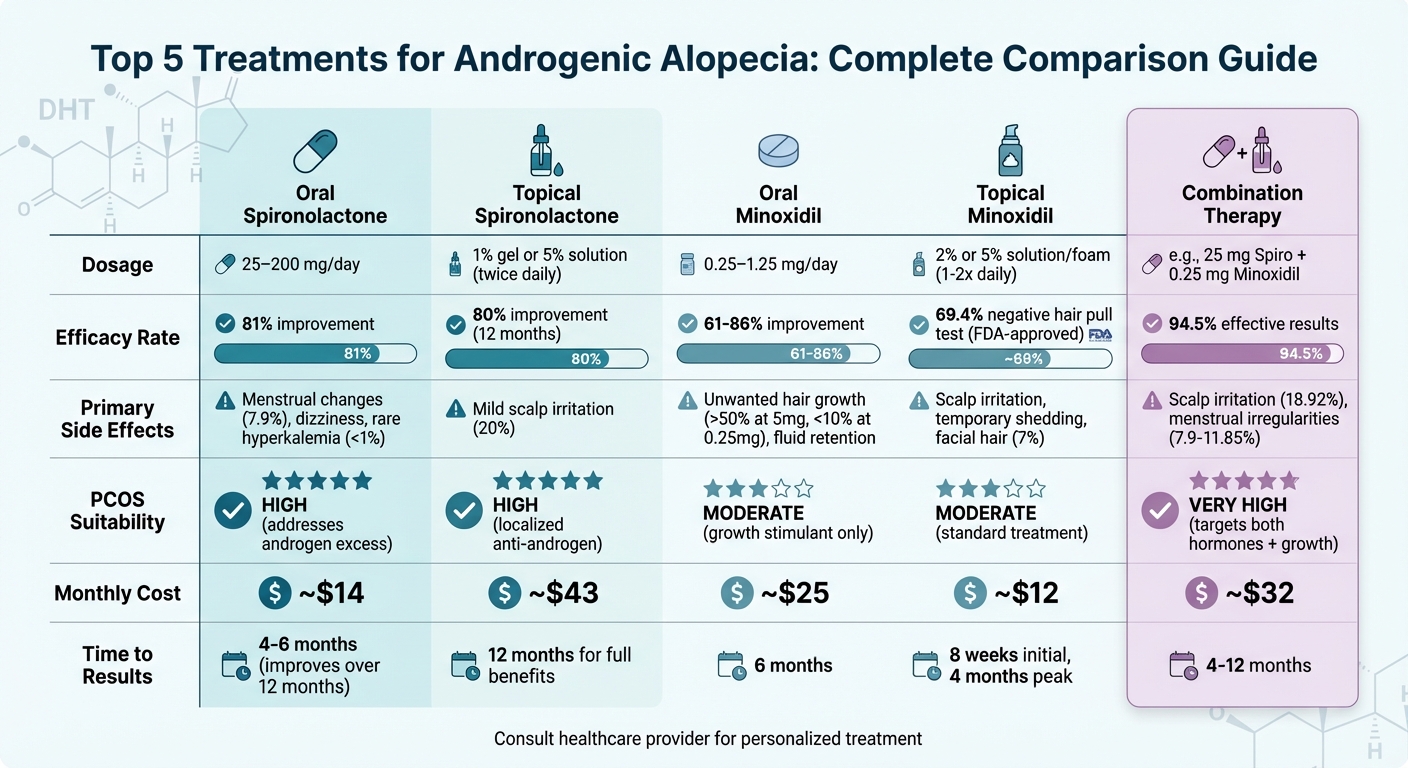
Comparison of Top 5 Androgenic Alopecia Treatments: Efficacy, Dosage, and Cost
Understanding treatment of androgenetic alopecia.
1. Spironolactone
Originally developed to manage high blood pressure, spironolactone has found a new role in addressing female pattern hair loss. It works by blocking androgen receptors, which prevents DHT from binding to hair follicles, and by reducing ovarian testosterone production. This makes it especially beneficial for women with PCOS .
Efficacy in Hair Regrowth
Studies highlight spironolactone’s effectiveness in promoting hair regrowth. A meta-analysis reported a 56.6% overall improvement, with success rates of 43.2% when used alone and 65.8% when combined with minoxidil. Results tend to improve significantly after 12 months, emphasizing the importance of sticking with the treatment.
In a systematic review of 195 women taking daily doses between 80 mg and 110 mg, 81% noted visible hair growth improvements. Another study conducted at Lahey Hospital & Medical Center by Dr. Maryanne Makredes Senna examined 62 women on low-dose spironolactone (average 35.28 mg). Over the course of a year, their Sinclair Scale scores dropped from 2.47 to 1.81, indicating substantial progress.
Suitability for Women with PCOS
For women with PCOS, spironolactone offers a dual benefit: addressing hair loss while also tackling other androgen-driven symptoms like acne and unwanted facial hair. By blocking testosterone and reducing ovarian androgen production, it helps restore hormonal balance .
"Spironolactone is now becoming the most commonly used, off-label anti-androgen for the treatment of female AGA with 100 to 200 mg as the usual oral daily dose." - Wang et al., Department of Dermatology, The First Affiliated Hospital of Nanjing Medical University
For women managing PCOS-related hair loss and other symptoms, Oana Health offers spironolactone starting at $14 per month, including prescriptions from licensed professionals and free home delivery.
Common Dosages
Spironolactone is typically prescribed in daily doses ranging from 25 mg to 200 mg. For hair loss, doses between 100 mg and 200 mg are common. For those sensitive to higher doses, low-dose options (≤50 mg) are available . Patients usually need 4-6 months of consistent use to notice results, with improvements becoming more pronounced over the first year . To maintain hair regrowth, long-term use is often necessary, as stopping the medication usually leads to renewed shedding.
Side Effect Profiles
The most frequently reported side effects include menstrual irregularities, which affect 7.9–11.9% of users . Other potential side effects include dizziness, headaches, increased urination, and, in about 18.92% of cases, scalp itching or flaking . Hyperkalemia (high potassium levels) is rare, occurring in less than 1% of patients on standard doses. However, healthcare providers may recommend periodic blood tests to monitor potassium levels, particularly for older patients or those on higher doses .
Spironolactone is classified as a Category X drug for pregnancy, meaning it must not be taken during pregnancy or if you are planning to conceive, as it poses risks like feminizing a male fetus. Women of childbearing age should use reliable contraception while on this medication.
Next, we’ll take a closer look at topical formulations of spironolactone.
2. Topical Spironolactone
Building on the discussion of oral spironolactone, the topical version offers a more localized way to block androgens while minimizing systemic absorption. Typically available as a 1% gel or 5% solution, it’s applied directly to the scalp twice daily, targeting androgen receptors in the area of concern.
Efficacy in Hair Regrowth
Research suggests that topical spironolactone delivers encouraging results for hair regrowth. For instance, a 12-month study found that 80% of participants using a 1% spironolactone gel alone showed noticeable improvement. When combined with 5% minoxidil, the success rate climbed to 100%. Histological analysis further confirmed an increase in the terminal-to-vellus hair ratio. Another study in 2022 by Ammar et al., involving 120 participants over three months, revealed that a 5% spironolactone solution alone improved hair density by 55% on the quartile grading scale. When paired with minoxidil, the improvement reached 100%.
A Solution for Women with PCOS
Topical spironolactone is particularly suited for women experiencing hair loss due to PCOS. Unlike the oral form, it works directly on androgen receptors in the scalp without causing systemic side effects like menstrual irregularities or potassium imbalances.
"Topical spironolactone is safer than oral administration and is suitable for both male and female patients, and is expected to become a common drug for those who do not have a good response to minoxidil." - Chaofan Wang, Department of Dermatology, The First Affiliated Hospital of Nanjing Medical University
For those interested, Oana Health provides topical spironolactone starting at $43 per month, including prescriptions from licensed professionals and free home delivery.
Common Dosages
Topical spironolactone is typically prescribed as a 1% gel or 5% solution, applied twice daily. Unlike oral versions, which require doses ranging from 25 mg to 200 mg, the topical form focuses its effects on the scalp. Patients are encouraged to maintain consistent use for at least 12 months to evaluate its full benefits.
Side Effects
Side effects are generally mild, with about 20% of users experiencing contact dermatitis, which may cause itching, burning, or scaling at the application site. Crucially, topical spironolactone avoids the systemic side effects often linked to its oral counterpart, such as menstrual disruptions or hyperkalemia. Up next, we’ll compare this treatment to oral minoxidil to explore additional options.
3. Oral Minoxidil
While topical minoxidil has FDA approval, oral minoxidil serves as an off-label alternative for women who struggle with applying it to the scalp. Originally developed in high doses to treat hypertension, oral minoxidil works by dilating blood vessels, which increases blood flow to hair follicles and prolongs the growth phase. Interestingly, about 20% of patients using it for hypertension experienced hair growth, prompting its use in treating hair loss.
Efficacy in Hair Regrowth
Low doses of oral minoxidil (ranging from 0.25 to 1.25 mg daily) have shown promising results, improving hair growth in 61%–86% of women. A 2024 study revealed that a daily 1 mg dose increased hair thickness comparably to 5% topical minoxidil, although photographic evaluations slightly favored the topical solution. Despite this, more than 60% of participants expressed satisfaction with the 1 mg daily dose. With 95% absorption through the gastrointestinal tract, its effectiveness hinges on the sulfotransferase enzyme converting it into its active form.
Common Dosages
For women, typical starting doses range from 0.25 to 1.25 mg per day, while men often require higher doses of 2.5 to 5 mg. Treatment usually begins with a low dose, which can be adjusted after six months if necessary. Some regimens combine 0.25 mg oral minoxidil with 25 mg spironolactone to help manage fluid retention. Providers like Oana Health offer oral minoxidil at starting prices of $25 per month. It's important to note that treatment must be ongoing, as stopping it will reverse any progress made.
Side Effect Profiles
One of the most common side effects is hypertrichosis, or unwanted hair growth, which occurs in over 50% of patients taking 5 mg daily but drops to under 10% with a 0.25 mg dose. Other reported side effects include lightheadedness, headaches, fluid retention, rapid heartbeat, and weight gain. Rarely, serious complications like pericardial effusion have been noted at higher doses. Additionally, oral minoxidil is classified as pregnancy category C and is excreted in breast milk, so it’s not recommended during pregnancy or breastfeeding. A multicenter study involving 1,404 patients found that fewer than 2% had to discontinue treatment due to side effects when properly managed.
Up next, we’ll dive into topical minoxidil to see how it stacks up against the oral form.
sbb-itb-6dba428
4. Topical Minoxidil
Topical minoxidil stands out as the only FDA-approved topical treatment for androgenic alopecia in women. It helps by extending the hair’s growth phase and enlarging hair follicles, which leads to thicker, longer strands. Additionally, it improves blood flow around the follicles and encourages the production of vascular endothelial growth factor (VEGF), a key player in hair health. Like hormonal therapies, topical minoxidil provides a focused approach that complements a broader treatment plan for androgenic alopecia.
Efficacy in Hair Regrowth
Clinical studies consistently show that topical minoxidil delivers notable results in promoting hair regrowth. For example, one randomized control trial reported that 69.4% of participants using 5% topical minoxidil experienced a negative hair pull test after 12 weeks. A meta-analysis also found an increase in hair density, ranging from 8.11 to 14.94 hairs per square centimeter compared to placebo. Women using this treatment often see a 14–18% boost in scalp hair over a year, with initial improvements visible around the 8-week mark and peak results achieved after about 4 months. This makes it a key option for managing hair thinning effectively.
Suitability for Women with PCOS
For women with PCOS, topical minoxidil is often the go-to treatment for androgenic alopecia. It's frequently paired with antiandrogens like spironolactone to tackle both hair thinning and the hormonal imbalances associated with PCOS. However, women with PCOS may be more susceptible to hirsutism, so proper application is essential. Always wash your hands immediately after use to avoid accidentally transferring the product to areas like your face.
Common Dosages
The standard dosages for women include a 2% solution applied twice daily (1 mL per application) or 5% foam used once daily (half a capful). Many prefer the foam formulation because it doesn’t contain propylene glycol, a common irritant in liquid versions. To maximize absorption, apply the product to a dry scalp and wait at least 4 hours before washing your hair. Over time, absorption improves naturally.
Side Effects to Consider
Common side effects include itching, dryness, and scaling of the scalp. About 7% of women may notice unwanted facial hair. Temporary shedding during the first 2–6 weeks is also normal, as dormant follicles shift into the growth phase; this typically stops by week 6. If irritation occurs with the liquid, switching to the foam can help.
In rare cases, excessive absorption might lead to headaches, dizziness, or palpitations, though only about 1.4% of the product enters the bloodstream. To maintain results, consistent use is essential, as stopping treatment can reverse progress. Up next, we’ll dive into combination therapies that can further improve outcomes.
5. Combination Therapies
Combination therapies tackle androgenic alopecia by addressing both hormonal imbalances and follicular health, often leading to better results compared to single treatments. While individual therapies focus on one mechanism, these combinations work on multiple fronts - balancing hormones and stimulating hair growth simultaneously.
Efficacy in Hair Regrowth
Combining treatments builds on the benefits of single agents, delivering noticeably improved outcomes. A 2024 randomized trial revealed that pairing topical minoxidil with oral spironolactone produced an "excellent" response in 56.7% of patients, whereas a minoxidil-finasteride combination showed no such results. Similarly, studies pairing topical spironolactone gel with minoxidil gel showed clear clinical improvements.
One effective oral combination - 80–100 mg spironolactone with 5% topical minoxidil - resulted in an average increase of 16.75 hairs per square centimeter and a 14.99 mm boost in hair shaft diameter. Even lower doses, such as 0.25 mg oral minoxidil combined with 25 mg spironolactone, reduced shedding and improved density. These findings align with earlier studies on spironolactone and minoxidil as standalone treatments. Early intervention is key, as treatment effectiveness diminishes with prolonged or severe hair loss.
"Spironolactone is an effective and safe treatment of androgenic alopecia which can enhance the efficacy when combined with other conventional treatments such as minoxidil." - Weixin Fan, Department of Dermatology, The First Affiliated Hospital of Nanjing Medical University
Suitability for Women with PCOS
For women dealing with PCOS, combination therapies offer a targeted solution. Spironolactone helps counteract elevated androgen levels, while minoxidil promotes hair growth. Across six studies involving 273 patients, 94.5% reported positive results when using spironolactone-based combinations. These therapies not only address hair thinning but can also help manage related PCOS symptoms like acne and unwanted facial hair.
Common Dosages
Dosages are carefully calibrated to balance effectiveness and safety. Common regimens include 100 mg oral spironolactone daily paired with 5% topical minoxidil, applied once or twice daily. For those seeking a topical-only option, 1% spironolactone gel combined with 5% minoxidil gel, applied twice daily, offers similar benefits with fewer systemic side effects. Low-dose oral combinations, such as 25 mg spironolactone with 0.25 mg minoxidil, are another option for those concerned about side effects. Consistency is key - ongoing use is necessary to maintain results.
Side Effect Profiles
Most side effects from combination therapies are mild to moderate, with only 2.79–3.2% of patients discontinuing due to adverse reactions. Common issues include scalp irritation (18.92%) and menstrual irregularities (7.9–11.85% among those taking oral spironolactone). Facial hair growth is reported in 4.1–6.93% of cases, while hyperkalemia is rare, occurring in just 0.9–1.3% of patients. Topical combinations typically cause fewer systemic effects, such as menstrual changes or breast tenderness, compared to oral options. Women using oral spironolactone should monitor their blood pressure and potassium levels, though complications are uncommon in healthy young women.
For those interested in personalized combination treatments, Oana Health offers telehealth consultations with licensed professionals. They provide prescription-based therapies delivered directly to your door, complete with free shipping.
Treatment Comparison Table
To make it easier to evaluate the treatments discussed earlier, here’s a quick-reference table comparing key factors like dosage, effectiveness, side effects, suitability for PCOS, and monthly cost.
| Treatment | Dosage | Efficacy Rate | Primary Side Effects | PCOS Suitability | Monthly Cost |
|---|---|---|---|---|---|
| Oral Spironolactone | 25–200 mg daily | 81% improvement | Menstrual irregularities (7.9%), dizziness/headache (6.5%), hyperkalemia (0.9%) | High – addresses androgen excess | $14/month |
| Topical Spironolactone | 1% gel or 5% solution (twice daily) | 80% improvement after 12 months | Local irritation, mild contact dermatitis | High – localized anti-androgen effect | $43/month |
| Oral Minoxidil | 0.25–5 mg daily | 38% density increase (frontal) and 23% (vertex) after 24 weeks | Hypertrichosis, lower limb edema, tachycardia | Moderate – stimulates growth without hormonal effect | $25/month |
| Topical Minoxidil | 2% or 5% solution/foam (twice daily) | FDA‐approved treatment for female pattern hair loss | Scalp irritation, facial hypertrichosis | Moderate – standard growth stimulant | ~$12 for 60 mL |
| Combination Therapy | e.g., 25 mg Spironolactone + 0.25 mg Minoxidil | 94.5% effective results | Varies with dosage, but lower doses reduce side effects | Very High – targets both hair growth and hormonal imbalance | $32/month |
This table underscores the strengths of each treatment, helping you identify the one that aligns best with your needs. Notably, combination therapies stand out for their effectiveness, particularly for managing hormonal imbalances linked to PCOS.
For tailored treatment recommendations, Oana Health provides telehealth consultations with licensed professionals. They can prescribe options like oral spironolactone, topical spironolactone, or oral minoxidil, all delivered straight to your door with free shipping.
Conclusion
Managing androgenic alopecia is a long-term commitment, as stopping treatment typically results in hair loss returning within months. The therapies outlined here - ranging from oral and topical spironolactone to minoxidil and combination approaches - have consistently delivered positive outcomes, with combination methods often yielding the best results.
Patience is key, as most treatments require 4–12 months of consistent use to show noticeable improvements. This highlights the importance of a tailored treatment plan designed to meet individual needs.
It's essential to consult a licensed healthcare provider for an accurate diagnosis and to rule out other conditions that could contribute to hair loss, such as iron deficiency, thyroid issues, PCOS, cardiovascular disease, or insulin resistance. Regular check-ins with a professional ensure safe management of potential side effects and track progress effectively.
"Shared decision-making between patient and practitioner is central to the selection of specific AGA treatments." - Jeff Donovan, MD, PhD, Donovan Hair Clinic
Oana Health makes personalized care more accessible by connecting individuals with licensed professionals who can prescribe evidence-based treatments like oral spironolactone, topical spironolactone, and oral minoxidil. These medications are delivered directly to your doorstep, helping to eliminate the embarrassment that often prevents people from seeking in-person care. This convenient approach ensures you receive the support needed to manage androgenic alopecia effectively.
With these proven treatments available through Oana Health, managing androgenic alopecia becomes a more achievable and straightforward process.
FAQs
What are the common side effects of using spironolactone for hair loss?
Spironolactone is a medication frequently prescribed for androgenic alopecia, but like any treatment, it comes with potential side effects. The most commonly reported issues include elevated potassium levels (hyperkalemia), dizziness, and mild stomach upset. Occasionally, some people might experience fatigue or notice changes in their menstrual cycle.
Before starting spironolactone for hair loss, it's crucial to consult a licensed healthcare professional. They can help you weigh the potential risks and benefits to determine if this treatment suits your needs.
How can combining treatments improve results for androgenic alopecia?
Combining treatments for androgenic alopecia (AGA) can often lead to better results by tackling multiple causes of hair loss at once. For example, using topical minoxidil alongside oral finasteride tends to deliver more noticeable improvements compared to using either treatment on its own. Minoxidil works by increasing blood flow and stimulating hair follicles, while finasteride helps by lowering levels of dihydrotestosterone (DHT), the hormone responsible for shrinking hair follicles.
Other treatment pairings, such as platelet-rich plasma (PRP) with microneedling or low-level laser therapy (LLLT), can further support hair regrowth. These methods focus on improving scalp health and reactivating dormant follicles, addressing hair loss from different angles. Since the most effective combinations depend on individual factors, consulting a healthcare provider is essential to develop a tailored treatment plan.
Why is it important to use hair loss treatments consistently?
Consistency plays a crucial role in managing hair loss. Most treatments are designed to either encourage hair regrowth or slow down further loss. However, discontinuing their use can cause any progress to fade within a few months.
For the best outcomes, it's important to stick to the prescribed treatment plan and apply the products as directed. Regular use helps sustain progress and keeps the treatment effective over the long term.