
Checklist: Choosing Oral or Topical Minoxidil
Struggling to choose between oral and topical minoxidil? Here's what you need to know:
- Effectiveness: Both forms promote hair regrowth, but oral minoxidil may work better for those with low scalp enzyme activity.
- Convenience: Oral requires one daily pill, while topical needs twice-daily application, which can be time-consuming.
- Side Effects: Topical causes localized scalp irritation, while oral can lead to systemic effects like unwanted body hair or fluid retention.
- Cost: Topical is available over-the-counter starting at $13.33/month; oral requires a prescription, costing $15–$40/month plus medical monitoring.
- Suitability: Oral is better for widespread hair loss or if topical causes irritation. Topical is safer for those with heart concerns or wanting to avoid systemic effects.
Quick Overview:
| Aspect | Topical Minoxidil | Oral Minoxidil |
|---|---|---|
| Effectiveness | Works locally; relies on scalp enzymes | Systemic activation; bypasses scalp issues |
| Ease of Use | Twice-daily scalp application | One daily pill |
| Side Effects | Scalp irritation, dryness | Unwanted body hair, fluid retention |
| Cost | $13.33–$45/month (OTC) | $15–$40/month (Rx + monitoring) |
| Best For | Localized hair loss, sensitive to systemic effects | Widespread thinning, low enzyme activity |
Takeaway: Oral minoxidil offers convenience and better adherence but comes with systemic risks. Topical is safer for localized treatment and those with heart concerns. Consult your healthcare provider to decide what fits your needs.
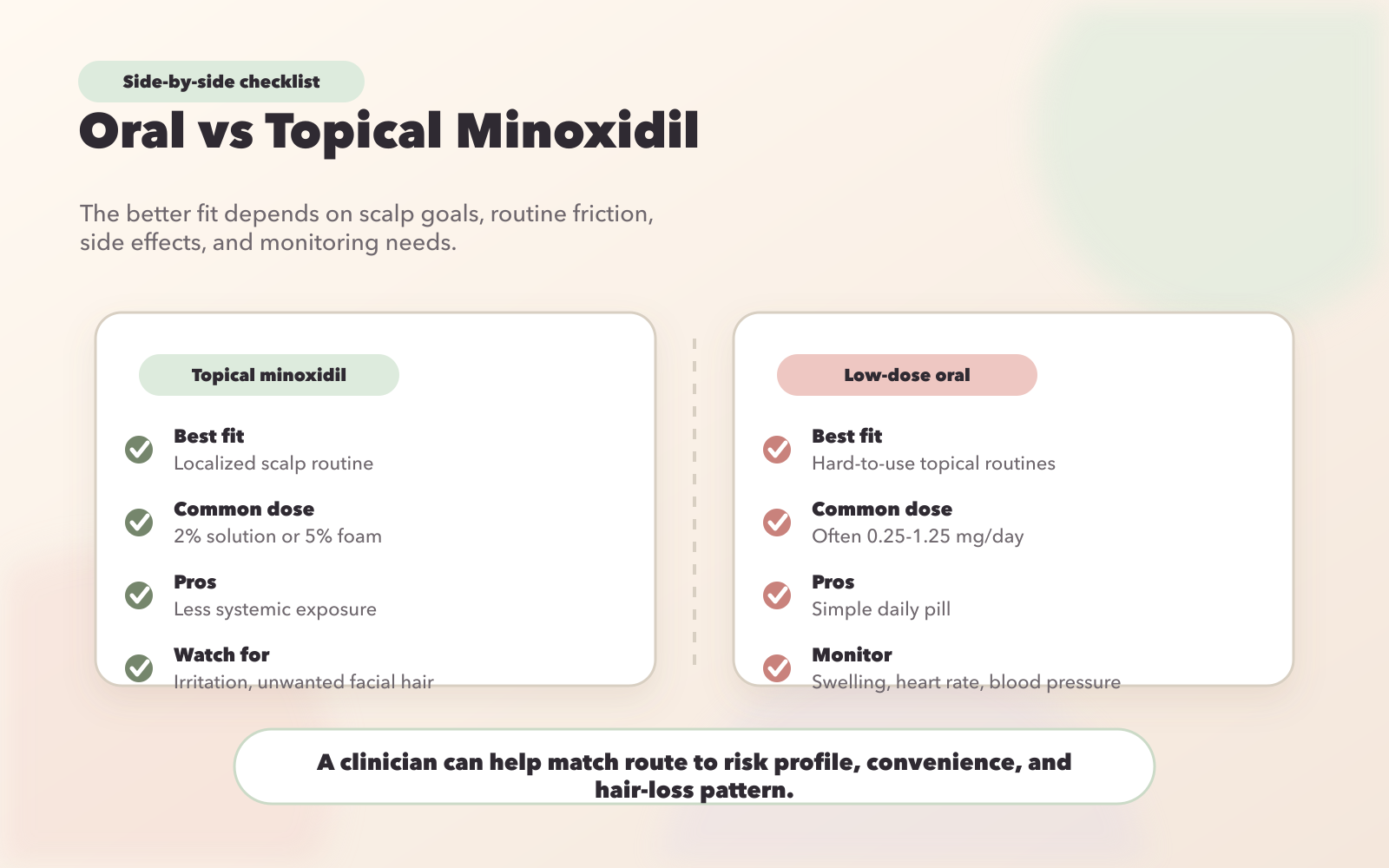
Oral vs Topical Minoxidil: Side-by-Side Comparison Chart
How Oral and Topical Minoxidil Work
How Each Form Works
Topical minoxidil, when applied to the scalp, relies on local SULT1A1 enzymes to convert a small percentage (1.4%–5%) into minoxidil sulfate. This active form then targets hair follicles to encourage regrowth.
Oral minoxidil, taken as a pill, works differently. About 95% of the drug is absorbed through the gastrointestinal system, where liver SULT2A1 enzymes convert it into minoxidil sulfate. This systemic activation allows the medication to circulate throughout the body.
Both versions stimulate hair growth by opening ATP-sensitive potassium channels. This action promotes vasodilation, improving blood flow and delivering more oxygen and nutrients to hair follicles. They also shorten the telogen (resting) phase and extend the anagen (growth) phase, helping thin hairs become thicker terminal hairs. Interestingly, around 60% of people have low follicular sulfotransferase activity, which may explain why oral minoxidil can sometimes outperform topical treatments.
Understanding these processes helps determine which form is more suitable for individual needs.
When to Use Each Form
Topical minoxidil is an FDA-approved, over-the-counter option designed specifically for scalp application. It’s ideal for those who don’t have scalp sensitivity and can commit to applying it twice daily. Since about 75% of the absorbed minoxidil is taken up within the first four hours, it’s important to avoid washing your hair during that time.
Oral minoxidil, on the other hand, might be a better choice if you experience irritation from topical formulations (often due to ingredients like propylene glycol) or find the twice-daily application inconvenient. It’s also worth considering if topical treatments haven’t delivered the desired results, as oral minoxidil’s systemic activation can be more effective. In one study, 18.8% of topical users stopped treatment due to its inconvenience, whereas none of the oral users discontinued for that reason. However, oral minoxidil requires a prescription and close medical supervision since it affects the entire body.
"I personally think oral is superior to topical, mainly because the patient's actually using it. They're more likely to take a pill a day versus apply something topically twice a day."
- Adam Friedman, MD, Professor and Chair of Dermatology at George Washington University
For those with cardiovascular concerns or who want to avoid systemic side effects - such as unwanted hair growth on areas like the face or arms - topical minoxidil is generally the safer first option. Oral minoxidil is not recommended for individuals with pheochromocytoma, as it can trigger catecholamine release.
sbb-itb-6dba428
Checklist: Effectiveness Comparison
Hair Regrowth Timeline and Results
When it comes to hair regrowth, both oral and topical minoxidil follow similar timelines. Typically, users can expect the first signs of new hair growth within 6–8 weeks of consistent application or ingestion. However, it’s common to experience temporary shedding during the initial 1–3 months of use for both treatments.
Noticeable improvements generally appear by 3–6 months with oral minoxidil, while topical minoxidil shows results around 4–6 months. Peak benefits are usually seen between 6–8 months for oral and 6–12 months for topical applications. For example, a 2020 study found that men taking 5 mg of oral minoxidil daily saw a +35.1 hairs/cm² increase in hair density and a 15.2% improvement in hair diameter after 24 weeks.
Interestingly, oral minoxidil users tend to miss fewer treatment days compared to those using topical solutions. This adherence advantage could play a role in its effectiveness for certain individuals. Let’s now explore how hair loss patterns influence these treatments.
Results by Hair Loss Pattern
Clinical evidence suggests that both oral and topical minoxidil perform similarly overall, but subtle differences emerge based on hair loss patterns. A 2024 JAMA Dermatology trial highlighted that 5 mg oral minoxidil provided a 24% improvement in the vertex (crown) area, slightly outperforming 5% topical minoxidil. Similar results were observed in the frontal scalp region.
For women, a 2021 randomized clinical trial involving 72 participants over 36 weeks revealed that those taking 0.25 mg of oral minoxidil daily achieved a 13% increase in hair density, compared to a 6% increase for users of 2% topical minoxidil applied twice daily. Additionally, after 12 months of using 5% topical minoxidil, 62% of patients experienced a reduction in alopecia-affected areas. Among men, 43% of those on 5 mg oral minoxidil reported "excellent improvement" scores by 24 weeks.
Oral minoxidil may be particularly beneficial for individuals with low scalp enzyme activity, as its systemic activation bypasses this limitation. For early-stage or localized thinning, topical minoxidil remains a reliable option. However, oral minoxidil is increasingly favored for advanced or widespread hair loss due to its systemic effects and higher adherence rates.
Oral vs. Topical Minoxidil: What’s Really More Effective?
Checklist: Side Effects and Safety
When deciding between topical and oral minoxidil, it's important to weigh their distinct side effects and safety considerations. Topical minoxidil mainly causes localized reactions on the scalp, such as itching, dryness, flaking, and a burning sensation. Since less than 5% of the medication is absorbed through the skin, systemic effects are rare [14, 23]. On the other hand, oral minoxidil affects the entire system, leading to side effects like unwanted body hair growth (hypertrichosis), headaches (reported by 14% of users), and fluid retention (seen in 1.3% to 10% of patients).
Topical Side Effects
The side effects of topical minoxidil are mostly confined to the application site. Common issues include scalp irritation, itching, and dryness, and, in some cases, contact dermatitis. To reduce these reactions:
- Apply the solution only to a dry scalp and avoid using it on sunburned, inflamed, or irritated skin.
- If the product accidentally gets into your eyes or on sensitive facial skin, rinse thoroughly with cool water.
- Wash your hands after application to avoid spreading the solution to other areas, which could lead to unwanted facial hair growth.
The alcohol-based formulation can leave hair feeling greasy. To help the solution dry faster, you can use a hairdryer on a low-temperature setting after application.
Oral Side Effects
Oral minoxidil comes with a wider range of systemic effects. Hypertrichosis is one of the most common side effects, occurring in 15% to 49% of patients on lower doses and up to 80% at higher doses. Other potential issues include cardiovascular symptoms like tachycardia, palpitations, and dizziness. Electrocardiogram (ECG) changes have been observed in about 60% of patients, though these are typically asymptomatic. Fluid retention is another concern, often causing swelling in the legs and ankles, particularly in women. If you experience sudden weight gain of 5 pounds or more, it could indicate significant fluid accumulation and should be reported to your doctor.
Medical Monitoring Requirements
Because oral minoxidil has systemic effects, it requires ongoing medical monitoring. Before starting treatment, your healthcare provider will check your blood pressure and heart rate, with follow-ups at 4–8 weeks and then every 3–6 months. Karen Berger, Pharm.D., explains:
"Your healthcare provider will review how and when to monitor your blood pressure, heart rate, and weight while taking oral minoxidil. It is important to follow these instructions closely and report any changes to your provider right away".
Daily weight checks and monitoring your resting pulse are also recommended. If your pulse increases by 20 beats per minute or more above your baseline, contact your healthcare provider. In contrast, topical minoxidil generally requires only self-monitoring for skin irritation and does not demand professional oversight.
Checklist: Practical Considerations
Daily habits, cost, and ease of use play a big role in sticking with a treatment over time.
Daily Use and Application
Topical minoxidil involves applying a liquid or foam directly to your scalp once or twice a day. To apply, part your hair, use a dropper or foam applicator, and massage the product into your scalp. However, the alcohol-based formula can leave your hair feeling greasy or sticky, which might make styling more difficult.
Oral minoxidil, by contrast, is taken as a single daily pill with water. This eliminates the need for scalp application and the messiness that comes with it.
"Taking a single daily pill eliminates the inconvenience of twice-daily scalp applications, avoiding issues with greasy hair, styling difficulties, and application mess." - Drugs.com
Oral tablets are also easier to travel with, making them a convenient option for people with busy or unpredictable schedules.
Once you've assessed how either option fits into your routine, the next step is to consider cost and availability.
Cost and Access
Topical minoxidil is widely available over-the-counter at drugstores and online, no prescription needed. Generic versions can cost as little as $13.33 per month with subscription services, while brand-name products like Rogaine range from $25.00 to $45.00 per month.
Oral minoxidil, however, requires a prescription and a medical consultation. Generic oral minoxidil typically costs between $15.00 and $40.00 per month, with a 2.5 mg dose falling in the $30–$40 range. Online consultations for a prescription often start at $59.00, and insurance generally does not cover the medication when it's prescribed solely for hair loss.
Some providers, like Oana Health, offer oral minoxidil for $25.00 per month, which includes the consultation, prescription, and free shipping.
| Product Form | Estimated Monthly Cost | Access |
|---|---|---|
| Generic Topical Minoxidil | $13.33 – $15.00 | Over-the-counter |
| Brand-Name Topical (Rogaine) | $25.00 – $45.00 | Over-the-counter |
| Generic Oral Minoxidil | $15.00 – $40.00 | Prescription only |
It's important to note that oral minoxidil requires additional medical monitoring. Heart health screenings are recommended at baseline, at 4–8 weeks, and then every 3–6 months, which may increase overall healthcare costs.
Consistency Requirements
No matter which form you choose, consistent daily use is essential for long-term results. Skipping doses reduces effectiveness, and stopping treatment altogether will reverse any hair regrowth. Studies suggest that oral minoxidil users tend to stick to their regimen better, likely because it doesn’t involve the hassle of scalp applications.
"By circumventing scalp application, oral minoxidil reduces the treatment burden and avoids the aesthetic and discomfort complaints that limit adherence." - Sonja Kobayashi, BSa, The Ohio State University College of Medicine
If you've found it hard to keep up with twice-daily topical applications or dislike the greasy residue, oral minoxidil’s simpler routine may make it easier to stay consistent. On the other hand, if you prefer the ease of picking up an over-the-counter option and want to avoid prescription medications, topical minoxidil could be a better fit - provided you can commit to the application schedule.
This checklist breaks down the practical aspects of both options to help you decide which one fits your lifestyle and goals.
How to Choose the Right Option
Main Decision Factors
Deciding between oral and topical minoxidil comes down to four main considerations: your hair loss pattern, cardiovascular health, scalp sensitivity, and daily habits.
If your hair loss is localized, topical minoxidil might be the better fit. However, for more widespread thinning or if you use hairpieces or keratin fibers that make applying topical treatments inconvenient, the benefits and risks of oral minoxidil could make it a more practical choice.
Cardiovascular health is another critical factor. People with heart conditions, blood pressure issues, or disorders like pheochromocytoma should generally lean toward topical minoxidil. This is because only about 1.4% of a topical dose enters the bloodstream, making it less likely to affect the heart. Oral minoxidil, on the other hand, works systemically as a vasodilator and requires close medical supervision.
Your scalp condition also matters. If you deal with eczema, contact dermatitis, or irritation from ingredients in topical products (like propylene glycol), oral minoxidil might be a better option to sidestep these issues. Additionally, if your body has low follicular enzyme activity, oral minoxidil may deliver better results.
Finally, think about your lifestyle and ability to stick to a routine. Research shows that oral minoxidil often leads to better adherence because it’s easier to incorporate into a daily routine compared to the more time-consuming application of topical treatments.
Once you’ve evaluated these factors, consult a healthcare provider to finalize your decision.
Working with a Healthcare Provider
After considering your personal needs, it’s crucial to collaborate with a healthcare provider for tailored advice. They’ll help you balance your preferences with safety and effectiveness.
Before your appointment, prepare by documenting your cardiovascular history, scalp sensitivities, and baseline vital signs. Be ready to discuss your daily habits - like how often you style your hair, whether you use hairpieces, and if you’ve had trouble sticking to treatments in the past.
If oral minoxidil is prescribed, regular follow-ups are essential. Expect to check in with your provider at 4–8 weeks initially, and then every 3–6 months. These visits will monitor your blood pressure, heart rate, and weight to catch any signs of fluid retention. Because oral minoxidil affects the entire body, your provider may suggest taking it at night and will advise you to watch for symptoms like chest pain, shortness of breath, rapid heartbeat, or sudden swelling in your ankles.
For a more convenient option, Oana Health offers telehealth consultations for oral minoxidil prescriptions at $25.00 per month, including free shipping. This service allows licensed medical professionals to review your health history and provide ongoing monitoring without requiring in-person visits.
Conclusion
Deciding between oral and topical minoxidil comes down to your hair loss pattern, overall health, scalp sensitivity, and daily habits. A 2024 study showed that taking 5 mg of oral minoxidil daily produced results similar to using 5% topical minoxidil twice a day. However, practical considerations often influence which option works best in everyday life.
If simplicity and convenience are top priorities, oral minoxidil might be the way to go since it requires just one pill a day. On the other hand, for individuals with heart conditions or those looking to avoid systemic side effects like hypertrichosis - which affects 15% to 49% of oral users - topical minoxidil offers a safe, localized solution. With only 1.4% systemic absorption, it minimizes the risk of side effects while targeting the scalp directly.
Ultimately, the choice depends on aligning the treatment with your health needs and lifestyle. A personalized approach ensures the best balance between effectiveness, side effects, and ease of use.
Before making a decision, consult your healthcare provider to discuss your medical history, current health status, and treatment objectives. If oral minoxidil is prescribed, be prepared for regular monitoring of your blood pressure, heart rate, and weight - initially every 4–8 weeks and then every 3–6 months. For added convenience, Oana Health offers telehealth consultations for oral minoxidil prescriptions at $25.00 per month, including free shipping and ongoing support from the comfort of your home.
Use this information as a guide when discussing options with your healthcare provider to choose the treatment that best fits your individual needs.
FAQs
What dose of oral minoxidil is usually prescribed for hair loss?
The usual oral minoxidil dose for tackling hair loss is relatively small, typically between 0.5 mg and 5 mg per day. Licensed healthcare providers often prescribe it off-label to help manage hair loss.
Can I switch from topical to oral minoxidil without losing progress?
Switching from topical to oral minoxidil can work, but it might lead to some temporary hair shedding during the transition. To keep your progress steady, it's a good idea to shift gradually rather than stopping the topical treatment all at once. Always consult a healthcare provider to develop a personalized plan that suits your needs.
What signs mean I should stop oral minoxidil and call my doctor?
If you notice serious side effects like unexpected hair growth on your face, weight gain, a rapid heartbeat, chest pain, or signs of fluid retention or heart-related issues while taking oral minoxidil, stop using it immediately and reach out to your doctor. These symptoms could signal a reaction that needs prompt medical attention.