
Full Regrowth vs. Partial Results: Minoxidil Explained
Minoxidil is a topical treatment for hair loss, FDA-approved for women with androgenetic alopecia. It improves blood flow to hair follicles, encouraging growth. While some users achieve noticeable regrowth, full restoration is rare. Most experience partial benefits like reduced shedding or thicker hair.
For women with PCOS, hormonal imbalances limit regrowth potential. Combining minoxidil with treatments like spironolactone or metformin can improve results by addressing underlying causes. Consistent use is key, and stopping treatment reverses progress.
Key Takeaways:
- Minoxidil works best on early-stage thinning.
- 5% strength shows better results than 2%.
- PCOS-related hair loss requires additional hormonal treatments.
- Results appear in 3–6 months, peaking at 12–24 months.
Tracking progress with photos and consulting clinicians for tailored care can help optimize outcomes.
How Minoxidil Works for Hair Regrowth
How Minoxidil Stimulates Hair Growth
Minoxidil promotes hair regrowth by expanding the blood vessels in the scalp, which boosts circulation and helps reawaken dormant hair follicles. This process shifts follicles from the resting phase (telogen) into the active growth phase (anagen), while also extending the time hair spends growing and reducing the resting period. The result? Hair strands have more time to develop and strengthen.
If you notice some shedding within the first 4–6 weeks of use, don’t panic - this is a sign that weaker hairs are being replaced by stronger ones. In a 12-month study, women who used 5% minoxidil foam twice daily saw hair shedding during washing drop from 69.7 hairs to 33.8 hairs. Even better, 62% of participants experienced noticeable regrowth. Clinical trials also showed that 5% minoxidil increased hair density by an average of 18.9 hairs per square centimeter, compared to just 3.9 hairs per square centimeter in the placebo group.
The 5% concentration is especially effective, delivering 45% more regrowth than the 2% version after 48 weeks and producing visible results faster. For example, you may see fine, soft vellus hairs by the 2-month mark, reduced shedding between 3–6 months, and fuller, thicker strands within 6–12 months. However, when hormonal imbalances like those caused by PCOS come into play, the story becomes more complex.
How Hormones and PCOS Affect Hair Loss
PCOS-related hair loss is driven by hormonal imbalances, particularly elevated levels of androgens like testosterone and its derivative, DHT. These hormones cause a process called miniaturization, where hair follicles shrink over time. This leads to thinner, shorter hairs, and eventually, the follicles stop producing visible strands altogether. Unlike hair loss caused by stress, PCOS results in actual structural changes to the follicles.
In PCOS, the root issue lies in insulin resistance and hormonal irregularities, rather than the natural aging process. While minoxidil can improve blood flow and encourage hair growth, it doesn’t address the underlying hormonal factors or insulin sensitivity. This is why women with PCOS may see some improvement in hair thickness and stabilization but might not achieve dramatic regrowth. These hormonal influences highlight the need for a more comprehensive approach that goes beyond minoxidil alone.
Why Minoxidil Alone May Not Work for PCOS
For women with PCOS, minoxidil can enhance follicle activity by improving circulation and jumpstarting the growth cycle. However, it doesn’t tackle the hormonal triggers - like elevated androgens and insulin resistance - that cause follicles to shrink in the first place. That’s where combination treatments come in.
Pairing minoxidil with hormonal therapies can lead to better results. For instance, medications like spironolactone, which blocks androgens, and metformin, which helps improve insulin resistance, address the root causes of PCOS-related hair loss. Meanwhile, minoxidil continues to stimulate the follicles. Oana Health offers personalized telehealth plans starting at $25/month for oral minoxidil. They also provide combination packs - including metformin and spironolactone - for $32/month, all prescribed by licensed clinicians and delivered straight to your door with free shipping.
Experiencing Increased Hair Shedding With Minoxidil Treatment | Androgenic Alopecia Update
Full Regrowth vs. Partial Results: What Studies Show
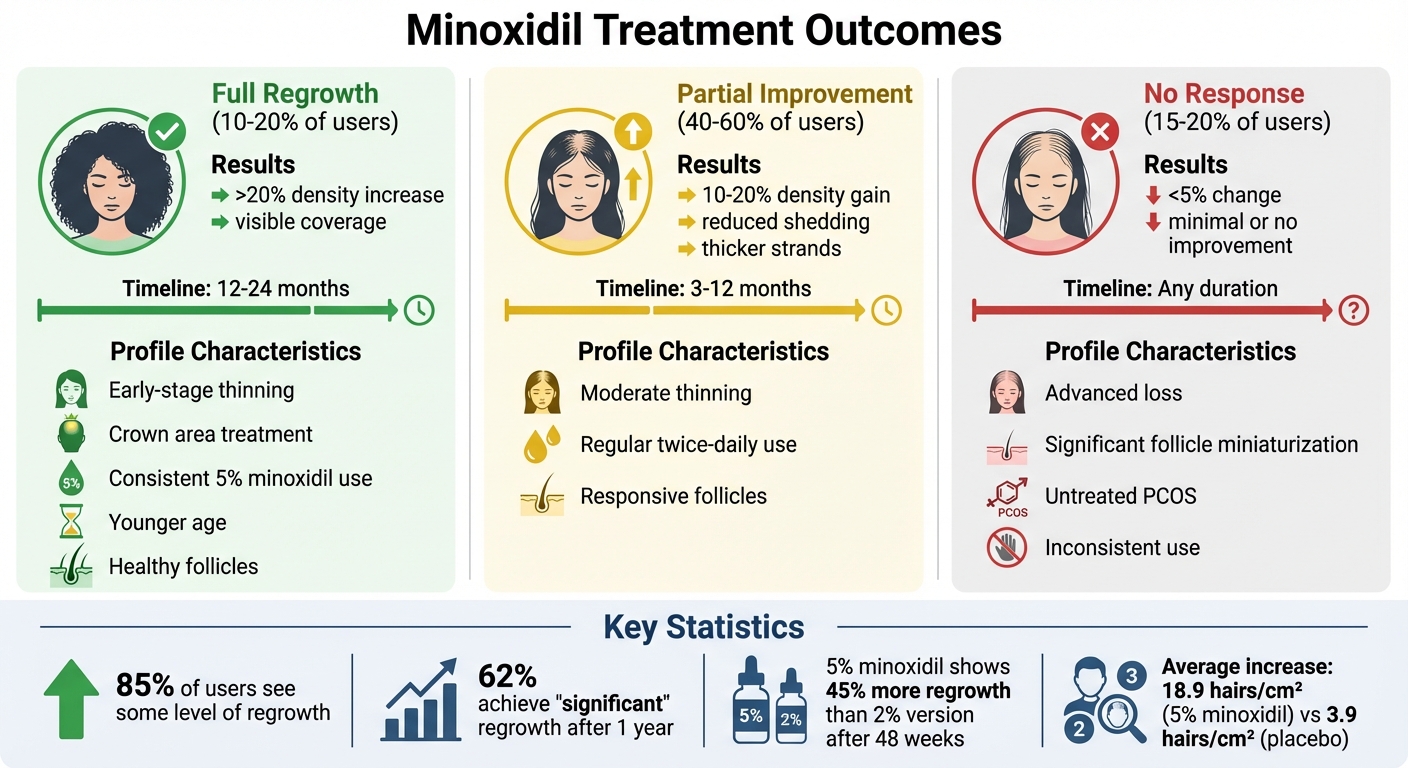
Minoxidil Treatment Outcomes: Full Regrowth vs Partial Results vs No Response
Clinical Data on Minoxidil's Effectiveness
Research indicates that achieving full hair regrowth with minoxidil is rare. Most users experience partial improvements, such as increased hair density or reduced shedding. For example, one study found that while 85% of participants saw some level of regrowth, only 62% achieved what was classified as "significant" regrowth after a year of use. Full restoration of hair is even less common, with estimates suggesting that only 10–20% of users see complete regrowth. For many, the results are limited to partial benefits.
The timeline for results varies. Fine, soft hairs (vellus hairs) typically appear within 2–3 months, moderate changes become noticeable by the 6-month mark, and the best outcomes are generally achieved between 12 and 24 months. Consistent application is essential - stopping minoxidil can reverse any progress made. Individual factors, such as age, genetics, and scalp health, heavily influence these outcomes.
Factors That Affect Regrowth Potential
Timing is especially critical for women with PCOS (polycystic ovary syndrome). Starting treatment early, while hair follicles remain viable, leads to better results compared to addressing advanced, long-term thinning. Minoxidil tends to work best on the crown and vertex (the top of the head), while the frontal hairline is often more resistant to treatment.
Hormonal imbalances also play a significant role. Elevated levels of androgens, like testosterone and DHT, can make hair follicles more sensitive, leading to miniaturization that minoxidil alone cannot fully reverse. For women with PCOS, these hormonal factors often limit the potential for complete regrowth. While minoxidil can help stabilize hair loss - reducing shedding and slightly thickening strands - it’s less likely to restore full density if hormonal issues remain unaddressed.
Comparison Table: Full Regrowth vs. Partial Results vs. No Response
The table below summarizes the range of outcomes based on clinical data and individual factors.
| Outcome Category | Expected Results | Time Frame | Typical Profile |
|---|---|---|---|
| Full Regrowth | More than 20% density increase; visible coverage | 12–24 months | Early-stage thinning, crown area, consistent 5% minoxidil use, younger age, healthy follicles |
| Partial Improvement | 10–20% density gain; reduced shedding; thicker strands | 3–12 months | Moderate thinning, regular twice-daily use, responsive follicles |
| No Response | Less than 5% change; minimal or no improvement | Any duration | Advanced loss, significant follicle miniaturization, untreated PCOS, inconsistent use |
This table highlights how outcomes can vary widely, depending on factors like treatment consistency, the stage of hair loss, and underlying conditions. If noticeable results haven’t appeared after 4–6 months of regular use, it might be time to reassess your approach - especially if hormonal imbalances, such as those linked to PCOS, are contributing to the issue.
sbb-itb-6dba428
Improving Results: Combining Minoxidil with PCOS Treatments
How PCOS Treatments Support Hair Regrowth
While minoxidil can stimulate local hair growth, it doesn’t tackle the root hormonal and metabolic issues caused by PCOS. Elevated androgens, insulin resistance, and chronic inflammation continue to damage hair follicles even with minoxidil. Pairing minoxidil with treatments that address these underlying factors often leads to better results.
For example, insulin sensitizers like metformin can lower insulin resistance and reduce androgen levels, while anti-androgens such as spironolactone block androgen receptors, making it easier for minoxidil to encourage thicker hair growth. Similarly, combined oral contraceptives with low-androgenic or anti-androgenic progestins help reduce ovarian androgen production and increase sex hormone–binding globulin, which lowers free testosterone in the bloodstream.
Even small lifestyle changes, like achieving a 5–10% weight loss, can significantly improve insulin sensitivity and reduce androgen levels. When paired with regular minoxidil use, these changes often lead to thicker hair regrowth and less shedding. This is because the follicles are no longer subjected to the same level of hormonal and metabolic stress.
Telehealth services now make these systemic treatments more accessible, offering personalized care plans tailored to each individual’s needs.
Getting Personalized Care Through Telehealth
Oana Health, a U.S.-based telehealth provider, offers customized, evidence-based treatment plans for hair loss and PCOS symptoms. Licensed clinicians assess hair loss related to PCOS through virtual consultations and may recommend topical or oral minoxidil (starting at $25/month) alongside other prescriptions like insulin sensitizers, anti-androgens, hormonal contraceptives, and weight-loss medications. Each treatment plan is tailored to the patient’s medical history and goals.
For instance, a patient with PCOS-related hair thinning might receive a combination of oral minoxidil and oral metformin ER ($22/month) to improve insulin resistance, along with a metformin & spironolactone pack ($32/month) to address androgen levels. After an initial evaluation, which includes a review of medical history, menstrual cycles, and lab results, clinicians create a plan that can be adjusted as needed during regular follow-ups. Through telehealth, patients can upload scalp photos, track weight, monitor cycles, and log symptoms, giving providers valuable data to refine their treatment over time.
"Oana's service has improved my insulin control and reduced unwanted hair growth due to PCOS. I'm recommending this to all my friends with PCOS." - Victoria A. [1]
Comparison Table: Minoxidil Alone vs. Combined Treatment
Here’s a quick look at how minoxidil performs on its own compared to when it’s paired with PCOS treatments:
| Aspect | Minoxidil Alone | Minoxidil + PCOS Treatments |
|---|---|---|
| Mechanism | Stimulates hair follicles locally; increases blood flow to the scalp | Combines local stimulation with systemic treatment of androgen and insulin issues |
| Typical Effectiveness | 40–60% response rate; moderate density improvement in 6–12 months | Higher stabilization rates and thicker regrowth, especially at the crown and mid-scalp |
| Time to Visible Change | Fine hairs at 2–3 months; noticeable changes by 6 months; peak at 12–24 months | Similar timeline for minoxidil effects; systemic improvements may take 6–12+ months to fully support regrowth |
| Durability | Gains reverse within months of stopping minoxidil | Benefits diminish gradually if either minoxidil or systemic treatments are discontinued |
| Side Effects & Monitoring | Scalp irritation, initial shedding, possible unwanted facial hair | Requires monitoring for systemic drugs (e.g., metformin, spironolactone); potential GI side effects with metformin [1] |
| Best Candidates | Women with mild, stable thinning and no major hormonal imbalance | Women with PCOS symptoms like irregular periods, weight gain, hirsutism, and insulin resistance |
For women whose hair loss is primarily driven by uncontrolled PCOS, minoxidil alone often yields slower and less noticeable results. By addressing both the local hair follicle environment and the systemic hormonal imbalances, combined treatments lead to more consistent and lasting improvements.
Managing Expectations and Tracking Your Progress
How Long Before You See Results?
Using minoxidil requires patience, as it works gradually. Typically, you can expect an initial shedding phase around 4–6 weeks after starting, as hair follicles shift into a new growth cycle. Noticeable improvements often appear between 3–6 months, with stabilization occurring by the 12-month mark. The full benefits usually peak between 1–2 years of consistent use. Research shows that the 5% minoxidil formulation tends to deliver better regrowth results compared to the 2% version. However, it’s important to continue regular application to maintain any progress.
How to Track Progress Effectively
Since changes with minoxidil are slow and subtle, tracking your progress accurately is key. Start by taking clear baseline photos before beginning treatment. Repeat these photos every 4–8 weeks under the same lighting and angles to monitor changes over time. For a more detailed approach, you can take standardized photos at fixed distances (e.g., 12 cm, 16 cm, or 24 cm from a reference point) every 1–3 months to document variations in hair density.
Other ways to assess progress include observing the width of your part line or checking scalp visibility in areas like the crown, mid-scalp, and hairline. Measuring ponytail thickness is another practical method - use a soft measuring tape or note how many loops of a standard elastic are required. Comparing side-by-side photos taken over 6–12 months can reveal gradual, yet meaningful, improvements.
Tracking your progress not only helps you stay motivated but also provides valuable insights for determining whether adjustments to your treatment plan might be necessary.
When to Reassess or Adjust Your Treatment
If your tracking shows little to no progress within the suggested timelines, it may be time to reconsider your approach. For example, if there’s no noticeable improvement after 6 months or no regrowth by 12 months, consult a healthcare professional to explore alternative options. Studies indicate that approximately 15.7% of users may not see effective results from minoxidil within a year.
For women experiencing hair loss due to PCOS, hormonal imbalances can sometimes reduce the effectiveness of minoxidil alone. If your progress plateaus despite following the treatment plan, a clinician might suggest a more comprehensive evaluation. This could include adding PCOS-specific therapies or combining treatments. Telehealth platforms like Oana Health offer personalized care options. Licensed clinicians there can adjust your plan during regular follow-ups, potentially incorporating oral minoxidil ($25/month) alongside other treatments like oral metformin ER ($22/month) or a metformin & spironolactone pack ($32/month) to address hormonal factors tied to PCOS-related hair loss.
Conclusion: Setting Realistic Goals for Hair Regrowth
When it comes to managing expectations with minoxidil, understanding what it can - and cannot - do is key. Complete hair restoration is quite rare, with fewer than 10% of women with androgenetic alopecia experiencing full regrowth. For most, the benefits are more modest, such as thicker hair strands, improved scalp coverage, and less shedding.
Clinical trials confirm that while 5% minoxidil foam can lead to significant partial regrowth, full restoration remains an exception rather than the rule. However, these improvements can make a big difference in styling options and may help slow down further hair loss.
For women with PCOS, it’s important to note that minoxidil doesn’t address the underlying hormonal imbalances driving hair loss. As mentioned earlier, combining minoxidil with therapies aimed at managing PCOS-related issues can yield better results.
If you’re looking for a more comprehensive approach, platforms like Oana Health provide personalized care. They connect users with licensed clinicians who can prescribe oral minoxidil ($25/month) alongside other targeted treatments like oral metformin ER ($22/month) or a metformin and spironolactone pack ($32/month). These treatments are conveniently delivered to your door, making it easier to tackle both hair loss and hormonal imbalances effectively.
FAQs
Is minoxidil more effective for early-stage hair loss or advanced hair loss?
Minoxidil is most effective when used during the early stages of hair loss, as there’s a greater likelihood of achieving near-complete regrowth. For those in more advanced stages, the results are typically partial improvement, since hair follicles may become less responsive over time.
Its success can also depend on the root cause of hair loss. Factors like hormonal imbalances or conditions such as PCOS can influence how well the treatment works. Acting early is key - starting minoxidil sooner often leads to better results.
What other treatments can help improve Minoxidil's results for women with PCOS?
For women managing PCOS, pairing Minoxidil with other treatments can lead to better outcomes. For instance, topical metformin may aid in improving insulin sensitivity, while options like azelaic acid or eflornithine can help minimize unwanted hair growth. These treatments work by targeting hormonal imbalances, enhancing the overall impact of Minoxidil.
Why is it important to use minoxidil consistently to maintain hair regrowth?
Using minoxidil regularly is crucial because it keeps your hair follicles actively stimulated. If you stop using it, the regrowth process will come to a standstill, and over time, your hair may revert to its earlier state of thinning or loss.
Staying consistent helps maintain the progress you've made, ensuring your follicles remain engaged. Skipping applications or stopping altogether can undo your results, so committing to a steady routine is essential for lasting improvements.