
Clomiphene Citrate: Dosage for PCOS Patients
Clomiphene Citrate is a widely used treatment for infertility caused by Polycystic Ovary Syndrome (PCOS). It works by stimulating ovulation and is often the first choice for doctors due to its affordability and effectiveness. Here's what you need to know:
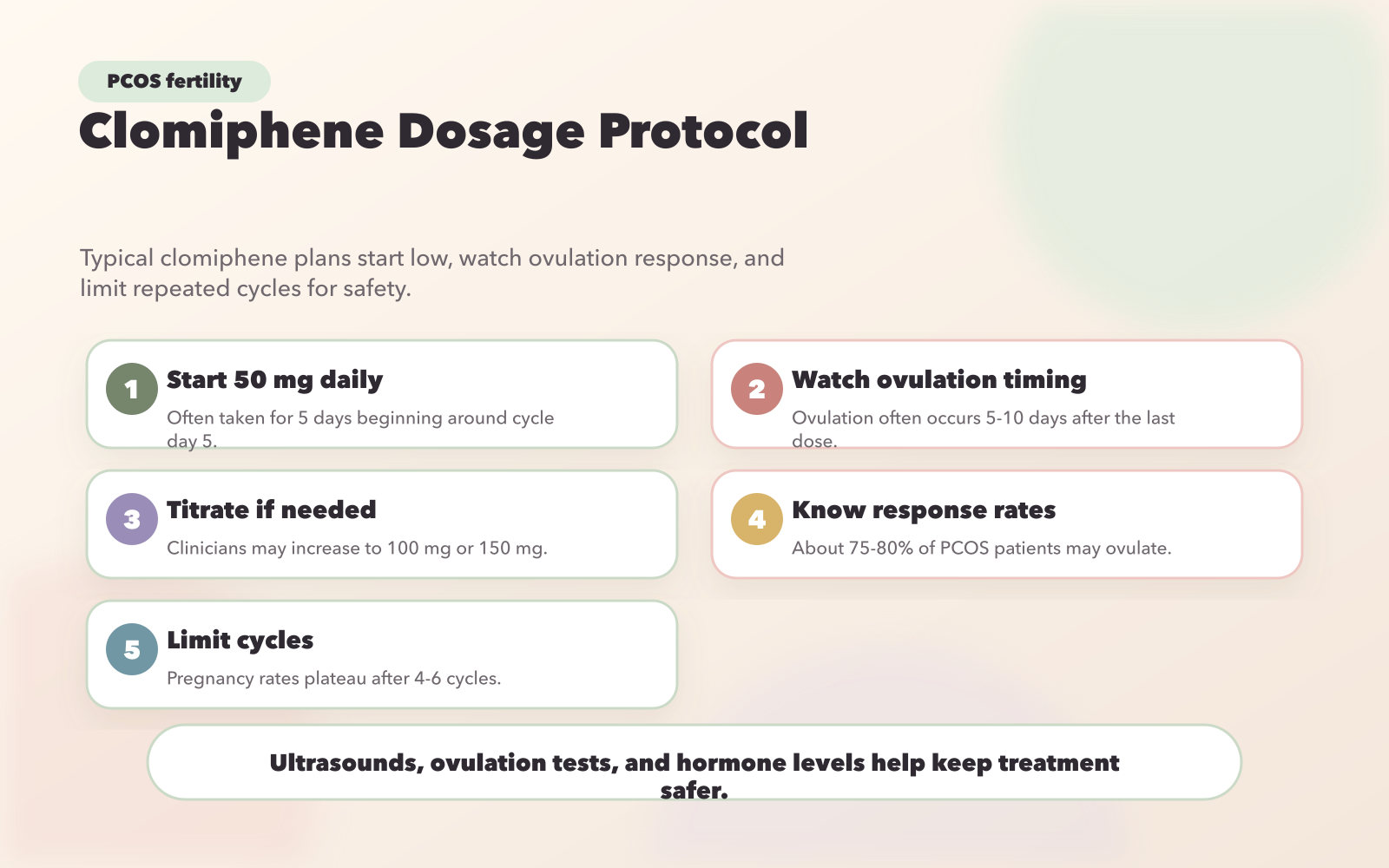
- Starting Dose: 50 mg daily for 5 days, beginning on the 5th day of your menstrual cycle.
- Ovulation Timing: Typically occurs 5–10 days after the last dose.
- When to Increase Dose: If 50 mg doesn’t work, doctors may increase it to 100 mg or 150 mg in subsequent cycles.
- Success Rates: 75–80% of women with PCOS ovulate with Clomiphene, but pregnancy rates plateau after 4–6 cycles.
- Clomiphene Resistance: About 15–40% of women don’t respond to the maximum dose. Alternatives like Letrozole, Metformin, or injectable gonadotropins may be used.
Monitoring through ultrasounds, ovulation tests, and hormone levels is essential to ensure safety and effectiveness. Treatment is typically capped at six cycles to minimize risks like ovarian hyperstimulation syndrome (OHSS). For those seeking additional help, telehealth services like Oana Health offer tailored PCOS care.
Clomiphene Citrate Dosage Protocol and Success Rates for PCOS Treatment
Standard Dosage and Treatment Protocols
Starting Dose and Cycle Timing
The usual starting dose for Clomiphene Citrate is 50 mg taken orally once a day for five consecutive days. This dosage is commonly prescribed to help induce ovulation in women with PCOS.
Treatment typically begins on the fifth day of your menstrual cycle, whether the cycle starts naturally or is medically induced. This timing is important because it aligns with the follicular phase, during which the ovaries prepare to release an egg. After completing the five-day course, ovulation generally occurs within 5 to 10 days.
Quick Overview: 50 mg daily for 5 days starting on Day 5 of the cycle, with ovulation expected 5–10 days later.
It’s crucial to follow this schedule and take the medication as directed. Proper timing and consistent daily dosing play a vital role in achieving the best results with Clomiphene Citrate.
How to Take Clomiphene Citrate
Once your dosing schedule is set, here’s how to take Clomiphene Citrate effectively. Take the medication as a single daily dose, ideally at the same time each day. If your prescribed dose is 100 mg, take two 50 mg tablets together as a single dose.
Before each treatment cycle, your doctor will typically recommend a pregnancy test and a pelvic exam to ensure it’s safe to proceed. After finishing the last pill, start using an ovulation test kit five days later to pinpoint your most fertile days. For women with PCOS, healthcare providers may adjust dosages or shorten treatment durations to minimize the risk of ovarian hyperstimulation syndrome (OHSS).
Dose Increases and Ovulation Success Rates
When to Increase the Dose
If the initial 50 mg dose doesn’t trigger ovulation, your doctor will usually raise the dosage by 50 mg in the next cycle, based on cycle monitoring. This adjustment is tailored to your body’s response.
To confirm ovulation, healthcare providers rely on two key methods. First, an ultrasound around day 12 of your cycle checks for dominant follicles - those measuring at least 10 mm. Second, a progesterone blood test, done 7–8 days after your expected ovulation date, helps confirm ovulation. A progesterone level of 3 ng/mL or higher is considered a positive result.
The dosage can go up to a maximum of 150 mg per day. However, if you’re ovulating at a specific dose but not conceiving, increasing the dose further won’t improve your chances in the next cycle.
Success Rates by Dosage
Adjusting the dosage has a direct impact on ovulation success rates, as shown in research.
For patients with PCOS, 75–80% eventually ovulate with treatment. However, nearly half - around 43% - don’t respond to the initial 50 mg dose.
A study involving 283 women with PCOS revealed the following outcomes:
- At the starting 50 mg dose, 56.9% of women ovulated.
- For those who didn’t respond to 50 mg, increasing the dose to 100 mg led to an additional 17.3% achieving ovulation.
- At the maximum 150 mg dose, another 4.6% responded.
This adds up to a cumulative ovulation rate of 78.8%, leaving about 21% of patients resistant even at the highest dose.
| Dosage Level | Ovulation Success Rate | Resistance Rate |
|---|---|---|
| 50 mg/day | 56.9% | 43.1% |
| 100 mg/day (cumulative) | 74.2% | 25.8% |
| 150 mg/day (cumulative) | 78.8% | 21.2% |
While these ovulation rates are promising, pregnancy success remains more modest. Among those who ovulate with Clomiphene Citrate, 60–70% conceive, and 40–50% go on to have live births. Notably, pregnancy rates tend to plateau after four consecutive ovulatory cycles, which is why treatment is generally limited to six cycles.
Managing Clomiphene Resistance in PCOS
Combining Clomiphene with Metformin
When Clomiphene alone doesn't work, adding Metformin can improve ovulation by addressing insulin resistance - a common issue in PCOS. Research shows that this combination increases live birth rates from 22.5% to 26.8%. Elevated insulin levels can lead to higher ovarian androgen production, disrupting follicle development and interfering with ovulation. Combining Metformin with low-dose gonadotropins has shown even better results, nearly doubling the odds of clinical pregnancy (odds ratio 2.25) and live birth (odds ratio 1.94).
Metformin is typically prescribed at doses between 1,500 and 2,250 mg daily. For example, an 850 mg dose taken twice a day costs around $73 per month. To minimize gastrointestinal side effects, doses are gradually increased. These adjustments can set the stage for exploring additional treatment options if resistance persists.
Other Treatment Options for Resistant Cases
Roughly 15% to 40% of women with PCOS show resistance to Clomiphene, even at the maximum dose. In these cases, alternative treatments should be considered.
For those who do not respond to Clomiphene - even with added therapies - Letrozole, an aromatase inhibitor, has shown promising results. It delivers a 79.3% ovulation rate, significantly higher than the 56.6% rate achieved with Clomiphene plus FSH. Additionally, Letrozole improves live birth rates (odds ratio 1.63) and clinical pregnancy rates (odds ratio 1.32). However, it is more expensive, averaging $340 per month.
Another option involves extended or stair-step Clomiphene protocols, which reduce cycle gaps and increase treatment duration. For instance, a 10-day protocol at 150 mg can achieve a 76% ovulation rate by the third cycle.
Injectable gonadotropins, such as FSH or HMG, are another alternative. They result in ovulation rates around 70% and a clinical pregnancy rate of about 20% per cycle. However, these treatments require close ultrasound monitoring due to the higher risk of multiple pregnancies (5.7% multiple live birth rate) and ovarian hyperstimulation syndrome.
For a surgical approach, laparoscopic ovarian drilling can be considered. This procedure offers ovulation rates between 54% and 76% over six months, with a reduced risk of multiple pregnancies.
"Approximately 15% of women with PCOS do not respond to the maximum dose of CC and are considered resistant to this medication." – Melo AS, Rui Alberto Ferriani, Paula Andrea Navarro
Tailored treatment plans are critical for managing PCOS effectively, especially for patients resistant to both insulin and Clomiphene. Services like Oana Health provide telehealth consultations and customized care, including Metformin options starting at $22 per month for Oral Metformin ER or $32 per month for a combination of Metformin and Spironolactone.
sbb-itb-6dba428
Monitoring and Safety During Treatment
Tracking Ovulation and Follicle Development
Monitoring plays a key role in confirming how well Clomiphene is working and deciding the best timing for treatment. Before starting each new cycle, a pelvic exam is done to check for ovarian enlargement or cysts, helping to avoid complications. Healthcare providers typically use ultrasound exams around day 12 of the cycle to observe follicle growth, while hormone tests help confirm the body’s response to the medication. If three or more dominant follicles are detected, it may indicate hyperresponsiveness. For example, in one study involving 283 women with PCOS taking 50 mg of Clomiphene, 8.5% experienced this condition.
At home, patients are advised to use ovulation predictor kits 5 to 10 days after finishing the medication to pinpoint ovulation timing. This information is crucial for planning intercourse or insemination. For individuals prone to high triglycerides, a fasting lipid panel is recommended at the start of treatment and periodically thereafter. These monitoring steps are designed to maximize the effectiveness of Clomiphene Citrate while minimizing risks, ensuring adjustments can be made promptly when needed.
Side Effects and Risk Management
Close monitoring also helps detect side effects early, allowing for quick intervention if necessary. Common side effects include hot flashes, headaches, dizziness, nausea, and breast tenderness. However, more serious symptoms require immediate action. If you experience visual disturbances - like blurred vision or flashing lights - you should stop the medication right away and schedule a thorough eye exam.
"Ovarian hyperstimulation syndrome (OHSS) is reported in patients using clomiphene citrate therapy for ovulation induction. OHSS can progress rapidly (within 24 hours) and become a medical emergency." – StatPearls
Though OHSS is less common with oral medications like Clomiphene compared to injectable treatments, patients with PCOS are at greater risk. Starting with the lowest dose (50 mg) reduces the likelihood of this complication. Signs of OHSS include rapid weight gain (more than 2.2 pounds in 24 hours), severe abdominal pain, ongoing vomiting, or decreased urination. If ultrasounds show too many mature follicles or estrogen levels rise too quickly, healthcare providers may choose to pause treatment or cancel the cycle to prevent OHSS.
Treatment is generally capped at six cycles to avoid long-term toxicity or severe side effects. If ovulation hasn’t occurred after three cycles, further use of Clomiphene is typically discouraged. Patients should also avoid driving or operating machinery until they know how the medication affects them. Additionally, cutting back on alcohol and tobacco can improve the chances of conception and reduce side effects. These safety measures are an integral part of the treatment plan, ensuring care is tailored to each patient’s needs throughout their Clomiphene journey.
PCOS & Ovulation Induction: How Can You Ovulate With PCOS?
Key Takeaways for Clomiphene Citrate Dosage in PCOS
Treatment should be tailored to the individual, as PCOS affects 5–10% of women and presents a wide range of symptoms, including infertility, insulin resistance, and hirsutism. Dr. Lee Radosh emphasizes this point:
"Polycystic ovary syndrome (PCOS) is not a simple pathophysiologic process for which one treatment addresses all manifestations... physicians must individualize treatment goals and target treatment to specific manifestations".
Factors like BMI, age, and hormone levels play a crucial role in determining the appropriate dosage.
The standard protocol involves starting with 50 mg daily for 5 days, beginning on the fifth day of the menstrual cycle. If ovulation doesn't occur, the dosage can be increased. However, treatment is typically limited to three cycles. If ovulation still hasn't been achieved, clomiphene is usually discontinued. For patients who don't respond to clomiphene alone, adding metformin - especially for those with obesity - or switching to letrozole has been shown to improve ovulation rates.
Monitoring is essential. Use pregnancy tests, pelvic exams, and ovulation kits 5 to 10 days after finishing the medication. When properly managed, clomiphene can result in a 20–40% live birth rate within six months. Regular monitoring ensures the treatment is both safe and effective.
For those seeking specialized care, Oana Health offers telehealth-based PCOS management. Their services include personalized prescriptions, free shipping, and support for symptoms like insulin resistance and weight management. Generic clomiphene is available for about $52 for a 5-day regimen at 100 mg/day.
FAQs
What can I do if Clomiphene Citrate doesn't help me ovulate?
If Clomiphene Citrate (CC) isn't helping to trigger ovulation, there are several strategies you can explore with your healthcare provider to address the issue:
- Verify ovulation status: Track your basal body temperature or use ovulation predictor kits over at least two cycles to confirm whether ovulation is actually occurring or not.
- Adjust the treatment plan: Your doctor might recommend increasing the CC dosage, for example, from 50 mg to 100 mg daily. Another option could be a stair-step protocol, where the dosage is gradually increased without waiting for a new cycle to begin.
- Try alternative medications: If CC isn’t working, letrozole is often suggested as a highly effective alternative, especially for patients with PCOS. Studies have shown it can lead to better success rates in some cases.
- Explore additional treatments: When oral medications don’t work, options like injectable gonadotropins or procedures such as laparoscopic ovarian drilling may be considered. For more complex cases, assisted reproductive technologies like IVF could be an option.
Collaborate closely with your doctor to determine the best course of action for your situation. A step-by-step approach can help improve the likelihood of ovulation while keeping potential risks in check.
How is the effectiveness of Clomiphene Citrate monitored for PCOS treatment?
The progress of Clomiphene Citrate treatment is usually tracked using ultrasounds and blood tests to monitor ovulation and ensure the medication is doing its job. Around days 10–12 of the cycle, a transvaginal ultrasound is performed to check the size of the follicles. A dominant follicle measuring between 18–22 mm typically signals that ovarian stimulation is on track. Blood tests, like those measuring estradiol levels, provide additional confirmation of hormonal changes and help reduce the risk of complications like ovarian hyperstimulation.
When a mature follicle is detected, patients may either use an at-home urine test to check for a natural luteinizing hormone (LH) surge or receive a trigger shot, particularly if timing for intrauterine insemination (IUI) is part of the plan. About seven days after ovulation, a follow-up progesterone test is done to confirm that ovulation has occurred. For those using telehealth services, such as Oana Health, these steps are managed remotely. Home test kits and local ultrasound appointments are arranged to make the process more convenient. Based on the results, adjustments to the dosage or treatment plan can be made, ensuring care is tailored to each individual.
Are there risks associated with using Clomiphene Citrate for more than six cycles?
Using Clomiphene Citrate for more than six treatment cycles isn't typically advised. Research indicates that its effectiveness may decrease with extended use. Moreover, prolonged treatment could raise the likelihood of side effects, including ovarian enlargement or complications tied to overstimulation.
If you're thinking about continuing treatment beyond this timeframe or have questions about your current plan, make sure to discuss them with a licensed healthcare provider. They can help ensure your approach remains both safe and effective.