
Clomiphene Citrate: Who Qualifies for Treatment?
Clomiphene Citrate is a trusted medication for women struggling with ovulation issues, especially those with Polycystic Ovary Syndrome (PCOS). It works by stimulating hormones to encourage egg maturation, offering a low-cost, effective option for improving fertility. Here’s what you need to know:
- Who Qualifies? Women of reproductive age with irregular or absent ovulation, particularly those with PCOS or other ovulatory disorders, may benefit. Proper liver, thyroid, and adrenal function are required.
- Who Should Avoid It? Women who are pregnant, breastfeeding, or have conditions like liver disease, certain ovarian cysts, or unexplained vaginal bleeding should not use Clomiphene Citrate.
- Success Rates: About 75% of women with ovulatory dysfunction ovulate on Clomiphene, with live birth rates between 20-40% within six months.
- Risks: While the chance of multiple pregnancies is low (10% for twins, <1% for higher-order multiples), side effects like ovarian cyst growth, visual disturbances, or Ovarian Hyperstimulation Syndrome (OHSS) can occur.
Speak with a healthcare provider to assess your eligibility, undergo necessary testing, and develop a tailored treatment plan.
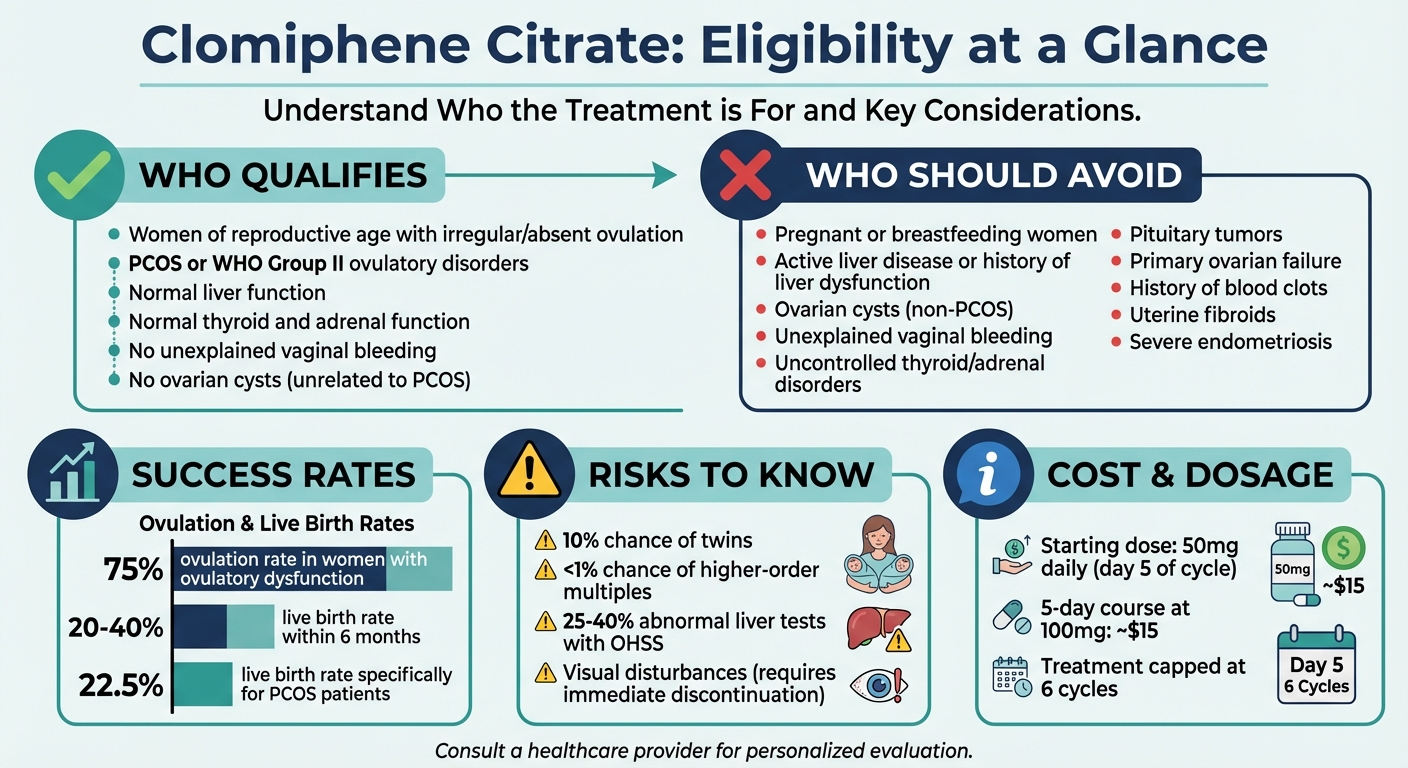
Clomiphene Citrate Eligibility Criteria and Success Rates
PCOS & Ovulation Induction: How Can You Ovulate With PCOS?
Who Can Take Clomiphene Citrate?
Clomiphene Citrate is most effective for women of reproductive age who experience irregular or absent ovulation. Specifically, it’s recommended for those classified in WHO Group II, which includes individuals with hypothalamic-pituitary dysfunction.
Before starting this treatment, your doctor will evaluate several health factors to ensure safety. For instance, you must have normal liver function and no prior liver disease. Additionally, your ovaries should not show signs of cysts (unrelated to PCOS) or enlargement, and you should not have unexplained vaginal bleeding or endometrial cancer. Proper thyroid and adrenal gland function is also crucial, as conditions like untreated thyroid disease or adrenal dysfunction could make this treatment unsuitable. Meeting these criteria helps determine whether Clomiphene Citrate is a safe and viable option for you.
Basic Requirements
Before prescribing Clomiphene Citrate, your doctor will perform a thorough pre-treatment evaluation. This typically includes a hysterosalpingography to check for blocked fallopian tubes and a semen analysis for your partner to rule out male infertility factors. A serum LH-to-FSH ratio greater than 2 often supports a diagnosis of PCOS. For younger patients, however, treatment is generally delayed until at least two years after menarche.
"Clomiphene citrate is considered a first-line treatment because of its low cost, relative ease of use, and minimal side effects." – Contemporary OB/GYN
Treatment usually begins with a 50 mg daily dose, starting around the fifth day of your menstrual cycle.
Medical Conditions That Qualify
Several medical conditions can make a woman eligible for Clomiphene Citrate treatment. The most common is Polycystic Ovary Syndrome (PCOS). Studies show that women with PCOS who use Clomiphene Citrate achieve a live-birth rate of 22.5%.
Other conditions that may qualify include secondary amenorrhea (when regular periods stop), amenorrhea after stopping oral contraceptives, psychogenic amenorrhea, and amenorrhea-galactorrhea syndrome. For women with PCOS and obesity, combining Clomiphene Citrate with metformin has been shown to improve pregnancy rates compared to Clomiphene alone. A 5-day course at a dosage of 100 mg per day typically costs around $15.
If you think Clomiphene Citrate might be right for you, consult a licensed medical professional through Oana Health for personalized guidance on your eligibility.
Who Should Not Take Clomiphene Citrate?
Clomiphene Citrate isn't suitable for everyone, and understanding when it's unsafe is crucial to avoid serious health risks. Identifying these contraindications ensures a safer and more informed approach to treatment. Below, we highlight the conditions that make Clomiphene use inadvisable.
Medical Reasons to Avoid Treatment
Clomiphene should never be used during pregnancy or while breastfeeding. Classified as a Pregnancy Category X drug, it can harm a developing fetus and may decrease milk production. A pregnancy test is required before each treatment cycle to confirm that you're not pregnant.
If you have active liver disease or a history of liver issues, Clomiphene is not recommended. Since the drug is processed in the liver, it can worsen existing problems. Studies show that in cases of Ovarian Hyperstimulation Syndrome (OHSS), liver function tests are abnormal in 25% to 40% of patients.
"Clomiphene citrate is contraindicated in patients with liver disease or a history of liver dysfunction." – DailyMed
Women with ovarian cysts not related to PCOS should avoid Clomiphene, as it might cause these cysts to grow. Similarly, unexplained vaginal bleeding must be investigated to rule out endometrial cancer before starting treatment.
Uncontrolled thyroid or adrenal disorders must be stabilized before beginning Clomiphene. Additionally, individuals with pituitary tumors or other intracranial lesions are generally unsuitable candidates for this medication.
Other Disqualifying Factors
Clomiphene is not an option for anyone allergic to clomiphene citrate or its inactive ingredients. Women with primary ovarian failure, where the ovaries no longer produce eggs effectively, are unlikely to benefit from this treatment.
A history of blood clots, vein inflammation, or high triglyceride levels could make Clomiphene unsafe, as it may worsen these conditions. Similarly, women with uterine fibroids should avoid the medication due to the risk of fibroid enlargement. In cases of severe endometriosis, where elevated estrogen levels could exacerbate symptoms or promote implant growth, alternative treatments like surgery or IVF may be more appropriate.
"Patients with any visual symptoms should discontinue treatment with clomiphene and have a complete ophthalmological evaluation conducted promptly." – Marilyn K. Mbi Feh, StatPearls
Clomiphene treatment is typically capped at six cycles to minimize long-term risks. If you experience visual disturbances - like blurred vision, spots, or flashes - stop using the medication immediately and consult your healthcare provider.
sbb-itb-6dba428
How Doctors Determine Eligibility
Before starting treatment with Clomiphene Citrate, doctors dive into a thorough evaluation process to ensure it's the right fit for you. This involves a detailed review of your medical history, specific blood tests, and imaging studies.
Reviewing Your Medical History
The first step is analyzing your menstrual history. Your doctor will look at the frequency, length, and regularity of your cycles, paying close attention to any signs of amenorrhea (missing periods) or oligomenorrhea (irregular periods). These details help determine whether you're ovulating on your own. Beyond that, lifestyle factors, such as medications (e.g., antidepressants, estrogens, progestins), excessive exercise, or significant weight changes, are taken into account. Since Clomiphene Citrate can sometimes worsen mental health conditions, your doctor will also assess your psychiatric history. Additionally, they'll review any past or current issues like liver disease, abnormal uterine bleeding, ovarian cysts, or endocrine disorders (e.g., thyroid problems or pituitary tumors) that might need attention before treatment.
"Before initiating infertility treatment with clomiphene, the underlying cause of the patient's anovulation should be assessed first, and lifestyle modifications recommended, or the causal medical condition should be treated." – StatPearls
This comprehensive history helps guide the next steps, including targeted blood work and imaging.
Required Blood Tests and Imaging
Hormone testing plays a key role in understanding your reproductive health. A typical panel measures levels of testosterone, LH, FSH, prolactin, TSH, and progesterone (often around day 23 of your cycle). These tests can identify problems like polycystic ovary syndrome (PCOS), thyroid dysfunction, or pituitary issues. For example, abnormal FSH levels might point to challenges with egg production, while Anti-Müllerian Hormone (AMH) testing offers a clearer picture of your ovarian reserve.
Imaging studies, like pelvic ultrasounds, are used to check for ovarian cysts unrelated to PCOS or uterine fibroids, both of which could make Clomiphene unsuitable. In some cases, doctors may recommend a hysterosalpingography (HSG), an X-ray with contrast dye, to confirm that your fallopian tubes are open - since blocked tubes could make the treatment ineffective.
Checking for Other Health Conditions
To ensure a safe and successful treatment, your doctor will also screen for other health concerns. For instance, a two-hour oral glucose tolerance test is often used to check for type 2 diabetes and insulin resistance, especially since women with PCOS are at a higher risk for these conditions. Blood pressure monitoring and a fasting lipid panel are performed to detect hypertriglyceridemia, a condition that Clomiphene could exacerbate. Overweight patients may also be screened for obstructive sleep apnea. Additionally, because PCOS is linked to higher rates of mood disorders, depression screening is typically included. Any underlying hormonal imbalances, such as thyroid dysfunction, must also be addressed before starting ovulation therapy.
"All women diagnosed with PCOS should be screened for metabolic abnormalities (e.g., type 2 diabetes mellitus, dyslipidemia, hypertension), regardless of body mass index." – AAFP
These assessments ensure that Clomiphene Citrate is both safe and tailored to each patient's needs, increasing the chances of a positive outcome.
Is Clomiphene Citrate Right for You?
Clomiphene Citrate is commonly used to address ovulatory dysfunction, particularly in women dealing with conditions like polycystic ovary syndrome (PCOS) or irregularities in the hypothalamic-pituitary axis. However, it’s not suitable for everyone. Women with primary ovarian failure or certain pituitary disorders are generally not candidates for this treatment.
Before starting Clomiphene, certain health conditions need to be ruled out. For instance, normal liver function is essential since the medication is processed by the liver. A history of liver disease typically excludes someone from treatment. Additionally, conditions like thyroid or adrenal disorders must be well-managed, and there should be no unexplained vaginal bleeding.
Beyond these health considerations, reproductive factors are also taken into account. A thorough evaluation of your fertility and anatomical health helps determine if Clomiphene is a good fit for you. Your doctor will look for any barriers that could impact treatment success.
A detailed medical evaluation is crucial in deciding whether Clomiphene is appropriate. Services like Oana Health provide telehealth consultations with licensed professionals who review your medical history, hormone levels, and overall health. They also conduct necessary screenings, such as blood tests and imaging, to create a treatment plan tailored to your needs.
Clomiphene has been shown to induce ovulation in over 75% of women with amenorrhea, and its use can lead to live birth rates of 20% to 40% within six months. To maximize your chances of success and minimize potential risks, always seek guidance from a healthcare professional rather than attempting to self-diagnose or self-treat.
FAQs
What tests are needed before starting Clomiphene Citrate treatment?
Before starting treatment with Clomiphene Citrate, your doctor will likely recommend a series of tests to assess your hormonal health and ovarian function. These tests often include measuring hormone levels such as FSH (follicle-stimulating hormone), LH (luteinizing hormone), and estradiol on the third day of your menstrual cycle. These readings provide important information about your ovarian reserve and overall hormonal balance.
In some situations, your doctor might also suggest a Clomiphene Citrate Challenge Test. This test involves checking FSH and estradiol levels on both day 3 and day 10 of your cycle to evaluate how your body responds to the medication. These evaluations are crucial in determining whether Clomiphene Citrate is a suitable treatment option for you.
Can Clomiphene Citrate be used with other medications to boost fertility?
Yes, Clomiphene Citrate can be used with other medications to support fertility efforts. For instance, it’s commonly combined with drugs like Provera to help regulate menstrual cycles and encourage ovulation. In some situations, Clomiphene Citrate is also paired with fertility procedures such as intrauterine insemination (IUI) or in vitro fertilization (IVF) to improve outcomes.
The specific combination of treatments will depend on your unique needs and medical history. Always consult a licensed healthcare professional before starting or combining any medications to ensure safety and effectiveness.
How do I know if Clomiphene Citrate might not be right for me?
Clomiphene Citrate might not be the right choice for everyone, especially if you have certain medical conditions or circumstances. These include a history of ovarian cysts, ovarian cancer, blood clots, blood vessel issues, adrenal gland disorders, or if you’ve experienced an allergic reaction to this medication. It’s also not recommended if you are pregnant or breastfeeding.
If you’re uncertain about whether Clomiphene Citrate is suitable for you, it’s crucial to consult a licensed healthcare provider. They can review your medical history and help determine if this medication is a safe option for your situation.