
COCPs vs. Other PCOS Weight Treatments
Struggling with PCOS-related weight issues? Here's what you need to know:
- COCPs (Combined Oral Contraceptive Pills): Often prescribed for menstrual irregularities and symptoms like acne and excess hair. They help reduce abdominal fat slightly but are generally weight-neutral and don't improve insulin resistance.
- Metformin: Focuses on improving insulin sensitivity and metabolic health, leading to modest weight loss. It's also helpful for women trying to conceive but can cause digestive side effects.
- GLP-1 Agonists: Medications like semaglutide are highly effective for weight loss and metabolic improvements, with many users losing 5–10% of body weight. However, they can cause nausea and aren't safe during pregnancy.
- Orlistat: Blocks fat absorption, leading to moderate weight loss. Side effects like oily stools can make it hard to stick with.
Quick Comparison:
| Feature | COCPs | Metformin | GLP-1 Agonists | Orlistat |
|---|---|---|---|---|
| Weight Loss | Minimal | Modest | High | Moderate |
| Primary Focus | Hormonal balance | Insulin sensitivity | Appetite control | Fat absorption |
| Best For | Acne, hair, cycles | Metabolic issues | Significant weight loss | Lipid profile |
| Common Side Effects | Nausea, bleeding | Digestive issues | Nausea, vomiting | Oily stools |
Each treatment has unique strengths. The right choice depends on your symptoms, goals, and overall health.
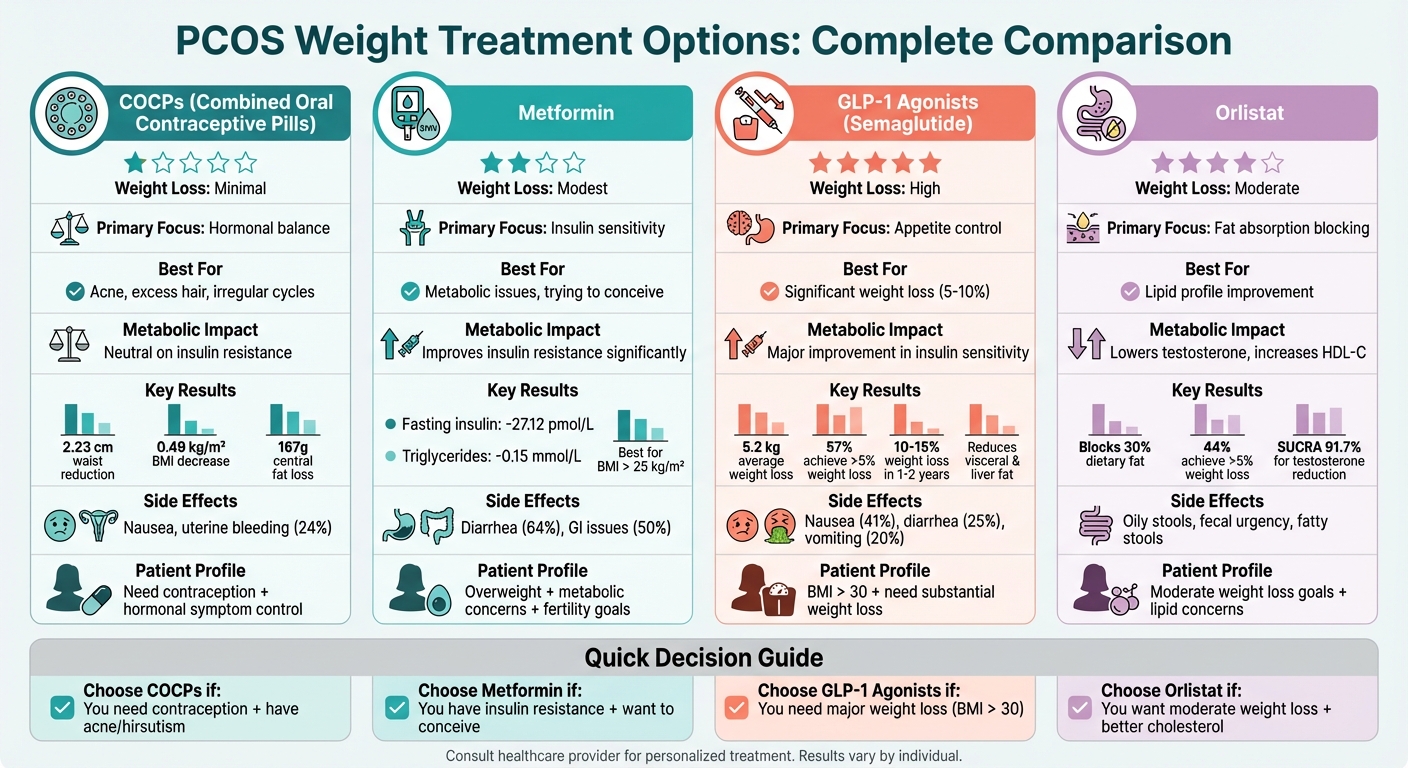
PCOS Weight Treatment Options Comparison: COCPs, Metformin, GLP-1 Agonists, and Orlistat
COCPs for PCOS Weight Management
How COCPs Affect Weight and PCOS Symptoms
When it comes to managing weight in PCOS, combined oral contraceptive pills (COCPs) play a role by stabilizing hormones. Findings from the COMET-PCOS trial highlight modest improvements in central fat and BMI. Conducted between January 2018 and June 2023 at the University of Pennsylvania and Penn State Health, the trial studied 240 women with hyperandrogenic PCOS and BMIs ranging from 25 to 48 kg/m². After 24 weeks on a low-dose COCP regimen (20 μg ethinyl estradiol/0.15 mg desogestrel), participants experienced:
- A 2.23 cm reduction in waist circumference
- A 0.49 kg/m² decrease in BMI
- A 167 g loss in central fat mass
These results stem from COCPs' ability to suppress luteinizing hormone (LH) and increase sex hormone-binding globulin (SHBG), which reduces free testosterone levels. This hormonal shift contributes to a measurable decrease in abdominal fat. However, COCPs don't enhance insulin sensitivity like metformin and may slightly elevate triglyceride levels and glucose tolerance test results.
Pros and Cons of COCPs for Weight Management
The benefits and limitations of COCPs for PCOS-related weight management include:
Advantages: Hormonal Regulation and Symptom Relief
COCPs are highly effective at managing menstrual irregularities, protecting the endometrial lining, and addressing acne and hirsutism. The modest reductions in waist circumference and abdominal fat are additional perks, particularly with fourth-generation progestins like drospirenone, which help minimize water retention.
As Dr. Anuja Dokras from the University of Pennsylvania explained, "Low-dose COCPs effectively managed PCOS symptoms without increasing prevalence of MetS".
Limitations: Limited Impact on Metabolic Health
While COCPs don't worsen metabolic syndrome, they also don't improve insulin resistance. Common side effects reported include uterine bleeding (24.1% of users in the COMET-PCOS trial), nausea, and headaches. Higher doses, especially those with cyproterone acetate, carry an increased risk of venous thromboembolism.
Dr. Michelle Ayazo from Florida Medical Clinic emphasized, "They won't cause weight loss, but the right birth control pill can be part of a robust treatment plan for managing PCOS".
Comparison Table: COCPs Outcomes
| Outcome Measure | Baseline (COCP Group) | Change After 24 Weeks | Statistical Significance |
|---|---|---|---|
| Waist Circumference | 108.0 cm | −2.23 cm | p = 0.01 |
| Body Mass Index (BMI) | 35.2 kg/m² | −0.49 kg/m² | p = 0.01 |
| Android Fat Mass | 3,703.0 g | −167 g | p < 0.001 |
| Total Body Mass | 95.2 kg | −1.74 kg | p = 0.001 |
| Metabolic Syndrome Prevalence | 30.4% | 28.8% | p = 0.26 (not significant) |
Data from the COMET-PCOS trial using low-dose COCPs (20 μg ethinyl estradiol/0.15 mg desogestrel)
Metformin vs. COCPs
How Metformin Affects Weight in PCOS
Metformin takes a different approach to managing PCOS compared to COCPs, focusing on metabolic challenges rather than hormonal imbalances. It enhances insulin sensitivity in the liver and other tissues while curbing glucose production in the liver. These effects are particularly noticeable in women with a BMI over 25 kg/m², where metformin helps lower body weight, BMI, and waist-to-hip ratios. On top of that, it reduces fasting insulin levels by an average of –27.12 pmol/L and decreases triglycerides by –0.15 mmol/L. For women trying to conceive, metformin offers an added benefit: it restores menstrual cycles and promotes ovulation, unlike COCPs, which have contraceptive effects.
Pros and Cons: Metformin vs. COCPs
Metformin and COCPs each bring unique strengths and weaknesses to PCOS treatment, making them suitable for different patient needs.
Metformin's Strengths: Focus on Metabolic Health
Metformin shines when it comes to improving metabolic markers. It lowers fasting insulin, total cholesterol, and triglycerides.
"The guideline will recommend COCP to be used over metformin for management of irregular cycles and hirsutism, and metformin over COCP for metabolic indications in PCOS", according to the Journal of Clinical Endocrinology & Metabolism.
Metformin's Drawbacks: Digestive Side Effects
One of metformin's main downsides is its potential to cause digestive issues. Up to 50% of users report nausea, diarrhea, or abdominal cramps. In the COMET-PCOS trial, over 64% of participants taking metformin experienced diarrhea. Severe gastrointestinal problems, though less common, affect 1% to 4.5% of users, compared to just 0.3% with COCPs. Starting with a low dose and gradually increasing it can help manage these side effects.
COCPs' Strengths: Hormonal Symptom Management
COCPs are more effective for addressing visible PCOS symptoms like hirsutism, acne, and irregular menstrual cycles. They outperform metformin in reducing the free androgen index (mean difference 7.08). Additionally, they are better at restoring regular menstrual cycles, with an odds ratio for treatment failure of 0.17 compared to metformin.
COCPs' Drawbacks: Limited Impact on Metabolic Health
While COCPs do not significantly worsen metabolic syndrome, they fall short in improving insulin sensitivity. In fact, some formulations may slightly reduce insulin sensitivity or increase triglycerides. This makes them less suitable for patients whose primary concerns are metabolic health or weight management.
This comparison highlights the need to tailor treatments based on individual health priorities and symptoms.
Comparison Table: Metformin vs. COCPs
Here’s a side-by-side look at the key differences:
| Feature | Metformin | COCPs | Combined Therapy |
|---|---|---|---|
| Primary Target | Insulin resistance and metabolic health | Menstrual regulation and hyperandrogenism | Both metabolic and hormonal issues |
| Weight/BMI Impact | Modest reduction (especially in BMI > 25 kg/m²) | Minimal impact; may reduce central fat mass | Similar to metformin alone |
| Hirsutism/Acne | Less effective | Highly effective | Most effective |
| Insulin Sensitivity | Significantly improves | May decrease slightly | Improved, with metformin offsetting COCP effects |
| SHBG Levels | Lower increase | Significant increase | Highest increase |
| Common Side Effects | Gastrointestinal issues (e.g., diarrhea, nausea) | Possible uterine bleeding and increased VTE risk | Combination of GI issues and COCP-associated risks |
| Best Patient Profile | Overweight (BMI > 25 kg/m²) with metabolic concerns; those wishing to conceive | Patients with irregular cycles, hirsutism, and acne; those needing contraception | Patients with significant metabolic and hyperandrogenic symptoms |
Data sourced from the COMET-PCOS trial and international PCOS guidelines.
GLP-1 Agonists and Orlistat vs. COCPs
GLP-1 Agonists for Weight Loss
GLP-1 receptor agonists, like liraglutide and semaglutide, work differently from COCPs by focusing on appetite control and glucose regulation. These medications reduce hunger, prolong feelings of fullness by slowing stomach emptying, and boost insulin secretion in response to glucose. In a 26-week study, liraglutide at 1.8 mg/day led to an average weight loss of 5.2 kg and a BMI reduction of 1.8 kg/m² compared to a placebo. At a higher dose of 3.0 mg/day, 57% of obese women with PCOS achieved at least a 5% weight loss, compared to only 22% with a placebo.
Beyond weight loss, GLP-1 agonists improve metabolic markers. They lower insulin resistance (HOMA-IR), reduce fasting glucose levels, and, when paired with standard therapy, further decrease body weight by 3.44 kg and waist circumference by 4.39 cm. These drugs also significantly cut down visceral and liver fat.
"Available evidence suggests that GLP-1 receptor agonists, particularly liraglutide, might represent the pharmacotherapy of choice in overweight/obese patients with PCOS." – Christodoula Kourtidou and Konstantinos Tziomalos, Aristotle University of Thessaloniki
However, these benefits come with trade-offs. Common side effects include nausea (41%), diarrhea (25%), and vomiting (20%). Additionally, GLP-1 agonists are not safe during pregnancy, requiring reliable contraception during use.
With GLP-1 agonists covered, let's look at Orlistat as another option for weight management.
Orlistat for Weight Management
Orlistat takes a different approach by targeting fat absorption. It blocks pancreatic lipase, preventing about 30% of dietary fat from being absorbed. While effective, its weight loss results are generally more modest compared to GLP-1 agonists. For instance, liraglutide 3 mg achieved a >5% weight loss in 76% of participants, compared to 44% with Orlistat.
Orlistat does offer some metabolic perks. It lowers testosterone levels and increases HDL-C, with a SUCRA ranking of 91.7% for reducing testosterone. However, its effect on insulin resistance is less pronounced than that of GLP-1 agonists.
Tolerability is a concern with Orlistat. The unabsorbed fat can lead to side effects like oily spotting, fecal urgency, and fatty stools, which might make it harder for patients to stick with the treatment long-term.
Comparison Table: GLP-1 Agonists, Orlistat, and COCPs
Here’s a quick breakdown of how these treatments stack up for managing PCOS-related weight and other symptoms:
| Feature | GLP-1 Agonists (e.g., Semaglutide) | Orlistat | COCPs |
|---|---|---|---|
| Primary Mechanism | Appetite suppression and enhanced insulin secretion | Inhibits pancreatic lipase to block ~30% of dietary fat absorption | Hormonal regulation; suppresses ovulation and reduces androgen production |
| Weight Loss Effectiveness | High; significant reductions in body weight and BMI | Moderate; superior to placebo yet generally less effective than GLP-1 agonists | Low/Neutral; primarily weight-neutral |
| Metabolic Impact | Improves insulin sensitivity, lowers fasting glucose, and reduces liver fat | Lowers testosterone levels and increases HDL-C | Improves hirsutism and acne; generally neutral on insulin resistance |
| Common Side Effects | Nausea (41%), diarrhea (25%), vomiting (20%) | Gastrointestinal issues (oily spotting, fecal urgency, fatty stools) | Uterine bleeding (~24%) and potential increased VTE risk |
| Best Patient Profile | Overweight/obese patients prioritizing robust weight loss and metabolic benefits | Patients seeking moderate weight loss with improved lipid profiles | Patients needing contraception with irregular cycles, hirsutism, or acne |
Data sourced from clinical trials and systematic reviews.
sbb-itb-6dba428
Personalized Treatment Options for PCOS Weight Management
Matching Treatments to Patient Profiles
PCOS doesn't look the same for everyone - it shows up differently depending on the individual. Symptoms and risks tied to metabolism can vary widely, which is why tailoring treatments to each person is so important. Factors like BMI, insulin resistance, hormonal imbalances, and even ethnicity can all play a role in determining the best approach.
For individuals with high insulin resistance, medications like metformin or GLP-1 agonists (e.g., semaglutide) are often recommended. If severe hirsutism or acne is a concern, options like Orlistat or specific combined oral contraceptive pills (COCPs) - such as those containing ethinyl estradiol and cyproterone acetate - may be more effective at reducing testosterone levels. For women with a BMI over 30 kg/m², GLP-1 agonists have been shown to help achieve a 10–15% weight loss within one to two years.
Ethnicity also plays a key role. For example, South Asian women are more likely to develop metabolic issues, such as Type 2 Diabetes, at lower BMIs due to higher abdominal fat. This makes early, aggressive interventions particularly important for this group. Unfortunately, many standard risk scoring systems fail to consider PCOS as a contributing factor, which can lead to less intensive care than what’s actually needed. This is where individualized care becomes critical, and telehealth services are stepping up to meet this need.
Oana Health's Telehealth Solutions

Telehealth platforms have made it easier than ever to access expert care tailored to your needs. Oana Health offers science-based, personalized solutions for managing PCOS. Through an online consultation with licensed medical professionals, you’ll receive a treatment plan designed specifically for you - whether your focus is on improving insulin resistance, losing weight, or managing androgen-related symptoms.
Available treatments include Oral GLP-1 for $199/month, which supports significant weight loss and boosts metabolic health, or Metformin & Spironolactone packs for $32/month, targeting insulin sensitivity and controlling androgens. Plus, medications are delivered straight to your door with free shipping, making it simple to stay consistent with your plan.
Conclusion and Key Takeaways
The key to managing PCOS-related weight issues lies in tailoring treatments to the individual. Each option serves a specific purpose: COCPs are great for regulating menstrual cycles and reducing hirsutism but don’t typically encourage weight loss; metformin enhances insulin sensitivity but has limited impact on weight; GLP-1 agonists like semaglutide stand out for their ability to promote 10–15% weight loss and improve metabolic health; and Orlistat can lower testosterone levels and raise HDL-C, though its gastrointestinal side effects can be a drawback.
Even a modest weight loss of 5–10% can lead to major improvements in both metabolic and reproductive health for those with PCOS. Finding the right mix of lifestyle adjustments and medical therapies is crucial for long-term success. Oana Health’s personalized approach ensures you get more than just a prescription - you get a plan designed to match your body, symptoms, and goals, creating a comprehensive strategy for managing PCOS effectively.
How To Lose Weight With PCOS And Metformin
FAQs
How do combined oral contraceptives (COCPs) compare to metformin for managing PCOS symptoms?
Combined oral contraceptives (COCPs) and metformin target different aspects of polycystic ovary syndrome (PCOS), making them effective for managing distinct symptoms. COCPs are primarily used to address hormonal imbalances, helping with irregular periods, acne, and excessive hair growth (hirsutism). They work by stabilizing hormone levels and promoting regular menstrual cycles.
Metformin, on the other hand, focuses on metabolic issues, such as improving insulin resistance and aiding in weight management. While it may have some effect on symptoms caused by high androgen levels, its impact in this area is generally less noticeable compared to COCPs.
The most suitable treatment often depends on the specific symptoms you're experiencing. In some cases, a combination of COCPs and metformin may provide more comprehensive symptom relief. A healthcare provider can guide you in choosing the best approach for your situation.
What are the main side effects of GLP-1 receptor agonists for managing weight in PCOS?
GLP-1 receptor agonists, often prescribed for managing weight in individuals with PCOS, can sometimes lead to side effects, especially gastrointestinal ones like nausea, vomiting, and diarrhea. These issues are usually more noticeable at the beginning of treatment but tend to lessen as your body gets used to the medication.
Another possible effect is facial thinning or a loss of subcutaneous fat, commonly called "Ozempic face." While this isn't harmful, it can alter facial appearance, which might be a concern for some people.
If you're thinking about GLP-1 receptor agonists, it's important to talk with a healthcare provider. They can help you weigh the benefits and risks based on your unique health needs. Personalized care, such as what Oana Health offers, can ensure your treatment plan is tailored to effectively address PCOS-related concerns.
What is the best treatment for PCOS if I have high insulin resistance?
For those managing PCOS alongside high insulin resistance, insulin-sensitizing medications such as metformin are often highly effective. These medications work to improve insulin levels, promote better metabolic function, and tackle some of the hormonal imbalances linked to PCOS.
When considering treatment options, it's crucial to consult a healthcare professional who can create a plan tailored to your unique needs. Services like Oana Health focus on offering personalized, evidence-based treatments for PCOS and related conditions, providing access to expert care right from your home.