
5 Common Myths About Spironolactone for Acne
This medication, often prescribed off-label in the U.S., is highly effective for managing hormonal acne, especially in women. However, myths surrounding its use can cause confusion and hesitation. Here's what you need to know:
- Results take time: Spironolactone isn't an overnight fix; expect noticeable improvements in 8–12 weeks, with full results in 3–6 months.
- Not just for PCOS: It's effective for various hormonal acne patterns, even without PCOS or severe symptoms.
- Long-term use is safe: Research shows it's well-tolerated with proper medical supervision, and side effects are usually manageable.
- Frequent blood tests aren't needed: Healthy women under 45 typically require minimal monitoring.
- Doesn't treat all acne types: Best for hormonal, oil-driven acne, not bacterial or blackhead-dominant breakouts.
If your acne flares around your period or clusters on your jawline, spironolactone could be worth discussing with a healthcare provider. Telehealth services like Oana Health make it easier to access this treatment and manage your care remotely.
Key takeaway: Spironolactone is a safe, effective option for hormonal acne when prescribed and monitored correctly.
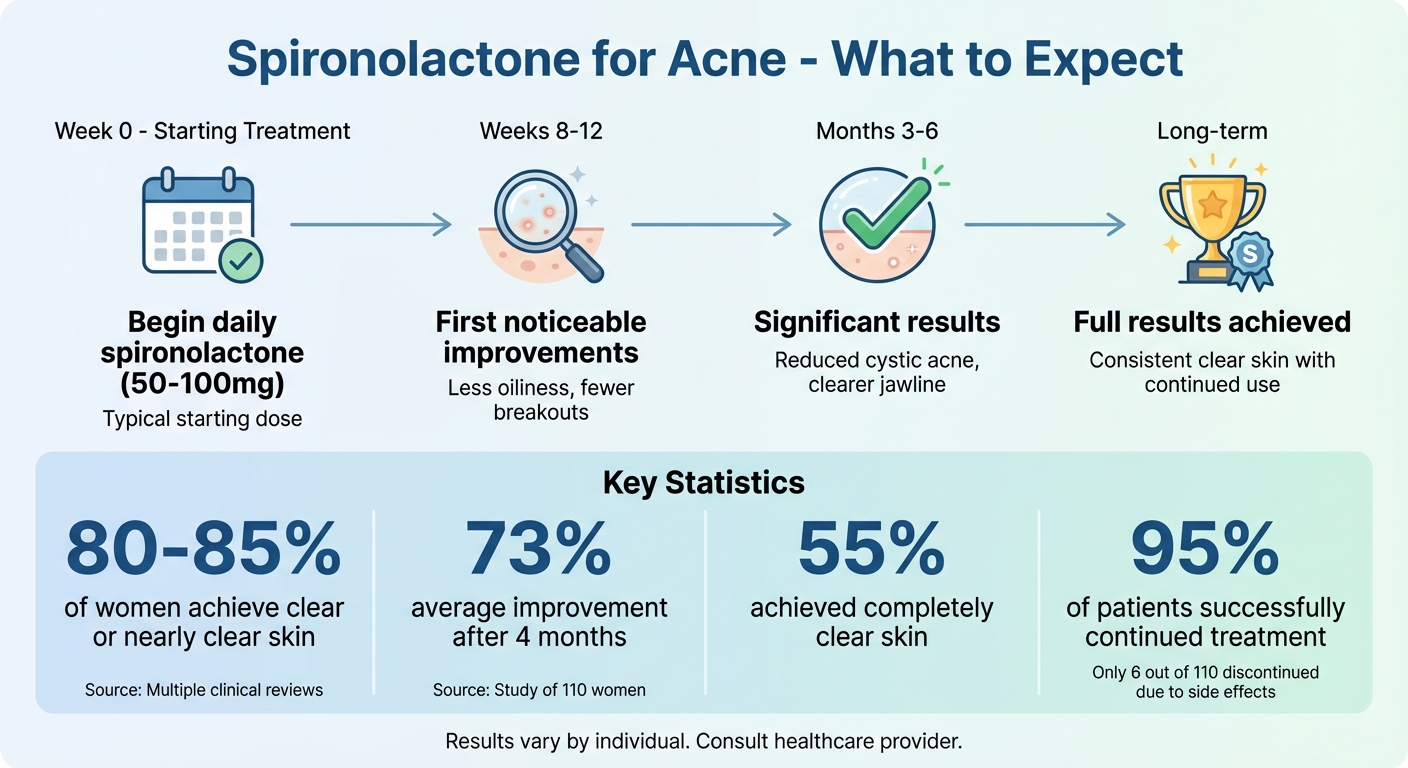
Spironolactone for Acne: Expected Results Timeline and Success Rates
How to treat hormonal acne with spironolactone in 2025: dermatologist and acne expert explains
1. Spironolactone Works Immediately
A common misconception is that spironolactone will clear up your skin in just a week or two. The truth? This medication works by targeting hormonal activity and reducing sebum production, which takes time to show results.
Most people start noticing less oiliness and fewer breakouts within 8–12 weeks. However, for more noticeable changes - like reduced cystic acne or fewer jawline breakouts - you’ll need to stick with it for 3–6 months of consistent use. For instance, a retrospective study involving 110 women found that significant improvements, averaging 73%, were observed after about 4 months of treatment. Another review reported that 80%–85% of women achieved either clear or nearly clear skin over several months.
It's important to remember that acne lesions take weeks to form and heal, so expecting overnight results isn’t realistic. Some patients might even experience a mild flare-up as their skin adjusts to the medication. But don’t panic - this is normal and doesn’t mean the treatment isn’t working. Dermatologists often stress the importance of patience and sticking to the prescribed regimen for long-term results.
Taking spironolactone daily as directed is crucial. Missing doses can disrupt hormone regulation and sebum production, slowing your progress. Many dermatologists also suggest pairing spironolactone with faster-acting topical treatments, like retinoids or benzoyl peroxide, to manage acne during those early weeks of treatment.
To help you stay on track, telehealth services like Oana Health offer support during this adjustment period. They provide virtual check-ins, clear guidance on the 3–6+ month timeline, and timely adjustments to your dosage. Tracking your progress with monthly photos and setting milestones at 3 and 6 months can also keep you motivated as you wait for the medication to work its magic.
2. Spironolactone Is Not Just for Severe PCOS Acne
Many believe spironolactone is only effective for women with severe PCOS-related acne, but that's a misconception. Spironolactone works by blocking androgen receptors, reducing the impact of hormones like testosterone on oil glands. This makes it beneficial for women with hormonally driven acne, even if they don’t have PCOS or severe cystic breakouts. In fact, dermatologists often prescribe it for mild to moderate hormonal acne - especially when it shows up along the jawline, flares before menstruation, or resists topical treatments.
According to the U.K.'s NHS, spironolactone is used to treat acne in women "because it affects hormones". Similarly, U.S. dermatology guidelines endorse its use for persistent adult female acne, even when hormone levels appear normal in blood tests.
Research supports its effectiveness. A study involving 110 women found that 94 of them saw improvement with spironolactone, and 61 achieved complete clearance. Broader reviews show that 80–85% of patients experienced clear or nearly clear skin, with acne lesions decreasing by 50–100% in the right candidates.
The key takeaway? Hormonal acne often stems from your skin's sensitivity to normal hormone levels rather than a hormonal imbalance like PCOS. If your acne tends to cluster on your lower face, worsens around your period, or includes deep, painful bumps, spironolactone might be worth discussing with your healthcare provider.
Thanks to telehealth, accessing this treatment has become easier than ever. Services like Oana Health offer virtual consultations to assess your acne, prescribe spironolactone if appropriate, and deliver the medication right to your doorstep. Their licensed professionals focus on hormonal acne treatment for women, whether or not PCOS is part of the picture, providing convenient care without the need for an in-person visit.
3. Long-Term Spironolactone Use Is Dangerous
There's a persistent myth that long-term spironolactone use is harmful. However, when prescribed responsibly and monitored appropriately, spironolactone has proven to be a safe option for managing hormonal acne in otherwise healthy women.
Research strongly challenges this misconception. For instance, a study involving 110 women with acne revealed that spironolactone "remains effective over the course of long-term therapy". Over a 17-month period, 85% of participants experienced improvement, and 55% achieved complete clearance of their acne. Importantly, while 51 women reported mild side effects like menstrual irregularities or breast tenderness, only 6 discontinued the medication due to these issues. This means about 95% of participants continued treatment successfully.
Most side effects, such as menstrual changes, can often be managed with simple dose adjustments. Serious complications, like dangerously high potassium levels, are exceptionally rare in young, healthy women taking standard acne doses - especially if they’re not on other medications that could increase potassium. Reviews involving nearly 1,500 women found no evidence of resistance to spironolactone over time, with 80–85% achieving clear or nearly clear skin.
Monitoring requirements are tailored to the individual and are not overly burdensome. For healthy women on typical doses (50–100 mg/day), initial lab work and periodic follow-ups based on risk factors are usually sufficient. Routine, frequent blood tests are unnecessary. That said, spironolactone isn't suitable for everyone. Extra precautions are necessary for those with kidney or heart conditions, those taking certain blood pressure medications, or during pregnancy, as spironolactone is contraindicated for pregnant women. For most women, though, long-term use under a doctor’s guidance is both effective and safe.
Additionally, modern telehealth services add convenience to safety monitoring. Platforms like Oana Health allow licensed clinicians to conduct virtual check-ins, order labs when needed, adjust dosages, and even deliver prescriptions straight to your doorstep. This makes managing long-term spironolactone use easier than ever.
sbb-itb-6dba428
4. Spironolactone Requires Frequent Blood Tests
There’s a common misconception that spironolactone demands frequent lab tests. In truth, most healthy women taking spironolactone for acne don’t need routine testing. Instead, monitoring depends on individual factors like age, kidney health, medications, and dosage.
Originally, spironolactone was used as a diuretic for heart and blood pressure conditions, which did require close tracking of potassium levels and kidney function - especially in older or medically complex patients. However, for healthy women under 45 with normal kidney function and no conflicting medications, U.S. dermatologists usually recommend a one-time baseline test for potassium and kidney function. Further testing is typically only necessary if the dosage increases or concerning symptoms develop.
For patients with added risk factors, monitoring becomes more frequent. This includes individuals with chronic kidney disease, high blood pressure, diabetes, those over 45–50, or those taking ACE inhibitors, ARBs, NSAIDs, or potassium supplements. In these cases, follow-up labs are advised every 3–6 months initially, and annually once stable. Symptoms like muscle weakness or heart palpitations between tests could signal an electrolyte imbalance and may warrant immediate attention.
Telehealth platforms, such as Oana Health, simplify lab monitoring. They assess your medical history and risk factors, order local tests only when necessary, and adjust your medication dose remotely, making the process more convenient.
5. Spironolactone Treats All Acne Types
Let’s clear up a common misconception: spironolactone isn’t a universal solution for every type of acne. This medication is specifically effective for hormonal acne in adult women. If your breakouts tend to cluster along your jawline, chin, or lower cheeks, flare up around your period, or manifest as deep, tender cysts, spironolactone may work wonders for you. However, if your acne primarily consists of small blackheads, whiteheads, or is bacterial in nature, spironolactone alone probably won’t do the trick.
Dermatologists often recommend combining spironolactone with other treatments for the best results. For instance, a study involving 110 women showed that 55% achieved completely clear skin when using spironolactone, with significant reductions in acne severity overall. Pairing it with a topical retinoid can boost its effectiveness, while benzoyl peroxide helps tackle bacteria and inflammation.
The key to successful acne treatment lies in personalization. Your regimen should align with your specific hormonal profile and acne patterns. For example, if you experience hormonal cystic acne along your jawline but also have scattered blackheads, your dermatologist might prescribe oral spironolactone alongside targeted topical treatments. According to the American Academy of Dermatology, spironolactone can reduce acne by 50–100% in the right candidates, but it’s not a one-size-fits-all solution.
Telehealth services have made personalized care more accessible than ever. Platforms like Oana Health can evaluate your acne concerns and determine if your condition is hormonal. Licensed clinicians review factors like your acne patterns, menstrual history, and symptoms such as unwanted facial hair to decide if spironolactone is a good fit. They can prescribe both spironolactone and complementary treatments, adjusting your regimen through virtual follow-ups, with medications conveniently delivered to your doorstep.
How Telehealth Can Support Spironolactone Treatment
Starting spironolactone treatment has become much easier, thanks to telehealth. Telehealth platforms have transformed access to hormonal acne care, allowing patients to complete the initial evaluation entirely from home. Licensed clinicians can review your acne patterns, menstrual history, current medications, and overall health through an online assessment to determine if spironolactone is the right fit - often with appointments available within just a few days.
This process is both convenient and thorough. Your clinician will evaluate signs of hormonal acne, like jawline breakouts and menstrual flares, while also screening for any potential contraindications. For most healthy women, starting doses of 50–100 mg per day can often be prescribed without an in-person visit. If lab work is needed - such as for those with kidney concerns or specific medication interactions - telehealth providers can arrange for blood tests at a local lab, with results reviewed electronically.
Oana Health is a telehealth service that focuses on female hormones, PCOS, and related conditions, including acne, unwanted facial hair, and hair loss. Their licensed medical professionals conduct a brief online intake to evaluate your health and, if appropriate, prescribe personalized treatments. Treatment plans start at $32 per month, with medications shipped directly to your door.
Follow-up care is just as convenient. Virtual check-ins, typically scheduled every 8–12 weeks, allow your clinician to review progress photos, adjust dosages, and address any side effects such as breast tenderness or dizziness - all without the need for an office visit. This flexible approach ensures you can stick with the treatment long enough to see results, which often take several months to fully develop. Patients also benefit from 24/7 support and prompt responses to their concerns.
Since hormonal acne often overlaps with conditions like PCOS, insulin resistance, or weight-related issues, platforms like Oana Health offer a comprehensive approach. They combine spironolactone with other treatments, all managed by one virtual care team. This coordinated care model makes managing hormonal acne more accessible and practical for busy women across the U.S.
Conclusion
Spironolactone has proven to be a reliable and safe option for managing hormonal acne in women, especially when prescribed and monitored by a qualified medical professional. Studies indicate that around 80–85% of women see significant improvement with this treatment. Results typically start to show within 8–12 weeks, with continued progress over time.
This medication works by addressing oil-driven hormonal acne, but pairing it with topical treatments can often yield even better results. That said, it’s not suitable for everyone - certain health conditions or medications might make it less appropriate.
If you’re dealing with persistent breakouts along your jawline, flare-ups tied to your menstrual cycle, or adult-onset acne, it’s worth consulting with a licensed clinician to explore your options. For many women, spironolactone offers a practical alternative to long-term antibiotics or multiple courses of isotretinoin.
Thanks to modern telehealth services, accessing this treatment has become even easier. For example, Oana Health connects you with U.S.-licensed medical professionals for online evaluations and delivers prescriptions directly to your home. Remember, hormonal acne is both common and treatable - you don’t have to navigate it alone.
FAQs
How does spironolactone work to treat hormonal acne?
Spironolactone works to treat hormonal acne by targeting androgen receptors and lowering the production of androgens - hormones that can lead to excess oil (sebum) production in the skin. By cutting down on oil buildup, it helps prevent clogged pores and acne flare-ups tied to hormonal changes.
This focused method is particularly helpful for individuals struggling with acne related to hormonal imbalances, such as those associated with PCOS or menstrual cycles.
What are the potential side effects of taking spironolactone for acne?
Spironolactone is typically well-received, though some individuals might encounter side effects. The more common ones include dizziness, breast tenderness, irregular menstrual cycles, and higher potassium levels. In rare cases, it may cause kidney problems or allergic reactions.
If you experience anything out of the ordinary or have worries about the medication, reach out to your healthcare provider. They can assess your situation and ensure spironolactone is a suitable option for you.
How does telehealth make spironolactone treatment easier for acne?
Telehealth streamlines the process of managing your spironolactone treatment for acne, making it both easier and more accessible. With virtual consultations, licensed healthcare providers can evaluate your condition, prescribe the appropriate dosage, and track your progress - all from the comfort of your home.
On top of that, your medication can be shipped straight to your doorstep, eliminating the hassle of pharmacy trips. This method not only saves time but also helps you stick to your treatment plan with personalized care tailored to your needs.