
Deep Learning for Androgenic Alopecia Detection
Androgenic alopecia (AGA), or pattern hair loss, affects millions of people, with nearly 50% of women experiencing it by age 70. Traditional diagnostic methods, relying on visual assessments, often lack consistency, with reproducibility rates of only 65–78%. Deep learning is changing this by using AI models like convolutional neural networks (CNNs) to analyze high-resolution scalp images, achieving diagnostic accuracies of up to 97.6%.
Key takeaways:
- AI-powered diagnosis: AI models detect early AGA signs, such as changes in hair density and follicle structure, with high precision.
- Early intervention: Accurate detection during reversible stages of hair loss can prevent progression.
- Efficiency: AI systems analyze scalp images in seconds, offering faster and more consistent results than manual assessments.
- Teledermatology integration: Mobile apps now enable at-home trichoscopic imaging and instant AI-based assessments.
AI-driven tools are improving AGA diagnosis and treatment, enabling earlier detection and personalized care options, particularly for women with conditions like PCOS and elevated DHT. With advancements in AI, managing hair loss is becoming more precise and accessible.
AI and Hair Loss: Measuring Progress with Data-Driven Insights
sbb-itb-6dba428
How Deep Learning Detects Androgenic Alopecia
Deep learning is reshaping how androgenic alopecia (AGA) is identified, offering precision beyond traditional methods. By employing convolutional neural networks (CNNs), these systems analyze image patterns at a pixel level, focusing on trichoscopic images - high-resolution photos magnified 30× from different scalp regions like the frontal, vertex, temporal, and occipital areas. This detailed analysis enables the extraction of critical features that dermatologists might miss during visual assessments.
The process begins with capturing high-magnification scalp images without the need to shave the hair. CNNs then identify individual follicle openings, even when hair shafts overlap. As Meng Gao and colleagues from the Hospital of Dermatology at the Chinese Academy of Medical Sciences explain:
"The hair follicle opening was chosen as the unique mark of each hair, and hair diameter was measured near the opening... this framework can achieve similar accuracy to manual labelling." - Meng Gao et al.
Once follicle openings are detected, the AI measures biomarkers such as hair density and diameter distribution. Each hair is classified into one of three types: vellus (diameter < 0.03 mm), intermediate (0.03–0.06 mm), or terminal (diameter > 0.06 mm). This classification is crucial since AGA progression typically involves a reduction in terminal hairs and an increase in vellus hairs, a phenomenon known as miniaturization, which often requires androgen management and targeted treatment options. In a notable study analyzing 2,910 trichoscopic images, researchers achieved a 95.44% accuracy rate in detecting follicle openings.
Trichoscopic Imaging in AI Models
Trichoscopic imaging plays a critical role in early hair loss detection. These high-magnification images reveal details like individual follicles and hair shaft characteristics that are invisible to the naked eye. AI systems can process these images in just 2 seconds, significantly faster than manual analysis by dermatologists.
Modern AI models often use a two-step approach. First, a detection network (D-Net), based on Fully Convolutional Networks, locates each follicle opening. Then, a regression network (R-Net), built using MobileNet architecture, predicts hair counts and diameter proportions. This combination has shown impressive accuracy - 93% for frontal scalp analysis and 90% for vertex area analysis - when grading hair loss using the Basic and Specific (BASP) classification system. For instance, a study at Ewha Womans University Medical Center demonstrated that AI could reliably distinguish healthy scalps (BASP 0) from early-stage hair loss (BASP 1–3), with perfect recall in identifying early cases.
These trichoscopic images feed into neural networks, enabling more precise and reliable detection.
Deep Learning Architectures for Hair Loss Detection
The choice of deep learning architecture directly impacts the accuracy and reliability of AGA detection. Several CNN models have been particularly effective:
- ResNet-18: Known for balancing performance and computational efficiency, this architecture is ideal for smaller medical datasets. In a study at Ewha Womans University, an ensemble ResNet-18 model achieved 90% accuracy and an Area Under the Curve (AUC) of 0.97 when distinguishing between no hair loss and early-stage AGA.
- Mask R-CNN: Designed for instance segmentation, this model excels at outlining balding regions. A study at Shenzhen People's Hospital achieved 97.6% precision in identifying hair loss areas using this architecture.
- MobileNet (R-Net): Focused on predicting hair density and diameter, this model has shown improved estimation accuracy.
- FCN (D-Net): Specializes in detecting follicle openings, with a reported accuracy of 95.44%.
| Architecture | Primary Function | Key Performance |
|---|---|---|
| ResNet-18 | Binary classification (healthy vs. early AGA) | 90% accuracy; 0.97 AUC |
| Mask R-CNN | Segmentation of balding regions | 97.6% precision |
| MobileNet (R-Net) | Predicting hair density and diameter | Improved estimation accuracy |
| FCN (D-Net) | Detecting follicle openings | 95.44% accuracy |
These architectures often utilize transfer learning, which involves starting with models pre-trained on large datasets like ImageNet and fine-tuning them for trichoscopic data. Input images are typically resized to 224×224 pixels and normalized to ensure consistency, with many systems also using the Hue, Saturation, and Value (HSV) color model to account for variations in skin tone. This preprocessing ensures the AI focuses on hair-specific features without being influenced by differences in lighting or skin color.
Diagnostic Accuracy of Deep Learning Models
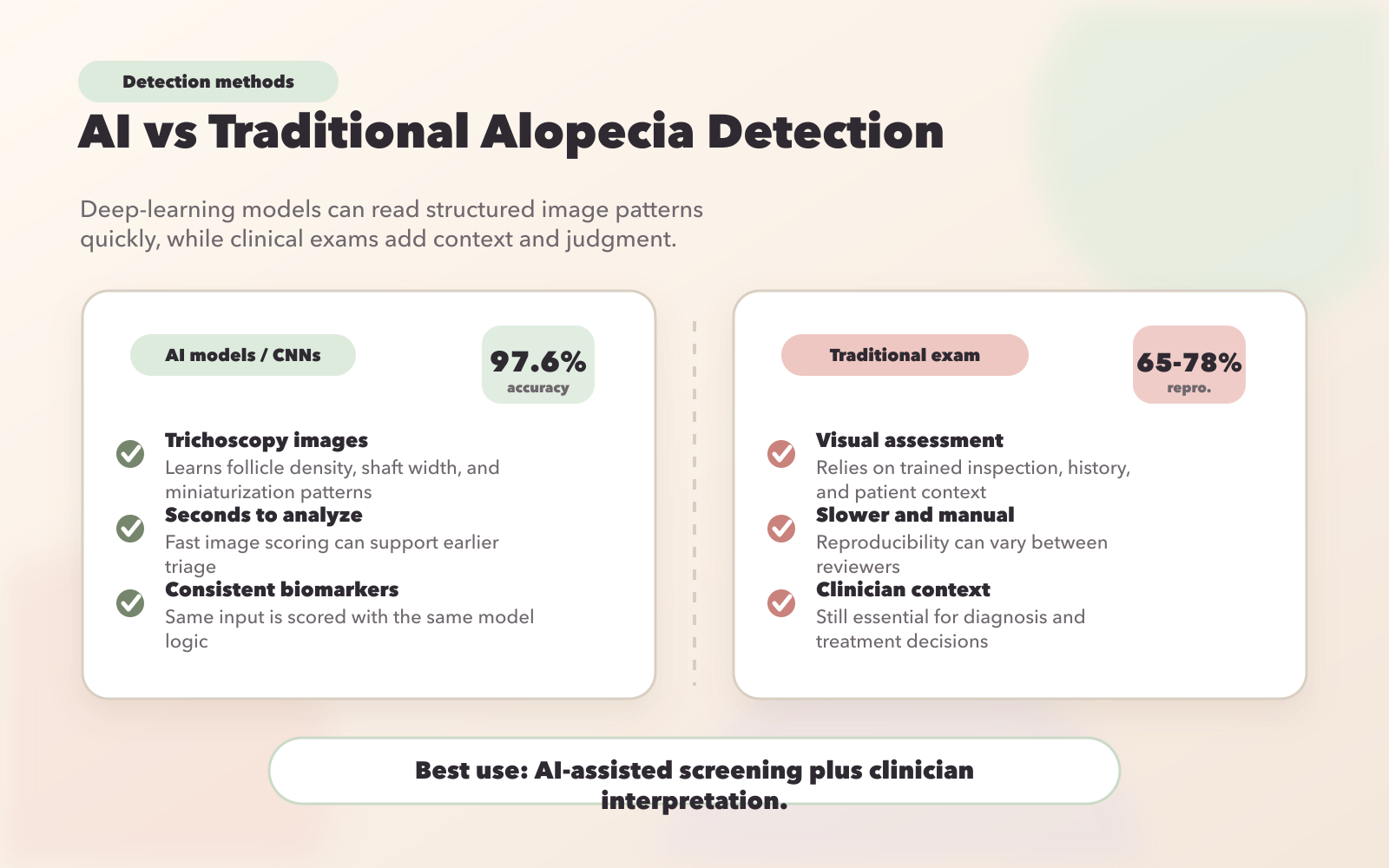
AI vs Traditional Methods for Androgenic Alopecia Detection: Accuracy and Speed Comparison
Deep learning models are setting a new standard in diagnostic accuracy, far surpassing the traditional reproducibility rates of 65–78% often seen among dermatologists. For example, these models have achieved diagnostic accuracies as high as 97.6% in identifying androgenic alopecia, offering consistent, measurable results that minimize the subjectivity of manual evaluations.
In July 2025, researchers at Ewha Womans University Medical Center tested a ResNet-18 model using 318 trichoscopic images. The model was tasked with distinguishing between healthy scalps (BASP 0) and early-stage hair loss (BASP 1–3). It delivered impressive results, achieving 90% accuracy and an AUC score of 0.97 during external validation, with a recall rate of 100%. According to Min Jung Suh, one of the researchers:
"This stability may be attributed to the binary simplification of BASP labels (BASP 0 vs. BASP 1–3), which reduced class fragmentation and enhanced the signal-to-noise ratio during training." - Min Jung Suh, Ewha Womans University College of Medicine
Further studies have built on these successes, exploring alternative models for more detailed severity staging. At Sapienza University, a study using an SVM algorithm analyzed trichoscopic data from 200 patients. The model achieved 90% test accuracy with an AUC score of 0.95. Lead researcher Marco Di Fraia highlighted its clinical relevance:
"The principal aim of our model is to reveal those patients presenting with a macroscopically appearing mild alopecia although having a trichoscopically active disease that might quickly advance to more severe stages." - Marco Di Fraia, Sapienza University of Rome
These AI models consistently outperform traditional methods, delivering accuracy rates between 90–97.6% across various severity levels. The following table provides a comparison of key metrics across different AI architectures:
Model Performance Comparison
| Model Architecture | Primary Task | Accuracy | AUC Score | Notable Feature |
|---|---|---|---|---|
| ResNet-18 | Binary classification (healthy vs. early AGA) | 90% | 0.97 | 100% recall for early cases |
| SVM | Severity staging (mild vs. severe) | 90% | 0.95 | Detailed analysis of hair pattern features |
| Mask R-CNN | Hair loss region identification | 97.6% | N/A | 100% accuracy for Grade I |
| D-Net (FCN) | Follicle opening detection | 95.44% | N/A | Processes images in approximately 2 seconds |
Each architecture shines in specific areas. ResNet-18 is particularly effective for early-stage screenings, balancing computational efficiency with strong performance on smaller datasets. SVM models are well-suited for analyzing extracted patterns like vellus hair percentages, while Mask R-CNN excels in mapping balding regions with precision. These models also offer significant time savings, completing trichoscopic analyses in about 2 seconds - far faster than the several minutes typically required by human experts.
Clinical Benefits of AI-Based Early Detection
Switching from traditional visual assessments to AI-powered diagnostics tackles a long-standing issue in dermatology: the inconsistency in expert evaluations. For example, traditional expert grading for androgenic alopecia achieves only 65–78% reproducibility among dermatologists. AI steps in by replacing subjective judgments with precise pixel-level analysis and geometric measurements, ensuring more consistent and reliable results.
AI doesn’t just improve accuracy - it also saves time. Tasks like identifying vellus hair, empty follicles, and single hair follicular units, which once required manual effort, can now be automated by deep learning models. This efficiency significantly reduces delays during clinical appointments, allowing clinicians to focus more on treatment planning. This combination of speed and precision lays the groundwork for even more clinical advancements.
AI in Teledermatology
AI integration into telehealth platforms is changing how hair loss is diagnosed. Mobile apps powered by deep learning models now allow patients to capture trichoscopic images at home, following standardized imaging protocols like fixed angles and distances. These apps can then provide instant, objective assessments of hair loss severity. This is especially useful for initial screenings, where AI models designed for binary classification (e.g., healthy scalp vs. early-stage hair loss) can prompt patients to seek medical attention before noticeable thinning occurs.
Between July 2018 and January 2024, researchers at Ewha Womans University Medical Center developed a ResNet-18 model to ease the manual workload of BASP scoring. This model achieved an impressive 90% accuracy in external validation and was tailored for use in teledermatology settings. As highlighted in their findings:
"Deep learning–based systems may reduce the burden of manual labeling, minimize subjectivity in early hair loss diagnosis, and offer consistent alerts for possible AGA, thereby improving the accessibility, accuracy, and standardization of dermatologic care." - Ewha Medical Journal
These advancements in teledermatology are making it easier to deliver personalized care to patients.
Early Detection and Personalized Treatment
AI’s role extends beyond diagnosis to enhancing treatment strategies. By providing a precise severity index - expressed as a percentage probability rather than a general category - AI enables dermatologists to move beyond generalized treatments and offer tailored interventions. This is particularly crucial for androgenic alopecia, where early intervention during the reversible stages of follicular miniaturization can prevent irreversible hair loss.
Accurate early diagnosis also streamlines clinical workflows, paving the way for targeted therapies. Platforms like Oana Health are using this technology to create personalized treatment plans for hair loss. By combining AI-driven diagnostics with telehealth consultations, licensed medical professionals can prescribe treatments tailored to each patient’s specific needs, ensuring timely and appropriate care. This approach addresses a critical gap highlighted by researchers at Sapienza University of Rome, who noted that AI could identify "patients presenting with a macroscopically appearing mild alopecia although having a trichoscopically active disease that might quickly advance to more severe stages". With treatments shipped directly to patients' homes, the entire process - from detection to treatment - becomes more streamlined and accessible.
Recent Research and Future Developments
Recent studies continue to highlight the potential of deep learning in detecting androgenetic alopecia (AGA), building on earlier diagnostic advancements and offering new perspectives.
Findings from Recent Studies
At Shenzhen People's Hospital, researchers analyzed 761 images from 257 patients to create a cutting-edge AI grading system. Using the Mask R-CNN framework, they achieved an impressive 97.6% precision. They also introduced the Area-Segmentation Integration (ASI) metric, which measures the ratio of hair loss area to the total scalp area. This system surpassed traditional BASP length measurements, reaching 100% accuracy for Grade I (no hair loss) and 95% for Grade VI. However, intermediate cases, like Grade III, proved more complex, with an accuracy of 81%.
Meanwhile, the ResNet-18 model from Ewha Womans University Medical Center continues to excel, maintaining 90% accuracy and a 0.97 AUC for early-stage detection. It also delivers 100% recall for early-stage cases and processes data efficiently, completing each epoch in just 8.5 seconds. These advancements set the stage for further refinement of AI-based diagnostic tools.
Future Improvements in AI Systems
Despite their impressive results, current models face challenges that researchers are actively addressing. One major hurdle is the lack of data diversity - Hamilton-Norwood Grade VII cases make up only 4.6% of datasets, often leading to their exclusion during training. Additionally, camera systems with 32.5-megapixel resolution struggle to detect follicular structures smaller than 200 micrometers, making it difficult to identify early miniaturization (20–50 micrometers) without advanced trichoscopy.
To tackle these issues, researchers at Dongguk University expanded their dataset by 6–10 times using geometric transformations and color normalization. Their ensemble of DenseNet, XceptionNet, and ResNet achieved 95.75% accuracy with a 93.36% F1 score. Looking ahead, efforts will focus on integrating micro-scale trichoscopic parameters, increasing ethnic representation in datasets, and developing mobile-first diagnostic tools. These tools aim to standardize imaging protocols, enabling consistent remote analysis. Emerging solutions, such as those offered by Oana Health, could revolutionize remote scalp analysis and teledermatology, paving the way for earlier interventions and more personalized treatments.
Conclusion
Deep learning has reshaped how androgenic alopecia (AGA) is detected. Traditionally, dermatologists relied on subjective visual assessments, which only achieved 65–78% reproducibility. Now, AI models provide 90–97.6% accuracy by analyzing hair loss patterns at the pixel level. This shift allows for early intervention during reversible stages of AGA, preventing permanent follicular miniaturization.
The efficiency gains in clinical practice are hard to ignore. AI systems analyze images in about 2 seconds, eliminating the need for time-consuming manual evaluations while maintaining diagnostic accuracy. This means quicker diagnoses and more tailored treatment plans for patients.
The potential of AI in dermatology is further highlighted by the Ewha Medical Journal:
"This model demonstrated high accuracy and generalizability for detecting early-stage AGA from trichoscopic images, supporting its potential utility as a screening tool in clinical and teledermatology settings." - Ewha Medical Journal
Telehealth platforms are also leveraging deep learning to bring early screening to more patients. For example, Oana Health combines AI-based diagnostics with personalized treatments, such as oral minoxidil and topical spironolactone, delivered directly to patients' homes.
As AI models continue to improve detection accuracy and incorporate more diverse datasets, the future of hair loss management looks promising. Patients now have access to earlier interventions that can slow or even halt the progression of AGA, transforming it into a manageable condition.
FAQs
Can AI detect AGA before I notice thinning?
AI has the ability to detect androgenic alopecia (AGA) even before noticeable thinning appears. By examining trichoscopic images, it evaluates hair density and the variation in hair diameter, making it possible to identify AGA at an earlier stage and consider timely intervention options.
How accurate is an at-home AI scalp scan?
At-home AI scalp scans can vary in accuracy depending on the system used. Research indicates that they are capable of evaluating hair loss severity, follicular density, and overall scalp health with notable effectiveness. While some systems show a high level of diagnostic precision, ongoing studies aim to compare their results more thoroughly with clinical benchmarks.
What photos do I need for an AI hair-loss check?
To use an AI hair-loss check effectively, you'll need clear, high-quality photos of your scalp or hair. Trichoscopic images - close-up shots that magnify the scalp to reveal details like hair follicles, density, and diameter - are particularly helpful. Make sure your photos are well-lit, sharp, and focused on the areas of concern. Blurry or dimly lit images can make it harder for the AI to provide an accurate assessment of your hair loss.