
Diode Lasers for Hirsutism: Results by Skin Type
Diode lasers are highly effective for reducing unwanted hair caused by hirsutism, achieving up to 90%–92% hair reduction after eight sessions. However, results vary based on skin type and hormonal factors. Here's what you need to know:
- Skin Types I–III (Lighter Skin): These skin types tolerate higher laser energy levels, leading to faster and more effective results with minimal side effects like redness or swelling.
- Skin Types IV–V (Medium to Dark Skin): Lower energy levels and cooling techniques are essential to prevent burns or pigmentation changes. Results are comparable to lighter skin types with proper adjustments.
- Skin Type VI (Very Dark Skin): Requires careful parameter settings and cooling due to higher melanin levels in the skin. Nd:YAG lasers may sometimes be preferred for safety, but diode lasers still deliver strong results.
Key Factors Affecting Results:
- Hormonal Imbalances: Conditions like PCOS or thyroid dysfunction can hinder laser effectiveness. Combining laser treatments with medications like spironolactone or oral contraceptives often improves outcomes.
- Treatment Protocols: Adjusting laser settings to match skin tone and hair type, along with using cooling methods, ensures safety and better results.
Addressing hormonal causes alongside laser treatments maximizes long-term success. Tailored approaches for each skin type and proper post-care, like sun protection, are crucial for safe and effective hair reduction.
Diode Laser Results by Fitzpatrick Skin Type
Results for Skin Types I–III (Lighter Skin)
For women with Fitzpatrick skin types I–III and dark terminal hair, diode lasers are highly effective. These skin types have lower levels of epidermal melanin, which allows for the use of higher energy levels (30–35 J/cm²) without significant risk of burns or pigmentation issues.
Clinical data indicates that a single session can reduce hair by 10%–40%. After three to four sessions, hair reduction reaches about 75%, and by eight sessions, it can climb to as much as 92%. Trichoscopy often shows coarse terminal hair transforming into fine, barely visible vellus hair - commonly known as "peach fuzz" - which is less of a cosmetic concern.
"In the ideal subject with fair skin and dark hair, laser treatment can reduce hair growth significantly."
- Yasmeen Jabeen Bhat, MD, Department of Dermatology, Government Medical College
Side effects are usually mild and temporary, including pain during treatment (97.3%), redness (89%), and localized swelling around hair follicles (83.6%). These symptoms typically subside quickly. For individuals with medium to dark skin tones, treatment parameters need to be adjusted to account for higher melanin levels.
Results for Skin Types IV–V (Medium to Dark Skin)
A study conducted at AIIMS Jodhpur evaluated the use of an 805 nm diode laser on 73 women with Fitzpatrick skin types III–V. Practitioners started with lower fluences (18–20 J/cm²) and longer pulse durations (30 ms) to minimize the risk of burns. Mild burns were reported in 11% of cases, but all pigmentation changes resolved within one to two months.
In this study, patients achieved a 40% reduction in hair after just two sessions. By the eighth session, hair reduction reached 92%, outperforming Nd:YAG lasers (35%) and IPL devices (10%) in effectiveness. Another study, conducted in November 2016 at the Skin & Laser Centre in Mumbai, tested a 1060 nm vacuum-assisted diode laser on 10 patients with skin types IV–V. Results showed a 74.6% reduction in underarm hair six months after treatment, and 67% of treated thigh areas were rated as having "good" or "very good" clearance.
"For the Indian skin with dark hairs, the diode laser still stands the test of time. But, since the diode laser has a narrow margin of safety, proper pre and post-procedure cooling is recommended."
- Neerja Puri, Department of Dermatology, Punjab Health Systems Corporation
Given the narrower safety margin for these skin types, aggressive cooling is essential. Practitioners often use continuous contact cooling with sapphire tips or ice packs before and after each pulse. Patients are also advised to apply SPF 30+ sunscreen and avoid sun exposure between sessions to prevent post-inflammatory hyperpigmentation. For very dark skin (Fitzpatrick type VI), even further adjustments are necessary.
Results for Skin Type VI (Very Dark Skin)
Fitzpatrick type VI presents unique challenges due to the high melanin content in the epidermis, which competes with hair follicles for laser energy. To safely target hair follicles, practitioners must use longer pulse durations (≥30 ms), lower fluences, and aggressive cooling measures.
While Nd:YAG lasers (1064 nm) are often considered safer for type VI skin because of their lower absorption by melanin, diode lasers remain a popular choice due to their superior performance in reducing coarse terminal hair. However, careful parameter selection and cooling protocols are critical.
Patients with type VI skin may experience side effects such as pain, redness, and swelling, with a slightly elevated risk of temporary pigmentation changes if cooling is inadequate. Working with a skilled practitioner is key to ensuring both safety and effectiveness for this skin type. These tailored protocols help maximize the benefits of diode laser treatments across all skin tones while minimizing risks.
Laser Hair Reduction-Number of sittings for Unwanted Hair Removal- Dr.D A Satish | Doctors’ Circle
How Results Compare Across Skin Types
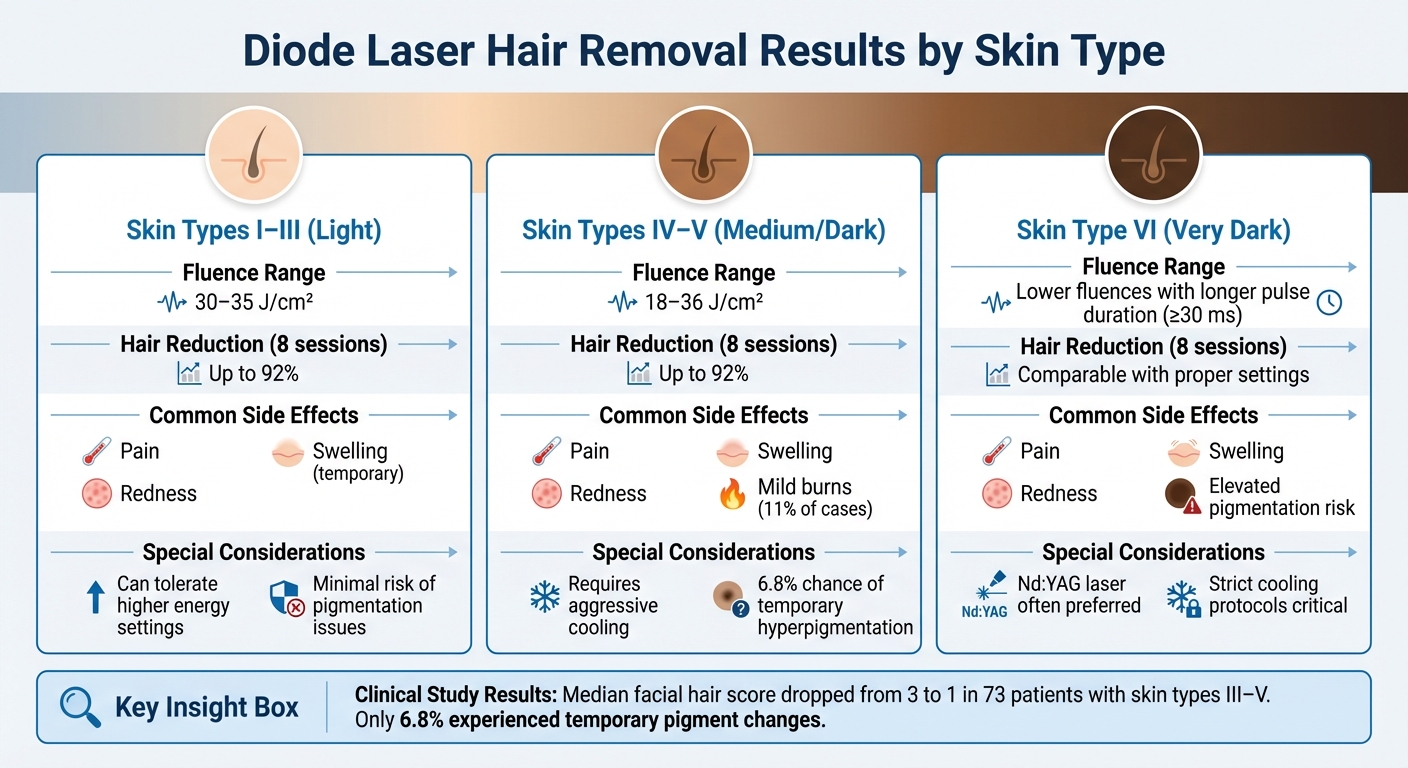
Diode Laser Hair Removal Results by Fitzpatrick Skin Type
Key Metrics and Safety Considerations
Laser hair removal results can vary significantly depending on skin type, with differences in energy settings, effectiveness, and side effects. For lighter skin tones (Types I–III), fluence levels between 30–35 J/cm² are typically safe and effective, achieving up to 92% hair reduction after eight sessions. Common side effects for these skin types include mild pain, redness, and swelling, which are generally temporary.
For medium to dark skin tones (Types IV–V), the process requires more caution. Fluence levels start lower, around 18–20 J/cm², and increase gradually based on the skin's tolerance. With the right adjustments, these skin types can achieve results comparable to lighter skin tones, but there is a higher risk of temporary hyperpigmentation, which occurs in 6.8%–30% of cases. These pigment changes typically resolve within one to two months, especially when aggressive cooling techniques are used.
Darker skin tones (Type VI) require even more specific adjustments, such as using lower fluences combined with longer pulse durations (≥30 ms). The Nd:YAG laser is often the preferred choice for these skin types due to its deeper penetration and lower risk of skin damage. However, strict cooling protocols are essential to minimize side effects like redness, swelling, and pigmentary changes.
Comparison Table of Results
| Skin Type | Fluence Range | Hair Reduction (8 sessions) | Common Side Effects | Special Considerations |
|---|---|---|---|---|
| I–III (Light) | 30–35 J/cm² | Up to 92% | Pain, redness, swelling | Can tolerate higher energy settings; minimal risk of pigmentation issues |
| IV–V (Medium/Dark) | 18–36 J/cm² | Up to 92% | Pain, redness, swelling, mild burns (11%) | Requires aggressive cooling; ~6.8% chance of temporary hyperpigmentation |
| VI (Very Dark) | Lower fluences with longer pulse duration (≥30 ms) | Comparable with proper settings | Pain, redness, swelling, elevated pigmentation risk | Nd:YAG laser preferred; strict cooling protocols are critical to prevent skin damage |
Clinical studies back up these findings. For example, research conducted at AIIMS Jodhpur demonstrated a median facial hair score drop from 3 to 1 in 73 patients with skin types III–V. Notably, no serious adverse events were reported, and temporary pigment changes occurred in only 6.8% of cases. This underscores the importance of tailoring treatment to individual skin types for safe and effective results.
sbb-itb-6dba428
What Affects Laser Hair Removal Results
How Hormonal Imbalances Affect Treatment Success
Hormonal imbalances can have a big impact on the effectiveness of diode laser treatments, especially in cases of hirsutism. Conditions like PCOS, thyroid dysfunction, adrenal hyperplasia, and hyperprolactinemia can encourage hair regrowth, leading to less consistent results. When these hormonal issues are left untreated, additional laser sessions are often required due to ongoing androgen stimulation. For instance, a study conducted at AIIMS Jodhpur on 73 women revealed that 21.9% of participants needed to continue taking oral medications - such as spironolactone or oral contraceptives - alongside their laser treatments to maintain their progress.
In particular, hyperprolactinemia can raise melanocyte-stimulating hormone levels, which may reduce the effectiveness of light-based therapies.
"Untreated hormonal diseases can result in variable-to-poor responses to laser hair removal, and these patients usually require more sessions than patients with normal hormone levels."
- Yasmeen Jabeen Bhat, Department of Dermatology, Government Medical College
To improve long-term results, addressing the root hormonal issues is crucial. This can involve treatments like peripheral androgen blockers or insulin sensitizers. Balancing hormones not only boosts the effectiveness of laser treatments but also supports the success of combination therapies.
Additional Treatments That Improve Results
Considering the influence of hormones on laser hair removal outcomes, adding pharmacological treatments can significantly enhance results. Women with PCOS and other hormonal conditions often see better outcomes when diode laser therapy is paired with medications. Antiandrogens like spironolactone, oral contraceptives, and metformin are commonly used to suppress the hormonal triggers of hair growth.
Here’s a quick look at some pharmacological treatments often combined with laser therapy:
| Treatment Type | Mechanism | Role Alongside Laser |
|---|---|---|
| Spironolactone | Blocks androgen receptors | Reduces hormonal stimulation of hair growth |
| Oral Contraceptives | Suppresses LH and FSH to lower androgen levels | Helps stabilize hormone levels |
| Metformin | Improves insulin sensitivity | Addresses metabolic aspects of PCOS |
| Eflornithine Cream | Inhibits enzymes involved in hair growth | Enhances visible results when used with laser |
"The combination of diode laser with either metformin or combined oral contraceptive pill was superior to the application of diode laser alone."
- PubMed Systematic Review
For women with hyperandrogenemia, adding topical eflornithine cream can further improve results. To sustain the benefits, pharmacological treatments should be continued for at least six months.
Conclusion
Diode lasers have proven highly effective in reducing unwanted facial hair caused by hirsutism across a wide range of skin tones. Studies show that diode laser treatments can achieve up to 90%–92% hair reduction after eight sessions. However, the success of these treatments hinges on tailoring the laser parameters to the patient’s Fitzpatrick skin type. For lighter skin tones (I–III), higher fluences of 30–35 J/cm² are generally well-tolerated. In contrast, darker skin tones (IV–V) require lower fluences, around 20–24 J/cm², to reduce the risk of burns and pigmentation issues.
Hormonal factors also play a significant role in determining treatment outcomes. Conditions like PCOS, thyroid disorders, or hyperprolactinemia can lead to persistent hair regrowth, potentially impacting the effectiveness of laser therapy. A study conducted at AIIMS Jodhpur found that 21.9% of patients needed to continue oral medications, such as spironolactone or oral contraceptives, alongside their laser treatments to maintain stable results.
Combining diode laser therapy with other treatments can further improve outcomes. For example, using antiandrogens, insulin sensitizers like metformin, or topical eflornithine cream can address both the visible hair growth and the underlying hormonal imbalances contributing to hirsutism.
Safety is equally important, especially for patients with darker skin tones. Proper cooling protocols and diligent sun protection are essential to minimize risks, given the laser’s narrow safety margin. By customizing laser settings, addressing hormonal factors, and incorporating complementary treatments, patients can achieve lasting and effective hair reduction.
FAQs
Can hormonal imbalances impact the effectiveness of diode laser hair removal for hirsutism?
Yes, hormonal imbalances - like those caused by polycystic ovarian syndrome (PCOS) - can influence how effective diode laser hair removal is for hirsutism. Elevated androgen levels associated with these conditions often result in thicker and denser hair, making the process of hair removal more challenging.
Diode lasers are effective for reducing hair growth across various skin types. However, when hormonal imbalances remain untreated, individuals may experience slower progress or require additional sessions to achieve their goals. Addressing these imbalances with medical treatment can help improve results and support better long-term hair reduction.
What precautions should be taken when using diode lasers on darker skin tones?
Diode lasers are considered a safe and effective option for darker skin tones, including Fitzpatrick skin types V and VI. However, taking the right precautions is essential to avoid potential issues like burns or pigmentation changes.
Before undergoing treatment, it's important to steer clear of sun exposure, tanning, or using any skin-lightening products, as these can make the skin more sensitive. Additionally, the skin should be free from active infections, severe conditions, or vitiligo to ensure a safe procedure.
During the treatment, using proper cooling techniques and adjusting laser settings specifically for darker skin tones can help minimize risks. It's equally important to work with a skilled professional who has experience treating a variety of skin tones. Careful monitoring throughout the procedure and during the recovery period plays a big role in achieving the best results while keeping the skin safe.
Can combining diode laser treatments with medications make hair reduction more effective?
Combining diode laser treatments with specific medications can boost the effectiveness of hair reduction for facial hirsutism. Studies indicate that pairing eflornithine cream with laser therapy delivers better results than using laser treatment by itself. This approach not only slows down new hair growth but also makes it easier to target and reduce existing hair.