
Educational Standards for BHRT Providers
Proper training in Bioidentical Hormone Replacement Therapy (BHRT) is critical to ensure patient safety and effective treatment. Without standardized education, providers risk dosing errors, contamination, and reliance on unregulated compounded formulations, which can lead to serious complications. Here’s what you need to know:
- Licensure and Certification: Only licensed MDs or DOs can prescribe BHRT. Board certification in specialties like Obstetrics and Gynecology, Internal Medicine, or Endocrinology ensures expertise.
- FDA-Approved vs. Compounded BHRT: FDA-approved bioidentical hormones are rigorously tested for safety and consistency, unlike compounded versions, which can vary in potency and lack standardized oversight.
- Training Programs: Accredited courses, like those from the BHRT Training Academy and WorldLink Medical, provide detailed instruction on hormone balance, dosing, and patient care.
- Hands-On Experience: Clinical mentorship and practical training enhance providers' ability to manage complex cases and perform procedures like hormone pellet therapy.
- Ongoing Education: Continuing Medical Education (CME) programs keep providers updated on the latest research and safety protocols in BHRT.
Basic Educational Requirements for BHRT Providers
When it comes to Bioidentical Hormone Replacement Therapy (BHRT), safety concerns underscore the importance of rigorous education and certification for providers.
Medical Licensure and Board Certification
In the United States, only licensed physicians with an MD (Medical Doctor) or DO (Doctor of Osteopathic Medicine) degree are authorized to prescribe hormone replacement therapies. Specialists commonly involved in BHRT include obstetricians-gynecologists (Ob/Gyns), internists, and family practitioners. While pharmacists at compounding facilities play a role in preparing BHRT medications, they can only dispense prescriptions issued by licensed medical professionals.
Board certification serves as a key indicator of a provider's expertise. Certifications relevant to BHRT typically include areas like obstetrics and gynecology, internal medicine, family medicine, and endocrinology. Achieving initial board certification in a general medical specialty requires at least three years of accredited training. For subspecialties, an additional year of training is necessary, along with maintaining an active medical license and compliance with state and federal regulations.
Beyond formal qualifications, hands-on clinical experience significantly enhances a provider's ability to manage BHRT effectively.
Clinical Experience and Scope of Practice
Practical experience is critical in ensuring safe and effective BHRT management. Seasoned providers are better equipped to address challenges like inconsistent dosing or contamination risks. They also understand the distinction between FDA-approved bioidentical hormones and compounded formulations, which lack the same regulatory oversight.
"The more experience a doctor has treating your condition, the better prepared he or she is to advise you on the best type of hormone replacement based on your individual circumstances." - Sarah Lewis, PharmD
A provider’s specialty also influences their approach to BHRT. Obstetricians and gynecologists focus on female reproductive health and menopause, while endocrinologists address hormone-related conditions across various bodily systems. Internists and family practitioners, on the other hand, offer more general adult care, which often includes hormone management.
BHRT Training Programs and Certifications
BHRT Certification Programs
Licensed physicians focusing on BHRT have access to several accredited training programs. For instance, the BHRT Training Academy offers a comprehensive 45-hour on-demand course that dives into hormone balance, adrenal and thyroid issues, and restoring sexual function. PracticalCME provides a specialized course centered on saliva testing and hormone balancing, awarding 8.0 AMA PRA Category 1 Credits. Additionally, WorldLink Medical offers the Legacy ABHRT Certification, an intensive 80-hour program that includes a 420-question exam.
A key focus of these trainings is salivary hormone testing, which evaluates cortisol, estrogens, progesterone, and testosterone levels. Participants also learn to implement protocols for compounded formulations, including creams, pellets, and troches, alongside complementary therapies like vitamins and herbal treatments. Many programs provide practical tools such as customizable patient forms and lab tracking systems, which can be seamlessly integrated into clinical practice.
"This is going to be a game-changer for me AND for my patients. Hormone optimization has been a HUGE missing piece of the puzzle for me." - Chris Costabile, Medical Provider
Post-certification support varies by program. The BHRT Training Academy offers ongoing access to a professional network, while PracticalCME provides direct faculty guidance for interpreting lab results. Organizations like Biote go a step further, pairing each provider with a clinical mentor to assist with regulatory compliance and keep them informed about the latest research developments.
These certification programs, combined with continuous CME opportunities, ensure that providers maintain high standards of clinical care in BHRT. The next section explores how ongoing education supports these efforts.
Continuing Medical Education (CME) Requirements
After earning specialized certifications, ongoing education becomes critical to staying current in BHRT practices. Programs such as George Washington University's two-week online course and the Institute for Functional Medicine's advanced module offer between 20.0 and 22.5 AMA PRA Category 1 Credits. These programs are highly practical, with 99% of participants reporting that they gained new skills to manage complex endocrine conditions.
PracticalCME enhances this commitment by offering free course updates for two years. Providers can also access mobile apps from organizations like the Endocrine Society, which feature interactive decision-making tools and updated clinical guidelines for quick, point-of-care use. Membership in groups like the American Functional Medicine Association (AFMA) provides additional resources, including archived webinars on clinical case reviews and discounts on new educational materials.
These continuing education opportunities ensure that providers stay informed and equipped to deliver the best possible care in the evolving field of BHRT.
Clinical Training and Practical Experience
Preceptorship and Mentorship Programs
Mentorship bridges the gap between theoretical knowledge and hands-on patient care. Organizations like Biote have established extensive networks, featuring 66 seasoned clinical mentors across specialties such as OBGYN, Family Practice, and Urology. After completing their initial training, providers are paired with a mentor to navigate complex patient cases, stay compliant with regulations, and keep up with the latest research.
Mentorship approaches differ widely. Some programs offer one-on-one clinical guidance, enabling practitioners to consult directly with medical directors or senior experts for case-specific advice. Others use group-based learning, where faculty lead discussions on anonymized patient labs, promoting collaborative problem-solving. For example, the National Procedures Institute's BHRT Part II course, priced at $1,495, dedicates two days to interactive case reviews and clinical discussions.
Beyond structured programs, community-based mentorship fosters ongoing professional development. Peer networks and expert forums provide continuous learning opportunities. Additionally, webinar libraries with archived clinical case reviews allow providers to explore expert insights on hormone testing and prescription protocols at their own pace. Over 7,100 healthcare providers from 4,100 clinics have participated in mentorship-supported training programs such as the Biote Method.
These mentorship initiatives are complemented by hands-on training, which sharpens technical skills essential for BHRT procedures.
Hands-On Training Programs
Practical training builds on foundational education and mentorship, equipping practitioners with the skills needed for precise clinical execution. The AAOPM Hormone Pellet Training program has trained over 20,000 graduates across more than 25 U.S. locations, focusing on hands-on practice with anatomical models to master trocar insertion techniques for pellet therapy. These one-day intensive courses, starting at $1,299, include direct faculty supervision.
This type of training addresses critical gaps in medical education. Research shows that many residents feel unprepared to manage menopause due to limited exposure during OBGYN residencies. Hands-on BHRT courses fill this void by teaching data-driven dosing strategies. Using proprietary clinical decision support software, these programs guide practitioners in determining precise dosages based on lab results and patient symptoms.
Flexibility is another hallmark of these programs. In-person sessions provide direct practice under faculty guidance, while livestream options feature interactive HD video demonstrations with real-time Q&A. George Washington University offers a two-week online course that combines case-solving modules with extended learning, awarding between 20.0 and 22.5 AMA PRA Category 1 Credits. These standardized protocols boast a less than 1% rate of adverse events related to implementation, with 93% of patients opting to continue therapy.
sbb-itb-6dba428
Regulatory and Compliance Standards for BHRT
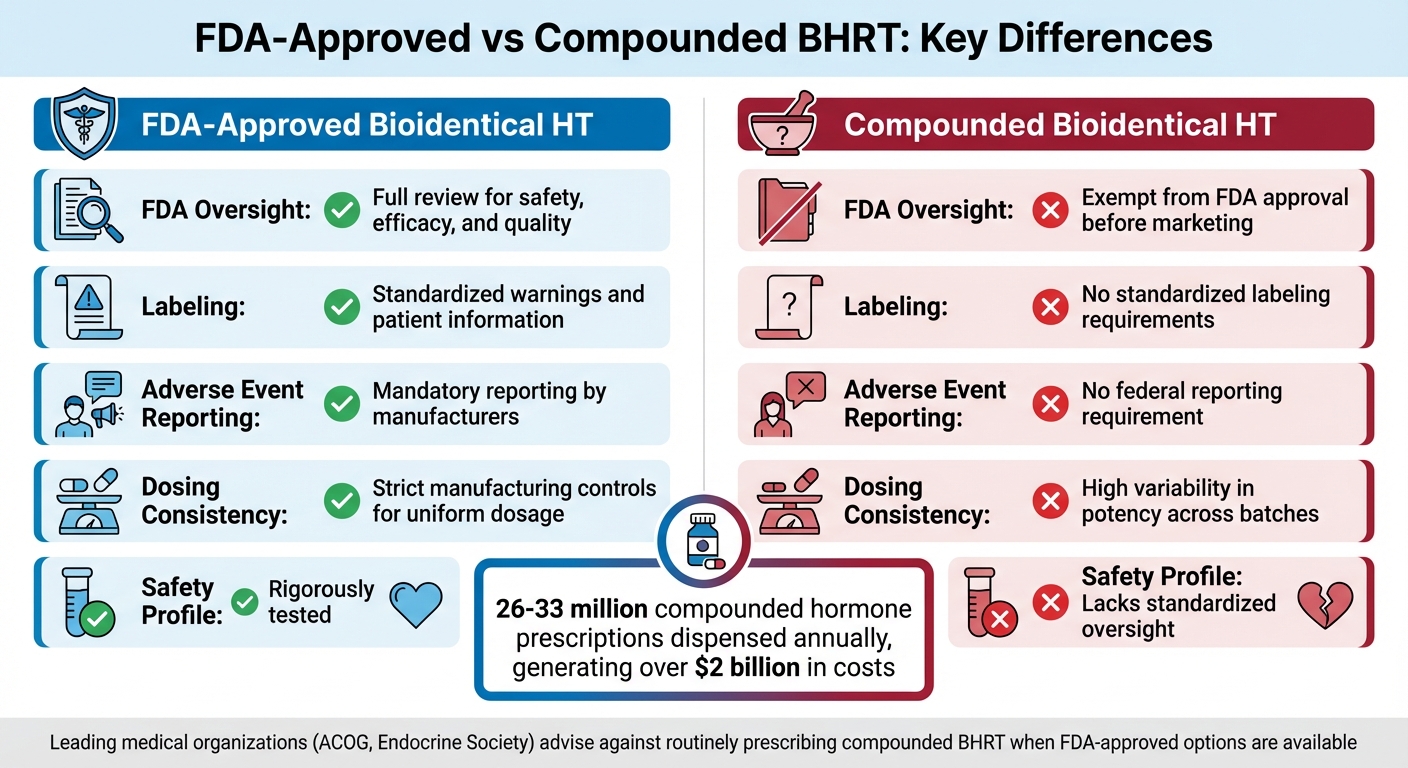
FDA-Approved vs Compounded BHRT: Safety and Regulatory Differences
Informed Consent and Patient Education
Healthcare providers have a responsibility to educate patients thoroughly about their options when it comes to BHRT. The American College of Obstetricians and Gynecologists (ACOG) emphasizes this point: "If a patient requests the use of compounded bioidentical menopausal hormone therapy, clinicians should educate them on the lack of FDA approval of these preparations and their potential risks and benefits, including the risks specific to compounding". This collaborative approach to decision-making is particularly important when discussing compounded therapies or off-label treatments, such as testosterone for women.
It's essential for patients to understand that the term "bioidentical" is largely a marketing label and does not imply greater safety compared to FDA-approved options. Unlike FDA-approved therapies, compounded formulations often lack standardized package inserts and boxed warnings, and their dosages may differ from what is listed. For testosterone therapy, in particular, clinicians should inform patients about possible irreversible side effects, including virilization, excessive hair growth, and acne.
The widespread use of compounded hormone therapy highlights the importance of informed consent. Each year, an estimated 26 to 33 million compounded hormone prescriptions are dispensed, generating over $2 billion in costs. Providers should carefully document the consent process, especially when prescribing compounded BHRT for specific reasons, such as patient allergies to ingredients in mass-produced medications. Patients should also be made aware that salivary and urinary hormone testing are not FDA-approved and do not provide accurate dosing information. These consent protocols are foundational for meeting the legal and ethical standards discussed next.
Legal and Ethical Requirements
In addition to informed consent, providers must navigate a range of legal and ethical standards. BHRT is regulated at both federal and state levels. Under Section 503A of the Federal Food, Drug, and Cosmetic Act, compounding pharmacies that create patient-specific prescriptions are exempt from FDA approval, as well as certain manufacturing and labeling requirements. However, compounded BHRT products are not subject to federal adverse event reporting, which limits the ability to monitor safety effectively.
State licensing boards play a key role in defining the scope of practice for BHRT providers, including prescribing authority and the supervision requirements for non-physician practitioners. Pharmacies producing BHRT are required to follow United States Pharmacopeia (USP) standards and Good Compounding Practices (GCP) to ensure quality and safety. Providers should verify that the pharmacies they work with meet these standards and undergo independent testing.
Leading medical organizations, such as ACOG and the Endocrine Society, advise against routinely prescribing compounded BHRT when FDA-approved bioidentical formulations are available. ACOG has also warned that "physicians who dishonestly market a product as medically beneficial may compromise public trust in physicians' clinical advice". Because state regulations on supervision and delegation vary, practitioners should stay up to date by consulting their state’s medical or nursing boards for the latest guidelines.
| Regulatory Aspect | FDA-Approved Bioidentical HT | Compounded Bioidentical HT |
|---|---|---|
| FDA Oversight | Full review for safety, efficacy, and quality | Exempt from FDA approval before marketing |
| Labeling | Standardized warnings and patient information | No standardized labeling requirements |
| Adverse Event Reporting | Mandatory reporting by manufacturers | No federal reporting requirement |
| Dosing Consistency | Strict manufacturing controls for uniform dosage | High variability in potency across batches |
Conclusion
Ensuring the safety of Bioidentical Hormone Replacement Therapy (BHRT) requires thorough education, specialized training, and a commitment to evidence-based practice. Providers must hold valid medical licensure and board certification in fields like Obstetrics and Gynecology, Internal Medicine, or Family Medicine. Beyond these foundational qualifications, advanced training in BHRT is critical. This includes understanding hormone pharmacology, mastering patient assessment techniques, and distinguishing between FDA-approved bioidentical hormones and unregulated compounded formulations. These elements reinforce the regulatory and clinical standards discussed earlier.
The Endocrine Society emphasizes that FDA-approved bioidentical hormones provide a level of safety and effectiveness not guaranteed by unregulated compounded alternatives. This highlights the importance of proper education, enabling providers to make informed decisions about when to prescribe FDA-approved options and how to counsel patients on the risks associated with compounded formulations that lack standardized oversight.
Specialized training in BHRT addresses gaps often found in traditional medical education. Programs offering hands-on experience - like training in pellet insertion techniques and personalized dosing strategies - help clinicians deliver better outcomes while reducing potential complications.
Ongoing Continuing Medical Education (CME) and mentorship play a vital role in filling the gaps left by conventional training. These opportunities support providers in navigating the complexities of BHRT safely and effectively. By incorporating frameworks such as the ABMS/ACGME Core Competencies, CME ensures clinicians stay updated on the latest research, safety protocols, and regulatory changes.
By combining rigorous licensure, practical clinical training, continuous professional development, and mentorship, providers can offer personalized and safe BHRT care. The Endocrine Society advises, "a symptomatic perimenopausal or post-menopausal woman [should] discuss her individual risks and anticipated benefits of HT with her physician".
At Oana Health (https://oanahealth.com), we prioritize these educational and training standards, ensuring that our BHRT services are both safe and effective for every patient.
FAQs
What are the risks of using compounded BHRT compared to FDA-approved treatments?
Compounded bioidentical hormone replacement therapy (BHRT) comes with certain risks due to the absence of strict standardization and oversight. Unlike treatments approved by the FDA, compounded BHRT doesn’t go through the same rigorous safety, efficacy, and quality testing. This can lead to issues like inconsistent dosing or even contamination.
Another concern is the limited clinical data available on the effectiveness and long-term safety of compounded BHRT. In contrast, FDA-approved treatments are thoroughly reviewed to meet stringent safety and quality requirements, making them a more dependable option for many patients.
Why is hands-on training important for BHRT providers?
Practical training plays a key role for BHRT providers, as it develops the hands-on skills necessary to safely and effectively administer hormone therapies. While theoretical coursework provides a solid foundation of knowledge, clinical training bridges the gap by offering real-world experience in tasks like hormone pellet insertion and tailoring treatment plans to individual patients.
This type of training is essential in reducing risks, such as incorrect dosing or procedural mistakes, and enables providers to closely monitor patient progress and make adjustments when needed. By blending practical experience with a strong educational base, providers are better equipped to deliver safe, personalized care that improves patient outcomes.
How does ongoing education and mentorship enhance BHRT expertise?
Continuing education and mentorship play a key role in sharpening skills and knowledge in Bioidentical Hormone Replacement Therapy (BHRT). These opportunities ensure providers remain informed about the latest research, safety standards, and clinical methods, all of which are critical for delivering top-notch care. Advanced training programs equip practitioners with the tools to manage hormones effectively, meet patient needs, and implement treatments rooted in evidence.
Mentorship, guided by seasoned professionals, adds another layer of support. It offers invaluable insights for navigating complex cases, resolving challenges, and fine-tuning clinical approaches. Together, ongoing education and mentorship build confidence, improve patient outcomes, and promote safer, more tailored BHRT solutions.