
Emerging Research on Metformin and Fertility in PCOS
Metformin, a common diabetes medication, is showing promise in improving fertility for women with Polycystic Ovary Syndrome (PCOS). PCOS, a condition affecting 1 in 10 women of reproductive age, often leads to ovulation issues due to insulin resistance and high androgen levels. Metformin helps by reducing insulin resistance, lowering androgen levels, and improving hormonal balance, which supports ovulation and egg development.
Key findings:
- Ovulation Improvement: Women with PCOS on Metformin are 2.64 times more likely to ovulate compared to a placebo.
- Fertility Boost: Live birth rates increase from 19% (placebo) to up to 37% with Metformin.
- Combination Treatments: Pairing Metformin with Clomiphene Citrate (CC) enhances ovulation and pregnancy rates, especially for women resistant to CC alone.
- IVF Benefits: Metformin reduces the risk of Ovarian Hyperstimulation Syndrome (OHSS) in long IVF protocols.
Dosage typically ranges from 1,500–2,000 mg/day, with extended-release formulations preferred for fewer side effects. For better outcomes, treatments often last 3–6 months and may continue through the first trimester to reduce miscarriage risk. Services like Oana Health offer affordable Metformin options starting at $22/month, with telehealth consultations for personalized care.
Metformin is not a one-size-fits-all solution, but it plays a valuable role in PCOS management when tailored to individual needs.
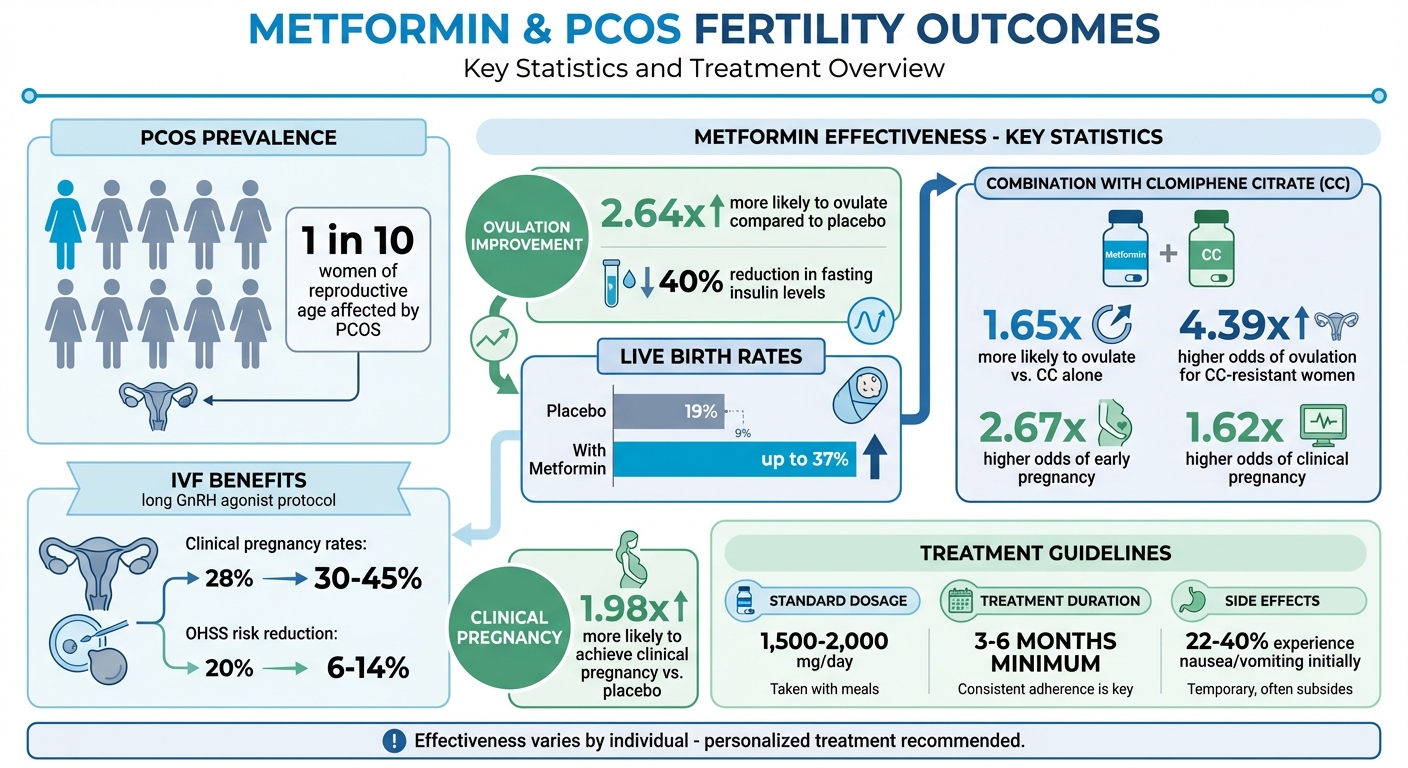
Metformin for PCOS Fertility: Key Statistics and Treatment Outcomes
How Metformin Affects Ovulation and Egg Quality
Reducing Insulin Resistance
Metformin addresses a key issue in PCOS: insulin resistance. In this condition, cells don't respond effectively to insulin, even when the pancreas produces more of it. Elevated insulin levels push the ovaries to produce more testosterone and stimulate the liver to release insulin-like growth factor 1 (IGF-1), which further raises androgen levels.
"The impact of higher levels of insulin and IGF-1 on the ovary is for the ovary to release higher levels of testosterone. All of these hormones - including insulin, IGF-1 and testosterone - prevent the growth of ovarian follicles through to ovulation." – Neil P Johnson, Professor, University of Adelaide
Metformin helps by enhancing glucose uptake in muscles and reducing glucose production in the liver. This leads to lower circulating insulin levels - studies show a 40% drop in fasting insulin levels. With less insulin in the bloodstream, androgen production decreases, creating the right hormonal conditions for ovarian follicles to grow beyond 10mm and reach ovulation. This reduction in insulin paves the way for further hormonal improvements, including better testosterone regulation and a healthier balance between LH and FSH.
Correcting Hormone Imbalances
After lowering insulin levels, Metformin also helps address hormonal imbalances. It boosts the production of Sex Hormone-Binding Globulin (SHBG) in the liver, which binds to free testosterone. Higher SHBG levels mean less active testosterone disrupting the reproductive system.
Metformin also helps correct the LH to FSH ratio, often elevated in women with PCOS. By restoring this balance, it resolves "follicular arrest", a condition where follicles fail to grow beyond 10mm and can't mature. This hormonal adjustment supports the intricate signaling within the ovaries, allowing for healthy egg development. Studies show that women with PCOS taking Metformin experience ovulation rates 2.64 times higher than those on a placebo.
Recent Studies on Metformin and Fertility
Recent research continues to shed light on Metformin's role in improving fertility outcomes, particularly for women with PCOS. These studies explore how Metformin performs when used alongside other fertility treatments and its impact as a standalone option.
Metformin Combined with Other Fertility Medications
The effectiveness of Metformin often depends on the fertility medication it's paired with. For example, when combined with Clomiphene Citrate (CC), Metformin significantly boosts ovulation rates. Women using this combination are 1.65 times more likely to ovulate compared to those using CC alone. This approach is especially beneficial for women who are "clomiphene-resistant", meaning they haven't responded to Clomiphene on its own.
One study found that pairing Metformin with CC increases the odds of ovulation by 4.39 times and early pregnancy by 2.67 times compared to CC alone. Clinical pregnancy rates also improve, with odds increasing by 1.62 times when Metformin is added to Clomiphene.
"The combination of metformin plus clomiphene should be the treatment of choice for clomiphene-resistant women with polycystic ovary syndrome." – AA Creanga, HM Bradley, C McCormick, and CT Witkop
However, Metformin does not enhance outcomes when combined with Letrozole. Studies show no improvement in ovulation or pregnancy rates when compared to Letrozole alone.
For women undergoing IVF with a "long" GnRH agonist protocol, Metformin offers some advantages. It raises clinical pregnancy rates from 28% to between 30% and 45%, while also lowering the risk of Ovarian Hyperstimulation Syndrome (OHSS) from around 20% to 6%–14%. That said, Metformin is not recommended for "short" GnRH antagonist protocols, as research suggests it may actually reduce live birth rates in these cycles.
These findings underscore the importance of tailoring Metformin use to specific treatments and patient needs. Beyond combination therapies, research also explores how Metformin impacts pregnancy and miscarriage outcomes more broadly.
Impact on Pregnancy and Miscarriage Rates
Metformin has shown promising results in improving clinical pregnancy outcomes. Women with PCOS taking Metformin are 1.98 times more likely to achieve clinical pregnancy compared to those on a placebo or receiving no treatment.
When it comes to miscarriage rates, the evidence is less conclusive but hints at a potential benefit. A Cochrane review reported a miscarriage risk ratio of 0.86 when comparing Metformin to placebo in IVF/ICSI cycles, though the statistical significance remains uncertain. Researchers suggest that the key may lie in continuing Metformin through the first trimester rather than stopping it after a positive pregnancy test.
"Continuing metformin to the end of the 1st trimester at an effective dose (e.g. 1000–2000 mg/day) may help to reduce the rate of miscarriages." – Women's Health Journal
Metformin's effectiveness also appears to vary based on body weight. In obese women, Metformin alone results in lower ovulation rates (OR 0.29) and pregnancy rates (OR 0.34) compared to Clomiphene Citrate. On the other hand, non-obese women see better results, with pregnancy odds 1.56 times higher when using Metformin compared to CC.
These studies highlight the nuanced role of Metformin in fertility treatments, emphasizing how factors like medication combinations, timing, and body weight can influence outcomes.
sbb-itb-6dba428
Using Metformin for PCOS: What to Know
Here’s what you need to know about Metformin for managing PCOS, including dosage guidelines and how to access it conveniently.
Standard Dosages and Treatment Guidelines
For women with PCOS, daily Metformin doses typically range between 1,500–2,000 mg. Obese individuals often require the higher end of this range (2,000 mg), while non-obese patients usually take around 1,500 mg.
Extended-release (ER) formulations are often preferred because they’re easier on the stomach, with a maximum dose of 2,000 mg. Starting with a lower dose and gradually increasing it - ideally taken with meals - can help reduce gastrointestinal discomfort. That said, side effects like nausea and vomiting are common when starting Metformin, affecting 22–40% of users, compared to about 10% with a placebo. Over 30% of users report nausea or vomiting initially, but these symptoms usually subside as the body adjusts.
For best results, treatment is generally recommended for at least three to six months. If pregnancy is a goal, continuing Metformin through the first trimester at doses between 1,000–2,000 mg/day may help lower miscarriage risks.
These protocols are widely recognized and can be easily followed through trusted telehealth services.
Accessing Metformin Through Oana Health
Obtaining Metformin has never been easier, thanks to reliable telehealth platforms like Oana Health.
Oana Health offers Oral Metformin ER for $22 per month, making it a simple and affordable way to manage insulin resistance and support fertility in PCOS. Their telehealth service connects you with licensed healthcare providers who review your medical history and design personalized treatment plans. Even better, medications are shipped directly to your door at no extra cost.
In addition to standalone Metformin, Oana Health provides combination treatment options tailored to individual needs. For instance:
- Metformin & Spironolactone pack ($32/month): Designed to promote hormonal balance.
- Oral GLP-1 & Metformin pack ($199/month): A more comprehensive approach for addressing PCOS-related metabolic challenges.
All medications are prescribed by licensed healthcare professionals and dispensed through FDA-regulated pharmacies, ensuring both quality and convenience.
Conclusion
Research highlights that Metformin plays a significant role in improving fertility for women with PCOS by addressing insulin resistance, lowering androgen levels, and helping normalize ovulation. For example, studies show that live birth rates can increase from 19% with a placebo to as high as 37% when using Metformin. Additionally, in long GnRH-agonist IVF protocols, Metformin has been shown to reduce the risk of OHSS from 20% to a range of 6–14%.
However, it's important to recognize that Metformin isn't a universal solution. Its effectiveness largely depends on tailoring the treatment to the individual. For instance, combining Metformin with clomiphene citrate is particularly effective for women who are resistant to clomiphene, but adding Metformin to letrozole doesn’t seem to provide additional benefits. Similarly, while Metformin has shown positive results in long IVF protocols, it may actually reduce live birth rates in short GnRH-antagonist protocols.
"Current clinical practice recognizes that there is no one-size-fits-all therapeutic approach for PCOS management." - Frontiers in Pharmacology
Given these nuanced outcomes, personalized treatment plans are essential. Services like Oana Health help women connect with licensed healthcare providers who assess their unique medical history, metabolic profile, and fertility goals. These professionals craft customized treatment plans, whether that involves Metformin alone, combination therapies, or adjusting dosages based on individual responses. Plus, they simplify the process by delivering medications directly to your doorstep.
When it comes to Metformin, its effectiveness truly lies in individualized care.
FAQs
How does Metformin help improve fertility in women with PCOS?
Metformin plays a key role in helping women with PCOS tackle fertility challenges by targeting insulin resistance - a frequent issue linked to this condition. By improving the body’s ability to manage insulin, Metformin helps rebalance hormones, which can lead to more consistent ovulation and enhanced egg quality.
This hormonal shift not only boosts the likelihood of conception but can also contribute to healthier pregnancy outcomes. For many women dealing with PCOS, Metformin becomes an important piece of their broader fertility treatment plan.
How does combining Metformin with Clomiphene Citrate help improve fertility in women with PCOS?
Combining Metformin with Clomiphene Citrate can boost ovulation and improve the chances of pregnancy for women with PCOS, especially those who don’t respond to Clomiphene on its own. This combination tackles insulin resistance - a common issue in PCOS - which can help the body ovulate more effectively.
However, while this method may increase ovulation rates, it doesn’t necessarily lead to higher live birth rates. It’s essential to work closely with your healthcare provider to determine if this treatment aligns with your individual needs and fertility goals.
What should I know about using Metformin for fertility in PCOS?
Metformin is frequently prescribed to help women with PCOS enhance fertility by promoting ovulation and improving egg quality. While it can be effective, it’s essential to be aware of potential side effects. Common issues include nausea, diarrhea, stomach pain, and loss of appetite, which often subside over time or with dosage adjustments. In rare instances, it may lead to lactic acidosis, a serious but uncommon condition.
When used as directed, Metformin is generally safe during pregnancy and breastfeeding, with no evidence suggesting it negatively affects fertility or the baby. However, it’s worth noting that prolonged use could lead to a vitamin B12 deficiency, which might require supplementation. To ensure both safety and optimal results, it’s crucial to take Metformin under the supervision of a healthcare provider.