
Emerging Topical Therapies for Hair Loss 2026
Hair loss treatments are evolving in 2026, offering new options beyond traditional solutions like minoxidil. If you're struggling with thinning hair, especially due to hormonal conditions like PCOS, here’s what you need to know:
- PP405: Activates dormant hair follicles by targeting mitochondrial processes. Early trials show a 20% boost in hair density for 31% of users within 4 weeks.
- Clascoterone 5%: Blocks androgens locally without systemic effects. Clinical trials report up to 539% improvement in hair count for some users over 6 months.
- Topical Spironolactone: Targets hormonal imbalances, particularly effective for PCOS-related hair loss. Studies show marked improvement in 30% of women after 12 months.
- ET-02: A developing therapy focusing on follicle stem cell correction, still in early trials.
Each treatment caters to different causes of hair loss and offers targeted results with fewer risks compared to oral medications. Companies like Oana Health are simplifying access to these therapies, providing affordable, prescription-based solutions delivered directly to your home.
Quick Comparison Table:
| Therapy | Mechanism | Trial Phase | Time to Results | Best For |
|---|---|---|---|---|
| PP405 | Reactivates follicle stem cells | Phase 3 (2026) | 4–8 weeks | Rapid hair density improvement |
| Clascoterone 5% | Blocks androgen receptors | Completed Phase 3 | 6 months | Androgenic alopecia |
| ET-02 | Stem cell correction | Early trials | Unknown | Investigational |
| Topical Spironolactone | Blocks androgen receptors locally | Established | 12–24 weeks (more pronounced after 12 months) | PCOS-related hair loss |
These advancements provide hope for addressing hair loss with safer, more effective treatments tailored to individual needs.
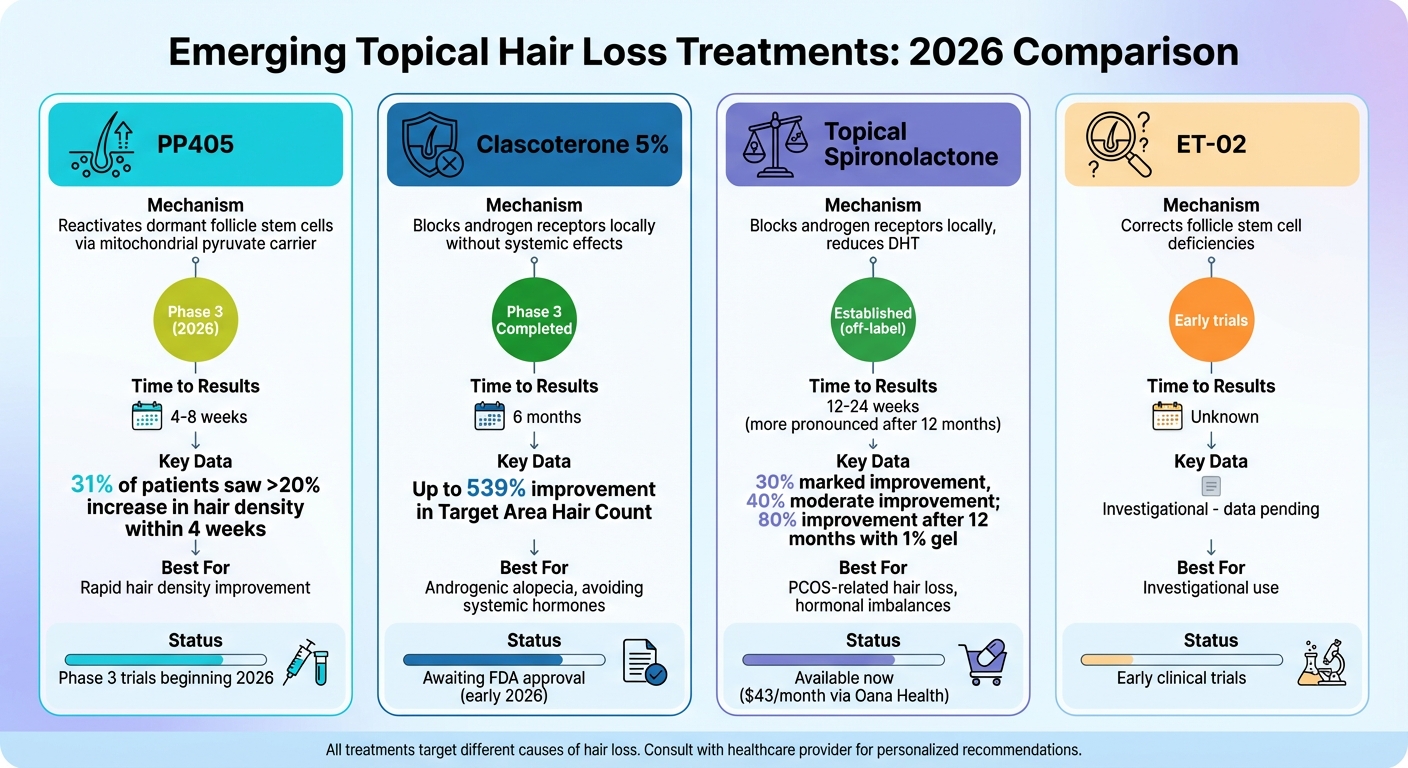
Comparison of Emerging Topical Hair Loss Treatments 2026
NEW Hair Loss Drug to Cure BALDNESS? | PP405
New Topical Treatments for Hair Loss in 2026
By 2026, four promising therapies are emerging to tackle hair loss, each working through unique mechanisms.
PP405: Stem Cell Reactivation Therapy
PP405 is designed to reactivate dormant hair follicle stem cells by targeting the mitochondrial pyruvate carrier (MPC). This process increases lactate production in balding areas of the scalp, promoting hair growth.
In a Phase 2a trial involving 78 participants, 31% of patients saw more than a 20% increase in hair density within just four weeks, with visible results appearing by week eight. According to Pelage Pharmaceuticals, this treatment even stimulated new hair growth from previously inactive follicles. Dr. Arash Mostaghimi from Brigham and Women's Hospital highlighted its potential:
"What's compelling about PP405 is that it brings scientific rigor to a space that's needed it for decades. A well-tolerated, topically delivered therapy that shows measurable biological activity this early is rare."
Safety data confirmed no systemic absorption, and with $120 million raised in Series B funding, Phase 3 trials are set to begin in 2026.
Next up is Clascoterone, which takes a different approach by targeting hormonal factors.
Clascoterone: Androgen Receptor Blocker
Clascoterone 5% works by blocking androgen receptors at hair follicles, preventing dihydrotestosterone (DHT) from shrinking them. In two Phase 3 trials (SCALP 1 and SCALP 2) involving 1,465 men, this treatment showed a relative improvement in Target Area Hair Count (TAHC) of up to 539% in one trial and 168% in another. Importantly, it demonstrated minimal systemic absorption, with side effects comparable to a placebo.
This localized action is particularly impactful for women with androgenic alopecia or conditions like PCOS. Unlike oral anti-androgens, Clascoterone avoids systemic hormonal side effects, working only where applied. Dr. Maria Hordinsky from the University of Minnesota noted:
"Patients previously faced limited options with notable systemic hormonal risks. These findings show the potential for clascoterone 5% topical solution to change that equation."
Cosmo Pharmaceuticals plans to complete 12-month safety studies in early 2026 and submit for FDA approval shortly after. A 1% version of Clascoterone (Winlevi) is already approved for acne treatment.
ET-02: Hair Follicle Stem Cell Correction
ET-02 is an early-stage therapy focused on correcting stem cell deficiencies at the hair follicle level. By addressing the cellular dysfunctions that disrupt the hair growth cycle, ET-02 aims to restore proper stem cell activity. While still in clinical trials, more data on its efficacy and safety is expected as research advances.
Topical Spironolactone: A Proven Option for Women
Topical Spironolactone offers an effective solution for women by blocking androgen receptors and reducing DHT levels. This treatment addresses hormonal imbalances that contribute to female pattern hair loss.
In a 2025 study of 80 women with female pattern hair loss, 1% topical Spironolactone gel was compared to 5% minoxidil. Results showed that 30% of women experienced "marked improvement" and 40% reported "moderate improvement" with Spironolactone, proving it as effective as minoxidil. Additionally, it caused fewer cases of contact dermatitis.
For women with PCOS, topical Spironolactone directly targets excess androgens, helping not only with hair loss but also oily skin and acne. Unlike oral anti-androgens, it avoids systemic risks like menstrual irregularities or pregnancy concerns. Researchers Ghada Fawzy Rezk Hassan and colleagues concluded:
"Both topical spironolactone and topical minoxidil were cheap, safe, and effective lines for the treatment of FPHL with minimal and tolerable side effects."
Comparing Topical Therapies
Each hair loss treatment works by targeting a specific mechanism. For instance, PP405 focuses on reactivating follicle stem cells and is currently in Phase 3 trials. Early findings suggest it could improve hair density, but final results and broader availability aren’t expected until 2026.
Clascoterone 5% offers a localized approach by blocking androgen receptors without systemic absorption. Results from Phase 3 trials showed a remarkable 539% relative improvement in Target Area Hair Count after six months.
Topical Spironolactone is particularly beneficial for women dealing with hair loss caused by hyperandrogenism, such as in cases of polycystic ovary syndrome (PCOS). A 16-week study showed minimal changes, but more significant clinical improvements were observed after 12 months of use.
Meanwhile, ET-02 is still in its experimental stages, with its effectiveness and ideal treatment timeline under review.
Treatment Comparison Table
Here’s a quick look at how these therapies stack up:
| Therapy | Mechanism | Trial Phase | Time to Results | Best For |
|---|---|---|---|---|
| PP405 | Reactivates dormant follicle stem cells | Phase 3 (emerging) | Data pending | Potential rapid response |
| Clascoterone 5% | Blocks androgen receptors locally | Phase 3 (completed) | About 6 months | Avoiding systemic hormones |
| ET-02 | Corrects follicle stem cell deficiencies | Early trials | Unknown | Investigational |
| Topical Spironolactone | Blocks androgen receptors locally | Established off-label | 12–24 weeks (more pronounced after 12 months) | PCOS-related hair loss |
When choosing a treatment, consider the underlying cause of your hair loss. For example, Topical Spironolactone might be a good option for women with PCOS-related hair loss, while Clascoterone 5% could suit those wanting to avoid systemic hormonal effects. Each therapy offers a tailored solution for different needs.
sbb-itb-6dba428
Oana Health: Personalized Hair Loss Solutions

In 2026, advancements in topical treatments for hair loss are reshaping the landscape, and Oana Health is at the forefront, offering tailored and accessible care.
Topical Spironolactone with Oana Health
Oana Health provides prescription topical spironolactone, specifically designed for women experiencing hair loss due to hormonal imbalances, such as those caused by PCOS. Clinical research highlights its effectiveness - showing an 80% improvement in hair regrowth after 12 months of using a 1% gel formulation, all while minimizing systemic side effects.
Chaofan Wang and colleagues from the Department of Dermatology at The First Affiliated Hospital of Nanjing Medical University emphasize the benefits:
"Topical spironolactone is safer than oral administration and is suitable for both male and female patients, and is expected to become a common drug for those who do not have a good response to minoxidil."
Oana Health offers this treatment for $43 per month, with a fully online process that eliminates the need for in-person visits. This approach combines cutting-edge science with convenience, ensuring users receive effective and easy-to-access care.
Convenient, Science-Driven Care
Oana Health doesn’t just focus on effective treatments - it prioritizes accessibility and personalization. Licensed physicians review your health history online to create a plan tailored to your needs. Medications are then shipped directly to your door from FDA-regulated pharmacies, with no added shipping costs.
Beyond topical spironolactone, Oana Health addresses the underlying factors contributing to hair loss. Treatments like insulin sensitizers and GLP-1 medications target issues such as androgen excess and insulin resistance, offering a comprehensive solution for hormonal imbalances and hair thinning.
Future Developments in Topical Hair Regrowth Therapies
The future of topical hair regrowth treatments is moving toward precision solutions that work at the cellular and genetic levels. Researchers are now going beyond traditional approaches, such as improving blood flow, to focus on the metabolic pathways that control hair follicle stem cells. This shift aims to "wake up" dormant follicles, potentially transforming how hair regrowth is achieved. The goal is to directly rejuvenate hair follicles at their core.
Several promising active ingredients are in clinical trials. For instance, PP405 is being refined to better activate dormant stem cells through metabolic targeting. GT20029, on the other hand, employs PROTAC technology to break down androgen receptors, while TDM-105795 works by activating follicle stem cells via thyroid-receptor β1 agonism.
Innovations in how these treatments are delivered are also making strides. Microneedle patches, for example, create tiny microchannels (200–300 μm) in the skin, allowing large-molecule drugs to reach hair follicles directly - without causing pain or bleeding. In 2024, researchers introduced an integrated microneedle patch called V-R-MN, which delivers over 80% of VEGF gradually over 28 days. This stimulates blood vessel formation around hair follicles, enhancing their growth environment.
Personalized therapies are another exciting frontier. With over 380 genomic loci linked to hair loss and individual variations in follicular sulfotransferase activity influencing how well patients respond to minoxidil, future treatments could be tailored to each person’s unique biology. For example, individuals with higher sulfotransferase activity tend to see better results from minoxidil, highlighting the potential for customized interventions.
These developments are expected to complement existing treatments, aligning with Oana Health's dedication to science-backed, targeted solutions that address the underlying causes of hair loss in an accessible way.
Conclusion
By 2026, the range of topical treatments for hair loss is expanding, offering new hope for women facing thinning hair - especially those dealing with hormonal imbalances like PCOS. While topical minoxidil remains the only FDA-approved option, newer therapies such as Clascoterone and PP405 are making strides by targeting androgen receptors and reactivating dormant stem cells. These approaches aim to reduce the systemic risks often associated with oral medications.
The Journal of the American Academy of Dermatology notes, "Patient‐specific factors, including age, signs of hyperandrogenism, or need for contraception may help determine which antiandrogen therapy is most appropriate". This highlights a shift toward personalized, multi-modal treatments that consider an individual’s hormonal profile, genetic background, and lifestyle. For women with conditions like PCOS, this tailored approach is especially valuable. Topical treatments like spironolactone, alongside combination therapies, present practical options for managing hair loss. For instance, Oana Health offers topical spironolactone at $43 per month and the MetSpiro pack - combining insulin sensitizers with antiandrogens - starting at $32 per month. These treatments are delivered straight to your door with physician oversight.
Looking ahead, the focus is on reactivating dormant hair follicles by addressing underlying metabolic and hormonal imbalances. Clinical trials have already shown promising results; for example, prostaglandin analogs have led to a 12.3% increase in hair counts. This data underscores the potential of emerging therapies to deliver measurable improvements through personalized care.
If you’re dealing with hair loss, particularly alongside hormonal imbalance, consider exploring personalized treatment options with Oana Health for expert, evidence-based solutions tailored to your journey.
FAQs
How do the latest topical treatments for hair loss compare to traditional options like minoxidil?
The latest topical treatments for hair loss, including low-dose finasteride or dutasteride gels, ketoconazole shampoos, and topical anti-androgens like spironolactone, aim to block DHT - the hormone responsible for shrinking hair follicles. On the other hand, minoxidil works differently by extending the hair's growth phase. Research indicates that topical finasteride often delivers better results than 5% minoxidil in improving overall hair density, making it a go-to option for many healthcare providers.
These treatments can also be paired with minoxidil for even better outcomes since they work through different mechanisms. Plus, they typically cause fewer skin irritations and have minimal systemic side effects compared to oral medications. For women, topical spironolactone - such as the one available from Oana Health - targets hormonal hair thinning without the side effects often associated with oral options. While minoxidil remains a trusted and fast-acting solution, these newer treatments provide targeted approaches to address the underlying causes of hair loss.
What are the potential side effects or risks of these new topical treatments for hair loss?
While newer topical treatments for hair loss, such as minoxidil and anti-androgen creams, are generally easy on the skin, some users might notice mild irritation. This can include redness, itching, or dryness. On rare occasions, more serious effects like low blood pressure or hormonal shifts may happen, though topical anti-androgens are less likely to cause these issues compared to oral options.
To ensure safe use, always stick to the recommended guidelines and reach out to a healthcare professional if you have any concerns about side effects or whether the treatment is right for you.
What is the most effective topical treatment for hair loss caused by PCOS?
Topical spironolactone is often regarded as an effective solution for managing hair loss linked to PCOS. It works by addressing the hormonal imbalances commonly tied to the condition, helping to minimize hair thinning and encouraging healthier hair growth over time.
To achieve the best outcome, it’s important to consult a licensed medical professional. They can assess whether this treatment suits your situation and provide a personalized plan tailored to your specific needs.