
Fenugreek for Hirsutism: What Studies Show
Fenugreek may help reduce hirsutism symptoms, especially in women with PCOS. Research suggests it can lower androgen levels, improve insulin sensitivity, and support hormonal balance with fewer side effects compared to traditional medications like metformin. Key findings include:
- Improved Hirsutism Scores: Fenugreek reduces unwanted hair growth, as shown in studies using the modified Ferriman-Gallwey scale.
- Hormonal Benefits: It lowers free testosterone and balances the LH/FSH ratio.
- Insulin Regulation: Fenugreek enhances insulin sensitivity, addressing a root cause of PCOS-related hirsutism.
- Lipid Profile Improvements: It lowers LDL cholesterol and triglycerides while raising HDL cholesterol.
- Fewer Side Effects: Compared to metformin, fenugreek causes less nausea and discomfort.
While promising, most studies are short-term and vary in dosage and forms (seed extracts, powders). Larger, long-term trials are needed to confirm its effectiveness. Fenugreek works best as a supplement to existing treatments rather than a standalone solution. Always consult a healthcare provider before use, especially if pregnant or on medications.
What Studies Show: Fenugreek in Women with PCOS and Hirsutism
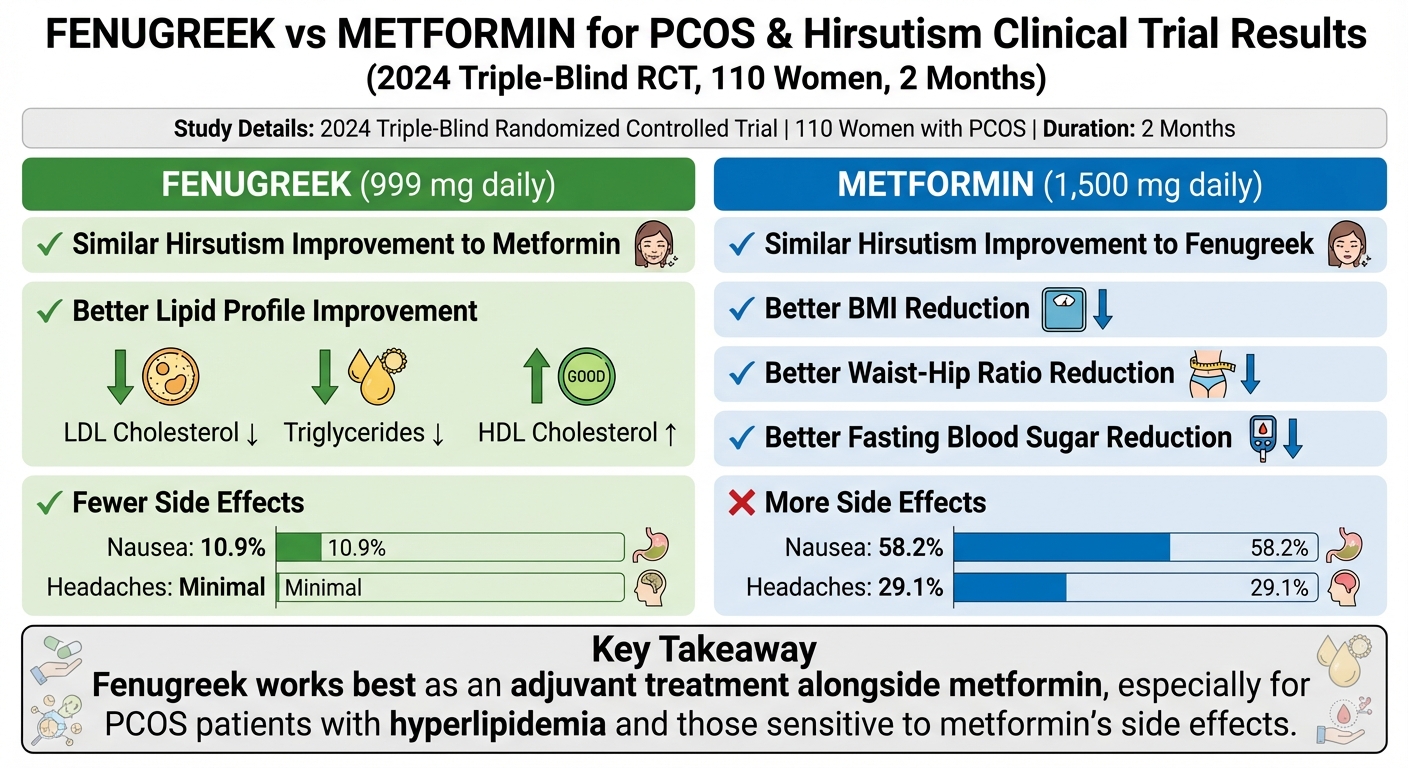
Fenugreek vs Metformin for PCOS: Clinical Trial Results Comparison
Fenugreek vs. Metformin Studies
A 2024 triple-blind randomized controlled trial compared fenugreek seed extract (999 mg daily) to metformin (1,500 mg daily) in 110 women with PCOS over two months. Both groups showed improvements in hirsutism and hair loss, suggesting fenugreek offers benefits similar to metformin. However, the two treatments had different strengths: metformin was better at reducing BMI, waist-hip ratio, and fasting blood sugar levels, while fenugreek outperformed in improving lipid profiles by lowering LDL cholesterol and triglycerides and increasing HDL cholesterol. Fenugreek also caused fewer side effects - only 10.9% of participants reported nausea, compared to 58.2% of metformin users, with 29.1% of those on metformin experiencing headaches.
Another trial explored fenugreek as a supplement to metformin. Over eight weeks, women taking both fenugreek extract and metformin saw improved menstrual regularity and better ultrasound results, including a significant reduction in polycystic ovaries (p = 0.01), compared to those using metformin alone.
Additional studies using specialized fenugreek extracts have reinforced these findings.
Studies Using Proprietary Fenugreek Extracts
Research has also centered on Furocyst, a fenugreek extract standardized to contain 40% furostanolic saponins. In a double-blind trial involving 208 women with PCOS, those who took 1,000 mg of Furocyst daily for 12 weeks experienced significant reductions in hirsutism and free testosterone levels compared to a placebo group. Another open-label study spanning 90 days reported notable results: 94% of participants benefited from treatment, with 36% achieving complete resolution of ovarian cysts, a reduction in mean cyst size by over 40%, and normalization of the LH/FSH ratio from 3.16 at baseline to 1.61 by the end of the study. Interestingly, 12% of previously infertile participants became pregnant during the trial.
Study Limitations
While the results are encouraging, the research has some notable limitations. Many studies involved small sample sizes - ranging from 50 to 208 participants - and relatively short durations (typically 8 to 12 weeks). This limited timeframe may not fully capture changes in hirsutism, given the slow nature of the hair growth cycle.
"The main limitation of the study was the short-term follow-up of patients, which was attributed to logistical [reasons]." – Shahla Mirgaloybayat et al., Endometriosis Research Center
Another issue is the lack of consistency across studies. Some trials used raw fenugreek seed powder, while others relied on proprietary extracts like Furocyst, making it challenging to generalize findings or establish clear dosing guidelines. As a result, the current evidence is still in its early stages, and larger, longer-term randomized controlled trials are needed to confirm fenugreek's effectiveness for hirsutism. These gaps highlight the importance of further research, including a deeper investigation into fenugreek's mechanisms, which will be addressed in the next section.
How Fenugreek Might Work
To understand fenugreek's potential impact on hirsutism, we need to look at how it interacts with the biology of PCOS. Fenugreek appears to disrupt this cycle by improving insulin sensitivity and balancing hormones.
Effects on Insulin Sensitivity
Fenugreek helps improve insulin sensitivity in a few key ways. Its high fiber content slows glucose absorption, while a compound called 4‑hydroxyisoleucine enhances insulin secretion. Additionally, it inhibits enzymes that cause glucose spikes after meals. By reducing insulin levels, fenugreek indirectly lowers the ovaries' production of androgens.
One study involving 50 women with PCOS showed promising results. A specific fenugreek extract led to a 17.82% reduction in left ovary volume and a 28.25% reduction in right ovary volume. Even more striking, 36% of participants were completely free of ovarian cysts after just three months.
Hormonal and Metabolic Effects
Fenugreek also influences hormone balance through its furostanol glycosides, which inhibit 5‑alpha reductase. This enzyme is responsible for converting testosterone into dihydrotestosterone (DHT), a hormone linked to excessive hair growth. Fenugreek has also been shown to normalize the LH/FSH ratio, decreasing it from 3.16 to 1.61 within 90 days. On top of that, it improves lipid profiles, reducing LDL cholesterol by 23.4% and triglycerides by 23.5%.
"Hyperinsulinemia may increase abnormal ovarian androgen secretion and develop abnormal follicles, leading to dysfunctional ovarian and menstrual cyclicity."
– Maryam Hassanzadeh Bashtian, Department of Midwifery, North Khorasan University of Medical Sciences
Anti-Inflammatory and Antioxidant Effects
Fenugreek contains polyphenols and flavonoids that fight oxidative stress by reducing lipid peroxidation and restoring antioxidant levels. These properties not only protect against oxidative damage but also enhance overall metabolic health, complementing its insulin-sensitizing effects.
sbb-itb-6dba428
Dosage, Safety, and Research Gaps
Dosages and Forms Used in Studies
Clinical trials provide valuable insights into how fenugreek is used and the dosages that have been tested. Most studies on PCOS and hirsutism have focused on oral capsules and tablets as the primary forms of administration. For general hormonal support, standardized seed extracts are typically dosed between 250 mg and 600 mg daily. When targeting PCOS, proprietary extracts are commonly used at doses ranging from 333 mg to 500 mg per day. Meanwhile, raw seed powder has been studied at doses as high as 50 g per day, primarily for addressing metabolic concerns.
For instance, a triple-blind trial conducted in July 2024 included 55 women with PCOS who were given 333 mg of fenugreek three times daily over two months. This regimen significantly improved lipid profiles compared to 500 mg of metformin administered three times daily (p < 0.001). Similarly, a 2015 U.S.-based study administered 500 mg/day of a proprietary fenugreek extract to 50 premenopausal women with PCOS for 90 days, resulting in notable reductions in ovarian cyst size and volume.
| Form | Typical Dosage | Frequency | Use Case |
|---|---|---|---|
| Standardized Seed Extract | 250 mg–600 mg | 1–2 times daily | Hormonal support |
| Seed Extract (PCOS) | 333 mg–500 mg | 2–3 times daily | Lipid profile improvement & cyst reduction |
| Seed Powder | 0.025 g–50 g | Variable | Blood sugar and metabolic health |
These diverse approaches to dosing highlight fenugreek's potential across various health concerns, prompting a closer look at its safety profile.
Safety and Side Effects
Fenugreek's safety is an essential consideration, especially when used at medicinal doses. While the FDA generally recognizes fenugreek as safe when consumed in food amounts, higher doses require more caution. Common side effects include gastrointestinal issues such as diarrhea, nausea, gas, bloating, and abdominal discomfort. Some users might notice a harmless maple syrup-like odor in their sweat and urine.
However, fenugreek is not suitable for everyone. It is contraindicated during pregnancy, as it can potentially induce uterine contractions and has been linked to serious birth defects, including cleft palate and neural tube defects. Additionally, individuals taking medications for blood pressure or blood sugar control need to monitor their levels carefully, as fenugreek can lower both. Those with allergies to plants in the Fabaceae family, such as peanuts, chickpeas, or soybeans, may also experience allergic reactions. Another precaution is to discontinue fenugreek at least two weeks before surgery, as it may slow blood clotting and increase bleeding risks.
On a positive note, a clinical study involving healthy menstruating women who took 500 mg daily of a hydro-ethanolic extract (FenuSMART) for 42 days reported no adverse events or significant changes in safety parameters.
What's Missing from Current Research
Although existing studies on fenugreek show promise, several research gaps remain. Most studies are limited by their short durations and small participant groups. For example, research on fenugreek for hirsutism typically involves sample sizes of 30 to 80 participants and study periods lasting only 42 to 90 days. These short timeframes make it difficult to assess long-term outcomes, particularly for chronic conditions like hirsutism. Additionally, there is a lack of comprehensive data on fenugreek's long-term safety and its effects on hormonal balance in women.
"Systematic information on fenugreek extracts' safety and influence on hormonal balance are limited." – Clinical Phytoscience
Another challenge is the inconsistency in the types of fenugreek preparations used across studies. Researchers have tested everything from raw seed powder to standardized extracts like Furocyst and FenuSMART, making it hard to draw universal conclusions about efficacy. Moreover, the role of fenugreek's phytoestrogens remains unclear. Depending on an individual’s baseline hormone levels, these compounds may either mimic or block estrogenic effects. To solidify the understanding of fenugreek's benefits and safety, large-scale, long-term clinical trials are essential, particularly for its use in managing hirsutism in women with PCOS.
Conclusion
Recent research highlights fenugreek's role in managing hirsutism, particularly in women with PCOS. Studies have shown that fenugreek supplementation can reduce hirsutism scores on the modified Ferriman-Gallwey scale, lower free testosterone levels, and improve the LH/FSH ratio. Clinical trials have also found that both fenugreek and metformin contribute to reducing unwanted hair growth. Additionally, studies using proprietary fenugreek extracts report high success rates in improving menstrual regularity.
That said, fenugreek is most effective when used as a complementary treatment alongside standard therapies, rather than as a standalone option. As one study notes: "Fenugreek cannot substitute metformin in PCOS treatment. However, regarding its lipid-lowering ability and low frequency of adverse effects, it can be used as an adjuvant treatment in PCOS, especially in PCOS patients with hyper-lipidemia and severe hair loss". While fenugreek shows promise in improving lipid profiles and causes fewer gastrointestinal side effects compared to metformin (10.9% vs. 58.2% nausea rates), metformin remains more effective for addressing weight loss, insulin resistance, and menstrual irregularities. Fenugreek's ability to enhance insulin sensitivity and regulate hormones underscores its value as a supportive option in PCOS management.
Always consult a licensed medical professional before starting fenugreek supplementation, as hirsutism may indicate underlying health issues that require accurate diagnosis. It's also important to note that fenugreek is not recommended during pregnancy, may interact with certain medications, and could trigger allergic reactions in some individuals. A healthcare provider can help create a personalized treatment plan that incorporates these findings.
For those dealing with unwanted facial hair, hormonal imbalances, or PCOS symptoms, Oana Health (https://oanahealth.com) offers telehealth services with licensed medical professionals. Their science-based, prescription-focused approach ensures you receive care tailored to your needs, with treatments conveniently delivered to your door, complete with free shipping.
FAQs
Is fenugreek as effective as metformin for treating hirsutism in women with PCOS?
Both fenugreek and metformin have shown promise in helping women manage PCOS symptoms, but metformin stands out when it comes to reducing hirsutism. A clinical study recently compared the effects of fenugreek (333 mg, taken three times daily) and metformin (500 mg, three times daily) over a two-month period. While both treatments helped improve PCOS symptoms, metformin proved more effective in addressing insulin resistance, blood sugar control, and menstrual irregularities - factors that play a significant role in excess androgen production and unwanted facial hair. Fenugreek, on the other hand, showed better results in improving cholesterol levels but didn’t perform as well in managing androgen-related issues.
Metformin’s effectiveness lies in its ability to increase insulin sensitivity and lower ovarian androgen production, which can help reduce hair growth for many women. Fenugreek, with its fiber and phytochemicals, offers mild improvements in glucose and lipid metabolism but is less impactful for the hormonal causes of hirsutism. For a more tailored approach to managing PCOS-related hirsutism, Oana Health provides telehealth consultations and evidence-based treatment plans designed to meet your individual needs.
What side effects should I be aware of when using fenugreek for hirsutism?
Fenugreek is generally safe for most people, but it does come with a few potential side effects. Some individuals might experience mild stomach issues, like nausea or diarrhea. Another quirky side effect? It can give your sweat or urine a maple syrup-like smell - a harmless but noticeable change.
One thing to watch out for is fenugreek's ability to lower blood sugar levels. For some, especially those with diabetes or on medications that influence blood sugar, this could result in hypoglycemia.
If you're thinking about using fenugreek for hirsutism, it's smart to check in with a healthcare professional first - especially if you have any medical conditions or are on other medications. A quick consultation can ensure it’s the right choice for you.
Can fenugreek effectively treat hirsutism on its own?
Fenugreek has shown potential in helping manage hirsutism by aiding in hormone balance, according to some studies. However, it’s important to note that its effects are not strong enough to serve as a standalone treatment. Standard medical therapies, such as metformin, remain essential for effective management.
If you’re considering options for treating hirsutism, it’s always a good idea to consult a healthcare provider to find the most suitable plan for your specific situation.