
Hormonal Causes of Hirsutism in Women
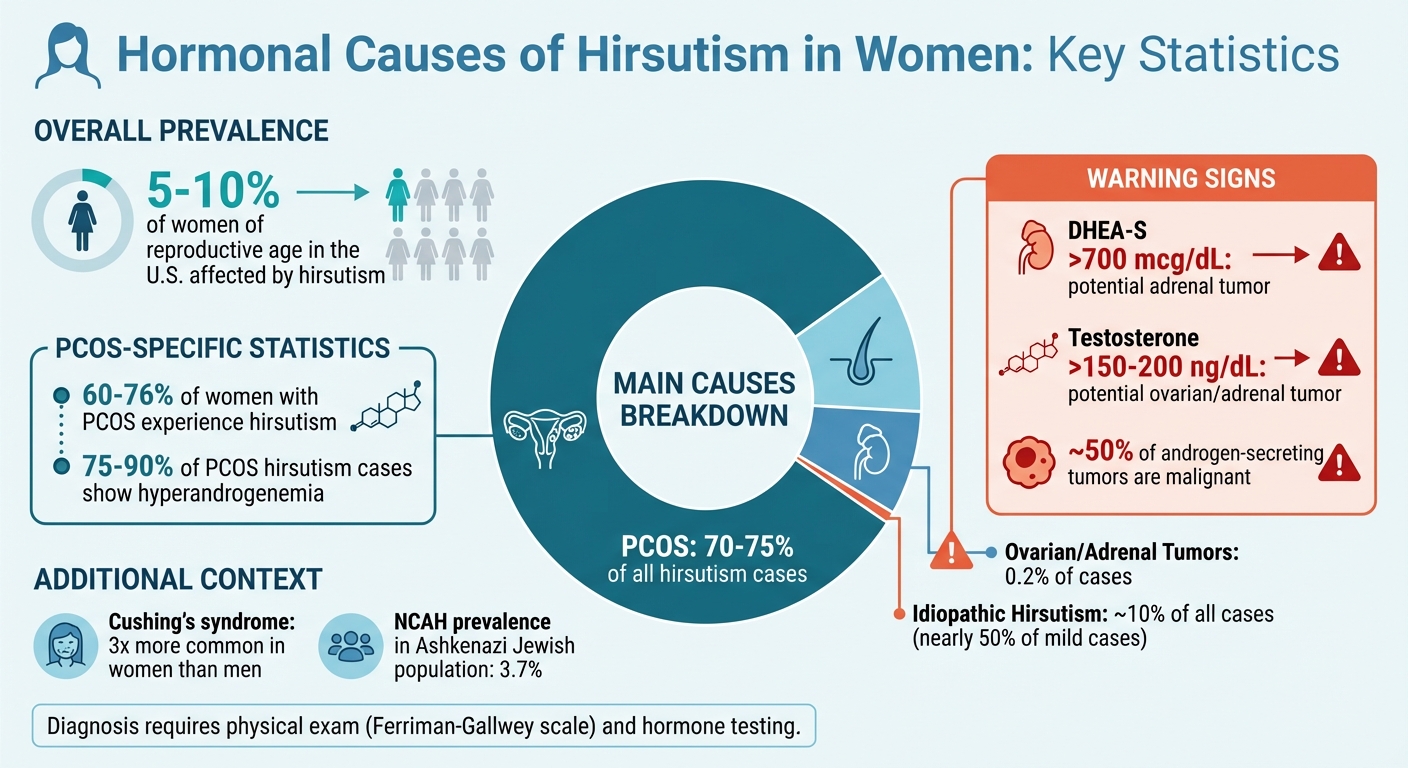
Hirsutism, the growth of thick, dark hair in areas typically associated with male patterns (like the face or chest), affects 5%–10% of women of reproductive age in the U.S. It’s primarily caused by hormonal imbalances, especially elevated androgen levels. Common causes include:
- Polycystic Ovary Syndrome (PCOS): Responsible for 70%–75% of cases, driven by high androgens and insulin resistance.
- Adrenal Disorders: Conditions like non-classic congenital adrenal hyperplasia (NCAH) or Cushing's syndrome lead to excessive androgen production.
- Ovarian Issues: Rare tumors or hyperthecosis can result in excessive testosterone.
- Insulin Resistance: Lowers SHBG (sex hormone-binding globulin), increasing free testosterone.
- Idiopathic Hirsutism: Normal hormone levels but heightened hair follicle sensitivity.
Diagnosis involves physical exams (e.g., Ferriman-Gallwey scale), hormone tests (testosterone, DHEA-S), and imaging for tumors if needed. Early detection is critical, especially for rare but serious causes like androgen-secreting tumors.
Treatment depends on the cause and may include medications (e.g., oral contraceptives, Spironolactone), lifestyle changes, or hair removal techniques. Addressing underlying issues is key to managing symptoms effectively.
Hormonal Causes of Hirsutism in Women: Statistics and Prevalence
Main Hormonal Causes of Hirsutism
High Androgen Levels
Elevated levels of androgens, such as testosterone, DHEA-S, and androstenedione, play a key role in turning fine vellus hair into thicker terminal hair. This happens due to increased activity of the enzyme 5‑alpha‑reductase type 2 in hair follicles, which is often heightened in women with hirsutism.
A decrease in SHBG (sex hormone-binding globulin), often linked to high insulin levels, further amplifies the effects of free testosterone. This free testosterone binds to androgen receptors, extending the hair growth phase (anagen phase) and leading to longer, thicker hair strands. These androgen imbalances are a hallmark of conditions like PCOS.
Polycystic Ovary Syndrome (PCOS)
Polycystic Ovary Syndrome, or PCOS, is responsible for 70% to 75% of hirsutism cases. In PCOS, elevated luteinizing hormone (LH) stimulates the ovaries to produce more androgens, while relatively low levels of follicle-stimulating hormone (FSH) hinder their conversion into estrogen.
Insulin resistance plays a major role in PCOS-related hirsutism. High insulin levels not only drive ovarian theca cells to produce more androgens but also reduce SHBG production in the liver. This increases free testosterone levels, further contributing to excessive hair growth. Studies show that 60% to 76% of women with PCOS experience hirsutism, with hyperandrogenemia detected in 75% to 90% of these cases. As highlighted in Androgens: Clinical Research and Therapeutics:
Hyperandrogenemia is the biochemical hallmark of PCOS.
Adrenal Disorders
Adrenal disorders are another potential cause of hirsutism, as they can lead to excessive androgen production. For instance, non-classic congenital adrenal hyperplasia (NCAH) results from a 21-hydroxylase deficiency. This condition disrupts cortisol synthesis, redirecting 17‑hydroxyprogesterone into androgen pathways. NCAH affects about 1% to 8% of women with hirsutism and is particularly common in the Ashkenazi Jewish population, where its prevalence is approximately 3.7%.
Cushing's syndrome, caused by excessive ACTH, overstimulates the adrenal glands, leading to increased cortisol and androgen production. This condition is about three times more common in women than men. Additionally, adrenal tumors, though rare (accounting for only 0.2% of hirsutism cases), can independently produce large amounts of androgens. A DHEA‑S level exceeding 700 mcg/dL is a warning sign for potential adrenal tumors, with approximately 50% of such tumors being malignant.
Hirsutism in Women: Causes and Treatment | PCOS & More
Other Causes of Hirsutism
Hirsutism can arise from several factors beyond elevated androgen levels, including certain ovarian conditions, insulin resistance, and heightened follicular sensitivity.
Ovarian Conditions Beyond PCOS
Although polycystic ovary syndrome (PCOS) is the most frequent cause of hirsutism, other ovarian issues can also lead to excessive hair growth by increasing androgen activity. One such condition is ovarian hyperthecosis, a benign disorder where clusters of luteinized theca cells produce excessive testosterone. This condition predominantly affects postmenopausal women and can cause severe hirsutism and virilization, such as a deeper voice.
Rare but serious ovarian tumors that produce androgens are another potential cause, accounting for about 0.2% of hirsutism cases. These include Sertoli-Leydig cell tumors, granulosa-theca cell tumors, and Hilus cell tumors. These tumors often lead to a sudden onset of hirsutism, with testosterone levels frequently exceeding 150 to 200 ng/dL. Alarmingly, nearly half of these tumors are malignant, underscoring the importance of early detection.
Insulin Resistance and Its Role
Insulin resistance plays a key role in hirsutism by directly stimulating ovarian theca cells to produce more androgens. It also reduces the liver's production of sex hormone–binding globulin (SHBG), which increases the levels of free, active testosterone in the body. Obesity compounds this effect by further lowering SHBG and raising androgen levels. In women with PCOS who are obese, weight loss has been shown to reduce the free androgen index (on average, by 1.11) and to slightly improve hirsutism scores.
Idiopathic Hirsutism
Some women experience hirsutism not due to excessive hormones but because their hair follicles are unusually sensitive to normal androgen levels. This condition, known as idiopathic hirsutism, is characterized by normal menstrual cycles, ovarian structure, and androgen levels. It is diagnosed by ruling out other causes and accounts for about 10% of all hirsutism cases. Interestingly, it is responsible for nearly half of mild hirsutism cases. Here, the heightened sensitivity of hair follicles, rather than elevated androgens, is the root cause.
sbb-itb-6dba428
How Hirsutism Is Diagnosed
Diagnosing hirsutism starts with a detailed physical exam and specific hormone tests to uncover the root cause, whether it's PCOS, adrenal disorders, ovarian tumors, or another condition.
Physical Examination
Doctors commonly use the Ferriman-Gallwey (mFG) scale to measure the severity of hirsutism. This scale evaluates terminal hair growth in nine androgen-sensitive areas: the upper lip, chin, chest, upper and lower back, upper and lower abdomen, upper arms, and thighs. Each area is scored from 0 (no terminal hair) to 4 (extensive growth). A total score between 8 and 15 indicates mild hirsutism, while scores above 15 suggest moderate to severe cases.
During the exam, physicians also check for signs of virilization, such as a deeper voice, an enlarged clitoris, male-pattern baldness (often at the temples), and increased shoulder muscle mass. Although rare - affecting less than 1% of cases - these signs may point to an androgen-secreting tumor. Additionally, the skin is examined for acne, oily patches, and acanthosis nigricans, a skin condition that can signal insulin resistance. These observations guide the need for further hormone testing to confirm the diagnosis.
Hormone Testing
After the physical exam, hormone tests help narrow down the potential causes. Total testosterone is the primary test for assessing androgen production. Extremely high levels (above 150–200 ng/dL) can indicate ovarian or adrenal tumors. If total testosterone levels appear normal despite significant symptoms, doctors may measure free testosterone for further clarity.
Other hormone tests include:
- DHEA-S: Levels above 700 mcg/dL suggest an adrenal origin.
- 17-hydroxyprogesterone (17-OHP): Elevated levels (above 200 ng/dL) may indicate non-classic congenital adrenal hyperplasia.
- LH to FSH ratio: A higher luteinizing hormone (LH) relative to follicle-stimulating hormone (FSH) can point to PCOS.
- Prolactin: High levels can help identify pituitary tumors in women with irregular menstrual cycles.
Identifying the Specific Cause
By combining clinical findings with lab results, doctors can distinguish between different conditions causing hirsutism. For instance:
- PCOS often presents with mildly to moderately elevated testosterone and normal or slightly elevated DHEA-S levels, along with irregular periods and signs of insulin resistance.
- Adrenal disorders are typically marked by very high DHEA-S levels.
- Ovarian tumors usually cause testosterone levels to spike significantly (over 150–200 ng/dL) and are associated with a rapid onset of symptoms.
- Idiopathic hirsutism is diagnosed when androgen levels are normal, and menstrual cycles are regular, making it a diagnosis of exclusion.
"Any patient with rapid onset of hirsutism, obvious signs of virilization, or a palpable abdominal or pelvic mass should undergo a thorough workup for a possible androgen-secreting tumor." – David Bode, MD
If hormone levels are abnormally high, imaging tests like pelvic ultrasounds (for ovarian tumors) or CT/MRI scans (for adrenal masses) are recommended to pinpoint the source. These insights help lay the groundwork for the treatment strategies covered later.
Conclusion: Treating Hirsutism Based on Its Cause
Why Finding the Cause Matters
Understanding the root cause of hirsutism is key to effective treatment and overall health. While most cases stem from conditions like PCOS, hirsutism can occasionally indicate serious issues, such as rare adrenal or ovarian tumors - over half of which are malignant. This makes pinpointing the underlying cause not just important but essential.
Treatment options depend on the diagnosis. For example, glucocorticoids are used to manage congenital adrenal hyperplasia (CAH), while oral contraceptives are often prescribed for PCOS. Addressing the specific cause allows for targeted care, which can also tackle related metabolic concerns. For individuals with non-classic congenital adrenal hyperplasia (NCCAH), diagnosing the condition before pregnancy is critical to evaluate the risk of passing on a severe form of the disorder to their child.
Hirsutism is often linked to metabolic issues such as insulin resistance, higher risks of type 2 diabetes, and cardiovascular problems. Factors like obesity can make standard treatments less effective, highlighting the need for a tailored approach. Even with permanent hair removal techniques like laser or electrolysis, untreated hormonal imbalances can lead to regrowth. A personalized treatment plan ensures that both the symptoms and their underlying causes are addressed.
"Effective medical treatment of PCOS and associated hirsutism depends on the endocrinological expertise and experience of the therapist in each individual case." – Daisy Kopera, MD
Get Personalized Treatment with Oana Health
Oana Health specializes in telehealth services for women dealing with hirsutism, PCOS, and hormonal imbalances. Their licensed professionals assess your medical history to create science-backed, personalized treatment plans. Options include Spironolactone for reducing androgens, Eflornithine to slow hair growth, or combination therapies to manage insulin resistance.
Treatments are shipped directly to your home for free, and ongoing support ensures progress is closely monitored. Since noticeable changes in hair growth can take about six months, with maximum results often seen by nine months, Oana Health's long-term telehealth care makes managing hirsutism more convenient and accessible.
FAQs
What hormonal imbalances can lead to hirsutism in women?
Hirsutism in women is primarily linked to higher-than-normal androgen levels, particularly hormones like testosterone and dihydrotestosterone (DHT). While these hormones naturally exist in small amounts in women, certain conditions - such as polycystic ovary syndrome (PCOS), adrenal gland disorders, or other hormonal imbalances - can disrupt this balance.
When androgens increase, they can lead to excessive hair growth in areas more common for men, such as the face, chest, or back. If you're noticing signs of hirsutism, reaching out to a healthcare provider is essential. They can help pinpoint the root cause and recommend treatments that address your specific situation.
What tests are used to diagnose hirsutism in women?
Hirsutism is usually diagnosed through a combination of a physical exam and targeted lab tests. During the exam, a healthcare provider evaluates the pattern and extent of excess hair growth, often using the Ferriman-Gallwey scoring system. They’ll also delve into your medical history to identify any related symptoms, such as unusually rapid hair growth or signs of underlying conditions like androgen-secreting tumors.
Lab tests play a key role in identifying hormonal imbalances. These typically include measuring levels of testosterone and other androgens. If additional symptoms like irregular menstrual cycles are present, further tests may be conducted to check for thyroid dysfunction, prolactin abnormalities, or insulin resistance. In cases where a tumor is suspected, imaging tests such as ultrasounds or MRIs may be recommended to examine the ovaries or adrenal glands.
If you’re noticing symptoms of hirsutism, it’s important to consult a licensed healthcare provider. For convenient, science-backed treatments delivered directly to your home, services like those from Oana Health are worth exploring.
What are the best ways to treat hirsutism in women?
Treating hirsutism usually begins with tackling the root cause - hormonal imbalances, especially elevated androgen levels. Medical options often include oral contraceptives (combining estrogen and progestin) to lower androgen production, or anti-androgen medications like spironolactone and finasteride, which work by blocking androgen effects. For facial hair specifically, a topical cream like eflornithine may be prescribed to slow growth.
On the cosmetic side, methods such as shaving, waxing, plucking, laser hair removal, and electrolysis can manage unwanted hair. Keep in mind, though, that some of these are temporary solutions or require multiple sessions. When hirsutism is linked to conditions like polycystic ovary syndrome (PCOS), addressing the hormonal imbalance often leads to more effective results. Since hair growth cycles take time, visible improvements might take a few months, so staying consistent is crucial.
Consulting a healthcare provider is essential to develop a treatment plan tailored to your needs. For accessible, expert care, you might explore telehealth services like Oana Health, which focus on female hormones, PCOS, and related concerns.