
How Cardio Helps Balance Androgens in PCOS
Cardio is one of the most effective ways to manage PCOS symptoms by addressing high androgen levels, a key issue for many women with this condition. Elevated androgens, often caused by insulin resistance, can lead to symptoms like acne, irregular periods, and weight gain. Regular cardio improves insulin sensitivity, reduces testosterone levels, and increases SHBG, helping to restore hormonal balance.
Key Takeaways:
- Insulin Resistance and Androgens: Insulin resistance in PCOS drives excess androgen production, worsening symptoms.
- Cardio Benefits:
- Boosts insulin sensitivity by up to 30% in 12 weeks.
- Lowers testosterone and increases SHBG, reducing active androgens.
- Reduces visceral fat, improving overall metabolic health.
- Best Cardio Types:
- Steady-State: Moderate-intensity exercises like walking or cycling, 30–60 minutes, 3–5 times a week.
- HIIT: Short, high-intensity intervals, 20–40 minutes, 2–3 times a week for faster results.
- Consistency Matters: Hormonal improvements typically appear after 12–16 weeks of regular cardio.
By incorporating cardio into your routine, you can effectively manage PCOS symptoms while improving overall health and well-being. Start with 3 sessions per week and gradually increase frequency and intensity for lasting results.
PCOS Weight Loss Workout | Hormonal Imbalances, Irregular Periods (Beginner, Low Impact)
What Are Androgens and Their Role in PCOS
Androgens, such as testosterone and androstenedione, play a key role in estrogen production and the growth of ovarian follicles in women. However, when these hormone levels rise too high, they can trigger many of the symptoms linked to PCOS.
High androgen levels, affecting roughly 80% of women with PCOS, are closely associated with issues like hirsutism (excess hair growth on the face and body), persistent acne, and androgenic alopecia (male-pattern hair thinning or scalp hair loss). Beyond these physical symptoms, elevated androgens can interfere with the menstrual cycle, causing irregular periods, infrequent ovulation, or even a complete lack of ovulation, which can make conceiving more difficult. This hormonal imbalance plays a major role in driving PCOS symptoms, often exacerbated by insulin resistance - a topic explored further below.
Excess androgens also encourage the buildup of visceral fat, a type of fat linked to inflammation, endothelial dysfunction, and increased cardiovascular risks.
How Insulin Resistance Increases Androgen Levels
The relationship between insulin and androgens creates a challenging feedback loop. Insulin resistance, which affects 50% to 90% of women with PCOS, forces the body to produce more insulin than usual. This surplus insulin stimulates the ovarian theca cells to produce extra androgens. It also boosts the activity of the enzyme P450c17 (CYP17A1), which is essential for androgen production, while reducing the liver's production of Sex Hormone Binding Globulin (SHBG). With lower SHBG levels, more testosterone circulates in its active form, intensifying PCOS symptoms.
"Insulin can stimulate androgen production directly by the ovaries and indirectly by centrally stimulating luteinizing hormone release." - Licy L Yanes Cardozo, Department of Medicine, University of Mississippi Medical Center
This cycle worsens over time. Abdominal fat releases inflammatory compounds that impair insulin receptor function, further aggravating insulin resistance and androgen overproduction. Breaking this cycle by addressing insulin resistance is crucial for restoring hormonal balance.
Why Lowering Androgens Improves PCOS Symptoms
Reducing androgen levels can significantly alleviate symptoms like acne, excessive hair growth, and hair thinning. More importantly, it can help restore regular ovulation, leading to more consistent menstrual cycles and possibly improving fertility.
Lowering androgens also supports better metabolic health. For instance, each standard deviation increase in testosterone is associated with a 37% higher risk of type 2 diabetes. By reducing androgen levels, women may lower their long-term risk of metabolic complications. Lifestyle changes, such as incorporating cardio exercises, can improve insulin sensitivity, directly targeting the root cause of excessive androgen production.
"Hyperandrogenism promotes insulin resistance and hyperinsulinemia, which can further exacerbate hyperandrogenemia as well as lead to weight gain and obesity." - Grei Shele, Department of Biochemistry, Lake Erie College of Osteopathic Medicine
How Cardio Lowers Androgen Levels
Cardiovascular exercise plays a crucial role in breaking the insulin–androgen cycle. By making muscles more effective at processing blood sugar, regular cardio reduces the insulin signal that stimulates ovarian theca cells, which are responsible for producing excess testosterone.
A 16-week study showed that both continuous and intermittent aerobic training significantly lowered total testosterone levels. Intermittent training went a step further by reducing the Free Androgen Index. Similarly, a 24-week cycling program (30–40 minutes at 60–70% VO₂max, three days per week) led to decreased testosterone levels and an increase in SHBG (sex hormone-binding globulin) levels. These changes improve glucose utilization, paving the way for better hormonal balance.
How Cardio Improves Insulin Sensitivity
Cardio also enhances the body’s ability to manage glucose by increasing GLUT-4 expression, a key protein that helps cells absorb glucose. Muscle contractions during exercise naturally boost GLUT-4 activity, allowing glucose uptake without needing insulin. For example, a 16-week personalized treadmill program at 55% VO₂max resulted in a 34% increase in glucose uptake during hyperinsulinemic–euglycemic clamp tests.
This improvement in insulin sensitivity reduces circulating insulin levels, which in turn lowers the hormonal signals that cause the ovaries to produce excess androgens. Additionally, cardio helps reduce visceral fat, which is a major contributor to chronic inflammation and insulin resistance in PCOS.
"Insulin has the capacity to act as a co-gonadotrophin, thus stimulating ovarian androgen production."
- Woodward A, et al., Journal of Diabetes & Metabolic Disorders
How Regular Cardio Regulates Hormones
Regular aerobic exercise has a direct impact on hormone regulation. It helps normalize LH (luteinizing hormone) pulsatility and increases SHBG levels, which reduces the amount of active testosterone in the bloodstream. Elevated LH levels are common in PCOS and overstimulate the ovaries. By increasing SHBG, more testosterone binds to it, leaving less free testosterone available. This hormonal shift helps alleviate symptoms like acne and excess hair growth.
A meta-analysis involving 231 participants found that structured exercise routines increased SHBG by an average of 4.10 nmol/L and reduced total testosterone by 0.20 nmol/L. However, consistency is critical - noticeable improvements in fasting insulin and androgen levels typically require at least 12 weeks of regular exercise, with the best results appearing between 16 and 24 weeks. Committing to moderate aerobic exercise for at least 30 minutes, three times a week, over 12 weeks can significantly improve glucose uptake and lower testosterone levels.
Best Types of Cardio for Androgen Balance
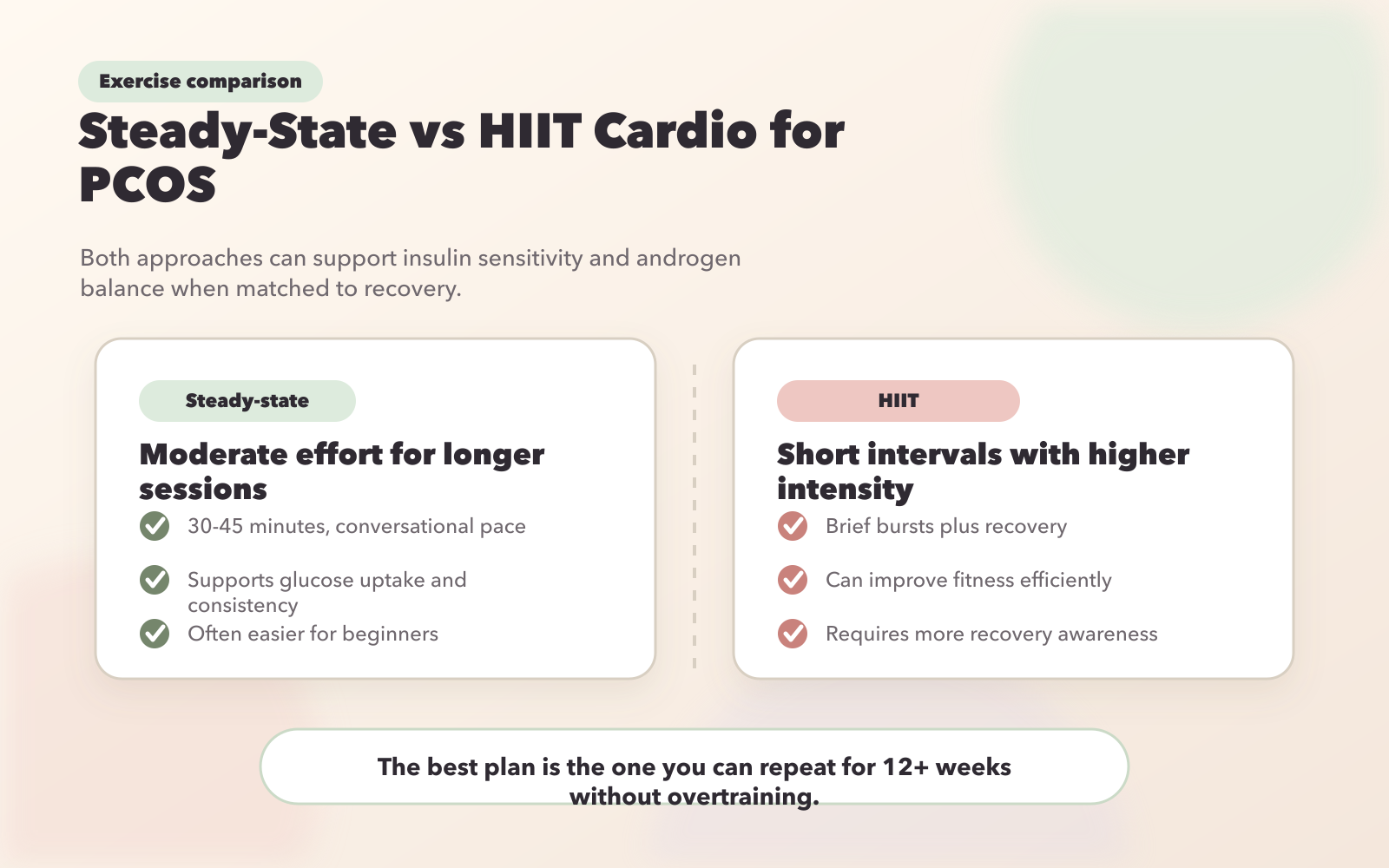
Steady-State vs HIIT Cardio for PCOS: Exercise Comparison Guide
Cardio exercises can influence androgen levels in different ways. Both steady-state cardio and high-intensity interval training (HIIT) are effective at reducing testosterone levels, but they achieve this through distinct processes and timelines.
Studies suggest that neither type of cardio has a clear advantage over the other in improving hormonal markers like testosterone, SHBG (sex hormone-binding globulin), or the Free Androgen Index in women with PCOS. Below, we’ll explore these two cardio methods and their unique benefits.
Steady-State Cardio for Hormone Balance
Steady-state cardio involves maintaining a moderate pace for an extended period. Activities like brisk walking, cycling, or swimming at a steady intensity fall into this category. This type of exercise works by gradually improving insulin sensitivity and increasing SHBG levels over time.
Among steady-state exercises, walking and cycling are the most researched for managing PCOS. Studies have shown significant reductions in free testosterone and DHEA-S levels during 16–32-week programs.
For the best results, aim for 30–60 minutes of moderate-intensity exercise at 60–70% of your maximum heart rate, at least three times a week. This means exercising at a pace where you can still hold a conversation but notice your breathing picking up. Consistency is key - most studies report noticeable hormonal improvements after 12 weeks, with the most significant changes occurring between 16 and 24 weeks.
"Moderate cardio, such as brisk walking, can be incredibly beneficial for individuals with PCOS. It helps improve insulin sensitivity, which is a crucial factor in managing PCOS symptoms." - Dr. Tara Brandner, Family Nurse Practitioner and Fertility Coach
Steady-state cardio is also linked to greater improvements in cardiorespiratory fitness (VO2max) and reductions in BMI and waist circumference compared to HIIT in some studies. For context, an increase of just 1-MET (3.5 ml/kg/min) in cardiorespiratory fitness can lower the risk of cardiovascular disease-related mortality by 15%.
HIIT for Faster Hormonal Results
High-intensity interval training alternates between short bursts of maximum effort and recovery periods. HIIT is much more time-efficient, delivering similar physiological benefits to steady-state cardio in roughly 27.5% less time.
In one randomized trial involving 28 women with PCOS, an 8-week HIIT program (3 sessions per week, with 4–6 sets of 30-second sprints at 100–110% maximum aerobic velocity) significantly reduced testosterone, cortisol, BMI, and insulin resistance.
"HIIT has a greater impact on body composition, fat profile, and insulin resistance than aerobic and resistance training." - Santos IKD, et al.
A typical HIIT session lasts 20–40 minutes, with intervals pushing your heart rate to 80–95% of its maximum for 30 seconds to 4 minutes, followed by recovery periods at 50–60% of your max. This method quickly reduces testosterone and cortisol levels while improving insulin sensitivity.
That said, keep HIIT sessions to twice a week - overdoing high-intensity exercise can lead to spikes in cortisol, potentially aggravating PCOS symptoms. The intensity - working at 100–110% of your maximum aerobic velocity - plays a critical role in achieving optimal hormonal changes in women with PCOS.
| Exercise Type | Intensity | Session Length | Best For |
|---|---|---|---|
| Steady-State | 60–70% max heart rate | 30–60 minutes | Building endurance; reducing free testosterone and DHEA-S; increasing SHBG |
| HIIT | 80–95% max heart rate (bursts) | 20–40 minutes | Time-efficient workouts; rapid hormonal changes; improving insulin resistance |
Both methods are effective - the choice depends on your preferences, schedule, and fitness level. Many women with PCOS find success by combining 2–3 steady-state cardio sessions with 1–2 HIIT workouts each week for a balanced and sustainable routine.
sbb-itb-6dba428
How to Build a Cardio Routine for PCOS
How Often and How Hard to Exercise
Start with three 30-minute sessions of moderate-intensity exercise per week. This means working at about 60–70% of your maximum heart rate - enough to feel your breathing increase but still be able to hold a conversation. Stick with this plan for 4–6 weeks to establish a strong foundation. After that, you can gradually increase to 4–5 sessions per week, extending each one to 45–60 minutes.
For even more benefits, aim for at least 120 minutes of vigorous-intensity exercise weekly. This involves working at 70–90% of your maximum heart rate, which is more challenging but provides greater improvements in insulin resistance and cardiorespiratory health. Consistent effort over three months is typically when hormonal changes start to show.
"Vigorous intensity exercise may have the greatest impact on cardiorespiratory fitness, body composition, and insulin resistance." - Rhiannon K. Patten, Researcher
These cardio sessions create a solid base for incorporating strength training, which can further enhance hormonal health.
Adding Strength Training to Your Cardio Plan
Pairing strength training with cardio can significantly improve hormonal balance. While cardio helps with insulin sensitivity, resistance training focuses on reducing the Free Androgen Index, which lowers testosterone levels. To get the most out of this combination, aim for 2–3 full-body strength training sessions per week alongside your cardio routine. This approach directly supports hormonal health by targeting the Free Androgen Index.
For strength training, focus on endurance-based exercises. Use lighter weights with 15–20 repetitions per set to avoid temporary spikes in testosterone or cortisol. Include compound movements like squats, lunges, bent-over rows, and wall presses to efficiently engage multiple muscle groups. If you're just starting, begin with bodyweight exercises and gradually add light dumbbells or resistance bands as you build strength.
How to Track Your Progress
Once your routine is underway, tracking your progress is essential. Use a heart rate monitor to ensure you're staying in your target zone and maintaining the right intensity during workouts. Fitness apps can also help you monitor heart rate zones and log session durations.
Keep an eye out for changes in areas like menstrual regularity, energy levels, and how your clothes fit - these improvements often show up before you notice any changes on the scale. Logging your workouts in a journal or app can help you spot patterns, stay motivated, and celebrate your progress.
Other Health Benefits of Cardio for PCOS
Better Insulin Sensitivity and Metabolic Health
Cardio offers more than just hormone regulation - it plays a key role in improving metabolic health, which is essential for managing PCOS. Regular cardio can significantly lower the risk of developing Type 2 diabetes by enhancing your body’s ability to process sugar. It achieves this by improving insulin signaling in muscles and reducing insulin receptor and IRS1 serine phosphorylation.
In just 12 weeks, aerobic training can boost insulin sensitivity by up to 30%. These changes not only help lower androgen levels but also reduce the risk of cardiovascular issues, which are common in PCOS. For example, aerobic exercise has been shown to lower fasting blood glucose by 1.75 mg/dL, reduce systolic blood pressure by 4.40 mmHg, and decrease CRP levels by 0.34 mg/L - all of which contribute to a healthier heart. Considering that up to 70% of women with PCOS experience dyslipidemia, these metabolic improvements are especially impactful.
Mental Health and Mood Improvements
Cardio isn’t just good for your body - it’s a powerful tool for your mind. Women with PCOS are nearly three times more likely to experience depressive symptoms and four times more likely to suffer from anxiety compared to those without the condition. In fact, around 64.1% of women with PCOS report struggling with depressive disorders. Cardio can help break the cycle of stress and emotional strain tied to PCOS.
Exercise can also address body image concerns and social withdrawal, which are often triggered by physical symptoms of PCOS. Lowering your Body Mass Index (BMI) through cardio has been linked to reduced anxiety and depression scores. Even if your weight doesn’t change, improvements in body composition can enhance self-esteem and help you feel more confident in your own skin.
Conclusion
Cardio plays a key role in improving insulin sensitivity and reducing androgen levels for those with PCOS. Studies show that just 12 weeks of regular cardio can boost insulin sensitivity by up to 30%, while 16–32 weeks of consistent exercise helps lower free testosterone and DHEA-S levels.
But the benefits don’t stop at hormonal balance. Cardio also supports overall health by reducing the risk of Type 2 diabetes, lowering blood pressure, and improving cholesterol levels - factors that are especially important for managing PCOS-related cardiometabolic health. On top of that, it can help ease anxiety and depression, offering mental health benefits as well.
"Recommended guidelines for women with PCOS include vigorous aerobic exercise and resistance training to improve measures of insulin sensitivity and androgen levels."
- Grei Shele, Researcher
To get started, aim for 30–45 minutes of cardio three to five times a week. Whether you prefer steady-state workouts or high-intensity interval training (HIIT), consistency is what truly makes the difference. Using tools like heart rate monitors or tracking fasting insulin levels can help you measure progress and stay motivated.
The key is to make cardio a lasting part of your routine. If you stop, the benefits can fade quickly. By sticking to a regular schedule, you can take control of PCOS and boost your overall quality of life.
FAQs
How does cardio help improve insulin sensitivity in women with PCOS?
Cardiovascular exercise, particularly high-intensity aerobic activities, plays a crucial role in improving insulin sensitivity for women with PCOS. By helping to lower fasting insulin levels and enhancing the body's ability to manage blood sugar, cardio addresses one of the core metabolic challenges tied to PCOS.
Adding regular cardio sessions to your routine doesn’t just support better insulin regulation - it can also help with other PCOS-related issues like weight gain and fatigue. This, in turn, promotes hormonal balance and boosts overall health.
What types of cardio and how often should you do them to help manage androgen levels in PCOS?
Including aerobic exercises like running, brisk walking, or cycling in your weekly routine can play a big role in managing androgen levels and alleviating PCOS symptoms. To see meaningful improvements, focus on staying consistent and aim to incorporate these activities several times a week.
Combining cardio with resistance training - like weightlifting or bodyweight exercises - can take things a step further by promoting better hormone balance and boosting overall well-being. Remember to pay attention to how your body feels and consult a healthcare professional to develop a plan tailored to your needs.
Can cardio alone manage all PCOS symptoms, or should it be combined with other treatments?
Cardio can be incredibly effective in managing certain PCOS symptoms. It helps improve insulin sensitivity, supports weight management, and may even reduce elevated androgen levels. That said, it’s not a cure-all for every symptom linked to PCOS.
To get the most out of your efforts, it’s best to pair cardio with other strategies like strength training, a well-rounded diet, and medical treatments tailored to your specific needs. Together, these approaches tackle a variety of PCOS-related challenges, such as hormonal imbalances, acne, and excessive hair growth. Be sure to consult a healthcare provider to develop a plan that fits your unique situation.