
HRT Risks vs. Benefits for Mental Health
HRT (hormone replacement therapy) can significantly impact mental health during menopause, offering relief from mood swings, anxiety, and sleep disturbances. However, it’s not without risks, including the potential for depression, anxiety, and other psychiatric side effects. Here’s a quick breakdown:
Key Takeaways:
- Benefits: Reduces anxiety, depression, and sleep issues; improves cognitive function when started early (within 10 years of menopause).
- Risks: May increase depression, anxiety, or suicidal thoughts in some women, especially those under 40 or with pre-existing conditions like PMDD or PCOS and insulin resistance.
- Timing Matters: Starting HRT early in menopause often yields better outcomes. Delayed use (after age 65) may increase risks.
- Delivery Method: Transdermal options (patches, gels) often have fewer risks compared to oral pills. Local treatments (vaginal creams) pose the lowest systemic risks.
- Personalization: Tailoring treatment to individual health history is crucial for balancing benefits and risks.
HRT can be a valuable tool for managing mental health during menopause, but it requires careful consideration, professional guidance, and regular follow-ups to ensure safety and effectiveness.
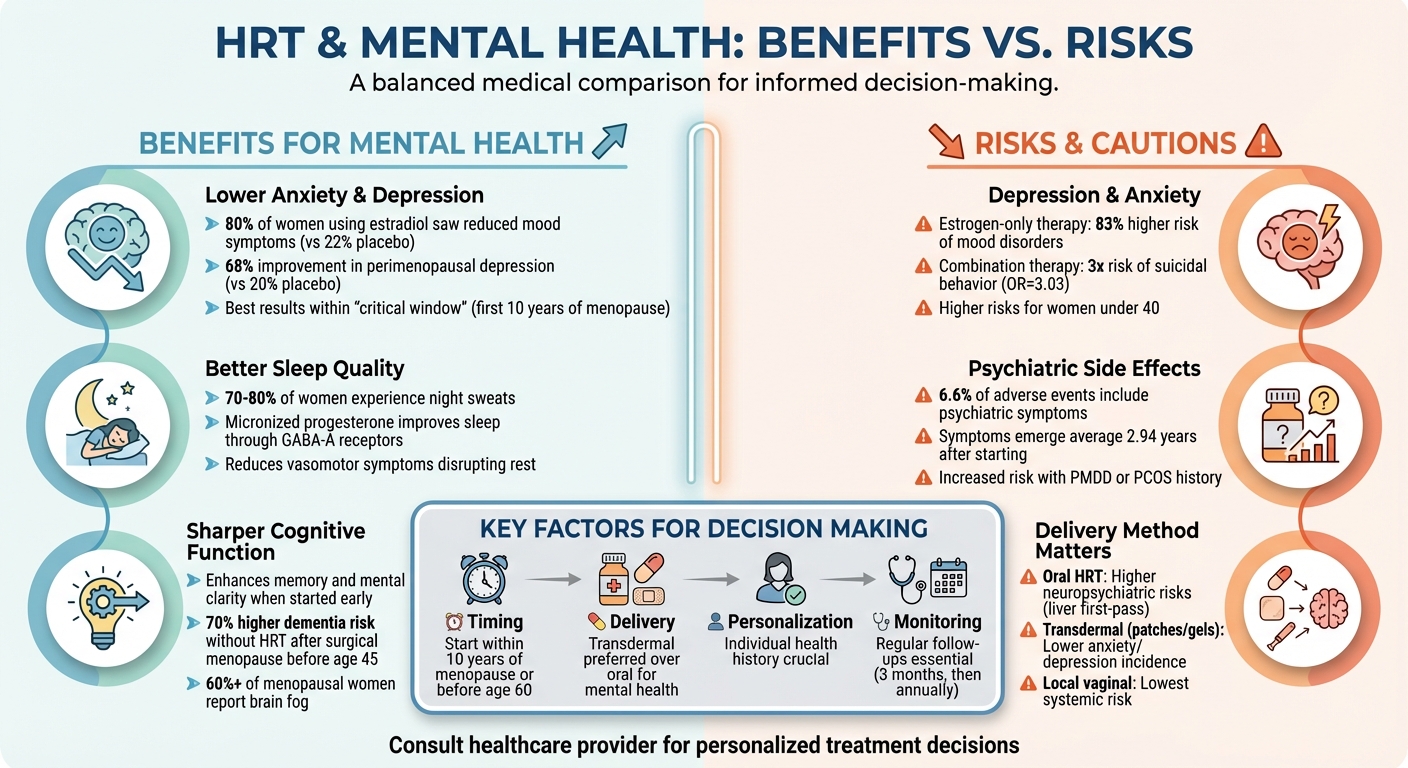
HRT Mental Health Benefits vs Risks Comparison Chart
Benefits of HRT for Mental Health
Lower Anxiety and Depression
Hormone replacement therapy (HRT) can help tackle the anxiety and depression that often come with menopause by replenishing estrogen levels. Estrogen plays a key role in stabilizing mood by influencing serotonin receptors and enzyme activity, helping to balance the hormonal fluctuations that trigger mood swings during this stage of life.
"Estrogen acts as a natural mood stabilizer and helps reduce anxiety. HRT replenishes estrogen levels, which helps balance hormones and, by extension, may alleviate anxiety." - Susan B. Trachman, M.D., Board-certified Psychiatrist
The impact can be dramatic. For instance, a randomized controlled trial revealed that 80% of women using estradiol experienced significantly reduced mood symptoms within three to six weeks, compared to just 22% of those on a placebo. Another study found that estradiol improved mood in 68% of perimenopausal women with depressive disorders, while only 20% of women on a placebo saw similar improvements. Progesterone, often paired with estrogen, also contributes to mental health by boosting the production of GABA, a neurotransmitter that promotes relaxation and calmness. On top of that, estrogen supports the growth of dendritic spines in areas of the brain like the hippocampus and prefrontal cortex, which are crucial for emotional regulation.
The benefits of HRT are most pronounced when started during the "critical window" - typically close to the onset of menopause. A 2025 systematic review highlighted that the most noticeable improvements in anxiety occur in women who begin HRT within a few years of their final menstrual period. Women considering HRT should discuss their options early in the perimenopausal phase to optimize these mental health benefits, which also pave the way for better sleep quality.
Better Sleep Quality
Sleep disturbances are a widespread issue during menopause, with 70% to 80% of women experiencing vasomotor symptoms like night sweats that disrupt their rest. HRT can improve sleep by reducing these symptoms, leading to better daytime energy and overall well-being. Since poor sleep and depression are closely linked, improving sleep also helps manage mood-related challenges.
Micronized progesterone, a bioidentical hormone used in HRT, has a mild sedative effect that promotes restful sleep. Its metabolites, such as allopregnanolone, act on GABA-A receptors in the brain to produce calming effects similar to those of benzodiazepines. Clinical data shows that micronized progesterone not only reduces vasomotor symptoms but also significantly improves sleep quality. This dual action makes it especially useful for women dealing with both hot flashes and insomnia.
"Depressed mood and sleep problems (insomnia, nighttime awakening or waking early) are likely to be mutually related and must be treated specifically." - Giulia Gava et al., University of Bologna
The benefits of improved sleep go beyond just feeling rested. Sleep deprivation during menopause is often linked to memory issues and difficulty finding words. By enhancing sleep, HRT helps restore cognitive function, addressing one of the most frustrating symptoms of menopause.
Sharper Cognitive Function
Better sleep and mood stability also contribute to improved cognitive performance. Research indicates that HRT can enhance memory and mental clarity in menopausal women, particularly when started during the "critical window" - within five years of menopause onset. Estrogen supports brain health by regulating glucose metabolism, boosting ATP production in brain mitochondria, and increasing the density of dendritic spines and synapses in areas like the hippocampus and prefrontal cortex, which are essential for memory and decision-making.
Women who undergo surgical menopause (removal of ovaries) at a young age often see the most pronounced cognitive benefits from HRT. For example, estrogen-only therapy significantly improved global cognition and verbal memory in these women, with measurable differences in standardized scores. Without HRT, women who experience surgical menopause before age 45 face a 70% higher risk of developing dementia.
"Estrogen, particularly 17β-estradiol, is known to have neurotrophic and neuroprotective effects, and modulatory effects on metabolic and biochemical pathways implicated in AD." - Lisa Mosconi, PhD, Associate Professor of Neuroscience in Neurology
Timing is critical for these cognitive benefits. The Kronos Early Estrogen Prevention Study (KEEPS), which tracked 727 recently postmenopausal women over four years, found no significant cognitive harm from HRT. While the study did not show overall cognitive improvements in a healthy, low-risk group, follow-up research in 2024 confirmed that short-term HRT started during early postmenopause had no long-term negative effects on cognition. With over 60% of menopausal women reporting memory issues or "brain fog", starting HRT at the right time can provide meaningful relief.
sbb-itb-6dba428
HRT vs Antidepressants in Perimenopausal Depression by Prof Jayashri Kulkarni
Risks of HRT for Mental Health
While HRT can provide mental health benefits, it’s essential to weigh these against the potential risks, which vary from person to person.
Higher Risk of Depression or Anxiety
The impact of HRT isn’t the same for everyone. A study involving 125,000 women found that those using HRT reported higher risks of anxiety and depression compared to postmenopausal women not on HRT. Often, these challenges reflect underlying conditions already present before starting therapy.
"The use of HRT does not appear to mitigate these effects [adverse mental health outcomes] and may be associated with more pronounced mental health challenges, potentially due to underlying baseline differences." - Katharina Zuhlsdorff, University of Cambridge Department of Psychology
The type of HRT plays a significant role in these risks. For instance, estrogen-only therapy increases the likelihood of mood disorders by 83% (OR=1.83) and sleep issues by 57% (OR=1.57). Meanwhile, combination therapy triples the risk of suicidal behavior (OR=3.03). Age is another critical factor - women under 40, such as those with premature ovarian insufficiency or surgical menopause, face much higher risks of psychiatric side effects.
These mood-related challenges often contribute to other psychiatric concerns, as detailed below.
Psychiatric Side Effects
Approximately 6.6% of HRT-related adverse event reports include psychiatric symptoms. Among these, insomnia is the most common, but more severe issues like mood instability, depression, and suicidal thoughts have also been reported. On average, these symptoms emerge about 2.94 years after starting HRT, though they can appear earlier.
Certain pre-existing conditions can make women more vulnerable. For example, those with a history of Premenstrual Dysphoric Disorder (PMDD) may experience heightened sensitivity to hormonal changes, leading to abnormal mood responses. Similarly, women with Polycystic Ovary Syndrome (PCOS) may see increased mood instability. Additionally, women with a history of depression are at risk of depressive symptoms recurring during estrogen withdrawal.
"It would be irresponsible to recommend this [hormone therapy] as a blanket prevention treatment for women." - Dr. Hadine Joffe, Executive Director, Connors Center for Women's Health and Gender Biology
How Delivery Methods Affect Mental Health
The way HRT is delivered can significantly influence mental health outcomes. Research involving over 3,800 postmenopausal women found that transdermal HRT (patches or gels) was linked to a lower incidence of anxiety and depression compared to oral pills. This difference is tied to how the body processes the hormones. Oral HRT passes through the liver first, altering its effects and potentially increasing the risk of neuropsychiatric issues. In contrast, transdermal methods bypass the liver, resulting in a different risk profile.
Local vaginal treatments, such as creams or tablets, pose the lowest risk. These options have minimal systemic absorption, meaning they generally don’t affect the central nervous system or raise the likelihood of mood disorders. On the other hand, systemic treatments like pills carry a much higher risk of psychiatric side effects.
"While our findings suggest that transdermal estrogen may offer potential mental health advantages compared with oral formulations, these results should not be generalized to the broader postmenopausal population. Hormone therapy is not a one-size-fits-all treatment." - Dr. Xuezhi (Daniel) Jiang, Professor of Obstetrics and Gynecology, Drexel University College of Medicine
Women with a history of depression or anxiety should consider discussing transdermal options with their healthcare provider. Choosing the right delivery method should be a collaborative process tailored to individual needs.
Factors That Affect HRT Mental Health Outcomes
Whether hormone replacement therapy (HRT) supports or challenges your mental health depends on several important factors. Understanding these can guide you and your healthcare provider in making informed treatment decisions.
When to Start HRT
Timing matters. Research shows that starting HRT during perimenopause or within a few years of menopause often leads to better mental health outcomes. For example, a study of 125,000 women found the average age of menopause onset was 49.45 years, with most starting HRT around age 49.03.
Timing becomes even more critical for younger women. Those under 40, often experiencing premature ovarian insufficiency or surgical menopause, face a much higher risk of depression and suicidal thoughts. Compared to women aged 40–55, this younger group has a significantly higher likelihood of depression-related side effects (OR = 0.44 for ages 40–55, OR = 0.28 for ages 55–65, and OR = 0.21 for those over 65).
"The timing of HRT can influence its effectiveness and risks. For many women, starting HRT close to the onset of menopause and using it for a limited period may provide the best balance of benefits and risks." - Menopause Solutions
Starting HRT later in life, especially after age 65, doesn’t provide the same mental health benefits and may even increase certain risks. According to the Critical Window Theory, initiating treatment within 10 years of menopause onset or before age 60 offers the most cognitive and emotional advantages.
Beyond timing, the type of hormones used also plays a significant role in mental health outcomes.
Effects of Progestogen and Estrogen
The type of hormones in HRT can have varying effects on mental health. Estrogen, particularly 17B-estradiol (E2), supports brain health by enhancing neural plasticity and regulating neurotransmitters like serotonin and acetylcholine, both crucial for mood and memory. For women without a uterus, estrogen-only therapy can be especially beneficial.
On the other hand, progestogens - added to protect the uterine lining - can sometimes lead to mood-related issues. The specific type of progestogen makes a big difference. Micronized progesterone, a bioidentical option, can have calming effects and improve sleep quality. In contrast, synthetic progestins like medroxyprogesterone acetate (MPA) are often linked to irritability and depressed mood, particularly in women with a history of depression.
Estrogen monotherapy, while effective for some, was associated with an 83% higher risk of mood disorders (OR = 1.83) compared to combination therapy. However, combination therapy reduced the risk of suicidal and self-injurious behavior by 67% (OR = 0.33). This underscores the importance of tailoring therapy to individual needs.
The method of delivery also matters. Transdermal estradiol, for instance, bypasses the liver’s first-pass metabolism, avoiding the inflammatory markers associated with oral delivery.
These differences highlight why personalizing HRT based on health history is essential.
Pre-existing Conditions and Personalized Treatment
Your health history plays a major role in how HRT affects your mental well-being. Women with hormone-sensitive mood disorders like Premenstrual Dysphoric Disorder (PMDD), Premenstrual Syndrome (PMS), or Polycystic Ovary Syndrome (PCOS) are more sensitive to hormonal changes and may experience heightened emotional challenges during HRT.
Physical health conditions also influence the safety and effectiveness of HRT. For example:
- Obesity (BMI >30) increases the risk of blood clots (venous thromboembolism) nearly sixfold with oral combined HRT compared to lean women on placebo. Transdermal delivery is often recommended for these patients since it bypasses the liver and doesn’t elevate clotting risks.
- Oral HRT raises triglycerides by 5% to 15%, while transdermal HRT can lower them by 5% to 30%.
| Condition | Recommended HRT Approach | Why It Matters |
|---|---|---|
| History of PMDD/PCOS | Close psychiatric monitoring | Increased sensitivity to hormonal fluctuations |
| Obesity (BMI >30) | Transdermal delivery | Oral HRT significantly increases blood clot risk |
| High triglycerides | Transdermal delivery | Oral estrogen raises triglycerides; transdermal lowers them |
| Surgical menopause | Early initiation (before age 40) | Prevents long-term depression from rapid estrogen decline |
Specialized telehealth services like Oana Health (https://oanahealth.com) offer personalized HRT options, including mental health support during menopause. Their licensed professionals tailor treatments to your unique health profile, delivering medications directly to your home with free shipping.
"It is necessary to conduct personalized risk stratification in HRT management, prioritizing age, administration route, and regimen type." - Nan Chen, Department of Geriatrics, Shenzhen Second People's Hospital
Effective HRT management involves screening for psychiatric history before starting treatment and regularly reassessing the type, dose, and delivery method to adapt to your changing needs. Women under 40 starting combined therapy require especially close monitoring for depressive symptoms and suicidal thoughts, as they report the highest rates of these adverse effects.
These variables, combined with an understanding of risks and benefits, underscore the importance of tailoring HRT to individual needs for better mental health outcomes during menopause.
Conclusion: Deciding About HRT for Mental Health
Choosing hormone replacement therapy (HRT) to address mental health during menopause hinges on several factors, including age, symptom severity, medical history, and personal preferences.
When Benefits Outweigh Risks
Timing matters when it comes to HRT's mental health benefits. The "Timing Hypothesis" suggests that women under 60 or within 10 years of menopause onset experience more benefits than risks. For example, an 18-year follow-up from the Women's Health Initiative found no difference in overall mortality between HRT users and those on a placebo.
HRT is especially helpful for women dealing with severe menopausal symptoms. Intense vasomotor symptoms, like hot flashes, are known to trigger mood swings and even depression. HRT effectively addresses menopause-related mental health issues, including anxiety, low mood, and sleep disturbances.
"HT is the most effective treatment for the relief of vasomotor symptoms (VMS), and also reduces bone loss, fracture risk and can treat the genitourinary syndrome of menopause." - Jaya Mehta, MD, Mayo Clinic
For women with a low 10-year estimated atherosclerotic cardiovascular disease (ASCVD) risk (less than 5%), HRT is generally considered safe. If you have risk factors such as obesity or high triglycerides, transdermal delivery methods - like patches, gels, or sprays - are safer options since they don’t increase the risk of blood clots or stroke. The risk of breast cancer remains minimal: approximately 5 additional cases per 1,000 women taking combined HRT for five years.
In November 2025, the FDA requested the removal of Boxed Warnings related to cardiovascular disease, breast cancer, and dementia from HRT labels. This change reflects updated research showing a favorable benefit/risk balance for women aged 45–55, aiming to address the underuse of HRT among those who could benefit most.
Getting Professional Medical Guidance
Consulting a licensed healthcare provider is key to using HRT safely and effectively. Your treatment should be tailored to your age, health history, and specific hormone needs. Despite 41 million U.S. women being in the typical menopausal age range, only about 2 million received prescriptions for systemic HRT in 2020.
"The recommendation is to use an individualized approach when treating symptomatic menopausal women with periodic reevaluation." - Jaya Mehta, MD
Your doctor can help determine the best delivery method to minimize side effects. For example, oral estrogen may increase risks of blood clots and gallbladder issues due to first-pass liver metabolism, whereas transdermal options avoid these risks. Women experiencing mood challenges may benefit from micronized progesterone, which tends to have fewer negative effects on mood compared to synthetic progestins.
Specialized services like Oana Health (https://oanahealth.com) provide personalized HRT plans. Their licensed professionals develop treatment strategies based on your unique health profile, with medications delivered directly to your doorstep.
This level of customization ensures that your HRT experience is fine-tuned to meet your evolving needs.
Final Thoughts
Deciding on HRT requires weighing its benefits against potential risks. Regular follow-ups are essential - three months after starting treatment to monitor progress and adjust dosages, and annually once stabilized. These check-ins help address ongoing symptoms, side effects, and long-term treatment plans.
Tracking mood changes, anxiety levels, and sleep quality gives your healthcare provider valuable insights during evaluations. Women with a history of PMDD or surgical menopause may need more frequent mental health monitoring due to heightened sensitivity to hormonal shifts. Routine breast and cervical cancer screenings remain essential.
"The benefits of hormone replacement therapy (HRT) usually outweigh the risks. Recent evidence says that the risks of serious side effects from HRT are very low." - NHS
The shift from a "lowest dose for shortest time" approach to personalized treatment plans focused on symptom management and quality of life represents a more refined understanding of HRT. With proper medical guidance and regular monitoring, HRT can play a valuable role in supporting mental health during menopause.
FAQs
How can I tell if HRT is helping my mood or making it worse?
To determine whether HRT is positively or negatively affecting your mood, pay close attention to any shifts over time. Keep a record of these changes and discuss them with your healthcare provider. Since responses to HRT can differ depending on personal factors and the specific therapy prescribed, staying in regular contact with your provider is key to making sure the treatment supports your mental well-being.
Which HRT option is least likely to affect mental health (pill vs patch vs vaginal)?
Vaginal low-dose estrogen is considered the hormone replacement therapy (HRT) option with the smallest impact on mental health. Since it generally doesn't increase blood estrogen levels, the risk of influencing mood or cognitive function is minimal. This makes it a popular choice for individuals prioritizing mental well-being during menopause.
What should I discuss with my clinician before starting HRT if I’ve had depression or PMDD?
Before beginning HRT, it’s important to discuss your history of depression or PMDD with your clinician. Be open about any past mood changes or mental health challenges. Since HRT can sometimes influence mood or even trigger depression, your provider will work with you to carefully evaluate the risks and benefits based on your individual circumstances.