
5 Ways Journaling Eases PCOS Anxiety
Living with PCOS can be overwhelming, especially when it comes to managing anxiety. Journaling offers a simple, effective way to regain emotional balance. Research shows that writing for just 15 minutes a day can reduce stress, improve mood, and help process emotions. Here’s how journaling can help with PCOS-related anxiety:
- Reduces Self-Criticism: Reflective writing helps challenge negative thoughts and build self-compassion.
- Lowers Anxiety: Gratitude journaling shifts focus to positive moments, reducing worry and stress.
- Processes Hormonal Emotions: Tracking mood, diet, and triggers helps manage emotional swings.
- Builds Emotional Strength: Writing encourages self-kindness and resilience during tough times.
- Improves Mental Health: Regular journaling lowers cortisol, reducing anxiety and depression symptoms.
Start small - write for 15 minutes daily. Pair it with professional care for better results, and use your journal to track symptoms or prepare for medical appointments. Journaling is an accessible way to take control of your mental health while managing PCOS.
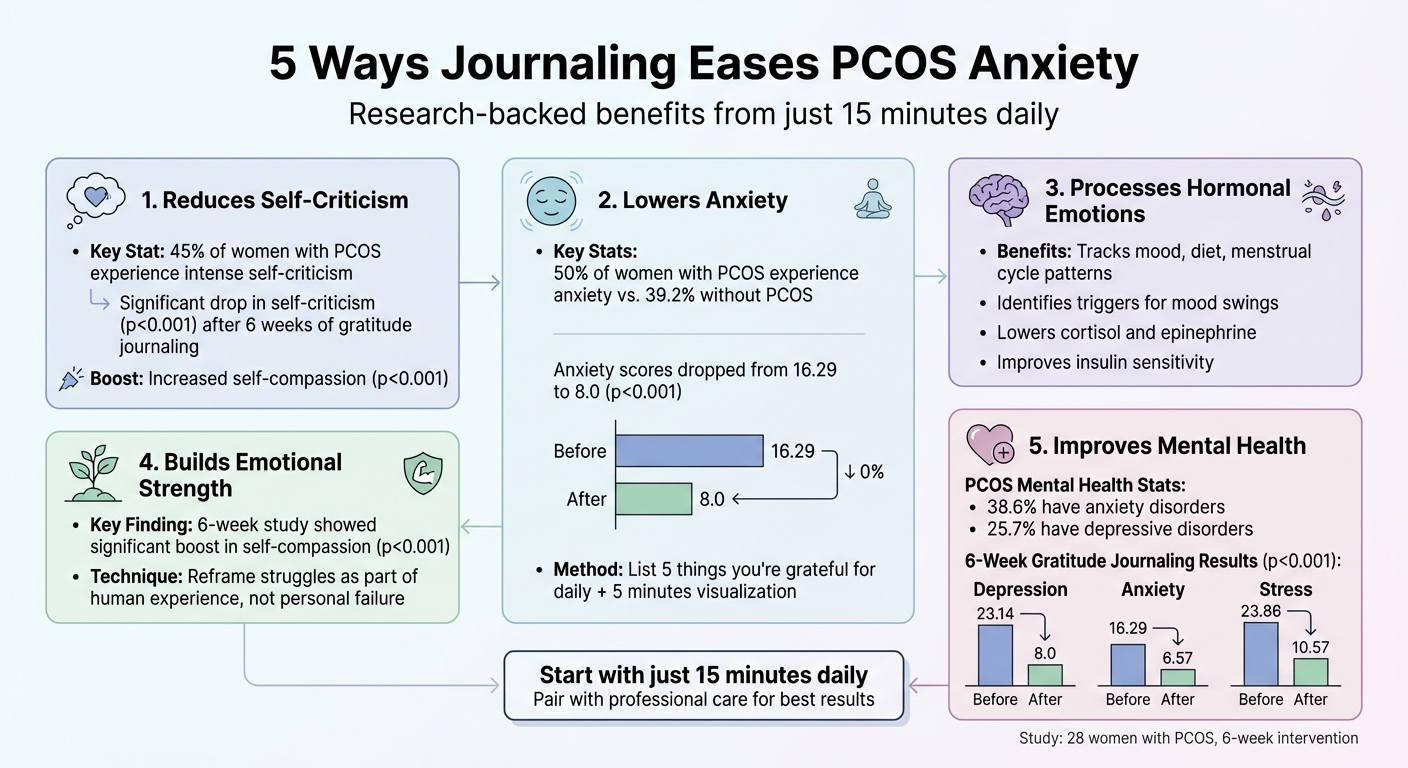
How Journaling Reduces PCOS Anxiety: Key Statistics and Benefits
1. Reduces Self-Criticism Through Reflective Writing
Living with PCOS can be tough, especially when it comes to battling negative self-talk. Studies show that about 45% of women with PCOS experience intense self-criticism and recurring negative thoughts. Dealing with symptoms like unwanted facial hair, acne, or weight gain can make it all too easy to spiral into feelings of low self-worth. Reflective writing, such as journaling, provides a way to turn these negative thoughts into more constructive and balanced perspectives.
Journaling helps you question and challenge irrational thoughts. Laura Braider, PhD, a psychologist at Northwell Health, explains: "Journaling can allow us to really dispute the irrational thoughts that we might be having or the stories that we might be telling ourselves". Writing down your thoughts helps you separate what’s real from what’s being distorted by anxiety or shame.
One study, conducted between March and September 2022 at Srushti Fertility Centre and Women's Hospital in Chennai, explored the impact of gratitude journaling on 28 women with PCOS. For six weeks, participants listed five things they were grateful for each day. The results? A significant drop in self-criticism (p<0.001) and a noticeable boost in self-compassion (p<0.001) compared to those who didn’t participate.
If you’re looking to try this yourself, consider the "Fact or Fiction" exercise. Write down a self-critical thought, like "I'm not attractive because of my PCOS symptoms", and decide if it’s fiction. Alternatively, use a two-column method: in one column, write an anxious thought like "I am broken", and in the other, counter it with a more balanced statement such as "I am managing a condition".
Set aside 15–20 minutes of quiet time to reflect on your thoughts and emotions surrounding PCOS. This practice encourages self-compassion and helps you break free from the harsh judgments that often come with living with this condition.
2. Lowers Anxiety Through Gratitude Practices
Gratitude journaling can help shift attention away from the challenges of PCOS and onto the brighter moments in life. For many women with PCOS - 50% of whom experience anxiety compared to 39.2% of women without the condition - this simple habit can interrupt the cycle of worry and stress.
A six-week study involving 28 women revealed a striking outcome: participants who practiced gratitude journaling by listing five things they were thankful for each day and visualizing them for five minutes saw their anxiety scores drop from 16.29 to 8.0 (p < 0.001). This highlights how impactful gratitude journaling can be in reducing anxiety.
Backing up these results, Seena Jose, a PhD scholar at Lovely Professional University, noted:
"Gratitude journal writing is an effective intervention for decreasing depression, anxiety, stress and self-criticism, and improving self-compassion in women with PCOS."
- Seena Jose
To try it yourself, dedicate 15–20 minutes each morning or evening to jot down five things you're grateful for. These could be moments like a friend's kind message or feeling strong during a workout. Then, spend five minutes visualizing each one, focusing on the emotions tied to these experiences.
This practice not only promotes a more positive mindset but also helps reduce stress hormones like cortisol and adrenaline, which can aggravate PCOS symptoms. Aim to stick with it for at least six weeks to notice meaningful changes in your anxiety levels.
3. Helps Process Hormonal Emotions and Reduces Stress
PCOS often throws hormones out of balance, leading to elevated androgens, insulin resistance, and fluctuating hormone levels. These changes can disrupt neurotransmitters, making mood swings and anxiety worse. Journaling provides a way to work through intense emotions while also easing stress.
By keeping track of your daily mood, diet, menstrual cycle, and activities, you can uncover patterns and pinpoint triggers. As Oana Health puts it:
"Keeping a diary to track your mood, diet, menstrual cycle, and daily activities can help identify patterns and triggers for mood swings. This insight allows for more proactive management." - Oana Health
Writing down your thoughts helps to slow racing thoughts and bring clarity. Reflective writing not only challenges negative thinking but also provides a safe outlet for emotions, reducing stress in the process. Recognizing emotional triggers doesn’t just help mentally - it can also have a positive impact on your physical health.
Journaling has been shown to lower stress hormones like cortisol and epinephrine. With reduced cortisol levels, your insulin sensitivity improves, which can help minimize further hormonal disruptions. Simply put, processing emotions on paper supports your body’s overall well-being.
For a specific technique, try "worry journaling" before bed. Spend just five minutes writing down your concerns to clear your mind and improve sleep quality. Alternatively, for a more cathartic release, you can write down negative emotions and then physically let them go - rip up or burn the paper. The American Diabetes Association highlights this practice as a way to transform negative emotions into more positive ones.
sbb-itb-6dba428
4. Builds Self-Compassion and Emotional Strength
For many women with PCOS, self-criticism and overthinking can feel like constant companions. These negative thought patterns can trigger the brain's threat response, intensifying anxiety. Journaling offers a powerful way to interrupt this cycle by nurturing self-compassion - the practice of treating yourself with kindness during challenging times.
A study conducted by Seena Jose at Srushti Fertility Centre revealed some compelling results. Over six weeks, 14 women with PCOS practiced gratitude journaling by listing five things they were thankful for each day. The outcome? A significant boost in self-compassion (p<0.001) and a marked reduction in self-criticism (p<0.001) compared to a control group.
Journaling also helps you reframe your struggles with PCOS symptoms - like weight gain or infertility - not as personal failings but as part of the broader human experience. As Seena Jose puts it:
"Self-compassion, which refers to showing kindness to oneself when facing suffering, is an effective approach to dealing with distressing thoughts and emotions."
This shift in perspective doesn’t just ease emotional pain - it builds emotional strength. Reflective writing can help you recognize your resilience by documenting past challenges you’ve overcome. Another effective tool is a thought diary, where you break down situations into columns for the event, your feelings, your thoughts, any irrational ideas, and the evidence-based reality. This structured method helps you challenge automatic negative thoughts and replace them with more balanced, constructive perspectives.
Even a short, consistent journaling practice - just 15–20 minutes a day - can strengthen your emotional resilience over time. Elizabeth Scott, PhD, highlights this beautifully:
"Thinking about your strengths and your best moments can help you to remember that, while you may not enjoy your current circumstances, you have the strength to handle what comes."
When combined with personalized, science-based treatments, these journaling techniques can be a valuable part of managing PCOS and reducing anxiety. At Oana Health, professional support and evidence-backed approaches come together to offer a holistic way to tackle PCOS challenges.
5. Improves Overall Mental Health
Journaling has been shown to make a noticeable difference in mental health. Women with PCOS often face heightened mental health challenges - 38.6% report dealing with anxiety disorders, while 25.7% experience depressive disorders. One study involving 28 women with PCOS revealed that six weeks of daily gratitude journaling significantly reduced depression (from 23.14 to 8.0), anxiety (from 16.29 to 6.57), and stress (from 23.86 to 10.57), with results showing a high level of statistical significance (p<0.001). These findings highlight journaling as a simple yet impactful tool in managing mental health struggles associated with PCOS.
Writing about emotions has another benefit: it helps lower stress hormones like cortisol and epinephrine. This reduction can improve insulin sensitivity and stabilize glucose levels. The American Diabetes Association emphasizes the positive impact:
"Journaling allows you to refocus on more positive topics, such as good experiences or strong relationships. That, in turn, can tamp down stress hormones that affect overall health."
This mental health boost aligns with earlier findings on reductions in self-criticism, anxiety, and stress. What’s even more encouraging is that these benefits can come from just a few minutes of journaling each day. For women with PCOS, who often report lower quality of life in physical, psychological, and social areas, journaling offers an accessible way to improve well-being. When paired with professional care from providers like Oana Health, journaling becomes an essential part of a holistic approach to managing PCOS symptoms.
Conclusion
Journaling offers a simple yet effective way for women with PCOS to manage anxiety and boost emotional well-being. Research shows that a six-week gratitude journaling practice can significantly reduce depression, anxiety, stress, and self-criticism (p<0.001), while also increasing self-compassion in women with PCOS. And the best part? Just five minutes a day can lead to noticeable improvements.
To get started, establish a daily routine - whether it’s in the morning to set a positive tone for the day or at night to unwind. Your journal can serve as a "worry journal" to clear your thoughts before bed or as a space to list things you’re grateful for. If you’re unsure what to write, try asking yourself: What emotions am I experiencing? What might have triggered them? How can I approach this differently?
For even greater benefits, pair journaling with professional medical care. The challenges of PCOS - ranging from hormonal imbalances to emotional struggles - often require a well-rounded approach to treatment. Services like Oana Health provide telehealth options for women with PCOS, addressing issues like insulin resistance, weight management, hair loss, and mental health, all with the convenience of free doorstep delivery. Use your journal to track symptoms, identify triggers, and jot down questions or concerns to discuss during medical appointments.
FAQs
How does journaling help reduce anxiety for women with PCOS?
Journaling offers a helpful way for women with PCOS to manage anxiety. By putting your thoughts and emotions on paper, you create a private space to work through feelings and ease mental tension. This simple act can redirect attention from negative thinking, bringing a sense of calm and control.
It’s also a useful tool for tracking physical symptoms and emotional patterns, helping you pinpoint triggers and discover effective coping strategies. Beyond that, journaling encourages mindfulness, boosts self-awareness, and nurtures self-compassion - all important for navigating the emotional ups and downs of PCOS. Over time, this habit can make a noticeable difference in reducing anxiety and improving mental health.
What are some easy journaling techniques to help beginners manage PCOS-related anxiety?
If you're just starting with journaling, keep it simple and approachable. Dedicate a few minutes each day to jot down your thoughts, emotions, or concerns. It doesn't have to be perfect - just write whatever comes to mind. You might also find guided prompts helpful, such as listing three things you're thankful for, describing your current mood, or noting a positive affirmation to focus on.
The secret to making journaling a habit is consistency. Short, daily sessions are a great way to get started without feeling overwhelmed. Remember, your journal is a private and judgment-free zone where you can sort through your emotions and thoughts. Over time, this small daily practice can become a powerful tool for reducing anxiety and supporting your mental health, especially when navigating the complexities of PCOS.
Can journaling help manage PCOS, or should I still seek professional treatment?
Journaling offers a helpful outlet for managing stress, working through emotions, and supporting your mental well-being when living with PCOS. That said, it’s crucial to remember that journaling isn’t a replacement for professional medical care.
To get the most out of it, think of journaling as a supportive tool to use alongside the treatments recommended by your healthcare provider. Together, this combined approach can better tackle both the physical and emotional aspects of PCOS.