
Minoxidil Dose and Response in Women: What Studies Show
Hair loss affects nearly half of all women at some point, often due to female-pattern hair loss (FPHL), a condition where hair thins over the scalp and crown. Minoxidil, the only FDA-approved treatment for women with FPHL, comes in topical forms (2% solution and 5% foam) and as low-dose oral tablets prescribed off-label.
Key findings from research:
- Topical Minoxidil: 5% foam applied once daily is more effective than the 2% solution but may cause scalp irritation or unwanted hair growth on the face. About 40% of women see hair regrowth with the 5% foam.
- Oral Minoxidil: Low doses (0.25–1.25 mg daily) are a convenient alternative for those who struggle with topical treatments. Studies show 79.7% of women using oral minoxidil report improvement, with fewer localized side effects but a higher chance of systemic effects like mild swelling or rapid heartbeat.
Response to minoxidil depends on enzyme activity in hair follicles. Testing for this activity can help predict whether topical or oral minoxidil will work better for an individual. Side effects are typically manageable, and adherence to treatment is key to seeing results. Regular monitoring is recommended, especially for oral formulations.
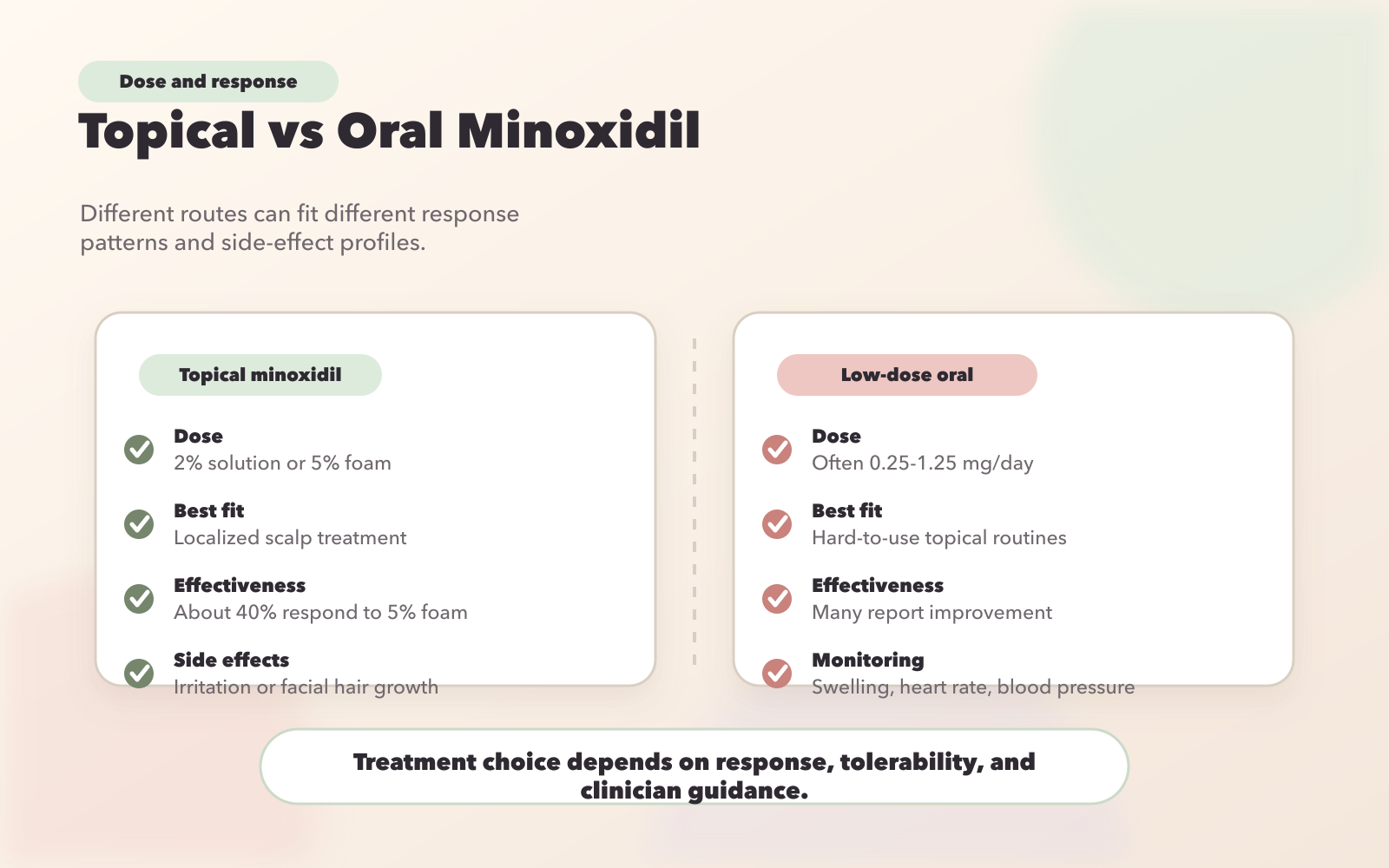
Topical vs Oral Minoxidil for Women: Dosing, Effectiveness, and Side Effects Comparison
Minoxidil for Hair Loss: Dermatologist Explains Truths, Myths, & What to Expect
In this video, a dermatologist breaks down the research insights on minoxidil and how it functions as a primary treatment for hair thinning.
sbb-itb-6dba428
What Studies Show About Minoxidil Doses in Women
Recent research highlights a range of dosing options for minoxidil, extending beyond the standard 2% solution. Tailoring treatments based on dose-specific responses has proven important in addressing female-pattern hair loss. One 48-week study involving 381 women aged 18–49 found that 5% topical minoxidil significantly outperformed the 2% solution in hair count and growth assessments. Both concentrations, however, showed better results than placebo.
Topical Minoxidil: Comparing Standard and Higher Doses
"5% topical minoxidil was superior to placebo on each of the 3 primary efficacy end points: promoting hair growth as measured by change in nonvellus hair count and patient/investigator assessments of hair growth and scalp coverage." – Anne W. Lucky, MD
The 5% formulation demonstrated greater effectiveness than the 2%, but it also came with higher rates of side effects, including scalp irritation and itching. Additionally, approximately 24% of women using the higher concentration experienced hypertrichosis (excess hair growth), particularly on the face and hands. Fortunately, this side effect is typically manageable and reversible. Despite these concerns, the 5% foam version has been shown to stimulate hair regrowth in about 40% of women.
For those exploring alternatives to topical solutions, low-dose oral minoxidil has gained attention as a viable option.
Oral Minoxidil: Low-Dose Effectiveness for Women
Low-dose oral minoxidil (LDOM) offers a practical alternative for women who face challenges with topical applications. The starting dose for women is often 1.25 mg daily, within a broader range of 0.625–5 mg. Studies indicate that oral minoxidil provides hair density improvements comparable to those achieved with topical treatments.
In a study involving 148 women using oral minoxidil, 79.7% showed clinical improvement, with 15.5% experiencing marked improvement. Side effects, such as rapid heartbeat or swelling, led only 2% of participants to discontinue treatment.
"Low-dose oral minoxidil may be an effective therapy with a good safety profile for women with FPHL, allowing an excellent long-term compliance." – Rita Rodrigues-Barata, MD
Oral minoxidil also boasts higher adherence rates since it avoids the messiness and texture-related issues common with topical solutions. For women seeking a convenient option, Oana Health provides oral minoxidil starting at $25 per month, prescribed by licensed professionals and delivered directly to your door with free shipping.
Factors That Affect How Women Respond to Minoxidil
How women respond to minoxidil varies based on how their hair follicles process the drug at a cellular level.
Enzyme Activity in Hair Follicles
Minoxidil is a pro-drug, meaning it needs to be converted into its active form, minoxidil sulfate, by the enzyme sulfotransferase (SULT1A1) in the outer root sheath of hair follicles. This conversion is what activates its hair-growth effects.
Interestingly, the effectiveness of minoxidil depends on how it’s administered - oral versus topical minoxidil. For topical minoxidil, higher SULT1A1 activity in hair follicles leads to better results, as the conversion happens directly on the scalp. However, with oral minoxidil, the situation flips. A 2024 study conducted at Hospital Universitario Ramón y Cajal in Spain followed 15 women taking 1.25 mg of oral minoxidil daily for six months. The findings revealed that 85% of women with low follicular SULT activity responded positively, compared to only 42.9% of women with high enzyme activity. This difference occurs because oral minoxidil is first activated in the liver before being delivered to the hair follicles via specialized proteins, like sulfate transporters (e.g., SLC22A9). When follicular SULT activity is low, these transporters may compensate by pulling more of the active form from the bloodstream.
"Our findings indicate that low SULT activity within the hair follicles is associated with a favorable response to oral minoxidil therapy in patients with AGA." – Juan Jimenez-Cauhe, MD, Hospital Universitario Ramón y Cajal
These findings suggest that diagnostic tests could help determine the most effective treatment approach for each individual.
Predicting Response Rates Through Testing
The Minoxidil Response Test (MRT) offers a way to measure SULT1A1 activity using plucked hair follicles. This test can predict how well someone might respond to topical minoxidil with 93% sensitivity and 83% specificity. Women with low enzyme activity, who may not see results with topical treatments, could benefit more from oral minoxidil.
For women exploring tailored treatment options, Oana Health provides oral minoxidil through licensed professionals who can guide decisions based on your unique response factors. This approach highlights the importance of individualized dosing strategies for optimal results.
Safety and Side Effects of Minoxidil in Women
When considering minoxidil as a treatment option, it’s important to understand its potential side effects. This knowledge helps in making informed decisions and tailoring treatments to individual needs.
Topical Minoxidil: Common Side Effects
One of the most common issues with topical minoxidil is scalp irritation. Symptoms like itching, redness, burning, or flaking are often linked to propylene glycol, an inactive ingredient found in liquid formulations. Switching to the 5% foam version, which typically doesn’t include propylene glycol, can often resolve these reactions.
Another possible side effect is unwanted facial hair growth (hypertrichosis). This can occur if the medication unintentionally transfers to the face. To minimize this risk, wear gloves during application, wash your hands immediately afterward, and apply the medication at least 2 to 4 hours before going to bed to avoid transfer from pillows.
Temporary shedding, or the "dread shed", is another side effect experienced by 12.5% to 22% of female users. This occurs 2 to 8 weeks after starting treatment as hair follicles transition from the resting phase to the growth phase. While alarming, this is actually a sign that the treatment is working, and the shedding typically stops within a few weeks as new hair begins to grow.
Less commonly, systemic side effects like headaches (reported in 2% to 7% of women) and heart palpitations (affecting about 3.5% of women) may occur. These are usually linked to excessive absorption of the medication, especially if applied to an irritated or sunburned scalp. Dermatologist Tanya Kormeili advises:
"Regardless of your gender, always use a lower dose to start with and monitor for side effects gradually before you decide to blast with a high dose".
| Side Effect | Management Strategy |
|---|---|
| Itching/Redness | Switch to a propylene glycol–free foam; use moisturizing dandruff shampoos |
| Unwanted Facial Hair | Wear gloves during application; wash hands afterward; apply 2–4 hours before bed |
| Initial Hair Shedding | Continue treatment; shedding generally stops within 2–8 weeks |
| Headaches/Dizziness | Ensure you’re not exceeding the recommended dose; consult a doctor if persistent |
Oral Minoxidil: Safety Data and Monitoring
For those seeking an alternative, oral minoxidil provides another option. Low-dose oral minoxidil (LDOM), typically 0.625 mg to 1.25 mg daily, avoids the localized irritation associated with topical applications. However, it comes with its own set of potential side effects.
Hypertrichosis is more common with oral minoxidil, affecting about 7.4% to 24% of women. This side effect is dose-dependent and can often be managed with combination therapies like spironolactone and minoxidil.
Another side effect is mild edema, seen in about 2% of users. This can sometimes be managed by slightly increasing daily salt intake, which helps counter mild orthostatic hypotension. Regular check-ups are essential for monitoring this condition.
The American Journal of Clinical Dermatology highlights:
"Clinical studies demonstrate comparable efficacy to topical minoxidil, with the added advantages of improved adherence, lower cost, and reduced application-related side effects".
As with any medication, oral minoxidil requires careful monitoring. Baseline testing for renal and liver function, electrolyte levels, and pregnancy status is recommended before starting treatment. Additionally, regular blood pressure checks (both sitting and standing) are necessary to monitor for cardiovascular effects.
Oral minoxidil is not recommended for women who are pregnant, have a history of pericardial disease, or have uncontrolled hypertension. For those interested in this option, Oana Health offers oral minoxidil through licensed professionals who provide guidance and monitor for potential side effects based on individual health profiles.
Conclusion
Research confirms that both topical and oral minoxidil can promote hair growth in women, though the effectiveness varies from person to person. A Phase III trial revealed that using 5% foam once a day increased hair count by 23.9 hairs/cm², closely matching the 24.2 hairs/cm² increase seen with the twice-daily 2% solution. For women who don't see results with topical treatments, low-dose oral minoxidil (1.25 mg daily) has shown promise, with 79.7% of participants reporting noticeable improvement.
These findings highlight the importance of tailoring treatments to the individual. Factors like enzyme activity in hair follicles can influence how well someone responds to a specific formulation. Some women may need to experiment with different doses or alternate between topical and oral options to find the best fit for their needs.
Experts from Frontiers in Pharmacology emphasize the need for more extensive studies: "Further large-scale, long-term studies are needed to define optimal dosing, confirm safety and determine whether sublingual administration offers consistent advantages over oral use". Additionally, deeper exploration into how minoxidil interacts with scalp tissue at the molecular level could improve predictions about who will benefit most from treatment.
These insights reinforce the idea that enzyme activity and personalized dosing play a key role in successful outcomes. If you're considering oral minoxidil, Oana Health offers access to licensed professionals who provide customized guidance based on your health profile and goals.
FAQs
How long until women see results with minoxidil?
Women typically begin to see results from minoxidil within 2 to 4 months of regular use. Noticeable improvements often become more apparent around the 3 to 6-month mark. The secret to achieving the best outcomes? Staying consistent with its application.
Should I try oral minoxidil if topical minoxidil didn’t work?
Yes, low-dose oral minoxidil could be an option if topical minoxidil hasn’t worked for you. Research indicates that it can help with hair loss conditions, including female-pattern hair loss. Studies suggest it’s a viable alternative when topical treatments don’t deliver results. However, it’s essential to consult with a licensed medical professional before starting any new treatment.
What health monitoring is needed for oral minoxidil?
Regular check-ups are essential when using oral minoxidil. These typically involve monitoring blood pressure and kidney function to catch potential side effects, such as low blood pressure (hypotension) or kidney problems. Always follow up with your healthcare provider for advice tailored to your needs.