
Minoxidil Success Rates for Women with Androgenic Alopecia
Looking for hair loss solutions? Here's what you need to know about minoxidil for women with androgenic alopecia:
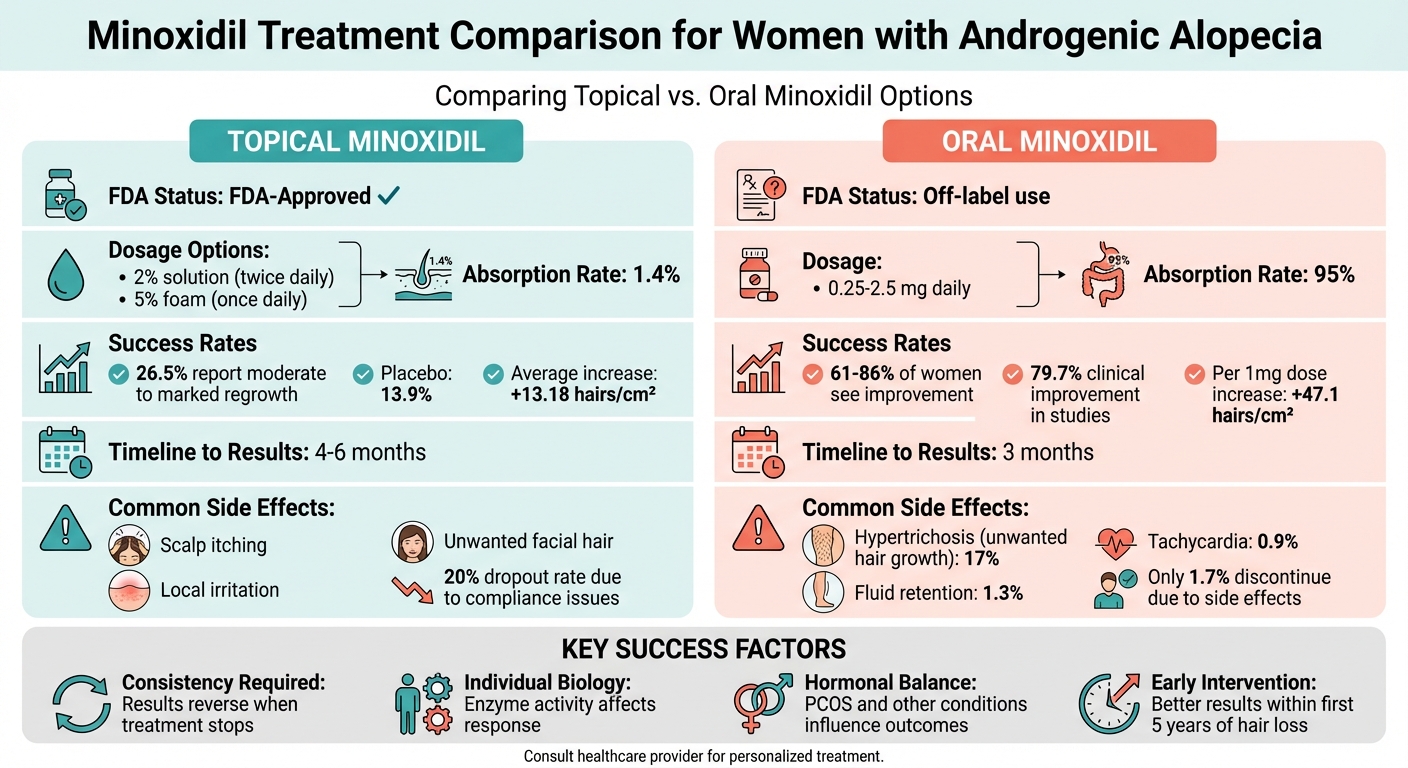
- Topical Minoxidil: FDA-approved for women. Clinical studies show 26.5% of users report moderate to marked hair regrowth compared to 13.9% in placebo groups. Visible results typically take 4–6 months. Options include 2% solution (twice daily) or 5% foam (once daily). Side effects may include itching or irritation.
- Oral Minoxidil: A low-dose oral alternative (0.25–2.5 mg daily) with a higher absorption rate (95%). Studies report 61–86% of women see improvement, with results often visible within 3 months. Common side effect: unwanted hair growth (17%). Rare side effects include fluid retention and tachycardia, but only 1.7% of users discontinue due to adverse effects.
- Key Factors for Success: Consistent use is crucial, as stopping treatment reverses progress. Individual response depends on factors like enzyme activity, hormonal balance, and early intervention.
If you're considering treatment, options like Oana Health provide personalized care and convenient access to oral minoxidil for $25/month with free delivery. Both topical and oral forms offer effective solutions, but commitment is essential for long-term results.
Topical vs Oral Minoxidil Success Rates and Side Effects for Women
Minoxidil for Hair Loss: Dermatologist Explains Truths, Myths, & What to Expect
Research on Topical Minoxidil for Androgenic Alopecia
Clinical studies provide valuable insights into how effective topical minoxidil is for treating androgenic alopecia in women. By examining these trials, we can better understand the potential outcomes and set realistic expectations for those considering this treatment.
Lucky et al. (2004): Comparing 5% and 2% Topical Minoxidil
In a pivotal study led by Lucky et al., researchers explored the effectiveness of topical minoxidil for women experiencing female pattern hair loss. This 48-week, double-blind, randomized controlled trial included 381 women aged 18 to 49, with an average age of 37 and an average hair loss duration of 10 years. Participants were divided into three groups, applying either a 5% minoxidil solution, a 2% solution, or a placebo twice daily.
The findings showed that the 5% solution delivered better results than both the 2% solution and placebo in several areas, including nonvellus hair count, patient satisfaction, and investigator assessments. Meanwhile, the 2% solution showed improvements in hair count and investigator ratings but fell short in patient-reported benefits.
"The 5% topical minoxidil group demonstrated statistical superiority over the 2% topical minoxidil group in the patient assessment of treatment benefit at week 48." – Lucky et al.
By the end of the trial, participants using the 5% solution expressed higher satisfaction, even though they experienced more side effects such as itching, local irritation, and unwanted facial hair. Despite these side effects, both concentrations were generally well tolerated, with no systemic side effects reported.
Zac et al. (2021): Patient Satisfaction with 5% Minoxidil
Complementing these findings, Zac et al. (2021) highlighted the link between visible improvements in hair density and patient satisfaction. Women who observed noticeable changes in their hair often reported feeling more confident and were more likely to stick with the treatment long term.
Oral Minoxidil Research and Success Rates
For women dealing with androgenic alopecia, low-dose oral minoxidil (LDOM) offers a practical alternative to its topical counterpart. Taken daily in doses ranging from 0.25 to 2.5 mg, oral minoxidil eliminates the hassle associated with topical applications.
Unlike the topical form, which relies on follicular enzymes for activation, oral minoxidil undergoes additional activation in the liver and platelets, potentially delivering enhanced results. Research indicates that 61% to 86% of women with female pattern hair loss see improvement with LDOM. Visible changes often begin around the three-month mark, as the treatment speeds up the transition to the growth phase and extends it, leading to thicker, denser hair over time. These unique pharmacological properties set oral minoxidil apart, making it a compelling option for exploring different clinical outcomes.
Ramos Study: Oral Minoxidil (1 mg) vs. 5% Topical Minoxidil
A randomized clinical trial conducted between August 2022 and April 2023 compared the effectiveness of 1 mg oral minoxidil to 5% topical minoxidil in 65 patients (64.1% of whom were female). Both treatments significantly increased hair diameter at three specific scalp points - 12, 16, and 24 cm from the glabella. Hair diameter improved from approximately 18 μm to 20-21 μm in both groups.
While photographic evidence suggested that the topical solution slightly outperformed the oral form in improving hair density, the oral group excelled in compliance. About 20% of participants using the topical solution dropped out due to issues like scalp irritation or difficulty maintaining the routine, while the oral group reported no compliance-related dropouts.
"Oral minoxidil achieved better therapeutic compliance due to its simple daily systemic medication compared to topical therapy." – Mina Saber, Researcher, Journal of Cosmetic Dermatology
In summary, the study concluded that 1 mg oral minoxidil is as effective as the 5% topical solution in increasing hair diameter, with the added benefit of greater convenience.
Sinclair and Bergfeld Low-Dose Oral Minoxidil Studies
Additional studies further confirm the effectiveness and safety of low-dose oral minoxidil across different dosages. A retrospective analysis from June 2020 examined 148 women (mean age: 47.2 years) with female pattern hair loss who were treated with a median dose of 1 mg daily for an average of nine months.
The results were encouraging: 79.7% of patients experienced clinical improvement, with 15.5% showing marked improvement (defined as an increase of two or more grades on the Sinclair scale) and 64.2% achieving slight improvement. The remaining 20.3% experienced stabilization, meaning their hair loss stopped progressing. Interestingly, women with more severe alopecia showed higher response rates, suggesting oral minoxidil may be particularly helpful for those with significant hair loss.
"LDOM may be an effective therapy with a good safety profile for women with FPHL, allowing an excellent long-term compliance." – Rita Rodrigues-Barata, Trichology Unit, Ramon y Cajal University Hospital
A larger multicenter study involving 1,404 patients found that only 1.7% discontinued treatment due to systemic side effects. The most common side effect reported was hypertrichosis (unwanted hair growth on the face or body), which occurred in about 17% of female patients. However, just 2% of the total study population stopped treatment due to adverse effects like tachycardia or edema.
The research also highlights a dose-dependent relationship between LDOM and hair growth outcomes. For every 1 mg daily dose increase, patients saw a boost of 47.1 hairs per cm² in total hair density and a 9.1 hairs per cm² increase in terminal hair density after six months. Hair diameter also increased by an average of 1.4 μm per 1 mg dose increase.
| Outcome (per 1 mg dose increase) | Expected Change (6 Months) | P-value |
|---|---|---|
| Total Hair Density | +47.1 hairs/cm² | 0.007 |
| Terminal Hair Density | +9.1 hairs/cm² | 0.001 |
| Hair Diameter | +1.4 μm | 0.01 |
These findings underscore the measurable, dose-related improvements in hair growth that oral minoxidil can provide, all while maintaining a generally favorable safety profile when prescribed at low doses.
sbb-itb-6dba428
What Affects Minoxidil Success Rates in Women
The effectiveness of minoxidil for treating androgenic alopecia in women depends on several factors. Recognizing these variables can help manage expectations and improve results.
Consistency is key. Minoxidil typically begins to show effects around 8 weeks, with peak results appearing by 4 months. However, stopping treatment reverses any progress quickly. This means women need to commit to using minoxidil indefinitely, as it manages the condition rather than curing it.
"Long-term use of minoxidil is necessary to uphold the achieved clinical outcomes of the medication, as these effects diminish when the drug is discontinued." – StatPearls
Beyond regular use, individual biology plays a significant role. Genetic differences in sulfotransferase enzyme activity can impact how well someone responds to minoxidil. For instance, some women experience better results due to higher enzyme activity, while others may see limited improvements. Interestingly, even medications like low-dose aspirin can interfere with this enzyme, potentially reducing minoxidil’s effectiveness.
Hormonal imbalances, such as those caused by PCOS (polycystic ovary syndrome), also influence outcomes. While minoxidil can address hair loss symptoms, it doesn’t tackle underlying hormonal issues like excess androgen levels or insulin resistance. For women with PCOS, combining minoxidil with anti-androgen treatments often leads to better results. Early intervention, especially before significant follicle miniaturization occurs, is crucial. Younger women generally experience more favorable outcomes compared to older patients.
Oana Health and Personalized Hair Loss Treatment
When it comes to treating androgenic alopecia, simplicity and convenience are key. Oana Health has developed a telehealth platform that connects patients with licensed medical professionals who specialize in hair loss treatments. The entire process - consultation, prescription, and delivery - happens online, making the journey toward effective treatment both seamless and accessible.
During the consultation, medical professionals carefully review each patient’s health history and specific hair loss concerns. This allows for a treatment plan tailored to individual needs, taking into account factors like hormonal imbalances and medical conditions. By focusing on personalized care, Oana Health ensures that each prescription is designed to address the unique challenges of every patient.
Oana Health’s approach is rooted in clinical evidence, particularly the proven efficacy of minoxidil, while leveraging technology to deliver a more personalized hair loss treatment experience.
Oral Minoxidil from Oana Health
Oana Health offers oral minoxidil for $25 per month, complete with free home delivery. This ensures patients have consistent access to their medication, which is essential for maintaining results over time. Unlike topical treatments, oral minoxidil eliminates common issues like scalp irritation, itching, and dermatitis, making it a more comfortable option for many.
Low-dose oral minoxidil has been shown to have a strong safety profile. In a multicenter study involving 1,404 patients (943 of whom were women), only 1.7% discontinued due to systemic side effects. The most frequently reported side effect is hypertrichosis (excessive hair growth in unintended areas), occurring in about 15.1% of patients. Other side effects, such as lightheadedness (1.7%), fluid retention (1.3%), and tachycardia (0.9%), are rare.
With ongoing monitoring, medical professionals can adjust the dosage as needed, ensuring the treatment remains effective while minimizing any potential side effects. This personalized care is a cornerstone of Oana Health’s commitment to helping patients achieve their hair restoration goals.
Conclusion
Recent studies on minoxidil for addressing androgenic alopecia in women have shown encouraging outcomes. Research indicates that both 2% and 5% topical solutions significantly outperform placebo, with women using minoxidil being twice as likely to see moderate hair regrowth compared to those not using it. On average, topical treatments increase hair density by 13.18 hairs per square centimeter over placebo results. Additionally, low-dose oral minoxidil has emerged as a promising alternative for those who may struggle with applying topical formulations.
The effectiveness of minoxidil often depends on factors like enzyme activity and starting treatment within the first five years of hair loss onset. While topical minoxidil is FDA-approved and effective, its absorption rate is relatively low - only about 1.4% penetrates the skin. On the other hand, oral minoxidil boasts a much higher absorption rate of approximately 95%.
These findings emphasize the importance of personalized treatment. A one-size-fits-all approach doesn’t account for differences in enzyme activity, hormonal influences, or how individuals tolerate side effects. Oana Health’s telehealth platform bridges this gap by connecting patients with licensed medical professionals who can customize dosages, monitor progress, and adjust treatment plans as needed. With oral minoxidil priced at $25 per month and free home delivery, patients benefit from both convenience and professional oversight. However, consistent use is key - hair loss typically resumes within months of stopping treatment.
FAQs
What’s the difference between topical and oral minoxidil for women with hair loss?
The main distinction between the two lies in their application and how they function. Topical minoxidil is applied directly to the scalp, usually as a foam or liquid solution, targeting hair growth in the specific area where it’s used. It’s easily accessible over the counter in the U.S. and is generally well-tolerated. Side effects, such as mild scalp irritation, are uncommon. However, noticeable results typically require several months of consistent application.
Oral minoxidil, in contrast, comes in pill form and works throughout the entire body. Initially approved as a treatment for high blood pressure, it’s now prescribed off-label for certain cases of hair loss. Because it acts systemically, it may lead to side effects like unwanted facial hair growth or changes in blood pressure. Oral minoxidil is usually recommended when topical treatments aren’t effective or cause adverse reactions. Due to its systemic nature, it requires careful monitoring by a healthcare professional.
Both options can promote hair growth, but the right choice depends on your specific needs, how well you tolerate the treatment, and guidance from a medical professional. Always consult with a healthcare provider to make an informed decision.
How does enzyme activity impact the effectiveness of minoxidil for hair loss?
Enzyme activity is a key factor in determining how well minoxidil works for treating androgenic alopecia. For the medication to be effective, specific enzymes in the scalp must metabolize it into its active form. This activated form is what stimulates hair follicles and encourages growth.
When enzyme activity is low or not functioning properly, minoxidil may not fully convert into its active state, which can limit its effectiveness. Conversely, higher enzyme activity can boost the drug's ability to promote hair regrowth. This variation in enzyme function sheds light on why some women see better results with minoxidil than others. Genetics and other individual factors may also play a role in influencing enzyme activity and the overall success of the treatment.
What should women know before starting Minoxidil for hair loss?
Before beginning Minoxidil for androgenic alopecia, women should know that sticking to a routine is essential. It often takes between 4 and 12 months of consistent use to see visible improvements. Starting treatment early is crucial since prolonged hair loss can result in follicle damage, which might not respond well to therapy.
Minoxidil is generally effective at encouraging hair regrowth and slowing down hair loss, but individual results can differ. Some mild side effects, such as scalp irritation, may occur, and in rare instances, unwanted facial hair might develop. It's important to consult a healthcare provider to identify the underlying cause of hair loss and create a tailored treatment plan. Staying committed to the regimen and addressing the issue early can make a significant difference in the results.