
Minoxidil for Early vs. Advanced Hair Loss
Minoxidil works best when hair loss is caught early. If you’ve noticed thinning within the last 5 years, starting treatment now can help maintain density and even regrow some hair. For advanced cases, where hair loss has persisted for over a decade, minoxidil focuses more on slowing further loss rather than regrowth.
Key Takeaways:
- Early Stage (first 5 years): Hair follicles are still active, making regrowth more likely.
- Advanced Stage (10+ years): Follicles are often miniaturized or dormant, limiting regrowth potential.
- Consistency is critical: Missing doses or stopping treatment reverses progress within 2–4 months.
Quick Comparison
| Feature | Early-Stage Hair Loss | Advanced-Stage Hair Loss |
|---|---|---|
| Visual Signs | Mild thinning, widening part | Noticeable baldness or patches |
| Follicle Health | Mostly active, terminal hairs | Miniaturized or dormant follicles |
| Treatment Goals | Regrowth and prevention | Prevent further loss |
| Results Timeline | Noticeable in 2–4 months | Stabilization by 5–6 months |
For the best results, start minoxidil early, stay consistent, and consider addressing underlying factors like hormonal imbalances or vitamin deficiencies.
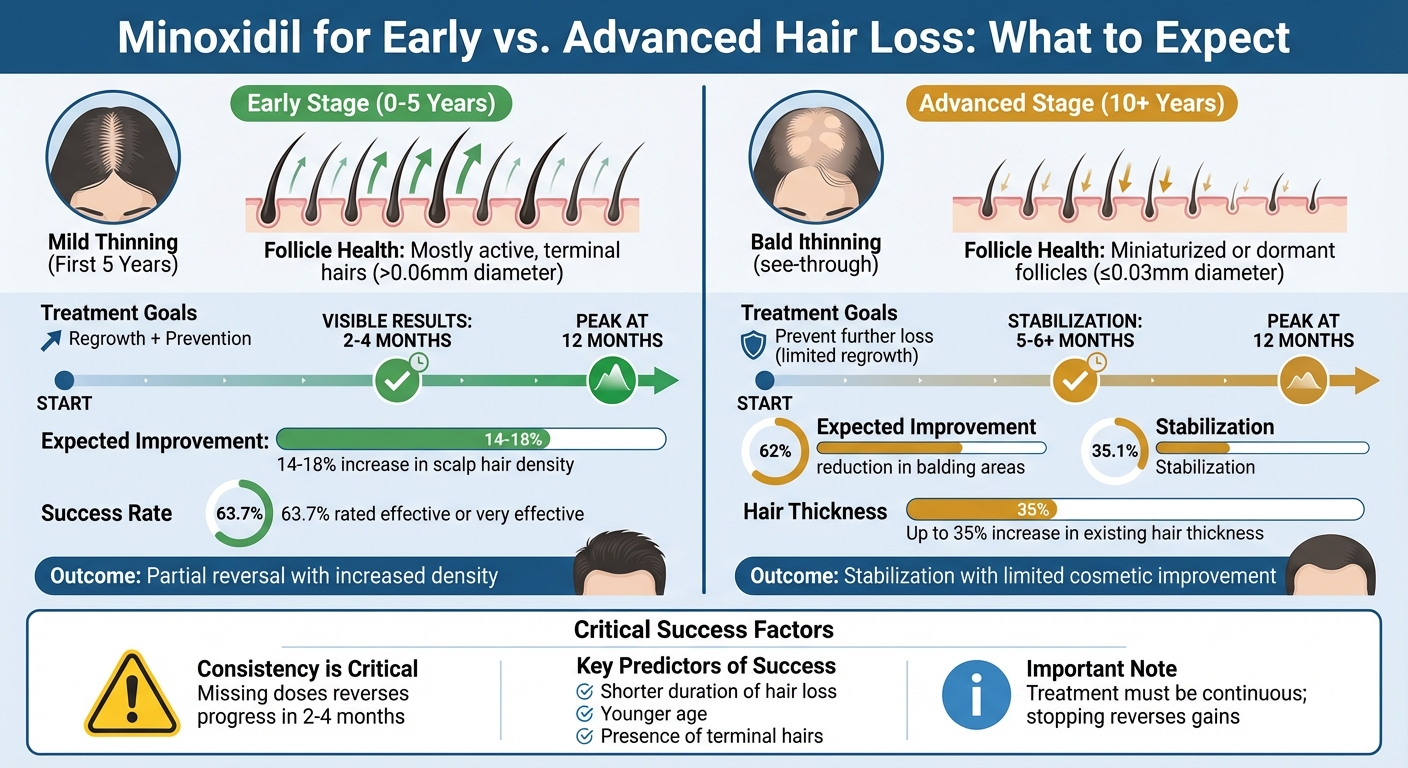
Minoxidil Treatment Outcomes: Early vs Advanced Stage Hair Loss Comparison
Dermatologist Explains How Minoxidil Works for Hair Loss (How to Use, Results, & More)
Hair Loss Stages Explained
Knowing where you stand on the hair loss spectrum is key to understanding what treatments might work best for you. Female androgenic alopecia progresses through specific stages, and these stages play a big role in determining how treatments like minoxidil perform. The next sections break down how minoxidil works depending on the stage of hair loss.
Early-Stage Hair Loss
In the early stages, hair loss usually appears as mild thinning at the crown and a slight widening of the central part (classified as Ludwig Grade I or Sinclair Grade 2). This stage typically occurs within the first five years after hair loss begins. While shedding may happen before noticeable thinning, most hair strands remain thick terminal hairs (with a diameter greater than 0.06 mm). Some follicles might start to miniaturize, but overall, they remain relatively healthy. Because of this, treatments like minoxidil tend to be more effective at this stage, offering a good chance for both regrowth and maintaining existing hair.
Advanced-Stage Hair Loss
In advanced stages, hair thinning becomes more severe. The top of the scalp may have a "see-through" look, or there may even be complete baldness in certain areas (classified as Ludwig Grade III or Sinclair Grade 5). This stage usually develops after 10 or more years of gradual progression and affects less than 1% of women. By this point, many hair follicles have transitioned from thick terminal hairs to fine, vellus-like hairs (≤0.03 mm in diameter), and some follicles may become fibrotic, meaning scar tissue has replaced healthy tissue. This significantly reduces the chances of regrowth. At this stage, treatments are generally aimed at slowing down further hair loss rather than reversing it.
| Feature | Early-Stage FPHL | Advanced-Stage FPHL |
|---|---|---|
| Visual Severity | Mild thinning; slight widening of the central part (Ludwig I) | Noticeable scalp visibility; "see-through" appearance or bald patches (Ludwig III) |
| Follicle State | Mostly healthy; early signs of miniaturization | Predominantly miniaturized or fibrotic follicles |
| Hair Type | Mainly terminal hairs (>0.06 mm diameter) | Large proportion of vellus-like hairs (≤0.03 mm diameter) |
| Duration | Typically within the first 5 years of onset | Hair loss lasting 10+ years |
| Treatment Goal | Prevent further loss and encourage regrowth | Focus on preventing additional loss; regrowth is limited |
Minoxidil Results in Early-Stage Hair Loss
Why Starting Early Improves Results
Minoxidil works best when hair follicles are still active and healthy. It extends the anagen (growth) phase and shortens the telogen (resting) phase, which helps improve hair length and thickness. However, it can only stimulate follicles that are still functional.
In the early stages of hair loss, follicles retain their ability to produce terminal hairs - those thicker, darker strands that give hair its fullness. This makes them more receptive to treatment. As dermatologist Dr. Herbert Feinberg explains:
"Nothing works when there are no follicles left. As a result, it's best to begin using Minoxidil in the early stages of hair loss".
The research backs this up. A year-long study involving 984 men using 5% minoxidil found that 15.9% rated it as "very effective", while 47.8% described it as "effective". For women, consistent use over a year typically leads to a 14% to 18% increase in scalp hair. These results highlight the importance of starting treatment before significant follicular damage occurs. The duration of hair loss and the number of still-functional follicles are key factors in determining success.
What to Expect and When
Starting early is critical, but what happens once you begin using minoxidil? The process unfolds in phases, starting with some initial shedding followed by new growth.
In the first few weeks, it's common to notice more hair shedding. This happens because minoxidil speeds up the shedding of older hairs to make room for new ones. While it might seem alarming, this is actually a sign the treatment is working.
Visible changes often start around week 8 for many users. In a study of 669 men, 13.9% noticed results within the first month, 52.3% by the second month, and 33.8% by the third month. Most users see significant improvements in hair density between months 3 and 4, with growth peaking around the 1-year mark.
The 5% minoxidil solution has been shown to outperform the 2% version. In a 48-week trial, the 5% formula led to 45% more hair regrowth compared to the 2% solution. On average, users saw an increase of about 13.28 hairs per cm² compared to a placebo. For women, hair loss severity improved by 0.85 on the Sinclair scale after six months and by 1.3 after one year.
Consistency is key to seeing results. Apply minoxidil to a completely dry scalp and avoid washing your hair for at least four hours afterward for optimal absorption. Missing doses or stopping treatment can cause hair to return to pre-treatment levels within 2 to 4 months.
For those looking for a more convenient option, Oana Health offers oral minoxidil. Their service includes personalized dosing, prescriptions from licensed medical professionals, and home delivery.
Minoxidil Results in Advanced-Stage Hair Loss
Challenges in Advanced Hair Loss
In the later stages of hair loss, the battle against regrowth becomes significantly harder. Hair follicles often undergo severe miniaturization, shifting from producing thick, terminal hairs to fine, nearly invisible vellus hairs - or worse, becoming completely dormant. This progression makes it increasingly difficult to revive hair growth.
A common complication in these advanced cases is fibrosis. This occurs when scarring forms around the hair follicles, creating a physical barrier that even powerful stimulants like minoxidil struggle to penetrate. According to Keeps, minoxidil may help regrow hair in thinning areas where fine "peach fuzz" is still visible. However, fully bald patches are unlikely to respond.
This is why spotting "peach fuzz" is so important. If fine hairs are still present, it’s a sign that the follicles remain active and could respond to treatment. These challenges highlight the importance of identifying and preserving any remaining active follicles, even in advanced cases.
What Advanced-Stage Patients Can Achieve
For those dealing with advanced hair loss, the focus often shifts from achieving dramatic regrowth to stabilizing further loss and improving the appearance of existing hair.
In a study involving 984 men using 5% minoxidil over one year, 62% saw a reduction in balding areas, 35.1% experienced stabilization, and only 2.9% continued to lose hair. Women also saw encouraging results, with most achieving a 14% to 18% increase in scalp hair density after consistent use for a year. Additionally, minoxidil has been shown to boost hair thickness by up to 35%, giving existing strands a fuller appearance and improving overall scalp coverage.
It’s important to note that stopping treatment typically leads to a reversal of gains within two to four months. As one study aptly summarized:
"There is no treatment to completely reverse AGA in advanced stages, but with medical treatment... the progression can be arrested and partly reversed in the majority of patients who have mild to moderate AGA".
For patients with more widespread hair loss, oral minoxidil from Oana Health provides a convenient alternative to topical treatments. This option offers personalized dosing and the ease of home delivery, making it a practical choice for many.
sbb-itb-6dba428
Early vs. Advanced Hair Loss: Direct Comparison
Comparison Table
The effectiveness of minoxidil can vary greatly depending on the stage of hair loss when treatment begins. The table below highlights the differences in outcomes between early- and advanced-stage hair loss:
| Feature | Early-Stage Hair Loss | Advanced-Stage Hair Loss |
|---|---|---|
| Clinical Stage | Mild to moderate thinning with active follicles still visible | Noticeable baldness with significant scalp exposure |
| Primary Treatment Goal | Halt progression and encourage regrowth | Preserve existing hair and slow further loss |
| Initial Visible Results | 2–4 months | 5–6+ months (often requires stabilization first) |
| Peak Results Timeline | 12 months | 12 months |
| Expected Improvement | Partial reversal with increased density | Stabilization with limited cosmetic improvement |
| Follicle Status | Higher presence of miniaturized terminal hairs | Predominantly vellus hairs or inactive follicles |
For those experiencing early-stage hair loss, the goal is to stimulate regrowth, converting fine vellus hairs into thicker terminal hairs. On the other hand, advanced-stage treatment focuses more on maintaining the current hair and preventing further loss, as significant regrowth is less likely.
Factors That Predict Better Outcomes
Beyond the clinical differences outlined above, individual patient factors also play a role in determining how effective minoxidil treatment will be. These factors tend to favor early-stage hair loss and include:
- Shorter duration of hair loss: The less time hair has been thinning, the better the response to treatment.
- Younger age: Younger individuals often see better results because their follicles are more responsive.
- Presence of terminal hairs: A higher number of terminal (nonvellus) hairs suggests active follicles that can respond to minoxidil.
These points emphasize the importance of starting treatment early, as it significantly increases the likelihood of achieving noticeable results.
Building a Complete Hair Loss Treatment Plan
Treatment Plan for Early-Stage Hair Loss
Starting treatment early can make a big difference in regrowth. A solid starting point is topical minoxidil 5%, applied twice daily to a dry scalp. Be sure to skip blow-drying right after application to allow the product to absorb properly. Most people begin to notice results within 2 to 4 months, with the best outcomes typically appearing around the 12-month mark.
To boost your chances of success, it’s important to address any underlying issues that could slow progress. Testing for Vitamin D deficiency, thyroid problems, and low iron levels is a smart step, as these deficiencies can lead to telogen effluvium (temporary hair shedding), which might worsen hair loss. Consistency is key - skipping applications or stopping treatment too soon will undo any progress you’ve made.
For those dealing with more advanced stages of hair loss, a broader treatment approach is often necessary.
Treatment Plan for Advanced-Stage Hair Loss
When hair loss becomes more severe, low-dose oral minoxidil (LDOM) may be a better option. Women typically start with doses between 0.25 and 1.25 mg daily, while men may take 2.5 to 5 mg. Studies show that 61% to 86% of women see improvement with this treatment. To reduce the chances of side effects like dizziness, it’s best to take LDOM at bedtime.
In advanced cases, relying on just one treatment often isn’t enough. Pairing oral minoxidil with anti-androgens, such as spironolactone (25–50 mg for women), or 5-alpha reductase inhibitors, like dutasteride (0.5 mg for men), can improve results. Dr. Elise A. Olsen from Duke University Medical Center highlights this approach:
"One treatment strategy for female-pattern hair loss is to start with either 5% topical minoxidil twice a day or a low dose of oral minoxidil and escalate the latter if no unacceptable side effects occur".
It’s important to set realistic goals at this stage. The primary focus is on stabilizing and preserving the hair you still have, rather than expecting a dramatic cosmetic change.
Addressing Hormonal and Metabolic Factors
For a well-rounded hair restoration plan, it’s crucial to tackle any hormonal or metabolic issues that might be contributing to hair loss.
Conditions like PCOS, thyroid disorders, or elevated androgen levels can interfere with treatment progress. Spironolactone can help by blocking androgen receptors and also reducing the fluid retention that minoxidil sometimes causes. For those dealing with metabolic challenges like insulin resistance, addressing these issues can support overall hair health.
Services like Oana Health offer telehealth consultations to address these interconnected factors. Their licensed professionals can prescribe treatments such as oral minoxidil starting at $25/month, spironolactone at $14/month, or topical spironolactone at $43/month. With free shipping and a focus on treating hormonal and metabolic contributors alongside minoxidil therapy, this approach helps you build a comprehensive plan to tackle hair loss from multiple angles.
Conclusion
Starting minoxidil early - preferably within the first five years of hair loss - can make a big difference. During this window, hair follicles are more responsive, allowing you to maintain density and encourage regrowth before significant miniaturization sets in. This underscores the importance of acting quickly when hair loss begins.
For those experiencing advanced hair loss, the focus shifts. At this stage, treatments are more about slowing further progression rather than bringing back lost follicles. As researchers Quan Q Dinh and Rodney Sinclair explain:
"Early diagnosis and initiation of treatment is desirable as these treatments are more effective at arresting progression of hair loss than stimulating regrowth".
Consistency is key. If you stop using minoxidil, any progress made will typically reverse within three to four months. In more severe cases, combining minoxidil with other therapies becomes necessary. This is because, over time, the effects of minoxidil alone can plateau - usually after 12 to 18 months - as DHT-driven follicle miniaturization continues to advance.
No matter where you are in your hair loss journey, a well-rounded and consistent treatment approach is crucial. Addressing underlying hormonal or metabolic issues - like PCOS, thyroid imbalances, or elevated androgen levels - can significantly improve results. Platforms like Oana Health offer telehealth consultations to tackle these factors. They provide treatments such as oral minoxidil starting at $25/month and spironolactone at $14/month, all shipped free of charge.
The takeaway? Start early, stay consistent, and treat both the symptoms and the underlying causes to achieve the best possible results.
FAQs
How does minoxidil work for early-stage hair loss compared to advanced hair loss?
Minoxidil, an FDA-approved treatment, works by boosting blood flow to the scalp, ensuring hair follicles receive more oxygen and nutrients. This process helps to enlarge follicles that have shrunk, extend the hair growth phase, and shorten the resting phase. It's particularly effective during the early stages of hair loss when follicles are still present but have become smaller and less active.
For those experiencing early-stage hair loss, minoxidil can lead to noticeable regrowth and an increase in hair density, especially within the first year of consistent use. Research indicates that many users maintain significantly more hair compared to their starting point, even after 30 months of treatment. However, in cases of advanced hair loss where follicles are no longer viable, minoxidil is less effective for regrowth but can still slow further hair loss and help preserve the hair that remains.
If you're seeking a customized, prescription-based solution, Oana Health offers telehealth consultations and delivers FDA-approved minoxidil formulations straight to your door, making early intervention and ongoing hair care easier than ever.
What factors affect how well minoxidil works for hair loss?
The success of minoxidil relies on several important factors. Starting the treatment early, while hair follicles are still active, tends to yield better outcomes. If hair loss has progressed significantly, regrowth might be slower or less noticeable. The concentration of the solution also plays a role - stronger options like 5% typically produce quicker and more visible results compared to lower concentrations.
Sticking to a consistent routine is key. Applying minoxidil twice daily can lead to noticeable changes in as little as four months, with the most pronounced results often appearing after about 12 months. However, long-term use is necessary to maintain progress, as stopping the treatment usually causes hair loss to resume. Factors like the cause of hair loss (such as androgenetic alopecia) and proper scalp preparation - clean and dry skin - also impact how effectively minoxidil works.
Oana Health provides customized, prescription-based minoxidil treatments designed to meet your specific needs, helping you achieve the best possible results and maintain your hair regrowth journey.
Can minoxidil be used with other treatments to improve results for advanced hair loss?
Yes, using minoxidil alongside other treatments can lead to better results, especially for those dealing with advanced hair loss. Studies have shown that combining minoxidil with medications like finasteride, dutasteride, or spironolactone often promotes more noticeable hair regrowth than using minoxidil on its own. This is because these combinations tackle hair loss from multiple angles - improving scalp blood flow while also lowering DHT levels, a major contributor to androgenetic alopecia.
For individuals experiencing significant hair loss, prescription-based combination therapies can be highly effective. At Oana Health, licensed medical experts can design a customized treatment plan that integrates minoxidil with targeted oral or topical medications. Plus, these treatments are conveniently shipped straight to your door at no extra cost, making it easier to take control of your hair restoration journey.