
No Shave FUE for PCOS Hair Loss: What to Expect
Struggling with hair loss due to PCOS? No Shave FUE (Follicular Unit Extraction) offers a discreet solution without shaving your hair. This advanced technique removes individual hair follicles while keeping your existing hairstyle intact, making it ideal for women who want privacy during their hair restoration journey.
Here’s what you need to know:
- What it is: A minimally visible hair transplant method that works around long hair to extract follicles.
- Who it helps: Women with PCOS-related diffuse thinning or androgenic alopecia, provided their hormones are stabilized.
- Cost: $4,000–$15,000 per session, depending on grafts needed.
- Recovery: Quick healing in 2–3 days, with results visible in 3–6 months and full density by 12–18 months.
- Limitations: Ongoing hormonal treatments like Spironolactone or Minoxidil are necessary to maintain non-transplanted hair.
While effective, this procedure doesn’t address the root cause of PCOS-related hair loss. Pairing it with hormonal management and lifestyle changes, like a low-glycemic diet and exercise, ensures better long-term results.
If you’re considering No Shave FUE, consult with a specialist to ensure your PCOS is under control and your hair loss is stable for at least 12 months. Proper planning and aftercare are key to achieving natural-looking, lasting results.
Curly Hair Female Hair Transplant | 1-Year Results | No Shave Technique
Determining If No Shave FUE Is Right for You
No Shave FUE is an option specifically for women with PCOS, but only if the condition is stabilized. Hormonal balance and addressing the underlying cause of hair thinning are essential before considering this procedure. Below, we’ll dive into what makes someone a good candidate and weigh the pros and cons of this method for PCOS-related hair loss.
Candidacy Requirements
To increase the success of a hair transplant, it’s critical to manage excess androgens like testosterone and DHT beforehand. Without hormonal stability, even transplanted hair may fail to thrive.
Here’s what surgeons typically assess for candidacy:
| Factor | Requirement for Candidacy |
|---|---|
| PCOS Status | Symptoms like insulin resistance and androgen levels must be stabilized. |
| Medication | Often involves anti-androgens like Spironolactone. |
| Hair Pattern | Diffuse thinning or widening of the part, especially on the crown. |
| Lifestyle | Commitment to a low-glycemic diet and stress management. |
Medications such as Spironolactone (50mg–150mg daily) are commonly used to block harmful hormone receptors that damage hair follicles. Some women also take Oral Minoxidil (approximately $25 per month) to boost hair growth and improve the density of donor areas before undergoing the procedure. Additionally, managing insulin resistance is crucial since high insulin levels can trigger androgen production. Incorporating daily exercise (about 30 minutes) and a low-glycemic diet can help stabilize hormones.
Candidates must also show stable hair loss, meaning no active shedding for at least 12 months. A donor area density of at least 70 follicular units per square centimeter is typically required to ensure enough healthy grafts. Encouragingly, between 60% and 100% of women with PCOS-related hirsutism see improvements after starting hormonal treatments, which can signal a positive response to therapy.
Benefits and Drawbacks of No Shave FUE for PCOS
No Shave FUE offers a discreet and natural-looking solution, but there are some trade-offs to consider. Here’s a breakdown of the key advantages and challenges:
| Benefits | Drawbacks |
|---|---|
| Complete discretion: Existing hair conceals the donor area during recovery. | Higher cost: Sessions range from $6,000 to $15,000 due to the time-intensive process. |
| Natural results: Transplanted hair blends seamlessly with your natural growth pattern. | Ongoing treatment required: Medications like Spironolactone or Minoxidil are necessary to maintain non-transplanted hair. |
| Quick healing: Donor extraction sites heal within 2–3 days. | Lower graft yield: Typically 800–1,600 grafts per session compared to over 2,000 with other methods. |
| No linear scar: Tiny, scattered marks instead of a noticeable scar. | Time-consuming: Procedures can take anywhere from 3 to 9 hours, depending on the number of grafts. |
It’s important to remember that a hair transplant doesn’t treat PCOS itself. Dr. Davin Lim explains:
"It is essential to be on medical therapy to prevent further hair loss... the balding process is still active in the context of the remaining hair follicles in the recipient sites".
This means that ongoing hormonal management is crucial even after the procedure. For those seeking a comprehensive approach to PCOS care, including treatments for hair loss, insulin resistance, and hormonal imbalances, Oana Health provides telehealth services with prescriptions delivered straight to your door.
Next, we’ll walk through the step-by-step process of No Shave FUE, so you’ll know exactly what to expect.
The No Shave FUE Procedure: Step-by-Step
Understanding the steps of the No Shave FUE procedure can help ease concerns and provide a clear picture of what to expect - from your initial consultation to the final graft placement.
Consultation and Planning
For women with PCOS, the process begins with confirming hormonal stability. Surgeons typically run tests for hormone and iron levels to ensure the best possible results for the transplant. They also examine the donor area - usually the mid-occipital region at the back of your head - to check for sufficient hair density. An ideal donor area should have over 80 follicular units per square centimeter, while areas with fewer than 40 units per square centimeter may not be suitable for transplantation.
Using trichoscopy, the surgeon identifies the hair loss pattern, which often resembles the "Christmas tree" shape seen in female pattern hair loss. They also verify that hair loss has remained stable for at least 12 months. If thinning areas show more than 15% miniaturization, medical therapy for 6–12 months may be recommended before moving forward. Patients are advised to stop using Minoxidil and avoid blood thinners for one week before the procedure.
Once the treatment plan is finalized, attention shifts to preparing the donor area.
Donor Area Preparation and Extraction
Unlike traditional FUE, No Shave FUE does not require shaving the entire donor area. Instead, the surgeon uses 0.9 mm micro-punches to extract individual follicular units directly from long hair. Each follicular unit naturally contains 1 to 4 hairs. To ensure precision, the surgeon works under high magnification (about 8.5x) to carefully extract grafts without harming the surrounding tissue.
This process is more time-consuming than standard FUE, requiring 70% to 90% more time. Navigating through long hair to access each follicle demands skill and patience, which contributes to the higher cost of No Shave FUE. The International Society of Hair Restoration Surgery (ISHRS) emphasizes:
"Non-shaved FUE may be performed in select cases but requires much more labor and time and is usually charged at a higher price".
Once the grafts are extracted, the focus shifts to their implantation.
Implantation and Creating Natural Density
After extraction, the surgeon creates tiny incisions in the thinning areas using specialized micro-tools. To achieve an "illusion of density", single-hair grafts are used for the hairline, while multi-hair units are placed to add volume.
Grafts are implanted at precise angles with micro-forceps to mimic the natural growth pattern of your hair. The ISHRS explains:
"The naturalness of the result has also a lot to do with how the hairline is designed, how the recipient sites are angled and distributed, and how the grafts are placed atraumatically".
Advanced FUE techniques boast success rates of up to 97%, though transplanted hair generally has a regrowth rate ranging from 10% to 80%. Following the procedure, hair typically grows at a rate of about 1 cm per month.
sbb-itb-6dba428
Recovery and Post-Procedure Care
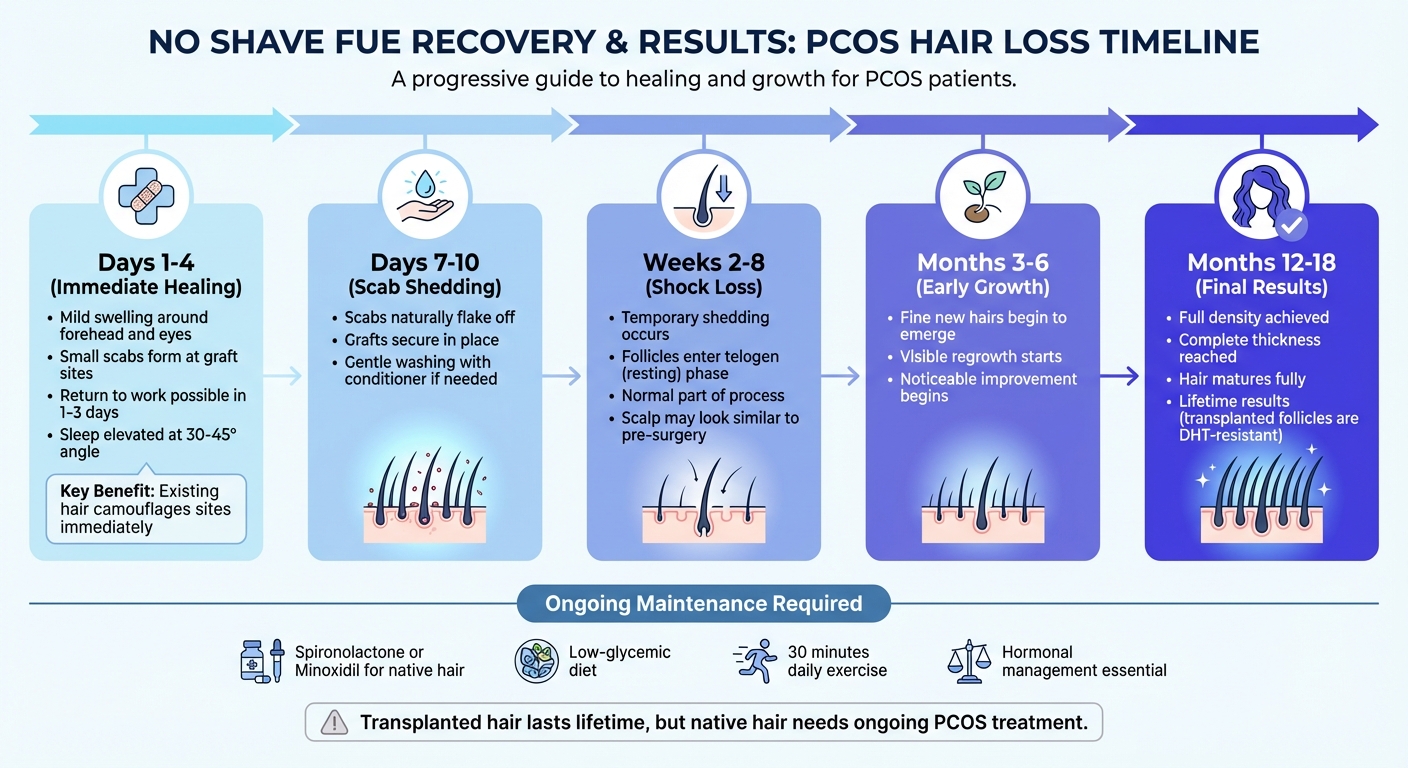
No Shave FUE Recovery Timeline: What to Expect After PCOS Hair Transplant
After undergoing a No Shave FUE procedure, understanding the recovery process is key to ensuring the best results and supporting hair regrowth. While recovery is generally straightforward, women with PCOS should also focus on maintaining hormonal balance alongside standard healing practices.
Recovery Timeline
Recovery progresses through several stages, each with its own milestones. In the first 24 to 48 hours, you might notice mild swelling around your forehead and eyes, along with small scabs forming at the graft sites. Dr. Tyng Tan highlights one of the immediate perks of No Shave FUE:
"The primary benefit of No-Shave FUE is that your existing hair works immediately to camouflage the tiny extraction and implantation sites".
This natural camouflage means many patients can return to work within 1 to 3 days. During the first few nights, sleep with your head elevated at a 30° to 45° angle using a neck pillow to help minimize swelling.
By days 7 to 10, scabs typically begin to flake off. If they don’t, applying conditioner for a few minutes can soften them, making them easier to gently remove with lukewarm water. Between weeks 2 and 8, you may experience "shock loss", where the transplanted hairs shed as the follicles enter the telogen (resting) phase. This is completely normal. Around month 3, fine new hairs start to emerge, and by month 6, you’ll see more noticeable regrowth. Full density and thickness are usually achieved within 12 to 18 months.
| Recovery Phase | Timeline | What to Expect |
|---|---|---|
| Immediate Healing | Days 1–4 | Mild swelling, redness, and scabs; light activities can be resumed. |
| Scab Shedding | Days 7–10 | Scabs naturally fall off as grafts secure in place. |
| Shock Loss | Weeks 2–8 | Temporary shedding; the scalp may look similar to its pre-surgery state. |
| Early Growth | Months 3–6 | Fine new hairs begin to grow, marking the start of visible improvement. |
| Final Results | Months 12–18 | Full density and thickness are achieved as hair matures. |
Each step in this timeline plays a role in the overall success of the procedure, making proper aftercare crucial.
Post-Procedure Care Tips
For optimal results, follow these aftercare guidelines while also addressing specific needs for PCOS-related hair loss.
- Wash your hair gently within 24–48 hours using a mild shampoo, and pat it dry carefully to avoid disturbing the grafts.
- Use a blow-dryer cautiously to prevent existing hair from pressing on the grafts.
- Rest completely for the first three days and avoid activities like strenuous exercise, heavy lifting, or swimming for at least two weeks to minimize the risk of graft dislodgement or infection.
- Refrain from using harsh products, heat styling, or chemical treatments for about four weeks.
Although transplanted follicles are resistant to DHT, your natural hair remains susceptible to androgenic thinning. To protect your native hair, continue any prescribed medications and focus on a low-glycemic, high-fiber diet. Managing blood sugar and insulin resistance is especially important for women with PCOS, as these factors can influence androgen-related hair loss.
Long-Term Results and Maintenance
Expected Results
Transplanted follicles from the No Shave FUE procedure are designed to last a lifetime, thanks to their origin in DHT-resistant areas. These follicles follow a predictable growth timeline: visible growth typically starts around 3–4 months, thickens significantly between 6–12 months, and reaches its full density by 18 months. Dr. Christopher Varona from Varona Hair Restoration explains:
"The transplanted hair will follow the same growth behavior from the area it was harvested from, so your results will be very long lasting".
For individuals dealing with PCOS-related hair loss, the focus shifts to restoring overall hair density rather than reshaping the hairline. While transplanted hair remains unaffected by PCOS, native hair can still experience thinning due to hormonal imbalances. This makes ongoing medical management essential for maintaining results. Addressing the root cause - hormonal imbalance - is critical to preserving long-term success.
Combining Treatments for Better Outcomes
To maintain the results of your No Shave FUE procedure, it’s crucial to manage the hormonal factors that triggered your hair loss. According to Dr. Davin Lim, medications can reduce hair loss in over 90% of patients. Stabilizing androgen levels and addressing insulin resistance are key steps in creating a healthy environment for both transplanted and native hair to thrive.
Additional therapies can further enhance hair density. Options like Topical Spironolactone ($43/month) and Oral Minoxidil ($25/month) work to counteract the effects of androgens. For those with insulin resistance, lifestyle changes - such as adopting a low-glycemic, high-fiber diet and committing to 30 minutes of daily exercise - can help lower androgen levels and reduce hair thinning.
Oana Health offers telehealth consultations that connect you with licensed medical professionals who can review your health history and provide personalized treatment plans. These treatments are delivered directly to your door with free shipping, simplifying the process of sticking to a multi-faceted approach. As Oana Health puts it: "PCOS hair loss is reversible. With the right plan, you can slow shedding, support regrowth, and feel like yourself again".
Conclusion
No Shave FUE offers a discreet way to restore hair density with minimal downtime, letting you get back to your routine quickly without noticeable signs of surgery. But achieving lasting results depends on addressing the underlying hormonal imbalances caused by PCOS.
While the procedure moves healthy follicles to areas of thinning, native hair remains vulnerable to factors like excess androgens and insulin resistance. Without proper hormonal management - using treatments like Spironolactone, which blocks androgen receptors, or Oral Minoxidil, which promotes hair growth - you may continue to experience shedding that could affect your surgical outcomes.
Making lifestyle changes is also essential. A low-glycemic diet and 30 minutes of daily exercise can help stabilize hormones by lowering insulin levels and reducing androgen production. Combining these lifestyle adjustments with medical treatments creates a stronger foundation for long-term regrowth.
Oana Health provides telehealth consultations with licensed professionals to develop personalized treatment plans. Their services include options like Topical Spironolactone ($43/month) and Oral Minoxidil ($25/month), both delivered to your door with free shipping. Pairing surgical hair restoration with targeted hormonal therapies gives you the best chance to reduce shedding, encourage regrowth, and maintain your results over time.
FAQs
What makes No Shave FUE different from traditional FUE for treating PCOS-related hair loss?
No Shave FUE, sometimes called Unshaven FUE, takes a different approach to hair restoration by skipping the need to shave the donor area before extracting hair follicles. In contrast to traditional FUE, which typically requires shaving for precise extraction, this method allows the surrounding hair to remain untouched. The result? A more discreet procedure that helps you maintain your usual look during the recovery phase.
For women dealing with hair loss caused by PCOS, No Shave FUE delivers results comparable to traditional FUE in terms of graft survival and overall effectiveness. What sets it apart is its ability to reduce visible signs of the procedure. This makes it an excellent choice for anyone looking to avoid interruptions to their daily life or changes to their appearance while healing.
Am I a good candidate for No Shave FUE if I have PCOS-related hair loss?
No Shave FUE (Follicular Unit Extraction) is often a suitable option for women with PCOS who are experiencing early to moderate hair loss. This method works best when there is enough hair density in the donor area, allowing for discreet extraction without needing to shave the scalp. However, for women with advanced hair loss or widespread thinning, this technique may not be the best choice, as it relies on having healthy donor hair for effective transplantation.
For women with PCOS, it’s also crucial to have hormonal levels under control. Hormonal imbalances can not only influence hair loss patterns but also affect the success of the treatment. Consulting with a qualified specialist is essential to evaluate your hair loss stage, overall health, and hormonal status. This personalized assessment will help determine if No Shave FUE is the right approach for your needs.
How can lifestyle changes improve the results of No Shave FUE for PCOS-related hair loss?
Making a few lifestyle adjustments can significantly boost the effectiveness of No Shave FUE for women dealing with PCOS-related hair loss. By tackling the hormonal imbalances caused by PCOS, these changes not only promote healthier hair growth but also improve the long-term outcomes of the procedure.
Focus on Diet and Exercise
A well-rounded diet and consistent exercise play a key role in managing PCOS symptoms. They can help with weight management and reduce insulin resistance - two common hurdles for women with PCOS. Even losing just 5% of body weight can make a difference, helping to regulate hormones, restore ovulation, and improve hair health. Cutting back on carbs and dairy may also help lower androgen levels, which are often linked to hair thinning.
A Holistic Approach
Combining No Shave FUE with these lifestyle changes creates a more comprehensive way to manage PCOS and its effects on hair. For the best results, it’s a good idea to collaborate with a healthcare provider to create a plan tailored to your specific needs and goals.