
How PCOS Support Groups Improve Emotional Health
Support groups for Polycystic Ovary Syndrome (PCOS) offer emotional relief and connection for those managing this common hormonal condition. PCOS affects 10% of women in the U.S., yet 70% remain undiagnosed. Beyond physical symptoms like weight gain, acne, and irregular cycles, PCOS often leads to emotional challenges, including depression and anxiety. Support groups help bridge the gap where medical care falls short, offering a sense of community and practical advice.
Key takeaways:
- Emotional toll: Women with PCOS are 4–5 times more likely to face mood disorders.
- Support groups: Reduce isolation, improve mental health, and provide shared strategies for managing symptoms.
- Research-backed benefits: Cognitive Behavioral Therapy (CBT) in group settings has shown significant drops in depression (-18.6 points) and anxiety (-15.3 points).
- Online access: Platforms like Reddit and Facebook offer accessible spaces for connection and advice.
Combining peer support with telehealth services, such as those provided by Oana Health, can address both the emotional and physical challenges of PCOS. Support groups validate experiences, while telehealth delivers treatments like Metformin or Spironolactone for symptom relief. Together, they create a well-rounded approach to managing PCOS.
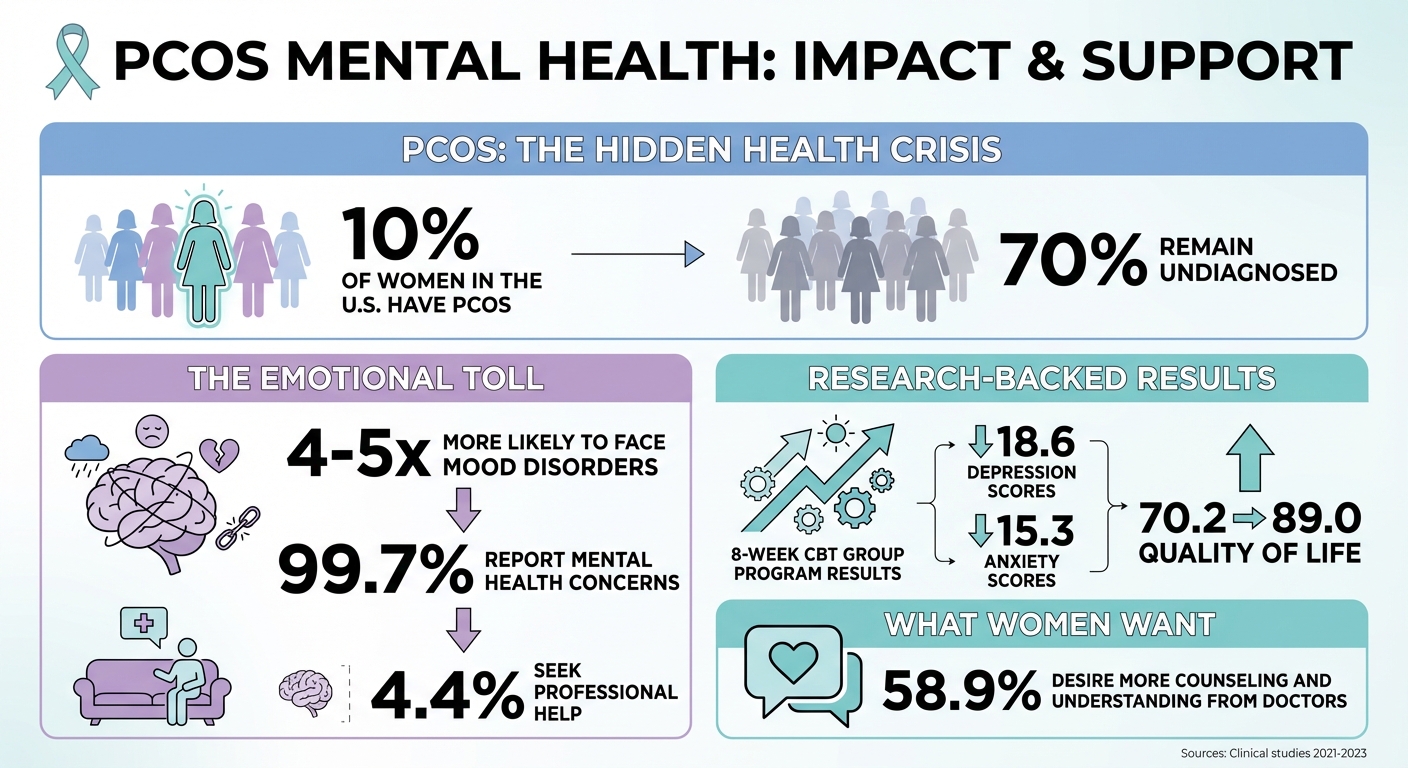
PCOS Mental Health Statistics and Support Group Benefits
How Support Groups Help Emotional Health
Support groups offer a way to connect with others navigating life with PCOS, going beyond what clinical care typically provides. They create a sense of community for those grappling with challenges like unwanted hair growth or weight management. The numbers speak volumes: while 99.7% of women with PCOS report mental health concerns, only 4.4% actually seek professional help. This gap highlights the importance of peer-driven support systems.
The Role of Peer Support
Peer support serves as a powerful tool for emotional well-being, offering a safe environment to share experiences and feel understood. Hearing others' stories can be incredibly validating, reminding participants they’re not alone in their struggles. For example, an 8-week Cognitive Behavioral Therapy program in Tabriz, Iran, demonstrated just how effective group settings can be. Participants experienced a significant drop in depression scores - by 18.6 points - and state anxiety scores fell by 15.3 points.
Reducing Isolation and Building Community
Support groups do more than just validate feelings - they actively help combat isolation by fostering a sense of belonging. Many women with PCOS feel disconnected, especially when they don’t receive the empathy or guidance they need from healthcare providers. In fact, 58.9% of women expressed a desire for more counseling and understanding from their doctors. Online support groups step in to fill this gap, offering accessible spaces to connect with peers. These groups also provide practical advice on managing symptoms, exploring treatment options, and advocating for better care. This collective approach helps ease the emotional burden that often accompanies PCOS.
Research Findings on PCOS Support Groups
2023 Ranasinghe et al. Study
A randomized controlled trial conducted at Al-Zahra Hospital in Tabriz, Iran, between July and October 2021, highlights how group-based interventions can benefit women with PCOS. In this study, 84 women participated in eight weekly sessions of Cognitive Behavioral Therapy (CBT), each lasting 60 to 90 minutes. During these sessions, researchers and psychologists worked with participants to identify cognitive distortions and practice relaxation techniques.
The results were striking. Depression scores plummeted from 24.4 to 6.7 - a drop of 18.6 points. Anxiety levels also saw a marked reduction, with state anxiety scores decreasing from 42.9 to 29.0 (a drop of 15.3 points). Beyond mental health, participants experienced a notable boost in their quality of life, with total scores improving from 70.2 to 89.0. They also reported progress in addressing weight concerns, infertility, and emotional struggles. These measurable outcomes underscore the value of structured, therapeutic group settings, paving the way for broader benefits seen in community-driven support systems.
Other Research on Community Support
Beyond clinical interventions, qualitative research emphasizes the emotional and social benefits of peer-led support forums for women with PCOS. A study involving 50 women who participated in a UK-based discussion forum with over 4,600 members revealed that these platforms offer much more than just information - they provide a sense of connection and validation. Many participants found that sharing experiences with others facing similar challenges eased feelings of isolation and enhanced their ability to cope with PCOS.
One participant shared, "I get strength from others who deal with it well... I cope better knowing how many of us there are coping alongside each other. I don't feel like such a freak".
This dynamic, known as lateral social comparison, helps women normalize their experiences and build psychological resilience. Additionally, peer-led forums often serve as a valuable resource for understanding symptoms and preparing for interactions with healthcare providers. This empowerment fosters confidence and a sense of control over their condition. These insights suggest that combining the strengths of support groups with telehealth services could create a more holistic approach to managing PCOS effectively.
Combining Support Groups with Telehealth
Benefits of Support Groups and Telehealth Together
Support groups and telehealth platforms tackle different but equally crucial aspects of managing PCOS. Peer groups provide a sense of emotional connection and shared understanding, helping women feel less alone in their journey. On the other hand, telehealth focuses on delivering clinical treatments to address the physical symptoms that often contribute to anxiety and depression.
Studies suggest that while weight loss can be helpful, it may not be enough to improve mental health on its own. Incorporating psychological support, such as Cognitive Behavioral Therapy (CBT) through telehealth, can significantly reduce anxiety and depression. This combined approach allows support groups to fulfill the need for emotional connection, while telehealth provides targeted medical treatments for issues like unwanted facial hair, acne, and irregular cycles - common triggers of emotional distress.
Support groups also play a pivotal role in guiding women toward effective treatments. They encourage members to seek professional, evidence-based care. As one participant in a study published in BMC Women's Health shared:
"Knowing what things should be done and when from other posters allows you to be more assertive. I've felt that I had the information to challenge unfair treatment".
This dual approach of emotional and medical support forms the foundation for platforms like Oana Health, which integrate clinical care with community-based support.
How Oana Health Supports PCOS Management
Oana Health enhances the peer support experience by providing science-backed treatments that address both the physical and mental health challenges of PCOS. By offering prescription-based treatments delivered directly to patients' homes, the platform eliminates common barriers such as time constraints and limited access to local specialists.
Oana Health’s offerings include:
- Oral Metformin ER: $22/month for managing insulin resistance
- Spironolactone: $14/month or Eflornithine 12%: $69/month for unwanted facial hair
- Oral Minoxidil: $25/month and Topical Spironolactone: $43/month for hair loss
- Bupropion XL: $25/month for mental health support
For more advanced care, options like Oral GLP-1 & Metformin combinations are available to provide comprehensive PCOS management.
All treatments are prescribed by licensed medical professionals who carefully review each patient’s health history. This ensures that care is personalized to address individual symptoms and priorities. By blending the emotional support of peer groups with expert medical care, Oana Health creates a well-rounded approach to managing both the physical and emotional challenges of PCOS.
sbb-itb-6dba428
How to Join a PCOS Support Group
Finding a Support Group
Start by speaking with your healthcare provider. They can often connect you with trusted support groups, many of which are run by volunteers and registered as charitable organizations that work closely with research and educational institutions.
You can also explore online communities on platforms like Reddit and Facebook. These spaces allow women to share personal experiences and cross-check advice with credible medical sources. For example, a UK-based online group boasts over 4,600 members and 340,000 posts, showcasing the wealth of support available to those seeking help. However, exercise caution when encountering self-proclaimed "PCOS specialists" on platforms like Instagram, especially those claiming to have "cured" the condition.
When choosing a group, consider whether it is peer-led or moderated by healthcare professionals, such as registered dietitians. This ensures the information shared is grounded in evidence-based practices. As one participant quoted in BMC Women's Health shared:
"I did not know anything really about PCOS and neither did the people giving me the diagnosis. I decided to go straight to those who'd have the best information and experience."
Always confirm any medical advice you encounter with your healthcare provider. Once you find a group that feels right, take some time to understand how their sessions are structured.
What to Expect from Support Groups
Most PCOS support groups run for 6 to 12 months, aiming to provide long-term emotional and practical support. Sessions typically last 60 to 90 minutes and are held weekly. For example, the University of Kansas Medical Center conducted a 6-month remote lifestyle program from September 2018 to September 2019. This program, designed for 12 women with PCOS, included weekly 45-minute group counseling sessions via Skype led by a registered dietitian. Impressively, 67% of participants resumed ovulation, with the average time to ovulation being 57 days.
Sessions often include check-ins to address obstacles, educational lessons on topics like managing insulin resistance or reading nutrition labels, and group discussions to foster social support. Common themes include managing symptoms, navigating fertility treatments, advocating for better medical care, and addressing emotional health challenges.
While these groups can be incredibly supportive, reading about others' struggles might sometimes heighten anxiety. If you find this happening, it’s okay to step back or limit your participation to protect your well-being.
Conclusion
PCOS support groups offer more than just a place to talk - they provide a sense of community and emotional relief that goes beyond managing symptoms. By connecting with others who genuinely understand their journey, women can feel less isolated and gain the validation and encouragement that traditional medical care often overlooks.
Research backs this up, showing that structured support groups can lead to notable reductions in depression and anxiety, with mean decreases of -18.6 and -15.3, respectively.
This highlights the importance of a well-rounded approach to PCOS care. Pairing support groups with telehealth services creates a more complete solution. While support groups address emotional challenges and provide peer-driven insights, telehealth platforms like Oana Health bring evidence-based treatments directly to your home, tackling the physical aspects of PCOS with convenience.
Whether you prefer meeting in person or connecting through virtual sessions, support groups create a space for sharing, learning, and building resilience. They offer the empathy and personal understanding that clinical settings often lack. For a well-rounded approach, combine the strength of peer support with professional telehealth care to manage both the emotional and physical sides of PCOS effectively.
FAQs
How can PCOS support groups help reduce feelings of isolation?
PCOS support groups play an important role in building a sense of community by connecting women who truly understand the day-to-day challenges of living with PCOS. Sharing personal stories and listening to others who have been through similar experiences can create a comforting sense of belonging and emotional relief. It’s a space where loneliness fades, replaced by understanding and support in a judgment-free zone.
Beyond emotional connection, these groups provide practical help too. Members often exchange coping tips, discuss ways to manage symptoms, and engage in open, honest conversations about their journeys. This collective sharing can ease feelings of anxiety and depression, replacing isolation with a sense of shared strength. For those seeking both medical care and community, Oana Health’s telehealth platform offers more than personalized PCOS treatments - it also connects patients with trusted support-group resources, making it easier to feel supported and understood.
How can PCOS support groups and telehealth services work together to improve emotional health?
Combining PCOS support groups with telehealth services creates a meaningful way to enhance both emotional and physical health. Support groups offer a lifeline for women dealing with PCOS, helping to ease feelings of isolation, foster a sense of belonging, and share practical coping strategies. They create a space where women can connect, share their journeys, and encourage each other to adopt healthier habits.
When telehealth is added to the mix, these benefits become even stronger. Telehealth connects women with licensed medical professionals who can provide tailored advice for managing PCOS symptoms, such as hormone imbalances, weight fluctuations, and mental health concerns. Plus, telehealth brings the perks of convenience and privacy - making it easier to access care without the hassle of travel or taking time off work. Together, support groups and telehealth form a comprehensive approach that addresses emotional well-being and clinical care, offering a well-rounded path toward managing PCOS effectively.
How can I find a trustworthy online PCOS support group?
Finding an online PCOS support group can be a game-changer for your emotional well-being. A good place to start is with trusted health organizations like the American PCOS Society or reputable hospital websites, as they often provide lists of credible and well-moderated groups. Social media platforms, including Facebook and Reddit, also host PCOS communities. However, it’s best to focus on groups managed by recognized organizations or those with verified credentials.
When selecting a group, pay attention to a few key factors: active moderation by healthcare professionals or trained leaders, accurate, evidence-based information, and clear privacy policies to safeguard your personal information. For more tailored support, you might explore telehealth services like Oana Health, which specializes in clinician-guided treatments for managing PCOS-related mental health challenges. Combining the shared experiences of peer support with expert guidance can make you feel more confident and less alone on your journey.