
PCOS Symptoms: Hormonal Imbalance Explained
Polycystic Ovary Syndrome (PCOS) affects 1 in 10 women of childbearing age in the U.S., yet up to 70% remain undiagnosed globally. The condition stems from hormonal imbalances, particularly elevated androgens and insulin resistance, which disrupt ovulation, metabolism, and overall health. Common symptoms include irregular periods, unwanted hair growth, acne, weight gain, and mood changes. Alarmingly, over 50% of women with PCOS develop type 2 diabetes or prediabetes by their 40s, and mental health struggles like anxiety and depression are more frequent.
Key Points:
- Hormonal Imbalances: Elevated androgens disrupt ovulation, causing acne, hair growth on the face or body, and scalp hair thinning.
- Insulin Resistance: Found in 65–95% of individuals with PCOS, it worsens symptoms and metabolic health.
- Irregular Menstrual Cycles: Common due to disrupted LH/FSH balance, leading to infertility risks.
- Mental Health: Women with PCOS report higher rates of anxiety and depression.
- Treatment Options: Medications like Metformin ($22/month), Spironolactone ($14/month), and Minoxidil ($25/month) can help manage symptoms. Lifestyle changes, including moderate weight loss, are also effective.
PCOS management requires addressing root hormonal imbalances. Telehealth services like Oana Health offer tailored treatments, making care more accessible and affordable.
Polycystic Ovarian Syndrome (PCOS) Symptoms Explained: Common & Uncommon Signs
What Causes Hormonal Imbalance in PCOS?
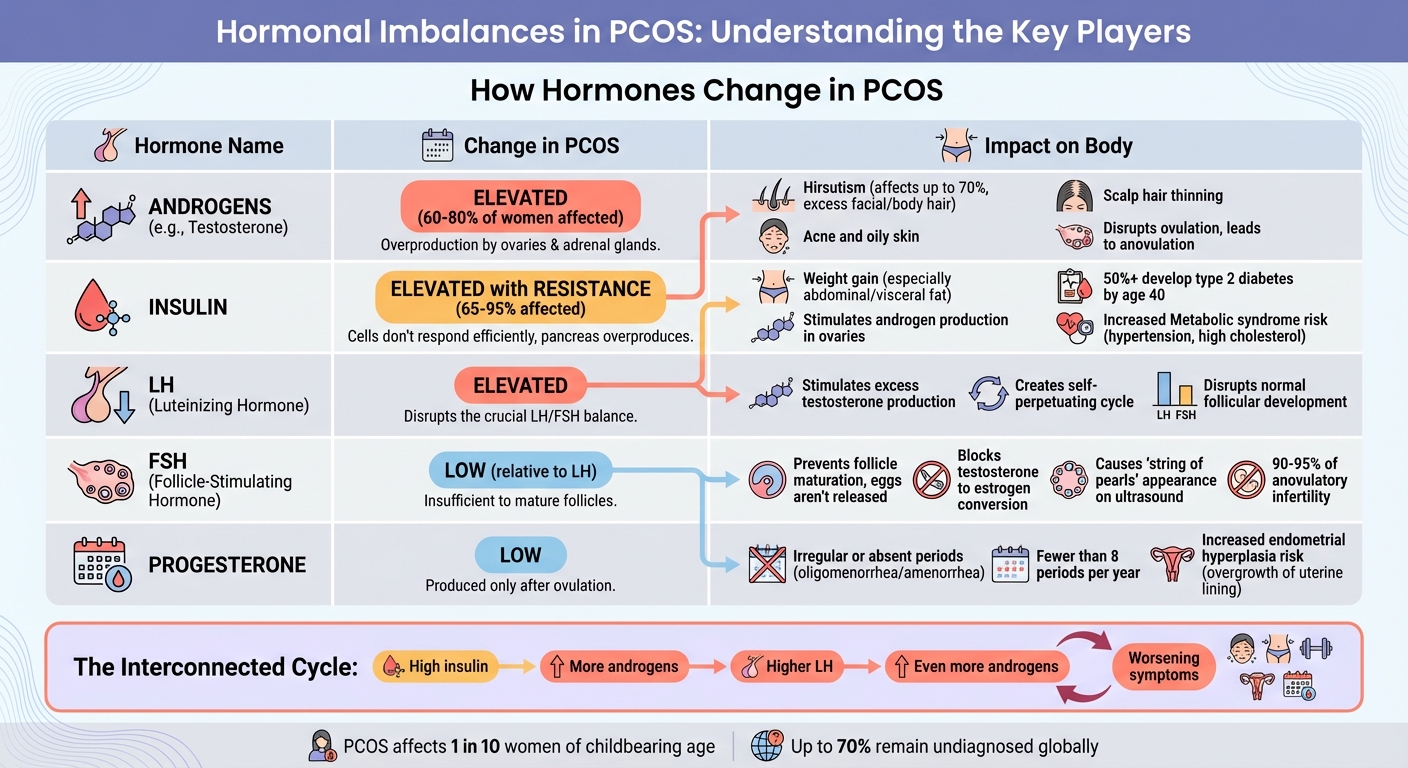
How Hormonal Imbalances Affect PCOS: Key Hormones and Their Impact
PCOS stems from a mix of hormonal disruptions, primarily involving excess androgens (male hormones), insulin resistance, and an imbalanced LH/FSH ratio. These factors are deeply interconnected, influencing everything from your menstrual cycle to your metabolism. Understanding how these hormones interact is key to addressing PCOS, which is why the condition often presents with such a wide variety of symptoms.
How Androgens Affect PCOS
Androgens, often referred to as "male hormones", are naturally present in small amounts in women. However, in PCOS, about 60–80% of women show signs of elevated androgens, typically due to increased testosterone production by the ovaries.
"Androgen excess (male hormone excess), seen in 60-80% of girls and women with PCOS, is a key problem in the disorder and likely comes from ovaries in most women." – Endocrine Society
High androgen levels disrupt the brain's signals for ovulation, causing ovarian follicles to stop developing properly. This leads to the characteristic "string of pearls" appearance seen on ultrasounds. Androgens also trigger skin issues like acne and cause hirsutism, which is the growth of coarse, dark hair on areas like the face, chest, and thighs - affecting up to 70% of people with PCOS. At the same time, scalp hair may thin due to androgenic alopecia.
Elevated testosterone levels further increase Luteinizing Hormone (LH) secretion from the pituitary gland, which then stimulates the ovaries to produce even more androgens, creating a self-perpetuating cycle that worsens symptoms. These combined effects contribute to many of the hormonal imbalances seen in PCOS.
Insulin Resistance and Hormonal Disruption
Insulin resistance affects 65–95% of individuals with PCOS. Beyond impacting blood sugar control, excess insulin directly influences reproductive hormones.
Insulin, along with LH, stimulates ovarian theca cells to produce androgens by increasing the activity of an enzyme called cytochrome P450c17α, which is crucial for testosterone production. This results in even higher androgen levels, intensifying symptoms.
"Insulin functions as a co-gonadotropin through its cognate receptor to modulate ovarian steroidogenesis." – Evanthia Diamanti-Kandarakis and Andrea Dunaif
Interestingly, while muscle and fat cells become resistant to insulin's glucose-regulating effects, the ovaries remain highly sensitive to its hormone-stimulating role. High insulin levels also reduce the liver's production of Sex Hormone-Binding Globulin (SHBG), allowing more active testosterone to circulate in the bloodstream. Additionally, insulin increases the frequency of GnRH pulses, which boosts LH secretion and further disrupts hormonal balance. It can also heighten adrenal sensitivity to ACTH, leading to more androgen production.
Visible signs of severe insulin resistance, such as dark, velvety patches of skin (acanthosis nigricans), may appear on areas like the neck, armpits, or groin. Women with insulin resistance and PCOS are also more likely to experience impaired glucose tolerance (31.3%, compared to 14% in weight-matched women). Even modest weight loss - around 5% - can improve insulin sensitivity and restore ovulation.
LH/FSH Ratio and Ovulation Problems
In a typical menstrual cycle, the pituitary gland releases Follicle-Stimulating Hormone (FSH) and Luteinizing Hormone (LH) in a balanced ratio. This balance ensures proper follicle development and ovulation. However, in PCOS, the GnRH pulses favor LH production over FSH, leading to an elevated LH/FSH ratio.
High LH levels prompt theca cells in the ovaries to produce more testosterone, while the relative lack of FSH prevents the conversion of testosterone into estrogen. This imbalance halts follicle maturation, causing the formation of small ovarian cysts. The resulting low progesterone levels lead to irregular or absent periods and heighten the risk of endometrial hyperplasia.
"Polycystic Ovary Syndrome is the most common cause of anovulatory infertility; ∼ 90–95% of anovulatory women seeking treatment for infertility have PCOS." – ScienceDirect
Additionally, individuals with PCOS often have elevated Anti-Müllerian Hormone (AMH) levels due to the abundance of small follicles. This further inhibits FSH activity, perpetuating anovulation.
| Hormone | Change in PCOS | Impact on Body Function |
|---|---|---|
| Androgens | Elevated | Causes hirsutism, acne, and scalp hair thinning; disrupts ovulation. |
| Insulin | Elevated (Resistance) | Leads to weight gain and metabolic issues; stimulates ovarian androgen production. |
| LH | Elevated | Stimulates theca cells to produce excess testosterone. |
| FSH | Low (Relative to LH) | Fails to support proper follicle maturation and estrogen production. |
| Progesterone | Low | Results in irregular periods and increases risk of endometrial hyperplasia. |
Common Symptoms of Hormonal Imbalance in PCOS
Hormonal disruptions in PCOS show up in various ways across the body. From irregular periods to challenges like unwanted hair growth and weight gain, these symptoms are tied to androgen excess, insulin resistance, and other hormonal imbalances. Recognizing these signs is the first step toward managing the condition effectively.
Irregular Periods and Lack of Ovulation
One of the hallmark symptoms of PCOS is an unpredictable menstrual cycle. You might experience amenorrhea (no periods), oligomenorrhea (fewer than eight periods a year), or episodes of heavy bleeding. These irregularities often occur because ovulation doesn’t happen, leading to "anovulatory periods".
This happens when elevated LH and low FSH levels disrupt follicle maturation, preventing ovulation. Without ovulation, progesterone stays low, and the uterine lining doesn’t shed on a regular schedule. Beyond being inconvenient, this is also the leading cause of infertility linked to PCOS.
"PCOS is the most common cause of anovulatory infertility, meaning that the infertility results from the absence of ovulation." - NICHD
Unwanted Hair Growth and Skin Problems
Excess androgens are responsible for some of the most visible PCOS symptoms. Hirsutism, the growth of thick, dark hair on areas like the face, chest, back, and thighs, affects up to 70% of women with PCOS. Elevated testosterone is the culprit, stimulating hair growth in typically male-pattern areas.
Androgens also lead to persistent acne on the face, chest, and back, along with oily skin. Another sign of insulin resistance, acanthosis nigricans, appears as dark, velvety patches of thickened skin in creases like the neck, armpits, and groin.
Long-term solutions like electrolysis and laser therapy can address unwanted hair growth, but medical treatments tackle the root cause. Options such as Spironolactone ($14/month) block androgen receptors to reduce acne and hair growth, while Eflornithine 12% ($69/month) slows facial hair growth by targeting an enzyme in hair follicles. Both treatments are available through Oana Health with free home delivery.
Hair Thinning and Scalp Hair Loss
While androgens stimulate hair growth in unwanted areas, they also contribute to androgenic alopecia or female-pattern hair loss. This condition typically causes thinning at the temples and crown of the head. Testosterone shrinks scalp hair follicles, leading to finer strands and eventual hair loss.
This can be distressing, but targeted treatments offer hope. Oral Minoxidil ($25/month) promotes hair growth by stimulating follicles, while Topical Spironolactone ($43/month) blocks androgens directly at the scalp. Both options are available through Oana Health with personalized dosing.
Weight Gain and Metabolic Issues
Insulin resistance plays a major role in PCOS-related weight gain. High insulin levels not only increase androgen production but also make it harder to lose weight, especially around the abdomen. This abdominal fat worsens insulin resistance, creating a vicious cycle.
The metabolic impact extends beyond weight. Around 80% of women with PCOS experience obesity, and over 50% develop type 2 diabetes or prediabetes before age 40. Additionally, 25–45% meet the criteria for metabolic syndrome, which includes high blood pressure, elevated blood sugar, and abnormal cholesterol levels.
Even losing 5–10% of body weight can improve insulin sensitivity, lower androgen levels, and restore ovulation. Metformin-based treatments (starting at $22/month via Oana Health) help regulate insulin processing, aiding in weight management and menstrual cycle regulation. Pairing this with 150 minutes of moderate exercise weekly can address many underlying metabolic issues.
Mood Changes and Mental Health Issues
The hormonal imbalances in PCOS don’t just affect your body - they also impact your mind. Women with PCOS are more likely to experience anxiety (28–39%) and depression (11–25%) compared to the general population. Factors like high androgens, disrupted estrogen and progesterone, and blood sugar fluctuations contribute to fatigue, irritability, and mental fog.
Interestingly, irregular menstrual cycles are the strongest predictor of mental health challenges in PCOS, even more so than visible symptoms like excess hair growth or infertility.
"We were surprised to find that menstrual abnormalities in women with PCOS was the strongest predictor for mental health issues, particularly when there are so many other symptoms - like beard growth and infertility - that can make a woman feel unfeminine." - Nancy Reame, MSN, PhD, FAAN, Columbia University School of Nursing
These mental health struggles often harm self-esteem and body image. High androgen levels have even been linked to difficulties in recognizing emotions like fear and disgust in others, which can affect social interactions.
For mood support, Bupropion XL ($25/month via Oana Health) can help, along with Metformin-based treatments to stabilize blood sugar. Lifestyle changes like regular exercise, mindfulness practices, and Cognitive Behavioral Therapy (CBT) are also effective in promoting emotional well-being.
sbb-itb-6dba428
Treatment Options for PCOS Symptoms
Addressing the root causes of hormonal imbalances is key to managing PCOS effectively. Prescription medications can help with symptoms like irregular periods, insulin resistance, and unwanted hair growth. Thanks to modern telehealth services, these treatments are now more accessible, offering personalized care delivered right to your doorstep.
Prescription Treatments
Medications backed by research play a crucial role in managing PCOS. Take Metformin, for example - commonly prescribed to improve insulin resistance and support weight management. Studies show it can restore menstrual cycles in 50% to 70% of women with PCOS. Oana Health offers Metformin starting at $22/month, with users often experiencing weight loss of 6.6 to 8.8 lbs.
For symptoms tied to excess androgens, such as acne and hirsutism, Spironolactone ($14/month) is a popular choice. It works by blocking androgen receptors and has shown greater effectiveness than other anti-androgens in reducing unwanted hair growth. It’s often used as a second-line treatment when oral contraceptives alone aren’t enough.
Eflornithine 12% ($69/month) is another option. This FDA-approved topical cream slows facial hair growth by targeting a specific follicular enzyme. For those dealing with scalp hair thinning, Oral Minoxidil ($25/month) can stimulate regrowth, while Topical Spironolactone ($43/month) helps block local androgen activity. Combining these treatments with methods like laser hair removal can amplify results.
By tackling insulin resistance and androgen excess head-on, these medications address the hormonal imbalances at the heart of PCOS. Telehealth services integrate these treatments into a seamless, modern care model.
Personalized Telehealth Care
Since PCOS affects women differently, individualized treatment plans are essential. Tailoring therapies to specific symptoms ensures better outcomes. Oana Health provides this personalized care through online consultations. Licensed medical professionals review your health history and recommend treatments that match your unique needs.
Telehealth makes managing PCOS incredibly convenient. You can complete consultations from home, and prescribed medications are shipped directly to you, cutting out the hassle of frequent clinic visits. This is especially useful for long-term management, as treatments like Metformin may take 4 to 6 months of consistent use to restore natural ovulation.
This personalized and convenient approach simplifies the management of PCOS symptoms over time.
Affordable Pricing for Long-Term Care
Since managing PCOS is a long-term process, affordability matters. Generic medications provided through telehealth platforms offer significant cost savings. For instance, Metformin is available for $22/month, and Spironolactone costs $14/month - far less than the brand-name equivalents, which can run $107 and $97 per month, respectively.
Combination therapies offer even more value. Metformin & Spironolactone is priced at $32/month, while Oral GLP-1 & Metformin costs $199/month. These prices include medication, consultations, and free home delivery with no hidden fees.
For those managing multiple symptoms, bundled treatment packages provide added convenience and savings. The Hairless Hype package ($69/month) targets unwanted hair growth, while the Hair Plus Plus package ($40/month) supports hair regrowth and reduces thinning. All medications are sourced from FDA-regulated pharmacies and prescribed by licensed professionals, ensuring high-quality care.
Affordable and consistent treatment options make it easier to manage the hormonal imbalances driving PCOS symptoms over the long term.
Conclusion
PCOS is a complex hormonal condition rooted in a continuous loop of androgen excess and insulin resistance. These imbalances fuel symptoms like acne, irregular periods, and hair thinning - all interconnected by the same underlying causes. Without proper intervention, this cycle remains unbroken, perpetuating the symptoms and associated risks.
The health implications are serious. Regular monitoring of blood pressure, cholesterol, and blood sugar levels is essential to address the risks tied to PCOS. This guide has outlined how hormonal disruptions lead to symptoms like irregular cycles and hair loss, emphasizing the need for a focused, individualized treatment plan.
Targeted treatment is the cornerstone of effective management. Addressing PCOS requires tailoring interventions to your specific hormonal profile. For instance, losing 5%–10% of body weight can significantly improve insulin sensitivity and help regulate menstrual cycles. Whether insulin resistance, elevated androgen levels, or a combination of both are at play, the right approach can restore balance and reduce long-term complications.
To support this journey, Oana Health provides telehealth services designed to address your unique hormonal needs. Their offerings include prescription treatments like Metformin, Spironolactone, and Oral Minoxidil. With affordable pricing, free shipping, and access to licensed medical professionals, managing PCOS becomes more achievable and sustainable. Understanding your hormonal imbalances is the first step toward reclaiming control with the right support system in place.
FAQs
How can I tell if my symptoms are caused by PCOS or something else?
Symptoms of PCOS (Polycystic Ovary Syndrome) can sometimes mirror those of other conditions, making diagnosis a bit tricky. Common signs include irregular periods, excess facial or body hair, and hair thinning. However, these symptoms can also be linked to issues like thyroid disorders or insulin resistance.
To diagnose PCOS, healthcare providers generally look for at least two of the following criteria:
- Irregular menstrual cycles
- Elevated androgen levels (male hormones)
- Polycystic ovaries visible on an ultrasound
Medical tests are essential to confirm PCOS and rule out other potential causes. If you're experiencing these symptoms, reaching out to a healthcare professional is crucial for an accurate diagnosis and appropriate care.
What labs or tests confirm insulin resistance and high androgens?
Tests for insulin resistance typically involve measuring fasting glucose, fasting insulin, and calculating the fasting glucose/insulin ratio. To assess high androgen levels, healthcare providers may check total testosterone, free testosterone, free androgen index (FAI), androstenedione, DHEAS, and SHBG. These lab tests are crucial for pinpointing hormonal imbalances commonly linked to PCOS.
How long do PCOS treatments take to show results?
PCOS treatments often require time to show visible results - sometimes up to 6 months, particularly when using medications like birth control. Staying consistent with your treatment plan and being patient is crucial, as progress depends on individual health factors and the specific approach being followed.