
Role of Estrogen and Progesterone in PCOS Weight Gain
Polycystic Ovary Syndrome (PCOS) affects up to 26% of women of reproductive age, disrupting hormones like estrogen, progesterone, and androgens. This imbalance leads to weight gain, particularly around the abdomen, due to factors like insulin resistance, disrupted appetite regulation, and irregular ovulation.
Key Takeaways:
- Estrogen Imbalance: High estrogen levels, often due to missed ovulation, promote fat storage and worsen insulin resistance.
- Low Progesterone: Without ovulation, progesterone levels drop, increasing hunger and reducing calorie burning.
- Insulin Resistance: Found in up to 95% of women with PCOS, this condition encourages fat storage, particularly visceral fat, and disrupts hormone balance.
- Leptin Resistance: Impaired hunger signals lead to overeating, further complicating weight management.
Treatment Options:
- Medications: Hormonal contraceptives, metformin, and anti-androgens can help regulate hormones and improve insulin sensitivity.
- Lifestyle Changes: A balanced diet, regular physical activity, and modest weight loss (as little as 5%) can significantly improve symptoms.
Addressing PCOS-related weight gain requires understanding and managing these hormonal and metabolic disruptions. Personalized care plans, like those offered by telehealth platforms, can support symptom management and long-term health.
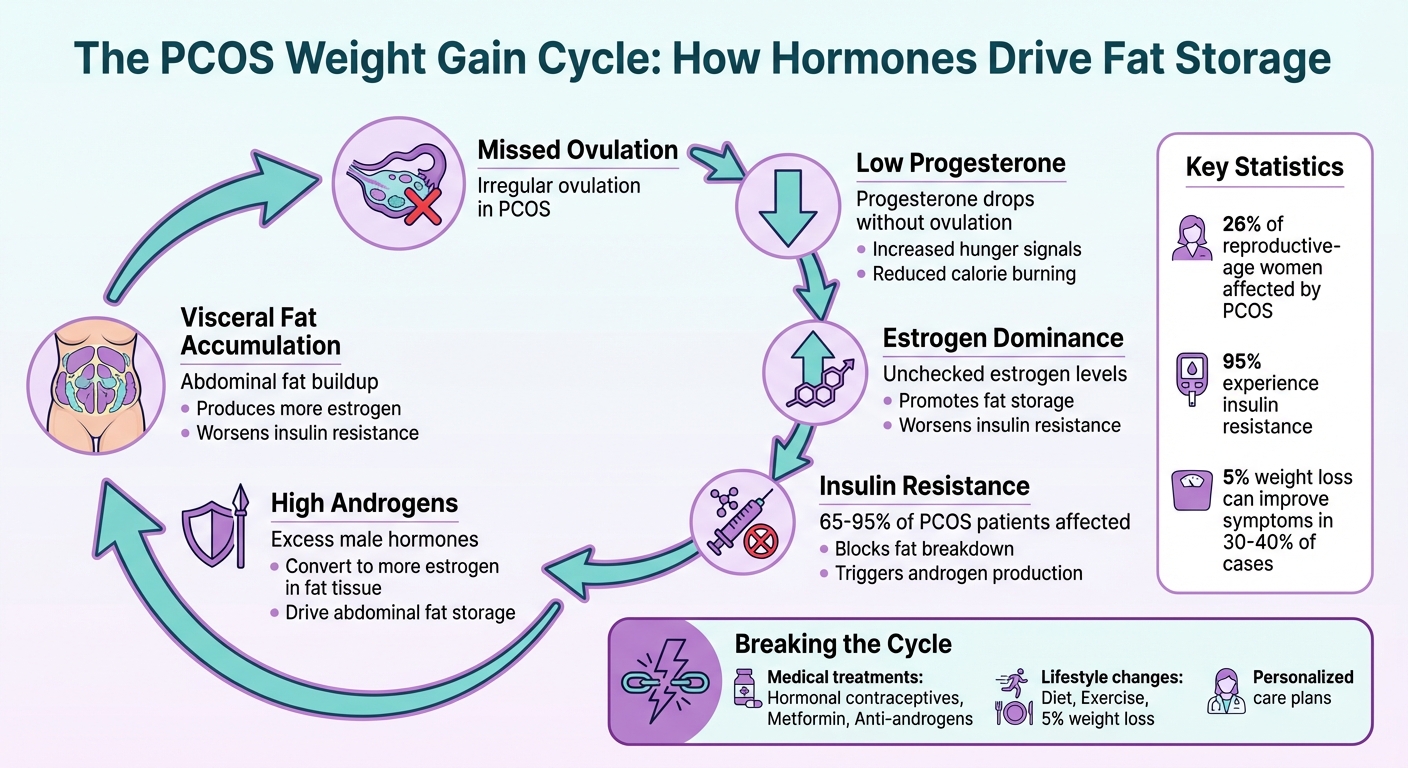
How Hormonal Imbalances Drive PCOS Weight Gain: The Vicious Cycle
How Estrogen Imbalance Causes Weight Gain in PCOS
High Estrogen Levels and Fat Storage
In PCOS, estrogen imbalance creates a cycle that encourages fat accumulation. When ovulation doesn’t occur regularly, as is common in PCOS, progesterone levels drop, leaving estrogen unchecked. On top of that, the high androgen levels typical in PCOS are converted into estrogens - mainly estrone - within fat tissue. This means that as fat increases, more estrogen is produced, which then promotes additional fat storage. This cycle not only fuels weight gain but also sets the stage for broader metabolic issues, which we’ll explore further.
Estrogen Dominance and Insulin Sensitivity
Estrogen dominance doesn’t just impact fat storage - it also worsens insulin sensitivity. This imbalance can intensify insulin resistance, creating a loop where reduced insulin sensitivity leads to higher insulin levels. Elevated insulin levels, in turn, encourage fat storage, block fat breakdown, and lower the liver’s production of sex hormone-binding globulin (SHBG). With less SHBG, more free hormones circulate in the body. Dr. R. Dumitrescu emphasizes this connection:
"Hyperinsulinemia, insulin resistance and an increase in androgen production are all linked together in PCOS patients."
This hormonal imbalance shifts fat storage to the abdomen instead of the hips or thighs. The result? A buildup of visceral fat - fat around the organs - that’s particularly resistant to insulin and carries additional health risks.
Effects on Appetite and Metabolism
Estrogen imbalance doesn’t stop at fat storage - it also disrupts appetite control and energy use. Normally, estradiol helps regulate hunger by stimulating POMC neurons and suppressing NPY activity in the brain. In PCOS, this process is disrupted, leading to poor appetite control. Pilar Vigil from the Reproductive Health Research Institute explains:
"In general, estradiol regulates homeostatic nutrition in women by decreasing food intake and increasing energy expenditure."
Estrogen also plays a role in boosting energy use by inhibiting AMPK activity in the hypothalamus, which activates thermogenesis (calorie burning) in brown fat. When estrogen signaling is disrupted, both appetite regulation and thermogenesis are impaired. Some studies even suggest that estradiol deficiency can reduce spontaneous physical activity by as much as 30% to 80%, making it even more challenging to stay active and manage weight effectively.
How Low Progesterone Affects Weight in PCOS
Progesterone's Role in Fat Burning and Metabolism
Low progesterone levels can make managing weight even harder for women with PCOS. Normally, progesterone works alongside estrogen to regulate many processes, including metabolism and fat storage, by slowing down GnRH (Gonadotropin-Releasing Hormone) pulses through a feedback mechanism. However, in PCOS, this feedback loop is disrupted. As Richard S. Legro, M.D., from Penn State College of Medicine, explains:
"The GnRH pulse generator shows an insensitivity to progesterone feedback in hyperandrogenic obese adolescent girls, thus perpetuating the state of abnormal gonadotropin release."
Without progesterone's influence, GnRH pulses stay rapid, which leads to higher levels of Luteinizing Hormone (LH) and lower levels of Follicle-Stimulating Hormone (FSH). Elevated LH prompts the ovaries to produce more androgens, which are linked to fat storage. Because women with PCOS often experience chronic anovulation, their progesterone levels remain consistently low, leaving this regulatory mechanism inactive.
Low Progesterone and Increased Hunger
Another way low progesterone impacts weight is by interfering with appetite regulation. In a healthy menstrual cycle, appetite naturally decreases when estradiol peaks and increases with rising progesterone levels. However, women with anovulatory PCOS miss this cyclical appetite dip, which can lead to increased hunger and, over time, weight gain. Additionally, studies suggest a link between progesterone levels and binge or emotional eating, particularly during the mid-luteal phase when progesterone would typically be at its highest.
Using Progesterone to Balance Estrogen Effects
Restoring progesterone levels, either naturally or through medical treatment, can help address some of the hormonal imbalances in PCOS. Progestins, for example, can reduce LH levels, lower ovarian androgen production, and increase Sex Hormone-Binding Globulin (SHBG). With fewer free androgens circulating in the body, the tendency for androgen-driven fat accumulation decreases.
Even small changes can make a big difference. Losing just 5% of body weight may help restore ovulation and natural progesterone production, potentially reducing symptoms in 30%–40% of PCOS cases. This hormonal shift also highlights how insulin and leptin resistance can further complicate weight management in PCOS.
How Insulin and Leptin Resistance Drive PCOS Weight Gain
Insulin Resistance and Fat Storage
Insulin resistance is a major issue for women with PCOS, affecting between 65% and 95% of them. It's a key factor behind weight gain. Here's how it works: when cells become resistant to insulin, the pancreas ramps up insulin production, leading to a condition called hyperinsulinemia. This excess insulin blocks the breakdown of stored fat (lipolysis) in fat tissue, making it harder to lose weight.
But that's not all. High insulin levels also play a role in hormone imbalance. They stimulate ovarian theca cells to produce too many androgens (male hormones), which leads to a buildup of abdominal fat, often referred to as "masculinized" fat distribution. R. Dumitrescu from Carol Davila University of Medicine and Pharmacy explains:
"Hyperinsulinemia, insulin resistance and an increase in androgen production are all linked together in PCOS patients."
Visceral fat, the kind that accumulates around the abdomen, is especially problematic. It's not only more inflammatory but also metabolically active. It contains the enzyme AKR1C3, which converts androstenedione into testosterone. Insulin boosts this enzyme's activity, creating a feedback loop where fat tissue produces more androgens, which in turn lead to even more fat storage. On top of this, PCOS disrupts normal satiety signals, making weight regulation even tougher.
Leptin Resistance and Hunger Signals
While insulin resistance drives fat storage, leptin resistance adds another layer of complexity by interfering with hunger regulation. Leptin, a hormone secreted by fat cells, normally signals the brain to reduce appetite and boost energy use. However, in women with PCOS, elevated leptin levels fail to send these signals effectively. This means the brain mistakenly thinks the body is starving, leading to increased hunger and overeating.
Adding to the challenge, women with PCOS often experience reduced suppression of ghrelin - the "hunger hormone" - after eating. This makes it harder to feel full, even after consuming enough calories. As Dorina Ylli, MD, PhD, from the Division of Endocrinology, explains:
"In patients with obesity high leptin levels are associated with low circulating soluble leptin receptors (SLR) consistent with a state of leptin resistance."
Leptin resistance doesn’t just affect appetite. It also disrupts the neuroendocrine system by interfering with Kisspeptin neurons in the brain. This disturbance increases the secretion of GnRH and LH hormones, which drives the ovaries to produce more androgens - further complicating weight management.
How Hormonal and Metabolic Problems Work Together
The hormonal and metabolic issues in PCOS don’t just coexist - they fuel each other in a vicious cycle. Leptin resistance leads to overeating, which worsens insulin resistance. In turn, insulin resistance raises androgen levels, promoting even more abdominal fat storage. This extra fat produces more leptin, worsening leptin resistance and perpetuating the cycle. Jana Vrbikova, MD, PhD, from the Institute of Endocrinology, captures this dynamic perfectly:
"There clearly is a vicious circle of abdominal obesity, insulin resistance, and hyperandrogenemia."
To make matters worse, dysfunctional fat tissue in PCOS reduces levels of adiponectin, a hormone that helps improve insulin sensitivity. At the same time, it increases pro-inflammatory cytokines like TNF-α and IL-6, which further exacerbate insulin resistance. When subcutaneous fat storage becomes overwhelmed, excess fat spills into the liver and muscles - a process called ectopic lipid deposition. This can lead to lipotoxicity and widespread metabolic problems.
sbb-itb-6dba428
Treatment Options for PCOS-Related Weight Gain
Medical Treatments for Hormone Balance
For women managing PCOS-related weight gain, hormonal treatments can help stabilize the underlying hormone imbalances. Combined oral contraceptives, which include both estrogen and progestin, are often the first choice for women not trying to conceive. These medications help regulate menstrual cycles and lower androgen levels, creating a hormonal environment that supports better weight management.
Another commonly used medication is metformin, which, although not FDA-approved specifically for PCOS, is widely prescribed to improve insulin sensitivity and aid in weight loss. The Endocrine Society recommends metformin as a second option for managing irregular periods when hormonal contraceptives aren't suitable. For those unable to take combined contraceptives, progestin therapy - such as medroxyprogesterone acetate - offers an alternative for regulating cycles, reducing ovarian androgen production, and improving insulin sensitivity.
Anti-androgens like spironolactone and finasteride can help manage symptoms such as acne and excessive facial hair. These are often paired with contraceptives for a more comprehensive approach. Emerging treatments like GLP-1 receptor analogues are being explored for their potential to improve blood sugar control and promote weight loss. Additionally, orlistat, a lipase inhibitor, can reduce dietary fat absorption and has been shown to lower testosterone levels and insulin resistance in women with PCOS.
Before starting any hormonal treatment, it’s important to screen for potential risks, such as smoking (particularly for women over 35), high blood pressure, or a history of vascular disease. While medical therapies are essential, they work best when paired with lifestyle adjustments.
Lifestyle Changes for Hormone Regulation
Lifestyle changes are a cornerstone of managing PCOS symptoms. According to the Androgen Excess and Polycystic Ovary Syndrome Society:
"Lifestyle management should be used as the primary therapy in overweight and obese women with PCOS for the treatment of metabolic complications."
A calorie-restricted diet is critical for weight loss, though there isn’t a one-size-fits-all approach to macronutrient composition. Whether low-carb or low-fat, the most important factor is finding a dietary plan that’s sustainable and effective for the individual.
Exercise is another powerful tool, particularly for reducing abdominal fat, which is a key driver of androgen excess. Regular physical activity, whether combined with dietary changes or on its own, helps lower cardiovascular risks, improve insulin sensitivity, and decrease central body fat. Even a modest weight loss of 5% can lead to noticeable improvements in symptoms, fertility, and ovarian health.
Lowering insulin levels through weight loss also reduces ovarian androgen production and increases levels of sex hormone-binding globulin (SHBG). This, in turn, decreases free testosterone levels, creating a positive feedback loop that can make further weight loss and symptom management easier.
Personalized Treatment Plans with Oana Health

Treating PCOS effectively requires a personalized approach because the condition manifests differently in every individual. Symptoms like weight gain, insulin resistance, and excess hair growth vary widely among patients. As the National Institute of Child Health and Human Development explains:
"The treatment(s) your health care provider suggests will depend on your symptoms, overall health, and plans for pregnancy."
Oana Health specializes in providing tailored care for women dealing with PCOS-related challenges. Their telehealth platform connects patients with licensed medical professionals who create science-based treatment plans customized to each person’s symptoms, metabolic markers, and fertility goals.
Through Oana Health, patients can access prescription-based treatments that are delivered directly to their homes with free shipping. Their comprehensive approach targets the "PCOS trinity" - reproductive, metabolic, and dermatologic issues - simultaneously. Since PCOS symptoms and phenotypes can evolve over time, Oana Health's flexible model ensures treatment plans adapt to changing needs. With nearly 70% of women with PCOS experiencing insulin resistance and the condition costing the U.S. healthcare system around $4 billion annually, accessible and individualized care has never been more crucial.
Conclusion: Managing PCOS Weight Gain Through Hormone Balance
Key Points About Hormones and Weight Gain
Addressing PCOS-related weight gain starts with understanding the hormonal and metabolic disruptions at its core. The condition often triggers a cycle where hormonal imbalances lead to increased hunger and reduced energy expenditure. For instance, when estrogen levels are disrupted, its usual metabolic benefits are diminished, which can make managing weight much harder.
Women with PCOS often experience irregular ovulation, missing the typical rise and fall of estrogen and progesterone throughout the menstrual cycle. This absence eliminates the natural appetite-suppressing effects that typically occur around ovulation. Additionally, insulin resistance - a common feature of PCOS - stimulates the ovaries to produce more androgens, which in turn promotes abdominal fat storage. This visceral fat worsens insulin resistance, creating what researchers describe as:
"There clearly is a vicious circle of abdominal obesity, insulin resistance, and hyperandrogenemia."
Even a modest weight loss of 5% can make a big difference. It can help restore ovulation, improve insulin sensitivity, and reduce metabolic complications. Shedding abdominal fat, in particular, lowers androgen levels and increases sex hormone-binding globulin (SHBG), which helps reduce free testosterone levels. These changes make it easier to maintain long-term weight management and improve overall health.
The Need for Evidence-Based and Personalized Treatment
PCOS is a complex condition that shows up differently in every woman. It can present through various combinations of symptoms, including excess androgens, irregular ovulation, and polycystic ovaries. As the Endocrine Society notes:
"Establishing a diagnosis of PCOS is problematic in adolescents and menopausal women. Hyperandrogenism is central to the presentation in adolescents, whereas there is no consistent phenotype in postmenopausal women."
This variability makes personalized treatment essential. Companies like Oana Health focus on creating individualized care plans tailored to each woman’s hormonal profile and symptoms. Their licensed medical professionals assess factors like metabolic markers, fertility goals, and symptom patterns to develop targeted treatments. Whether it’s metformin for insulin resistance, spironolactone for managing excess androgens, or GLP-1 medications for weight management, these options address the condition at its root. With medications delivered directly to your door and free shipping, managing PCOS becomes not only practical but also sustainable.
PCOS: Why You Gain Weight & What You Can Do About It!
FAQs
How do hormonal imbalances in PCOS, like estrogen and progesterone, lead to weight gain?
Hormonal imbalances in PCOS, particularly those involving estrogen and progesterone, play a major role in weight gain. Elevated estrogen levels can lead to increased appetite and encourage fat storage, especially around the hips and thighs. On the other hand, low progesterone levels can disrupt your metabolism, making it tougher to maintain or lose weight.
These hormonal changes also impact insulin sensitivity, which is often compromised in individuals with PCOS. Insulin resistance leads to higher insulin levels, prompting the body to store more fat while also stimulating the ovaries to produce excess androgens. This creates a cycle that worsens weight gain, particularly in the abdominal area. Breaking this cycle with specific treatments and lifestyle adjustments is crucial for managing weight and alleviating symptoms.
How can I manage weight gain caused by PCOS?
Managing weight gain associated with PCOS often begins with adopting lifestyle changes that are practical and long-lasting. Start by focusing on a balanced diet that prioritizes whole, unprocessed foods. This can enhance insulin sensitivity and help lower inflammation. Many people find that the Mediterranean diet works well, as it highlights healthy fats, lean proteins, and fresh fruits and vegetables.
Incorporating regular exercise into your routine is another essential step. A mix of aerobic activities and resistance training can help increase your metabolism and support weight control. Beyond diet and exercise, managing stress plays a crucial role. Techniques like mindfulness, yoga, or relaxation exercises can help balance hormones and improve insulin resistance.
For those seeking more tailored guidance, Oana Health provides telehealth services that offer personalized treatment plans. These plans combine lifestyle strategies with prescription-based options to help you work toward your health goals.
How does insulin resistance impact hormones and weight gain in women with PCOS?
Insulin resistance plays a major role in the hormonal imbalances and weight struggles experienced by women with PCOS. When the body’s cells don’t respond properly to insulin, the pancreas compensates by producing even more. This excess insulin can stimulate the ovaries to produce higher levels of androgens (male hormones), which can disrupt menstrual cycles, lead to unwanted hair growth, and worsen other PCOS-related symptoms.
On top of that, insulin resistance promotes fat storage, especially around the abdomen, and makes it harder for the body to burn fat efficiently. This can result in weight gain or make losing weight an uphill battle, even with a balanced diet and regular exercise. Addressing insulin resistance through lifestyle adjustments, medications, and individualized care can help rebalance hormones and support weight control. Seeking guidance from healthcare professionals with expertise in hormone and weight management can be incredibly helpful for navigating PCOS effectively.