
Progesterone Therapy: Benefits and Risks
Progesterone therapy helps correct hormonal imbalances, particularly when progesterone levels are low compared to estrogen. It’s commonly used to address conditions like PCOS, menopause, infertility, and irregular menstrual cycles. The therapy offers benefits such as regulating periods, supporting pregnancy, improving sleep, and reducing the risk of endometrial cancer. However, it can also lead to side effects like headaches, dizziness, and breast tenderness, and carries more serious risks like blood clots and increased cancer risks with prolonged use.
Key Points:
- Uses: Treats PCOS, menopause symptoms, infertility, and hormonal imbalances.
- Benefits: Regulates cycles, supports pregnancy, improves sleep, and protects against endometrial cancer.
- Side Effects: Includes headaches, drowsiness, and nausea.
- Serious Risks: Higher risk of blood clots, stroke, and breast cancer with long-term use.
- Delivery Methods: Oral capsules, vaginal suppositories, injections, or topical creams.
Always consult a healthcare provider to weigh the benefits and risks and determine the best delivery method for your needs.
Hormonal Imbalances Treated by Progesterone
Conditions Addressed by Progesterone
Progesterone therapy is often used to address hormonal issues stemming from low progesterone levels or an imbalance with estrogen. For instance, in cases of PCOS, anovulation (lack of ovulation) can reduce progesterone, and supplementation helps restore balance.
During menopause and perimenopause, natural progesterone levels naturally decline. While estrogen therapy can alleviate symptoms like hot flashes, progesterone plays a crucial role in protecting the uterine lining from overgrowth, which, if unchecked, can increase the risk of endometrial cancer.
For women struggling with infertility, progesterone therapy addresses luteal phase deficiencies, ensuring the uterine lining is prepared for implantation. Similarly, in cases of amenorrhea (absence of menstruation), progesterone supplementation can trigger the shedding of the uterine lining, effectively restarting the menstrual cycle.
Here’s a quick overview of how progesterone helps with specific conditions:
| Condition | Progesterone's Role and Action |
|---|---|
| Menopause/Perimenopause | Protects the uterine lining from overgrowth caused by unopposed estrogen, reduces hot flashes, and improves sleep |
| Amenorrhea | Stimulates a withdrawal bleed to restart the menstrual cycle |
| Infertility | Supports the luteal phase to prepare the uterine lining for implantation |
| PCOS | Balances low progesterone levels caused by anovulation |
| Endometrial Hyperplasia | Prevents uterine lining overgrowth from excess estrogen |
| Preterm Labor Risk | Helps prevent early labor by calming uterine contractions |
Addressing these conditions begins with understanding their symptoms, which often point to hormonal imbalances.
Symptoms of Hormonal Imbalances
When progesterone levels are out of sync, it often shows up in several ways. Irregular menstrual cycles - whether they’re heavy, unpredictable, or entirely absent - are a common sign. Low progesterone can also contribute to infertility or recurrent miscarriages by failing to adequately support the uterine lining.
Beyond reproductive health, hormonal imbalances can affect emotional and physical well-being. Mood changes like anxiety, depression, or irritability, along with sleep disruptions such as insomnia, may stem from low progesterone’s diminished calming effects on the nervous system. Physical symptoms, including migraines, breast tenderness, and unexplained weight gain, are also linked to low levels of this hormone. During perimenopause, declining hormone levels often result in hot flashes, night sweats, and vaginal dryness.
If these symptoms sound familiar, it’s important to seek professional evaluation. For personalized advice on managing hormonal imbalances and exploring progesterone therapy, reach out to the experts at Oana Health (https://oanahealth.com).
sbb-itb-6dba428
Benefits of Progesterone Therapy
Menstrual Cycle Regulation and Fertility Support
Progesterone therapy helps by restoring low progesterone levels, addressing the underlying cause of many menstrual irregularities. You can use a hormone symptom analyzer to see if your symptoms align with these patterns. By rebalancing hormones, it supports regular cycles and overall hormonal health.
For women seeking to conceive, progesterone plays a critical role. It transforms the endometrium into a secretory state, making it more receptive for implantation. After embryo transfer, progesterone maintains the uterine lining until the placenta takes over hormone production, ensuring a stable environment for the embryo. In cases of recurrent pregnancy loss, research highlights its importance. Progesterone therapy has been shown to reduce miscarriage risk in women with first-trimester bleeding and a history of two or more miscarriages.
"Progesterone is primarily known as the pregnancy hormone in females, and most of its function relates to maintaining pregnancy specifically by preparing the endometrium, decreasing myometrial contractions for implantation, promoting gestation, and inhibition of lactation during pregnancy." - Jessie K. Cable and Michael H. Grider, StatPearls
In addition to cycle regulation, progesterone therapy has a positive impact on mood and sleep, further enhancing quality of life.
Mood Stabilization and Better Sleep
When your body processes progesterone, it produces neuroactive compounds like allopregnanolone. These compounds interact with GABA-A receptors in the brain, producing calming effects similar to those of anti-anxiety medications.
Unlike synthetic progestins, which are often tied to irritability or depression, natural micronized progesterone has been found to either improve mood or remain neutral in its effects. A 2018 study revealed that taking 300 mg of oral micronized progesterone daily improved deep sleep quality without causing daytime drowsiness. Additionally, progesterone helps alleviate night sweats and hot flashes, common culprits of sleep disruption during menopause. Taking progesterone at bedtime takes advantage of its sedative properties, ensuring restful sleep without grogginess the next day.
These benefits not only improve daily well-being but also contribute to long-term reproductive and uterine health. This natural balance helps protect against more serious conditions, including endometrial abnormalities.
Protection Against Endometrial Cancer
One of progesterone therapy's most critical roles is reducing the risk of endometrial cancer. Estrogen promotes the growth of cells in the uterine lining, but without sufficient progesterone to counteract this, the lining can overgrow, leading to hyperplasia - a precancerous condition. If left untreated, hyperplasia progresses to cancer in about 30% of cases.
Progesterone combats this by halting abnormal cell division, encouraging programmed cell death, and converting the uterine lining into a healthier state. The results are compelling - progestin therapy reverses endometrial hyperplasia in 80% to 90% of cases. For women undergoing estrogen therapy who still have a uterus, adding progesterone is not optional - it’s essential.
"The importance of progesterone as a key inhibitor of carcinogenesis is reflected by the observation that women who ovulate and produce progesterone almost never get endometrial cancer." - Shujie Yang, Kristina W Thiel, and Kimberly K Leslie, Department of Obstetrics & Gynecology, University of Iowa
Risks and Side Effects of Progesterone Therapy
Common Side Effects
Progesterone therapy often comes with side effects. Among the most frequently reported are headaches (31%), drowsiness (27%), breast tenderness (27%), and dizziness (24%). Other issues include emotional changes (23%), abdominal pain (20%), joint pain (20%), and depression (19%).
To manage some of these effects, consider taking oral capsules at bedtime to help minimize drowsiness and dizziness. If you feel lightheaded when standing, try rising slowly from a seated or lying position. Resting your feet on the floor for a few minutes before standing fully can also help reduce the risk of falls caused by orthostatic hypotension.
Breast enlargement is another side effect, affecting 40% of patients, while gastrointestinal issues like bloating, nausea, and constipation occur in 12% to 20% of users. These symptoms often ease as your body adjusts, but if they persist or worsen, talk to your healthcare provider about possibly adjusting your dosage or switching to a different delivery method.
Serious Risks and Long-Term Concerns
While most side effects are manageable, long-term use of progesterone therapy brings more serious concerns, including cardiovascular and cancer risks. For example, data from the Women's Health Initiative revealed that women using combined estrogen and progestin therapy experienced 33 strokes per 10,000 women-years compared to 25 per 10,000 in the placebo group. Similarly, the risk of deep vein thrombosis doubled, increasing from 13 to 26 per 10,000 women-years, and the risk of pulmonary embolism more than doubled, rising from 8 to 18 per 10,000 women-years.
Breast cancer risk also increases with combined hormone therapy. According to the Women's Health Initiative, invasive breast cancer rates were 41 per 10,000 women-years for those on combined therapy, compared to 33 per 10,000 in the placebo group. Additionally, for postmenopausal women aged 65 and older, the risk of probable dementia more than doubled, reaching 45 per 10,000 women-years versus 22 per 10,000 in the placebo group.
To minimize these risks, it’s essential to use the lowest effective dose for the shortest duration. Quitting smoking is critical, as it greatly increases cardiovascular risks. Maintaining a healthy weight, along with managing blood pressure, cholesterol, and diabetes through diet and exercise, can also help lower these risks. If you’re planning surgery or anticipate extended bed rest, it’s recommended to stop therapy 4–6 weeks in advance.
Regular check-ups are key for early detection of complications. This includes annual breast exams, mammograms, and pelvic exams. Combining these lifestyle changes with consistent monitoring can go a long way in reducing potential risks.
Who Should Avoid Progesterone Therapy?
Contraindications and Risk Factors
Progesterone therapy isn't suitable for everyone. If you have breast cancer or other hormone-sensitive cancers, it’s best to avoid this treatment. The same applies if you’ve experienced blood clots, such as deep vein thrombosis (DVT) or pulmonary embolism (PE), or if you’ve had a stroke or heart attack, as progesterone could increase cardiovascular risks.
Unexplained vaginal bleeding is another red flag - this must be thoroughly investigated before starting hormone therapy. Severe liver dysfunction also makes progesterone unsafe, as it interferes with the body’s ability to process the hormone. Additionally, oral formulations like Prometrium, which contain peanut oil, should be avoided by individuals with peanut allergies.
Some conditions don’t necessarily rule out progesterone therapy but do require extra caution. For instance, if you have diabetes or thyroid disorders, close monitoring is crucial because progesterone can impact blood sugar and thyroid hormone levels. Other conditions that warrant careful evaluation include asthma, epilepsy, migraines, kidney or gallbladder disease, and a history of depression.
"Progestin, when used with estrogen, may increase the risk of heart attack, stroke, blood clots in the lungs and legs, and breast cancer." - MedlinePlus
Age can also be a factor. Women aged 65 and older may face additional risks. For example, the Women's Health Initiative Memory Study found that women in this age group had a relative risk of 2.05 for developing probable dementia compared to a placebo group. If you’re planning surgery or expect prolonged bed rest, it’s recommended to stop therapy 4 to 6 weeks beforehand to lower the risk of blood clots.
These considerations underscore the importance of a tailored approach to hormone therapy, as outlined below.
Personalized Assessment and Monitoring
Given the risks, a personalized assessment is essential before starting progesterone therapy. This means reviewing your medical history, current medications, and lifestyle habits like smoking. A healthcare provider can evaluate these factors to determine if progesterone is a safe option for you. This kind of individualized evaluation ensures the treatment is aligned with your specific health needs.
For example, Oana Health provides telehealth consultations with licensed medical professionals. They take a comprehensive look at your health, including cardiovascular and metabolic conditions, before prescribing hormone therapy. Their service also includes free shipping, making treatment both safe and convenient.
Once therapy begins, ongoing monitoring is critical. Regular breast exams and mammograms should be scheduled based on your age and risk factors, as progesterone may increase the chance of abnormal findings that need further investigation. Additionally, keeping an eye on blood pressure, cholesterol, and blood sugar levels is important, especially if you have pre-existing conditions. If you experience sudden symptoms like a severe headache, vision loss, chest pain, or calf pain, seek immediate medical attention - these could signal a blood clot or stroke.
Hormone Therapy: Understanding the Risks and Benefits
Progesterone Delivery Methods Compared
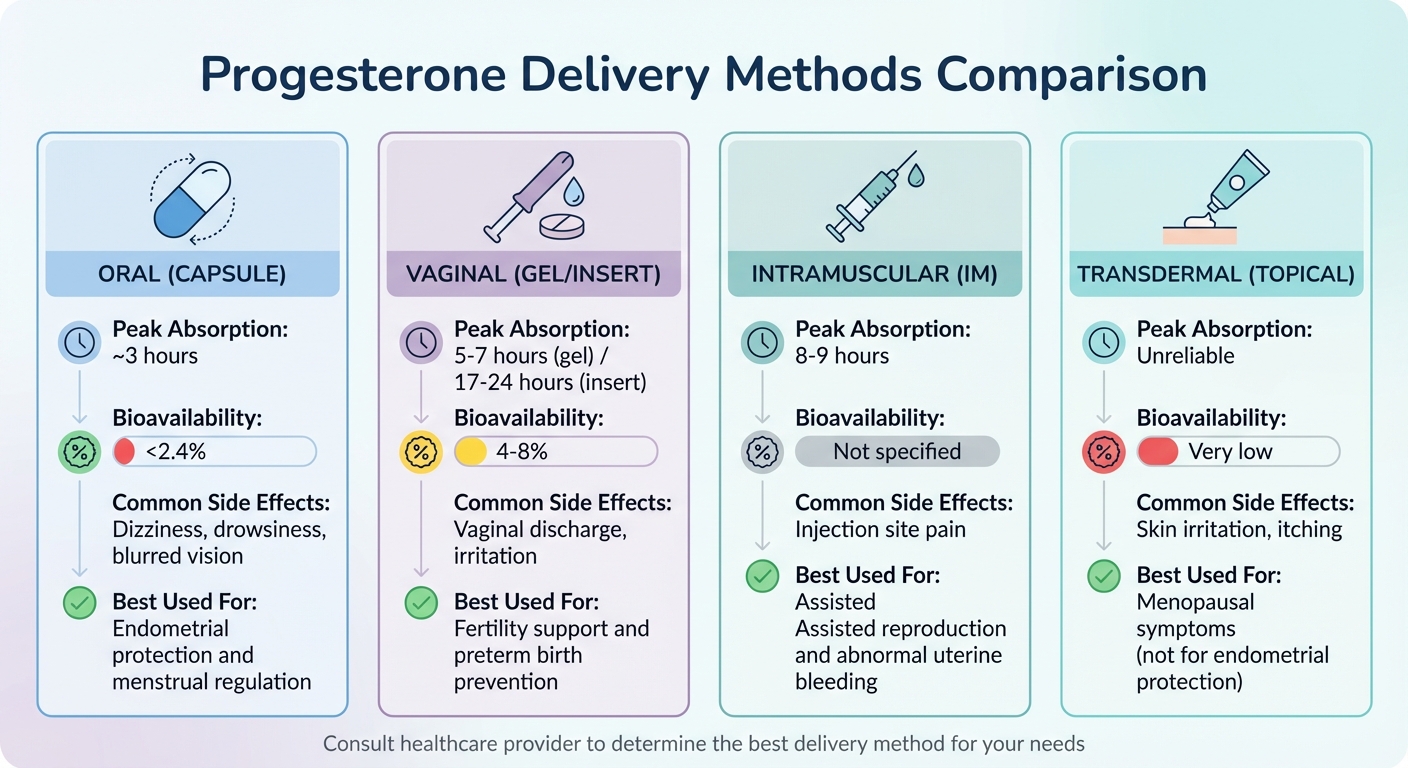
Progesterone Delivery Methods: Bioavailability, Absorption Time, and Side Effects Comparison
Choosing the best method for progesterone therapy is a crucial step in ensuring effective treatment tailored to individual needs. The right delivery method depends on factors like your specific condition, how your body responds to treatment, and the balance between benefits and side effects. The main options - oral, vaginal, intramuscular, and transdermal - differ in how the body absorbs them, their effectiveness, and possible side effects.
Oral progesterone is one of the more convenient options, usually taken as a daily capsule. While it reaches peak blood levels in about 3 hours, only 2.4% of the dose is absorbed due to the liver's first-pass metabolism process. This low absorption often requires higher doses, which can lead to side effects like dizziness, drowsiness, and blurred vision. Additionally, some brands, like Prometrium, use peanut oil in their formulations, making them unsuitable for individuals with peanut allergies.
For improved absorption, vaginal delivery is a stronger option. Available as gels or inserts, this method bypasses liver metabolism, resulting in higher bioavailability (4–8%) and steadier hormone levels. Gels typically reach peak levels within 5–7 hours, while inserts take 17–24 hours. Vaginal progesterone is particularly effective in fertility treatments and reducing the risk of preterm birth in women with a shortened cervix. However, it can cause local side effects like vaginal discharge or irritation. When using other vaginal medications, spacing them at least 6 hours apart is recommended to prevent absorption issues.
Another option is intramuscular injections, which deliver progesterone directly into the muscle. This method achieves peak levels in 8–9 hours and has a half-life of 20–30 hours. It's commonly used in assisted reproductive technology and to manage abnormal uterine bleeding. While effective, it can cause pain at the injection site and requires professional administration.
Lastly, transdermal progesterone - applied as creams or gels to the skin - is mainly used for mild menopausal symptoms. However, it rarely achieves the blood levels needed for endometrial protection and is not recommended for systemic therapy.
Delivery Methods Comparison Table
| Delivery Method | Peak Absorption Time | Bioavailability | Common Side Effects | Best Used For |
|---|---|---|---|---|
| Oral (Capsule) | ~3 hours | <2.4% | Dizziness, drowsiness, blurred vision | Endometrial protection and menstrual regulation |
| Vaginal (Gel/Insert) | 5–7 hours (gel) / 17–24 hours (insert) | 4–8% | Vaginal discharge, irritation | Fertility support and preterm birth prevention |
| Intramuscular (IM) | 8–9 hours | Not specified | Injection site pain | Assisted reproduction and abnormal uterine bleeding |
| Transdermal (Topical) | Unreliable | Very low | Skin irritation, itching | Menopausal symptoms (not for endometrial protection) |
Conclusion
Managing hormonal imbalances with progesterone therapy can address several critical concerns. It helps protect the uterine lining from hyperplasia and cancer, regulates menstrual cycles, and improves sleep quality. However, it’s important to weigh these benefits against potential risks, such as cardiovascular issues and an increased risk of breast cancer with prolonged use. This delicate balance highlights the importance of personalized and continuous monitoring.
"The decision to use progesterone therapy should be made individually, considering your specific symptoms, medical history, and risk factors." – Paloma Health
Natural micronized progesterone is often the preferred option due to its favorable safety profile. The choice of delivery method - whether oral capsules, vaginal gels, or transdermal creams - should align with your treatment goals, as each method has unique absorption characteristics and side effects. Regular checkups, including pelvic exams and mammograms, are essential for early detection of potential adverse effects. For individuals with thyroid conditions like Hashimoto’s, monitoring TSH and Free T4 levels is crucial, as progesterone can influence these markers and may necessitate thyroid medication adjustments. Report any warning signs, such as sudden severe headaches, chest pain, or calf pain, immediately.
With personalized care and consistent follow-ups, patients can enhance the effectiveness of progesterone therapy. Oana Health offers telehealth hormonal treatments, providing personalized assessments and free home delivery. Their licensed medical professionals develop customized treatment plans tailored to your health profile, ensuring safe and effective progesterone therapy with regular monitoring and timely adjustments.
FAQs
What are the most serious risks of long-term progesterone therapy?
Long-term progesterone therapy can help manage various hormonal conditions, but it’s not without risks. Though rare, some serious side effects include blood clots, heart attacks, strokes, and issues with the liver or eyes. While these complications are uncommon, they can be life-threatening if they do occur.
Before starting progesterone therapy, it’s crucial to review your medical history and any potential risk factors with your healthcare provider. Regular check-ups and monitoring are key to reducing risks and ensuring the treatment aligns with your health needs.
How can progesterone therapy support fertility treatment?
Progesterone therapy is a key component in fertility treatments, particularly for preparing the uterine lining to support embryo implantation. This process is vital during treatments like in vitro fertilization (IVF), where the hormone helps create the right conditions for the embryo to attach and develop.
Beyond implantation, progesterone supplementation plays a role in maintaining early pregnancy. It helps stabilize hormone levels, which can lower the risk of miscarriage in specific situations. By addressing hormonal issues that might interfere with conception or pregnancy, progesterone therapy provides essential support for those facing fertility challenges.
What should I consider when selecting a progesterone delivery method?
When deciding on a progesterone delivery method, it's essential to weigh factors like how effective it is, how convenient it feels to use, and your medical history. Options include oral pills, vaginal gels or inserts, injections, and transdermal patches or creams. Each comes with its own way of being absorbed by the body, potential side effects, and level of ease.
Take oral progesterone, for instance. It's a popular choice but can be less effective because the liver breaks it down during metabolism. On the other hand, vaginal methods offer more localized treatment with fewer effects on the rest of the body. If swallowing pills or digestive issues are a concern, injections or transdermal options might be more suitable. The best option also depends on why you need progesterone - whether it's for hormonal imbalance, infertility, or managing menopausal symptoms.
Choosing the right method comes down to your health needs, daily routine, and personal preferences. Working closely with a licensed medical professional ensures that your treatment is both safe and tailored to your unique situation.