
Rhodiola and Ashwagandha for Stress: Evidence Review
Feeling stressed and looking for natural solutions? Rhodiola and Ashwagandha are two herbs that have been studied for their ability to help manage stress by reducing cortisol levels, improving mood, and supporting hormonal balance naturally. Here's what you need to know:
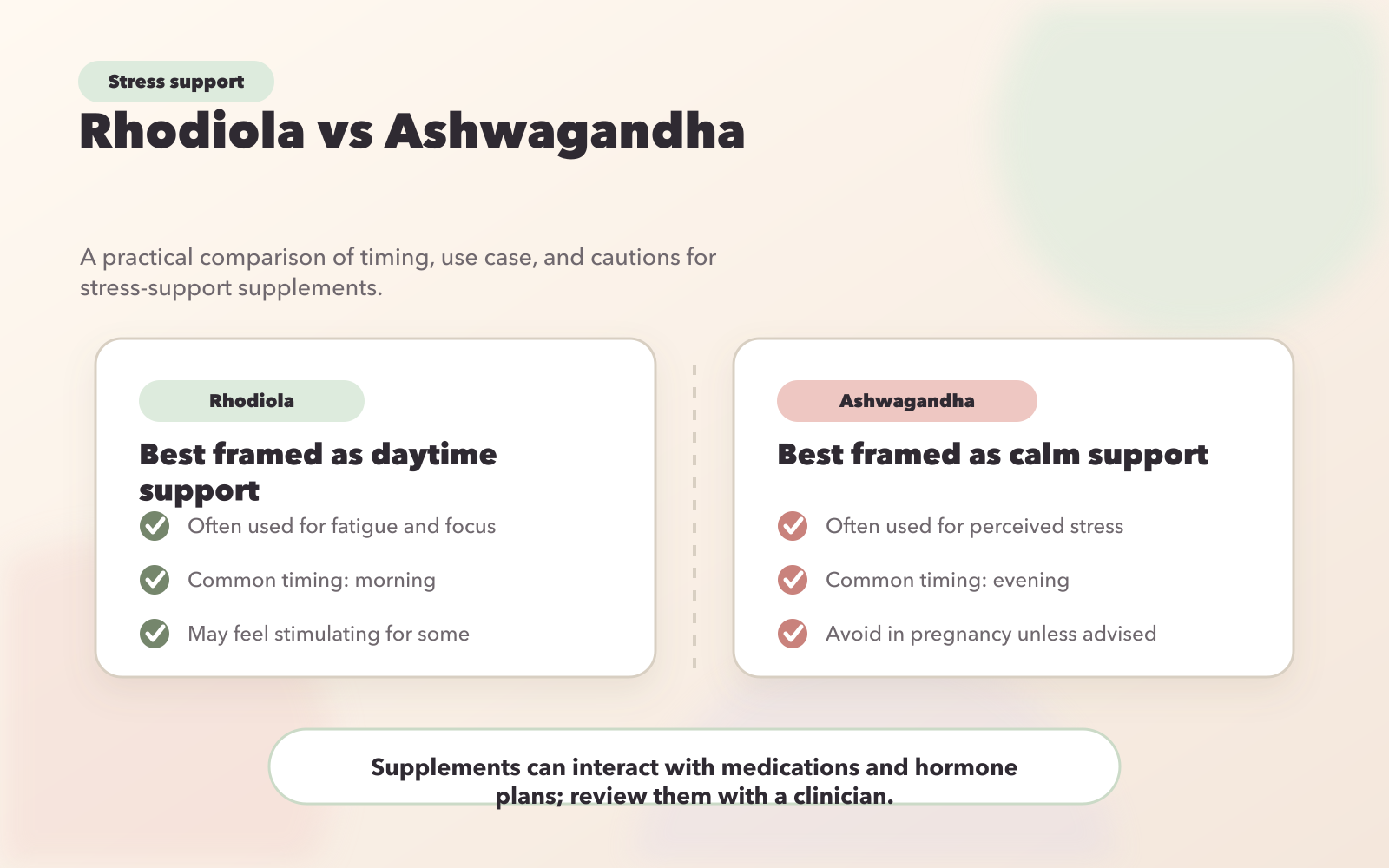
- Rhodiola Rosea: Ideal for reducing fatigue, boosting mental performance, and helping with short-term stress (like deadlines or physical demands). Studies show results as quickly as three days.
- Ashwagandha: Better suited for long-term stress and anxiety management. It also helps with hormonal imbalances, particularly in conditions like PCOS, which you can track using a PCOS symptom analyzer, and typically shows benefits after 8 weeks of consistent use.
- Both herbs work differently: Rhodiola energizes and enhances focus, while Ashwagandha calms and promotes relaxation.
Quick Comparison
| Feature | Rhodiola Rosea | Ashwagandha |
|---|---|---|
| Primary Benefit | Reduces fatigue, boosts focus | Lowers cortisol, eases anxiety |
| Best For | Acute stress | Chronic stress, hormonal issues |
| Typical Dosage | 100–600 mg/day | 300–600 mg/day |
| Timing | Morning/afternoon | Evening |
| Key Action | Improves energy, stamina | Calms, balances hormones |
While both herbs show promise, combining them may offer balanced support for managing stress and improving overall well-being. Always consult a healthcare provider before starting any supplement, especially if you have underlying conditions or take medications.
Rhodiola vs Ashwagandha: Benefits, Dosage, and Timing for Stress Relief
Scientific Evidence for Rhodiola Rosea in Stress Reduction
Key Clinical Trials on Rhodiola Rosea
Research has consistently highlighted Rhodiola's role in reducing stress and fatigue. One noteworthy study, led by Darbinyan et al., involved 56 healthy physicians working night shifts. Over 14 days, participants took 170 mg of standardized Rhodiola extract daily. The results showed a clear improvement in the Fatigue Index, which evaluates associative thinking, attention, and short-term memory - outperforming the placebo group.
Another trial by Edwards et al. focused on 101 adults experiencing life-stress symptoms. Participants consumed 200 mg of Rhodiola extract twice daily (a total of 400 mg) for four weeks. The study reported significant reductions in stress and fatigue, along with better quality of life. Impressively, improvements were noticeable within just three days of starting the regimen.
A Phase III trial conducted in Sweden by Olsson, von Schéele, and Panossian studied 60 patients suffering from burnout (ages 20–55). These individuals were given 576 mg of SHR-5 extract daily for 28 days. The findings revealed a decreased cortisol response to awakening stress and enhanced concentration levels, with benefits emerging as early as the first week. Dr. Erik M. G. Olsson from Uppsala University remarked:
Repeated administration of R. rosea extract SHR-5 exerts an anti-fatigue effect that increases mental performance, particularly the ability to concentrate, and decreases cortisol response to awakening stress in burnout patients with fatigue syndrome
.
Further evidence comes from a study by Spasov et al., which assessed 40 medical students during exam periods. A daily dose of 100 mg over 20 days led to improved physical fitness, mental performance, and overall well-being. Students also reported reduced mental fatigue and better sleep patterns.
| Study Population | Daily Dosage | Duration | Key Outcome |
|---|---|---|---|
| 56 Physicians (Night Duty) | 170 mg | 14 days | Enhanced Fatigue Index and mental performance |
| 101 Adults (Life-Stress) | 400 mg | 4 weeks | Reduced stress and fatigue |
| 60 Burnout Patients | 576 mg | 28 days | Lower cortisol response to stress |
| 40 Students (Exam Period) | 100 mg | 20 days | Improved fitness, mental performance, and sleep |
These findings provide valuable insights into Rhodiola's ability to alleviate stress and improve mental and physical performance.
How Rhodiola Reduces Stress
The mechanisms behind Rhodiola's stress-relieving effects are tied to its impact on neurotransmitters and the body's stress response system. Rhodiola interacts with key neurotransmitter receptors - such as those for noradrenaline, serotonin, dopamine, and acetylcholine - while also boosting the uptake of dopamine and serotonin precursors. This combination helps regulate mood.
Rhodiola also plays a role in balancing the hypothalamic-pituitary-adrenal (HPA) axis, the system responsible for managing stress. By reducing the secretion of corticotrophin-releasing factor (CRF) during stress, it leads to lower cortisol levels. Additionally, research shows Rhodiola influences over 50 genes tied to mood and behavior.
On a cellular level, Rhodiola enhances ATP synthesis, which supports faster recovery after physical exertion. It also acts as an MAO-A and MAO-B inhibitor, which may explain its antidepressant and cognitive-enhancing effects.
Benefits for Women's Hormonal Health
Rhodiola's ability to reduce stress has important implications for hormonal health, particularly for women dealing with conditions like PCOS. Elevated cortisol levels can disrupt menstrual cycles, impair fertility, and exacerbate PCOS symptoms. By lowering CRF and cortisol, Rhodiola helps restore hormonal balance.
One study involving 11 college-aged women found that taking 1,500 mg of Rhodiola daily for three days improved anaerobic performance. This suggests that Rhodiola may also enhance physical resilience during periods of hormonal changes or stress.
Emilija Ivanova Stojcheva, a researcher at Natac Biotech, explained:
Rhodiola rosea might protect the brain and heart by reducing the secretion of corticotrophin releasing factor (CRF) under stress, decrease corticosterone levels and increase the expression of stress-responsive genes, especially in the hippocampus and prefrontal cortex
.
Standardized Rhodiola extracts typically contain 3.0% rosavins and 1.0% salidroside in a 3:1 ratio. Clinical studies suggest dosages between 200 mg and 600 mg daily are effective for managing stress and fatigue. Moreover, Rhodiola has a strong safety profile, with fewer side effects than conventional antidepressants like sertraline.
Scientific Evidence for Ashwagandha in Stress Reduction
Key Clinical Trials on Ashwagandha
Recent research has provided strong evidence supporting Ashwagandha's role in stress reduction. Two meta-analyses - one from 2024 (9 RCTs, N=558) and another from 2025 (15 studies, N=873) - found that daily doses of 300–600 mg significantly reduced stress levels. Participants experienced notable improvements in both the Perceived Stress Scale (PSS, reduced by –4.72) and the Hamilton Anxiety Scale (HAM-A, reduced by –3.52), along with a drop in serum cortisol levels (by –2.58).
One standout study, conducted between September 2020 and November 2021 at the Narayana Institute of Cardiac Sciences and Vijaya Super Specialty Hospital in India, involved 50 healthy adults with mild-to-moderate stress. Participants received 500 mg of Ashwagandha root extract (standardized to 2.5% withanolides) combined with 5 mg of piperine daily for 60 days. Results showed reduced morning salivary cortisol, increased urinary serotonin, and improved performance on multitasking and decision-making tests. Lead researcher Dr. Lakshmi Mundkur noted:
The results of the study suggest that ARE [Ashwagandha root extract] with 2.5% withanolides can effectively improve stress and anxiety by reducing cortisol and increasing serotonin in healthy individuals.
Another important trial, conducted in 2019 at Risk Care Hospital in Thane, India, examined 60 healthy adults under stress. Participants were given either 250 mg/day or 600 mg/day of KSM-66 Ashwagandha root extract for 8 weeks. The 600 mg/day group showed a significant cortisol reduction (p < 0.0001) and improved sleep quality compared to the placebo group, illustrating a clear dose-dependent effect.
| Study Population | Daily Dosage | Duration | Key Outcome |
|---|---|---|---|
| 558 Patients (Meta-analysis) | 300–600 mg | 30–90 days | PSS reduced by -4.72; cortisol by -2.58 |
| 873 Patients (Meta-analysis) | 300–600 mg | 8 weeks | HAM-A anxiety reduced by -3.52 |
| 50 Adults (Mild-Moderate Stress) | 500 mg + piperine | 60 days | Lower cortisol; higher serotonin |
| 60 Adults (Stress) | 250 mg or 600 mg | 8 weeks | 600 mg group: significant cortisol reduction |
These findings highlight Ashwagandha's potential in managing stress and improving overall well-being.
How Ashwagandha Reduces Stress
Ashwagandha’s stress-relieving effects are tied to its ability to regulate the hypothalamic-pituitary-adrenal (HPA) axis, which helps lower cortisol levels. It also interacts with GABA receptors and boosts serotonin, contributing to its calming properties. Beyond its impact on neurotransmitters, Ashwagandha offers neuroprotective benefits by reducing oxidative stress and inflammation markers. This is similar to how certain medications regulate cytokines to manage systemic inflammation. As the Cleveland Clinic describes:
Ashwagandha has a positive effect on the endocrine, nervous, immune and cardiovascular systems by regulating your metabolism and helping you relax by calming how your brain responds to stress.
Clinical research suggests that doses of 300 mg to 600 mg daily of standardized Ashwagandha root extract are effective for managing stress, with noticeable benefits typically appearing after 8 weeks of consistent use. Interestingly, smaller doses (≤500 mg/day) taken over extended periods (longer than 8 weeks) may provide even more pronounced stress-reduction effects.
Benefits for PCOS and Related Stress
Ashwagandha’s stress-reducing properties are particularly helpful for women with PCOS, a condition often exacerbated by chronic stress. By regulating the HPA axis, it can help restore hormonal balance, reduce cortisol, and address inflammation, which are key contributors to PCOS symptoms. Additionally, Ashwagandha’s ability to enhance thyroid activity may benefit individuals with subclinical hypothyroidism, though thyroid patients should consult their healthcare providers before use.
For the best results, it’s recommended to use Ashwagandha root extracts standardized to at least 2.5% withanolides. While it’s generally safe for up to six months, long-term safety data beyond 90 days is still limited. Pregnant women should avoid Ashwagandha due to the potential risk of uterine stimulation.
Rhodiola Rosea vs. Ashwagandha: A Comparison
Comparing Benefits and Research Findings
Taking a closer look at these two herbs highlights their distinct advantages and how they support stress management in different ways. While both Rhodiola Rosea and Ashwagandha help mitigate stress, their approaches differ. Rhodiola Rosea is particularly effective in reducing mental and physical fatigue, boosting stamina, and improving performance during acute stress. This makes it a great choice for situations like meeting tight deadlines or handling intense physical demands. On the other hand, Ashwagandha focuses on reducing anxiety and lowering cortisol over a longer period (30–90 days), making it better suited for addressing chronic stress and hormonal imbalances. If you're unsure if your symptoms are related to stress or a hormonal imbalance, a quick assessment can help.
Rhodiola works by calming the stress-activated enzyme c-Jun N-terminal protein kinase 1 (JNK1) and inhibiting MAO enzymes, which are linked to stress responses. Meanwhile, Ashwagandha enhances GABA activity and regulates the HPA axis, leading to significant reductions in serum cortisol - meta-analyses report decreases ranging from 2.58 to 3.27 µg/dL. These differences in action highlight how each herb carves out its own role in stress management.
Here’s a side-by-side comparison of their key features:
| Feature | Rhodiola Rosea | Ashwagandha |
|---|---|---|
| Primary Benefit | Reduces fatigue and boosts mental resilience | Relieves anxiety and regulates cortisol |
| Best For | Acute stress and high-pressure situations | Chronic stress and hormonal balance |
| Key Mechanism | Inhibits JNK1 and MAO enzymes | Enhances GABA activity and modulates the HPA axis |
| Typical Use Case | Mental fatigue, work deadlines, athletic performance | Long-term anxiety, PCOS, insomnia |
| Active Compounds | Phenolic acids and flavonoids | Withanolides and alkaloids |
| Primary Action | Stimulating and fatigue-reducing | Calming and anxiety-reducing |
For women with PCOS, Ashwagandha stands out due to its ability to influence hormonal markers. One study found that Ashwagandha supplementation led to an 18% increase in DHEA-S levels and a 14.7% rise in testosterone among overweight participants. Rhodiola, by contrast, focuses on enhancing stress resilience through mechanisms like the induction of Neuropeptide Y and Hsp72.
Research Limitations for Each Herb
Despite their promising benefits, research on both herbs faces certain challenges. Many studies involve small sample sizes, which makes it hard to apply the findings to larger populations. Additionally, the bioactive compounds in these herbs can vary significantly due to genetic and environmental factors, meaning not all extracts are equally effective.
Another issue is the inconsistency among studies. Differences in dosage, treatment duration, and extract types make it tough to establish standardized guidelines. For example, research on Ashwagandha and stress has shown variability as high as 86%, and a large portion of the clinical trials (32 out of 41 in one review) were conducted in India, which might limit the applicability of the results to other populations.
Lastly, the long-term safety of both herbs remains unclear. While they are generally considered safe for up to six months, data on extended use is lacking. Rare cases of reversible liver injury have been linked to Ashwagandha doses between 450 mg and 1,350 mg, and Rhodiola may interact with the CYP3A4 enzyme, potentially affecting how other medications are metabolized.
Evidence for Combined Use in Hormonal Health and PCOS-Related Stress
Potential Synergy Between Rhodiola and Ashwagandha
Research suggests that combining Rhodiola and Ashwagandha may provide comprehensive support for stress management and hormonal health. These two adaptogens are often paired in formulations aimed at promoting balance, thanks to their complementary effects. Rhodiola is known for its energizing properties, enhancing physical stamina and mental clarity, while Ashwagandha is prized for its calming influence, helping to improve mood and sleep quality. Together, they create a "balanced energy response", where Ashwagandha’s soothing qualities counterbalance the stimulating effects of Rhodiola, avoiding the sluggishness sometimes linked to Ashwagandha.
The two herbs act on different aspects of the hypothalamic-pituitary-adrenal (HPA) axis. Ashwagandha primarily reduces cortisol levels - studies report decreases ranging from 15% to 30% - while Rhodiola supports the stress response and enhances cellular energy metabolism. Their timing of action also differs: Rhodiola delivers quick results, often within 30 minutes to 2 hours, whereas Ashwagandha requires 1–2 weeks to show sustained benefits for hormonal balance and anxiety relief. This makes their combination particularly appealing for addressing both immediate and long-term stress-related issues.
"Using ashwagandha and rhodiola together is thought to be a beneficial combination, as it may offer a synergistic approach to managing stress and promoting overall well-being."
Applications in PCOS Management
The combined effects of Rhodiola and Ashwagandha may also extend to managing symptoms of polycystic ovary syndrome (PCOS). Women with PCOS often face challenges like stress-related fatigue, mood swings, and hormonal imbalances - all areas where these adaptogens can be helpful. Rhodiola’s ability to combat fatigue and stabilize mood complements Ashwagandha’s role in improving insulin sensitivity, reducing inflammation, and supporting ovulation. Since the HPA axis is often overactive in women with PCOS, leading to elevated cortisol levels, Ashwagandha’s cortisol-lowering effects paired with Rhodiola’s energy-boosting properties may address multiple symptoms simultaneously.
Although direct studies on the combined use of these herbs in PCOS populations are limited, existing research on their individual benefits provides a strong foundation. For instance, Ashwagandha has shown promise in reducing PCOS symptoms, though more clinical evidence is needed to confirm its full potential. Claire Pettitt, a nutrition expert, highlights this gap, noting that while Ashwagandha appears beneficial, specific trials on its combined use with Rhodiola are still lacking.
To maximize their effects, experts recommend specific dosing strategies: Rhodiola (100 mg to 300 mg) is best taken in the morning or early afternoon to enhance focus and energy, while Ashwagandha (300 mg to 600 mg) is ideal in the evening to promote relaxation and restful sleep. Women with PCOS should consult a healthcare provider before starting these herbs, especially if they are on medications or Ayurvedic strategies for insulin resistance or thyroid conditions, as interactions are possible.
sbb-itb-6dba428
Research Gaps and Practical Recommendations
Where More Research Is Needed
Despite the clinical insights discussed earlier, several unanswered questions remain. For instance, most studies only cover short-term use, typically 30–90 days, leaving the safety of long-term administration (beyond 12 weeks) unclear. As noted by Arumugam V, et al.:
Further information is required to determine its safety with long‐term administration
.
Another issue is the lack of standardization in the type of extracts used. Differences in formulations - root vs. leaf, aqueous vs. ethanolic - make it difficult to establish a universal protocol. A systematic review emphasized:
significant variability in the WS extracts examined prevents a consensus on the optimum preparation or dosage for neuropsychiatric applications
.
Additionally, the demographic focus of existing research is narrow. A review of 41 human trials revealed that 32 were conducted in India, underscoring the need for studies involving more diverse populations.
For women with PCOS, the research is even scarcer. While some studies have shown cortisol reductions ranging from 1.16 to 2.36 µg/dL, there is limited understanding of Ashwagandha's effects on androgens and insulin sensitivity in this group.
Guidelines for Safe Use
Given the gaps in research, it's essential to follow established dosage recommendations for safe use. For Ashwagandha, start with 125–600 mg per day, typically divided into two doses. For Rhodiola, aim for 100–300 mg daily, though its dosing is less consistent. Since Rhodiola has energizing effects, take it in the morning or early afternoon to avoid sleep disturbances. Ashwagandha, known for its calming properties, is better suited for evening use.
Always consult a healthcare provider before starting these supplements, especially if you have conditions like hypertension, diabetes, hypothyroidism, or depression. Ashwagandha can influence thyroid function, lower blood sugar, and interact with certain antidepressants. Though rare, there have been reports of liver injury; watch for symptoms like abdominal pain, nausea, or unusual fatigue. To reduce the risk of diminished effectiveness, limit use to less than six months.
How Oana Health Can Support You
Oana Health provides telehealth consultations with licensed professionals who tailor treatments to your hormonal profile and PCOS-related concerns. Whether you're managing insulin resistance, unwanted hair growth, or PCOS weight fluctuations, Oana Health delivers personalized care and science-backed solutions directly to your home, supporting your path to hormonal balance and stress relief.
ADAPTOGENS EXPLAINED: Ginseng, Ashwagandha, Rhodiola + Science of Stress
Conclusion
Rhodiola rosea and Ashwagandha have shown promise as natural options for managing stress, backed by evidence of reduced cortisol levels and improvements in stress-related symptoms. A 2024 meta-analysis highlighted significant reductions in both perceived stress and cortisol levels. Rhodiola, in particular, has been noted for its ability to combat cognitive fatigue and burnout, supporting better mental alertness and physical stamina.
For women navigating hormonal imbalances, such as those caused by PCOS, these adaptogens may offer potential benefits by helping regulate the hypothalamic-pituitary-adrenal (HPA) axis and mitigating stress-induced hormonal disruptions. Ashwagandha has been linked to improved thyroid function and reproductive hormone balance, while Rhodiola’s anti-fatigue effects provide a complementary approach to addressing the intricate relationship between stress and hormonal health. That said, despite these encouraging findings, there are still critical research gaps.
Most studies have focused on short-term use (30–90 days), leaving questions about long-term safety unanswered. As Arumugam V. et al. noted:
further information is required to determine its safety with long-term administration
. Additionally, the absence of standardized extracts and limited diversity in clinical trials make it difficult to establish universal dosing guidelines or treatment protocols.
Given these uncertainties, professional guidance is crucial. These herbs can interact with medications for conditions like hypertension, diabetes, and thyroid disorders, potentially affecting blood sugar and pressure levels. Consulting with a healthcare provider ensures safe and tailored use.
To address these challenges, working with a professional can make all the difference. Oana Health provides telehealth consultations with licensed experts who can help you manage stress while supporting hormonal health. With their guidance, you can access science-based treatments delivered right to your doorstep.
FAQs
Which is better for me: Rhodiola or Ashwagandha?
Both Rhodiola and Ashwagandha are known for their stress-relieving benefits, but they work in different ways. Ashwagandha is often used to help lower cortisol levels, ease anxiety, and promote better sleep. On the other hand, Rhodiola is valued for its ability to improve resilience to stress and combat both physical and mental fatigue.
The choice between the two depends on your specific needs. If you're looking to manage cortisol levels and reduce anxiety, Ashwagandha might be the better option. However, if you're aiming to fight fatigue and build stress tolerance, Rhodiola could be more suitable. Always consult a healthcare professional to determine what’s best for your situation.
Can I take Rhodiola and Ashwagandha together?
Yes, you can typically take Rhodiola and Ashwagandha together without issues. Both are classified as adaptogens, which means they may work together to support stress management and promote a sense of balance in the body. However, if you have any medical conditions, are on medication, or have specific concerns, it’s always a good idea to consult with a healthcare provider before combining supplements.
Who should avoid Rhodiola or Ashwagandha?
People who are pregnant, dealing with autoimmune conditions, or taking medications should talk to a healthcare provider before using Rhodiola or Ashwagandha. These herbs can sometimes cause side effects or interfere with certain medications. It's always a good idea to get professional medical advice before adding herbal supplements to your routine.