
Sleep Apnea in PCOS: Obese vs. Non-Obese Women
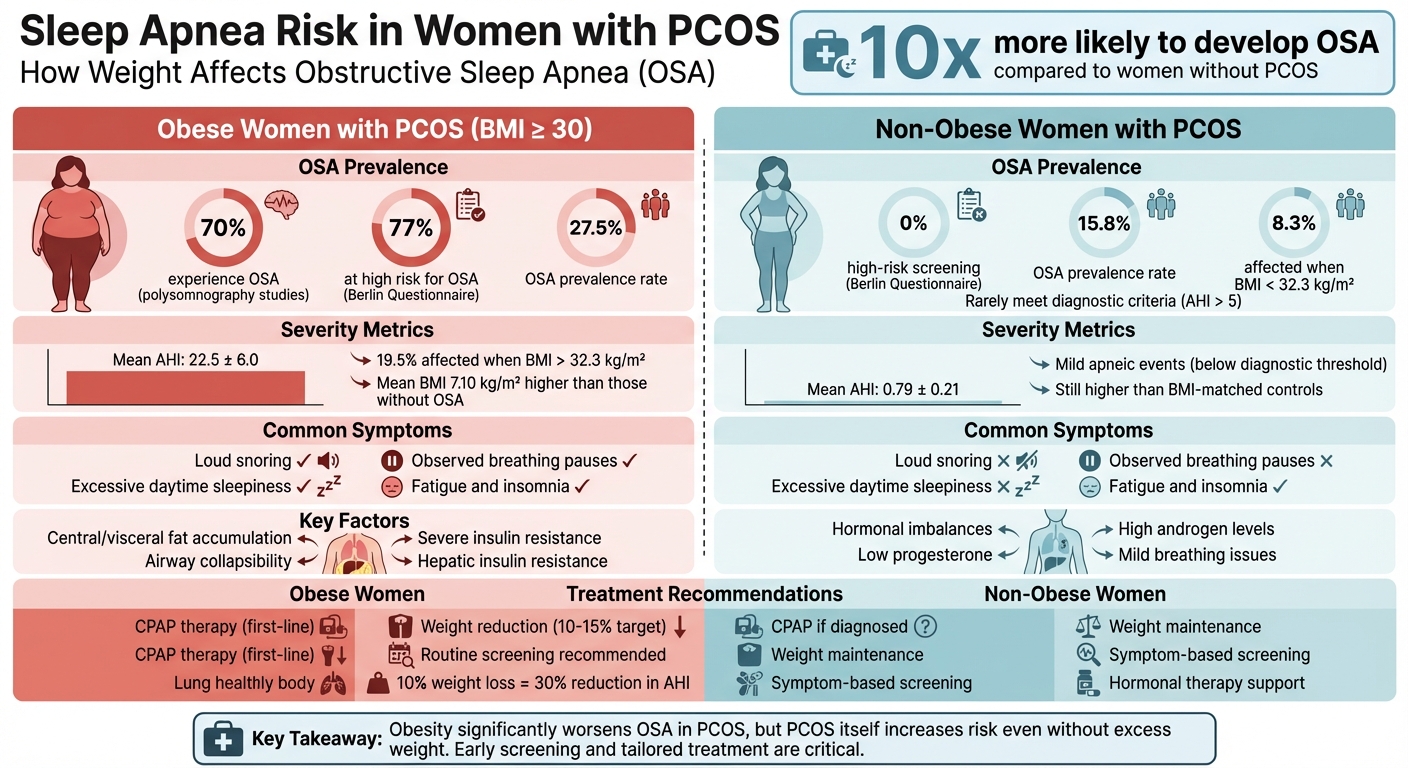
Women with PCOS are nearly 10 times more likely to develop obstructive sleep apnea (OSA) compared to those without PCOS. The connection is influenced by both weight and hormonal factors:
- Obese Women with PCOS: Up to 77% are at high risk for OSA, with severe symptoms like loud snoring and daytime sleepiness. Obesity amplifies insulin resistance and airway collapsibility, increasing OSA severity.
- Non-Obese Women with PCOS: Rarely meet diagnostic criteria for OSA (0% in some studies) but may still experience mild breathing issues due to hormonal imbalances, such as high androgen levels and low progesterone.
Key takeaway: Obesity significantly worsens OSA in PCOS, but even without excess weight, PCOS itself increases the risk. Early screening and tailored treatment, including CPAP therapy and weight management, are critical for improving outcomes.
Sleep Apnea Risk in PCOS: Obese vs Non-Obese Women Comparison
Understanding PCOS and obesity with Dr. Emilia Huvinen | Scale Up Your Practice podcast Ep.22
How Common Is Sleep Apnea in Women with PCOS?
Sleep apnea is significantly more common in women with PCOS compared to the general population, with prevalence rates ranging from 32–35%. This is a stark contrast to the 2–5% observed in the general population. However, the likelihood of developing sleep apnea in women with PCOS varies notably based on weight. The following sections break down how weight influences the risk of sleep apnea in women with PCOS.
Sleep Apnea Rates in Obese Women with PCOS
For obese women with PCOS, the numbers are striking. Studies using polysomnography have shown that up to 70% of these women experience obstructive sleep apnea (OSA). Screening with the Berlin Questionnaire reveals that 77% of obese women with PCOS (BMI ≥ 30) are at high risk for OSA, compared to 63% of obese women without PCOS.
Obesity severity plays a critical role here. Women with PCOS who have severe obesity, especially those with central or visceral fat accumulation, are at the greatest risk. This type of fat distribution - commonly referred to as male-pattern fat - has a stronger connection to breathing issues during sleep than overall body weight.
Sleep Apnea Rates in Non-Obese Women with PCOS
The picture is quite different for non-obese women with PCOS. Prospective studies using the Berlin Questionnaire have reported 0% high-risk screening for OSA in this group. Research consistently shows that non-obese women with PCOS rarely meet the diagnostic threshold for an apnea-hypopnea index (AHI) greater than 5.
"Our findings indicate that even though the risk for OSA in PCOS is high, it is related to the high prevalence of severe obesity. The risk for OSA among nonobese women with PCOS is very low." – Susan Sam, M.D., University of Illinois at Chicago
While non-obese women with PCOS may experience slightly more apneic events compared to BMI-matched controls, these events typically remain below the level needed for an OSA diagnosis.
Comparing Sleep Apnea Severity Between Obese and Non-Obese Women
When it comes to sleep apnea severity in women with PCOS, the impact of obesity becomes even more pronounced. Studies using the Apnea-Hypopnea Index (AHI) reveal a stark contrast: obese women with PCOS show a mean AHI of 22.5 ± 6.0, compared to just 6.7 ± 1.7 in weight-matched women without PCOS. Meanwhile, non-obese women with PCOS typically have much lower AHI scores, with one study reporting a mean of 0.79 ± 0.21.
OSA prevalence also shifts significantly with BMI. For PCOS patients, 8.3% with a BMI under 32.3 kg/m² are affected by OSA, but this jumps to 19.5% when BMI exceeds 32.3 kg/m². Among obese PCOS patients, OSA prevalence reaches 27.5%, nearly double the 15.8% observed in their non-obese counterparts. When OSA is present in PCOS patients, moderate cases (38.8%) are more common than mild ones (29.9%).
Differences in Symptoms
The symptoms of sleep apnea also vary greatly depending on weight. Obese women with PCOS are far more likely to display the classic signs of OSA, such as loud snoring, observed breathing pauses, and excessive daytime sleepiness (EDS). Screening consistently identifies these high-risk OSA symptoms predominantly in obese individuals.
In contrast, non-obese women with PCOS rarely exhibit these classic symptoms. Screening studies report that 0% of non-obese PCOS patients tested positive for high-risk OSA symptoms. However, atypical complaints like fatigue and insomnia are common across all weight categories, contributing to underdiagnosis in many cases.
"Women may not present with the 'classic' symptoms of OSA (loud snoring, EDS, nocturnal choking episodes, or witnessed apneas), and therefore may less likely be referred for a formal evaluation. Women were more likely to present with 'atypical complaints' such as insomnia or depression." – David A. Ehrmann, M.D.
These differences in symptom presentation highlight the crucial role BMI plays in shaping the severity and detection of sleep apnea in PCOS.
How BMI Affects Sleep Apnea Severity
BMI is a key predictor of both the risk and severity of OSA in women with PCOS. Research shows that PCOS patients with OSA have a mean BMI that is 7.10 kg/m² higher than those without OSA. But it’s not just overall weight that matters - fat distribution plays a critical role. Central or visceral fat around the abdomen has a stronger correlation with AHI scores than total body weight.
"Insulin resistance was found to be a stronger predictor of sleep disordered breathing than was age, BMI, or circulating testosterone concentrations." – David A. Ehrmann, M.D., University of Chicago
Managing weight effectively is vital, as both elevated BMI and central fat accumulation call for proactive screening and timely intervention.
sbb-itb-6dba428
Does Obesity Explain the PCOS-Sleep Apnea Connection?
Let’s take a closer look at whether obesity alone explains the link between polycystic ovary syndrome (PCOS) and obstructive sleep apnea (OSA). While body weight plays a role, the connection between PCOS and sleep apnea goes deeper than just obesity. Research shows that PCOS itself significantly raises the risk of sleep-disordered breathing, even when body mass index (BMI) is accounted for. In fact, women with PCOS are up to 30 times more likely to experience sleep apnea compared to those without the condition, regardless of their weight. This suggests that other factors tied to PCOS are at play. Below, we’ll explore how obesity adds to the risk of OSA and how PCOS independently contributes to breathing issues during sleep.
How Obesity Worsens PCOS and Sleep Apnea
When combined, obesity and PCOS create a perfect storm for increasing OSA risk. PCOS promotes central fat accumulation, which can narrow the upper airway and make breathing more difficult. Susan Sam, M.D., explains:
"PCOS and obesity synergistically increase the risk of OSA... only obese women with PCOS have hepatic insulin resistance and hypertriglyceridemia and that obesity and PCOS act synergistically to lead to these abnormalities."
This synergy is evident in the numbers: among obese women, 77% of those with PCOS tested positive for high-risk OSA, compared to 63% of obese women without PCOS. Obesity also worsens insulin resistance and elevates androgen levels, which encourages more abdominal fat storage and increases the likelihood of airway collapse. While obesity amplifies these risks, PCOS has its own direct impact on the development of OSA.
Evidence That PCOS Increases Sleep Apnea Risk Without Obesity
Even in the absence of obesity, PCOS independently raises the likelihood of OSA. A 2017 meta-analysis revealed that women with PCOS face a significantly higher risk of sleep apnea compared to those without the condition, with more frequent hypopneic events even among non-obese individuals.
Several mechanisms explain this increased risk. Hyperandrogenism, severe insulin resistance, and low progesterone levels all disrupt normal respiratory patterns, making breathing less stable during sleep. Elevated testosterone levels, for example, interfere with respiratory regulation. A 2008 University of Chicago study found that women with PCOS and OSA had much higher insulin resistance (HOMA index 5.7 vs. 3.5) than those without OSA, even when adjusted for age, BMI, and ethnicity. Additionally, chronic anovulation in PCOS leads to persistently low progesterone levels, removing the hormone’s natural role as a respiratory stimulant. This hormonal imbalance contributes to breathing disturbances, even if the clinical threshold for an OSA diagnosis isn’t reached.
Screening and Treatment Recommendations
Diagnosing and managing sleep apnea in women with PCOS requires a personalized approach, often influenced by factors like body weight. While overnight polysomnography remains the most reliable method for confirming obstructive sleep apnea (OSA), women with PCOS often present with different symptoms than men. Instead of the hallmark loud snoring, they may experience insomnia, chronic fatigue, or mood changes, complicating the diagnostic process.
Tools for Diagnosing Sleep Apnea
The Berlin Questionnaire is a commonly used screening tool for OSA, offering a sensitivity of 0.86 and a specificity of 0.77. It evaluates snoring habits, daytime sleepiness, and indicators like obesity or high blood pressure to identify patients who might need further testing. However, this tool may not perform as well in non-obese populations. In fact, one study found that none of the non-obese women with PCOS in the sample screened as high-risk for OSA.
For patients who screen positive - or for those who continue to report symptoms like fatigue and insomnia despite a negative screening - referral for a formal polysomnography is recommended. This overnight study provides a detailed analysis of sleep-related breathing issues, measuring the Apnea-Hypopnea Index (AHI) to quantify breathing interruptions per hour. For those seeking a more convenient option, portable Level III devices offer home testing, though they lack the depth of information provided by lab-based polysomnography. Confirming the diagnosis is crucial for crafting a treatment plan tailored to the patient’s weight and overall health.
Treatment Approaches for Different Weight Categories
For women with PCOS diagnosed with OSA, Continuous Positive Airway Pressure (CPAP) therapy is the first-line treatment, regardless of weight. CPAP works by delivering pressurized air through a mask to keep the airway open during sleep. Its benefits extend beyond better breathing - consistent CPAP use has been shown to improve insulin sensitivity. A notable study led by Dr. Esra Tasali at the University of Chicago demonstrated that eight weeks of CPAP therapy in obese women with PCOS reduced sympathetic nervous system activity by 25% and lowered diastolic blood pressure by approximately 2.3 mm Hg. According to Dr. Tasali:
"In young obese women with PCOS, successful treatment of OSA improves insulin sensitivity, decreases sympathetic output, and reduces diastolic blood pressure."
For obese women, weight management is a critical complement to CPAP therapy. Studies suggest that even a modest 10% weight loss can lead to a 30% reduction in the Apnea-Hypopnea Index. Since BMI and central fat distribution are key predictors of OSA risk in this group, losing weight can significantly enhance sleep quality. For those needing extra support, services like Oana Health provide telehealth options that combine medical weight loss treatments with PCOS-specific care.
In non-obese women with PCOS, the focus shifts to addressing hormonal imbalances. Hormonal therapies, such as oral contraceptives, have been linked to a lower risk of sleep-disordered breathing. Additionally, insulin-sensitizing medications like metformin can help manage the metabolic disruptions that contribute to OSA. Maintaining a stable weight is equally important, as even gradual weight gain can increase the likelihood of developing sleep disorders.
| Treatment Component | Obese Women with PCOS | Non-Obese Women with PCOS |
|---|---|---|
| Primary Therapy | CPAP (First-line) | CPAP (If diagnosed) |
| Lifestyle Focus | Weight reduction (10-15% target) | Weight maintenance |
| Screening Priority | Routine screening recommended | Symptom-based screening |
| Metabolic Goal | Improve insulin sensitivity | Maintain metabolic stability |
| Hormonal Support | Manage hyperandrogenism | Address hormonal imbalances |
Conclusion
Understanding the interplay between PCOS and sleep apnea highlights the importance of tailored care. Obesity significantly increases both the likelihood and severity of sleep apnea in women with PCOS. However, PCOS itself raises the risk of sleep apnea, even in women who are not obese. This dual influence calls for careful screening and personalized treatment plans.
Research shows that adult women with PCOS are nearly 10 times more likely to develop obstructive sleep apnea (OSA) compared to those without the condition. Even non-obese women with PCOS experience more sleep-related breathing issues than their weight-matched peers, though they often don’t meet the full clinical criteria for OSA. This indicates that the hormonal imbalances and insulin resistance central to PCOS play a role in sleep-disordered breathing beyond the impact of weight.
Sleep apnea in women with PCOS is often overlooked because their symptoms don’t always fit the typical profile. Instead of loud snoring, they may report insomnia, persistent fatigue, depression, or mood changes. This can lead to underdiagnosis, which is troubling since untreated OSA can worsen metabolic issues like insulin resistance, glucose intolerance, and high blood pressure. This connection emphasizes the need for a comprehensive and individualized approach to managing PCOS.
For obese women with PCOS, combining CPAP therapy with weight management often yields the best results. Non-obese women, on the other hand, may benefit from close monitoring of hormonal and metabolic health. Incorporating sleep apnea treatment into a broader PCOS care plan can help reduce the risks of type 2 diabetes and cardiovascular disease, while also enhancing overall well-being.
For those looking for accessible and tailored PCOS care, services like Oana Health offer telehealth solutions, including personalized, prescription-based treatments delivered conveniently to your home.
FAQs
Why are non-obese women with PCOS at a higher risk for sleep apnea?
Non-obese women with PCOS face an increased risk of sleep apnea, largely due to hormonal imbalances and metabolic issues tied to the condition. These disruptions can interfere with respiratory control and weaken airway stability, even without the presence of obesity.
This underscores that PCOS affects much more than just weight, emphasizing the need for a comprehensive approach to care. For those looking for guidance, platforms like Oana Health provide targeted treatments for PCOS and its related challenges, designed to meet individual needs.
How does insulin resistance affect sleep apnea in women with PCOS?
Insulin resistance is a critical link between sleep apnea and PCOS. Women with PCOS often struggle with insulin resistance, and studies indicate that sleep apnea can make this issue worse. It disrupts glucose tolerance and further increases insulin resistance, which raises the risk of metabolic problems like type 2 diabetes and heart disease.
What’s fascinating is that insulin resistance might also intensify sleep apnea, creating a feedback loop. Treating sleep apnea has been shown to enhance insulin sensitivity, underscoring the need to address both conditions together. Managing these interconnected factors can help lower health risks and improve overall well-being for women with PCOS.
Why don’t women with PCOS show typical sleep apnea symptoms?
Women with PCOS often experience sleep apnea in ways that differ from the more familiar patterns seen in men or individuals without the condition. Instead of the hallmark signs like loud snoring or noticeable pauses in breathing, their symptoms tend to be more subtle. Fatigue, trouble sleeping, and mood changes are common indicators, likely influenced by hormonal factors such as estrogen and progesterone, which play a role in how sleep apnea shows up.
Interestingly, while obesity is a well-known risk factor for sleep apnea, even women with PCOS who aren’t obese face a higher risk of developing it. This is tied to the distinct metabolic traits and fat distribution patterns associated with PCOS. Because these symptoms don’t always fit the classic profile, sleep apnea in women with PCOS often goes undiagnosed. Raising awareness and encouraging early evaluation are essential steps to address this issue.