
Spearmint vs. Spironolactone: Which Works Better?
Managing hormonal acne, hirsutism, or PCOS? Two popular options are spearmint (a natural remedy) and spironolactone (a prescription drug). Both aim to reduce androgen levels, but they differ in effectiveness, speed, and side effects. Here's the key takeaway:
- Spearmint: Works gradually, best for mild symptoms. Drinking spearmint tea twice daily can lower testosterone levels with minimal side effects. However, visible results may take months.
- Spironolactone: More effective for moderate to severe cases. It blocks androgen receptors and delivers faster results, especially for acne, but requires medical monitoring and may cause side effects like headaches or menstrual changes.
Quick Comparison
| Category | Spearmint | Spironolactone |
|---|---|---|
| Best For | Mild acne or hirsutism | Moderate to severe symptoms |
| Onset of Action | Hormonal changes: 5 days; visible results: 3+ months | Noticeable results: 12–24 weeks |
| Side Effects | Rare (e.g., mild stomach discomfort) | Common (e.g., headaches, dizziness) |
| Cost & Access | Affordable, over-the-counter | Prescription required; higher cost |
Bottom line: Choose spearmint for a natural, gradual approach or spironolactone for stronger, faster results. Always consult a healthcare provider to find the best fit for your needs.
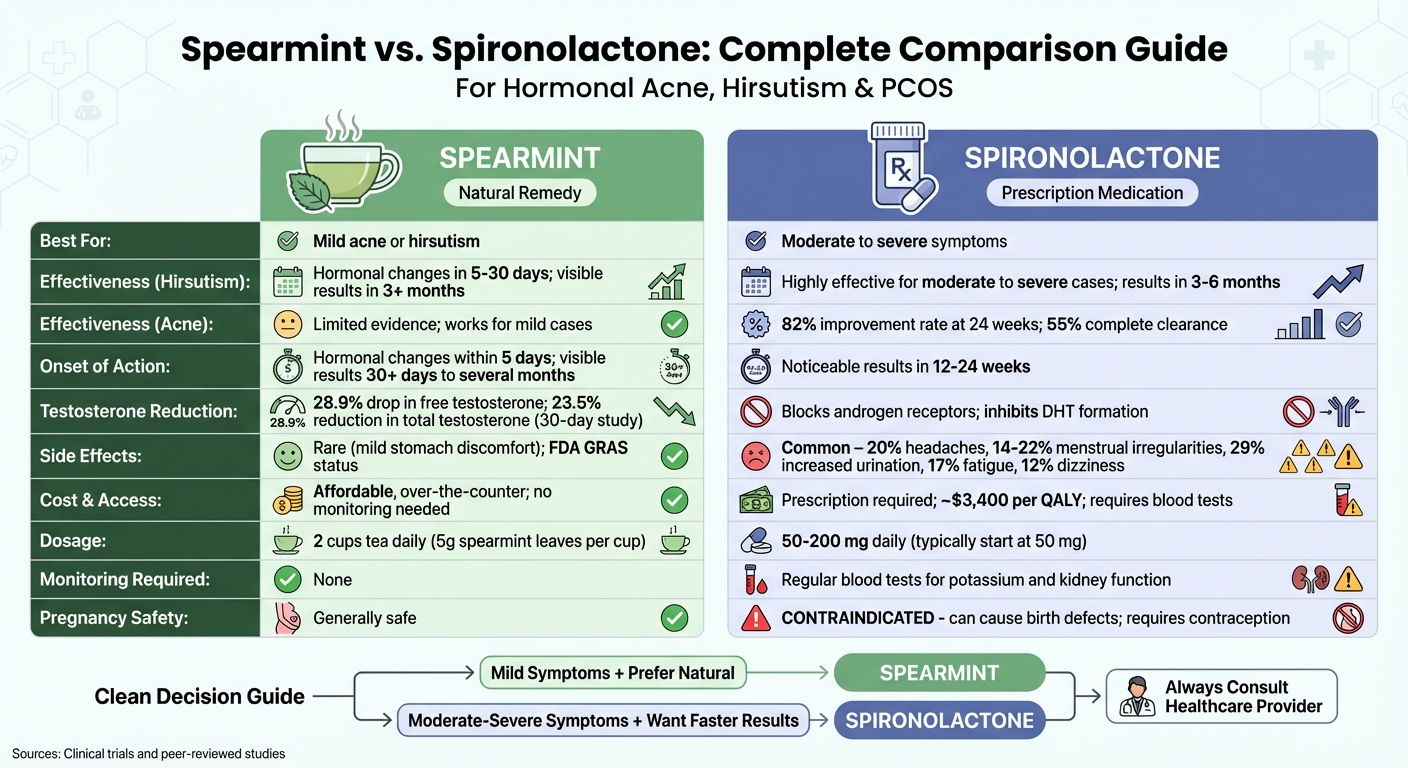
Spearmint vs Spironolactone Comparison Chart for Hormonal Acne and Hirsutism
PCOS Hack: Spironolactone & Spearmint Tea have the same benefits! #pcos
How Spearmint Reduces Androgens
Spearmint helps lower androgen levels by activating CYP3A4 enzymes in the liver, which aid in clearing sex hormones, and by increasing SHBG (sex hormone-binding globulin), a protein that binds to and deactivates free testosterone. These biochemical changes are thought to contribute to the clinical benefits observed in studies.
The key player here is carvone, the primary active compound in spearmint, making up as much as 74% of its composition - though one animal study measured it at 57.02%. Research suggests that carvone is responsible for the hormonal changes seen in clinical trials, such as reduced levels of free and total testosterone, along with higher levels of luteinizing hormone (LH) and follicle-stimulating hormone (FSH).
In one Turkish study, 21 women with hirsutism (12 with PCOS and 9 with idiopathic hirsutism) drank spearmint tea twice daily for just five days during the follicular phase of their menstrual cycles. The results were striking: free testosterone levels dropped significantly, while LH, FSH, and estradiol levels increased. Mehmet Akdoğan, the lead researcher from Suleyman Demirel University, concluded:
"spearmint can be an alternative to antiandrogenic treatment for mild hirsutism".
Spearmint for Hirsutism
Although spearmint triggers hormonal shifts relatively quickly, reducing visible hair growth takes more time. A 30-day study involving 42 women with PCOS showed a 28.9% drop in free testosterone (from 5.12 pg/mL to 3.64 pg/mL) and a 23.5% reduction in total testosterone (from 0.81 ng/mL to 0.62 ng/mL). The study also reported high completion rates, suggesting that spearmint is well-tolerated.
Interestingly, while the objective Ferriman–Gallwey scores for hirsutism didn’t reach statistical significance (p = 0.12) within the 30-day period, participants reported noticeable improvements in their condition through the Dermatology Quality of Life Index. Explaining this, Paul Grant noted that the delay in visible results is likely due to the slow growth cycle of hair follicles and cell turnover.
Spearmint for Acne
Spearmint’s hormonal effects extend beyond hirsutism - it can also help with hormonal acne. By lowering sebum production and acting as an antimicrobial against Propionibacterium acnes, spearmint addresses key factors behind acne breakouts. Most studies recommend consuming one cup of tea made from 5 grams of spearmint leaves, twice daily.
How Spironolactone Works
Spironolactone is a prescription medication that works by blocking androgen receptors. This prevents testosterone and dihydrotestosterone (DHT) from binding to cells, which in turn reduces sebum production and slows down hair growth. These effects make it particularly useful for managing conditions like acne and hirsutism.
Additionally, spironolactone lowers testosterone levels by inhibiting luteinizing hormone release and acting as a 5-alpha reductase inhibitor, which limits the formation of DHT - a key contributor to acne and hirsutism. As Kayla Penta from Lake Erie College of Osteopathic Medicine explains:
"Spironolactone functions as an androgen receptor antagonist and combats the effects of excess testosterone."
This combination of actions makes spironolactone a powerful tool for addressing hormonal imbalances that lead to certain skin and hair conditions.
Spironolactone for Hirsutism
Spironolactone’s ability to reduce androgen activity underpins its effectiveness in managing hirsutism, a condition characterized by unwanted hair growth. For this purpose, it is typically prescribed in doses ranging from 50 to 200 mg per day. Treatment often begins at 50 mg daily, with adjustments made based on the patient’s response. Clinical trials have shown its effectiveness, with one study reporting an odds ratio of 7.18 for improved hair growth when comparing 100 mg of spironolactone to a placebo.
Because hair follicles grow slowly, noticeable improvements in hirsutism usually take around 3 to 6 months of consistent treatment to appear.
Spironolactone for Acne
Spironolactone also addresses hormonal acne by preventing DHT from binding to sebocytes, the cells responsible for producing oil in the skin. In the SAFA trial, which included 410 women with persistent acne, participants began with a daily dose of 50 mg, increasing to 100 mg after six weeks. The results were notable: 81.9% of participants reported improvement compared to 63.3% in the placebo group, with an adjusted odds ratio of 2.72.
Another study found that 85% of patients experienced a reduction in acne, with 55% achieving complete clearance, particularly on the back and chest. While some initial changes may be seen around 12 weeks, more significant results are typically observed after 24 weeks of consistent use.
For those considering prescription treatments for hormonal acne or hirsutism, Oana Health's telehealth platform offers access to licensed medical professionals who can assess your needs and provide ongoing care.
Spearmint vs. Spironolactone: Direct Comparison
Choosing between spearmint and spironolactone depends on understanding how each works and what aligns with your needs. Spearmint influences enzyme activity, while spironolactone takes a more direct approach by blocking androgen receptors. This distinction plays a key role in their effectiveness and suitability for different symptoms. Here's a side-by-side look at their differences:
Comparison Table
| Category | Spearmint | Spironolactone |
|---|---|---|
| Effectiveness for Hirsutism | Best for mild symptoms; hormonal changes in 5–30 days, with physical results in 3+ months | Highly effective for moderate to severe cases |
| Effectiveness for Acne | Limited evidence; works for mild cases | 82% improvement rate at 24 weeks |
| Onset of Action | Hormonal changes within 5 days; visible results may take 30+ days to several months | Significant improvement typically seen in 12–24 weeks |
| Safety Profile | FDA-recognized as Generally Safe (GRAS); minimal reported side effects | Prescription required; about 20% report headaches, 14% experience menstrual irregularities |
| Cost and Accessibility | Affordable over-the-counter tea or supplement; no medical monitoring needed | Requires prescription and monitoring; estimated cost near $3,400 per QALY |
Patient Experiences and Preferences
The differences outlined above often guide patients in choosing between these two options. For those with mild symptoms or a preference for natural remedies, spearmint provides a gentler approach. As Kayla Penta from Lake Erie College of Osteopathic Medicine explains:
"Spearmint has value in being an option for those with the previously stated conditions without extreme severity and who would like to avoid the potential side effects of spironolactone."
Spearmint is especially appealing to individuals seeking a non-prescription alternative with moderate hormonal effects and minimal side effects. However, it requires patience, as visible improvements can take longer compared to spironolactone.
On the other hand, spironolactone is often the go-to choice for women dealing with severe acne or hirsutism due to its faster and more pronounced results. Clinical trials show that 55% of patients achieved complete acne clearance with spironolactone. However, side effects like breakthrough bleeding or lightheadedness may lead some to switch to spearmint.
For those with more severe symptoms considering prescription treatment, platforms like Oana Health can connect you with licensed professionals for personalized care. Whether you prioritize speed and effectiveness or a natural, slower approach, the choice ultimately depends on your symptoms, lifestyle, and tolerance for side effects.
sbb-itb-6dba428
Side Effects and Long-Term Use
When deciding on a treatment, understanding potential side effects is key to finding what suits your health needs. While spearmint is typically easy on the body, spironolactone comes with more frequent side effects due to its diuretic and anti-androgen properties. Let’s break down the specific side effects of each option.
Common Side Effects of Spearmint
Spearmint is widely considered safe, with clinical studies showing very few side effects. Most people can enjoy spearmint tea without any problems, making it a popular choice for those looking for a natural remedy. The occasional side effect, such as mild stomach discomfort, is usually minor.
That said, while drinking two cups of spearmint tea daily is safe, using concentrated spearmint capsules may pose risks to liver or kidney health. It’s always a good idea to check with a healthcare provider before trying these higher-potency options. The biggest drawback with spearmint isn’t safety but the lack of long-term studies beyond 30 days. However, no significant health risks have been noted in existing research.
Common Side Effects of Spironolactone
Unlike spearmint, spironolactone’s systemic effects often lead to more noticeable side effects. Clinical trials show that 29% of users experience increased urination, while 14% to 22% report menstrual irregularities - one of the main reasons women may switch to other treatments. Other common issues include fatigue (17%), headaches (14% to 20.4%), and dizziness (12%).
Hyperkalemia, or dangerously high potassium levels, is rare, affecting less than 1% of healthy women under 45 using spironolactone to treat acne. However, older adults or those with pre-existing conditions should undergo regular blood tests to monitor potassium and kidney function. To reduce risks, avoid potassium supplements, ACE inhibitors, and NSAIDs while on spironolactone.
A 2017 study from the University of Pennsylvania involving 110 women found that 46% experienced side effects. Most participants felt the benefits in acne improvement outweighed the discomfort, but 5.5% stopped treatment due to severe side effects. Liver toxicity, though rare, can occur within 4–8 weeks of starting the medication.
Important caution: Spironolactone should never be used during pregnancy, as it can cause feminization in male fetuses. Reliable contraception is essential if you’re taking this medication. Nikita Menta from The George Washington University School of Medicine emphasizes:
"Spironolactone is a safe, comparable, and promising alternative to antibiotics for acne management in adult and adolescent females,"
but stresses the importance of proper monitoring and taking necessary precautions for long-term use.
When to Choose Spearmint vs. Spironolactone
Deciding between spearmint and spironolactone comes down to how severe your symptoms are, how quickly you want results, and whether you prefer a natural or prescription-based approach. Both options target androgens, but they differ in strength, speed, and the level of medical oversight required. Let’s break down when each option might be the better fit.
Spearmint: A Natural Option for Mild Symptoms
Spearmint is a great choice if you're dealing with mild acne or hirsutism and prefer a natural remedy over medication. Incorporating spearmint into your routine is as simple as drinking two cups of spearmint tea daily. It’s a low-risk option that doesn’t require prescriptions, blood tests, or ongoing medical monitoring.
That said, spearmint takes time to show results. Hormonal changes and hair growth cycles don’t happen overnight, so you’ll need to stick with it for a few months to see noticeable improvements. If you’re someone who values a gradual, natural approach, this could be the right path for you.
Spironolactone: A Prescription for Severe Symptoms
For more severe cases, spironolactone is often the better option. If you're struggling with extensive unwanted hair or significant acne, this prescription medication works faster and delivers more dramatic results. In fact, a clinical trial showed that 71% of women using spironolactone saw clearer skin within 12 weeks, compared to just 43% in the placebo group.
However, spironolactone requires a prescription and regular monitoring, including blood tests. You’ll also need effective contraception since the medication can cause serious birth defects. While side effects are more common than with spearmint, many women feel the quicker and stronger results outweigh the potential downsides when symptoms are more intense.
Always consult a healthcare provider before starting either treatment. For a personalized approach, Oana Health offers telehealth consultations with licensed professionals who can help you choose the right treatment plan and even deliver medications directly to your door.
Conclusion
The comparison above highlights the distinct approaches and outcomes of the two treatments. Both aim to lower androgens, but their methods and timelines differ: spearmint works more gradually, while spironolactone delivers faster and more pronounced effects.
Spearmint provides a natural alternative with few side effects. Research indicates that drinking spearmint tea twice daily can help lower free testosterone levels. However, noticeable results take time to appear, making it a better fit for mild cases.
On the other hand, spironolactone is a prescription medication known for its quicker and more powerful results, particularly for moderate to severe acne and hirsutism. Clinical studies show an 82% improvement in acne by week 24, with spironolactone proving over five times more effective than a placebo within 12 weeks. However, it comes with potential side effects like menstrual irregularities and headaches and requires regular medical monitoring.
Experts often recommend spearmint for mild symptoms due to its gentle nature and minimal risks. Spironolactone, while highly effective, requires careful consideration due to risks like hyperkalemia and teratogenicity.
Ultimately, choosing the right treatment depends on factors like symptom severity, how quickly you want results, and your comfort level with prescription medications. Consulting a healthcare professional is essential to ensure a safe and effective plan tailored to your needs.
For personalized care, Oana Health offers telehealth consultations with licensed professionals. They’ll assess your situation, recommend the best treatment, and even deliver medications to your door. Whether you’re drawn to a natural remedy or need prescription-strength help, expert guidance ensures you make the right choice for your health.
FAQs
How quickly does spearmint work for acne or hirsutism?
Spearmint might begin to show effects on acne or hirsutism within just 2 to 5 days of consistent use. However, the timeline can differ for each person, depending on factors like hormone levels and overall health. For some, the changes may take a bit longer to become noticeable, so sticking with it and being patient is important.
If you're considering spearmint as a natural remedy, keep track of your progress and consult a healthcare professional to get advice tailored to your needs.
What are the common side effects of spironolactone?
Spironolactone is known to be effective for various conditions, but it can come with some side effects. Some of the more common issues include dizziness, nausea, vomiting, muscle cramps, and a general feeling of fatigue or low energy. Additionally, it can sometimes affect potassium levels, which is why regular check-ins with your healthcare provider are crucial.
If you notice persistent or severe symptoms, don’t hesitate to reach out to a medical professional. They can help ensure your treatment remains both safe and effective for your needs.
Can you take spearmint and spironolactone together for hormonal issues?
Spearmint and spironolactone are both known for their antiandrogenic effects, making them helpful in addressing hormonal concerns like PCOS and hirsutism. Spearmint, a natural remedy, may help reduce free testosterone levels, while spironolactone is a prescription medication commonly used to manage acne, excessive hair growth, and hormonal imbalances.
Although these two treatments are typically used independently, there is limited research on combining them. This means potential interactions remain unclear. To ensure both safety and effectiveness, it’s essential to consult a healthcare professional before using them together. Tailored advice is crucial for managing hormonal issues effectively.