
Strength Training for Insulin Resistance in PCOS
Strength training can help women with PCOS manage insulin resistance, a condition affecting up to 70% of those diagnosed. By increasing muscle mass, it improves how the body processes glucose, reduces insulin levels, and balances hormones. This not only alleviates symptoms like irregular cycles and acne but also lowers the risk of long-term complications such as Type 2 diabetes and cardiovascular disease.
Here’s why strength training works:
- Improves glucose uptake: Activates GLUT-4 proteins to transport glucose into muscle cells.
- Builds muscle mass: Muscle acts as a "sink" for glucose, reducing blood sugar levels.
- Supports hormonal balance: Increases SHBG, reducing excess testosterone.
- Reduces abdominal fat: Helps mitigate insulin resistance severity.
A simple routine - 30 minutes, 3 times a week - can yield results in as little as 8 weeks. Pairing this with medications like Metformin enhances outcomes. Start with basic compound exercises like squats, lunges, and push-ups, progressing gradually to avoid injury. For personalized care, telehealth platforms like Oana Health offer tailored plans, combining exercise guidance with medication delivery to streamline PCOS management.
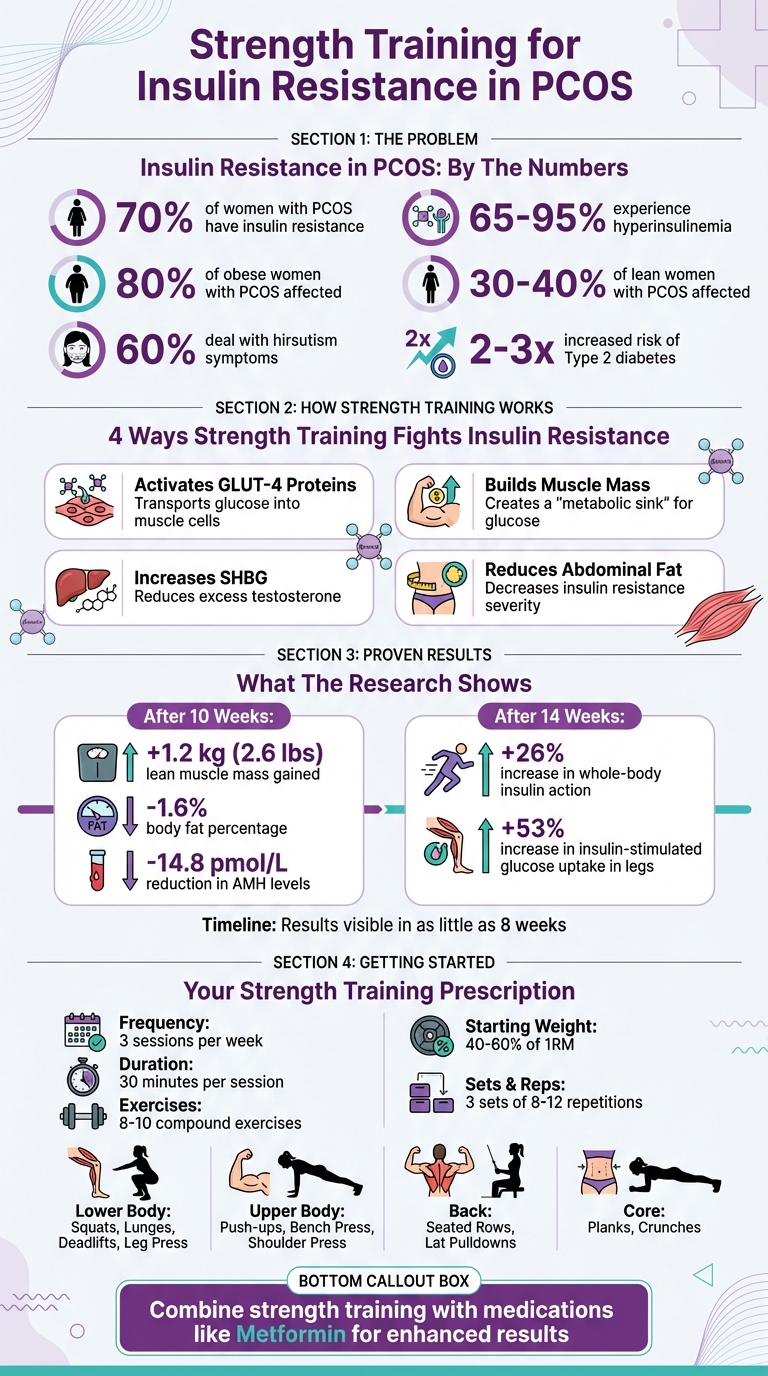
How Strength Training Reduces Insulin Resistance in PCOS: Key Statistics and Benefits
Best exercise for insulin resistance (treating PCOS naturally)
What is Insulin Resistance in PCOS
Insulin resistance plays a significant role in polycystic ovary syndrome (PCOS), with its mechanisms and effects extending far beyond the surface. In simple terms, insulin resistance happens when muscle, fat, and liver cells don’t respond properly to insulin. To compensate, the pancreas starts producing more insulin, a condition called hyperinsulinemia. Think of it like a door that’s stuck - cells need increasingly higher amounts of insulin to let glucose in.
In women with PCOS, insulin resistance is an inherent feature, meaning it can occur regardless of body weight. However, being overweight can worsen the condition. Studies show that between 65% and 95% of women with PCOS experience insulin resistance and the resulting hyperinsulinemia. This includes about 80% of women who are obese and 30% to 40% of those who are lean.
What sets PCOS apart is how insulin resistance affects the body. It disrupts the pathways responsible for glucose uptake but leaves ovarian pathways responsive to insulin’s role in stimulating androgen production. This imbalance not only alters hormone levels but also drives many of the symptoms tied to PCOS. As researchers Evanthia Diamanti-Kandarakis and Andrea Dunaif explain:
Polycystic ovary syndrome (PCOS) is now recognized as an important metabolic as well as reproductive disorder conferring substantially increased risk for type 2 diabetes.
How Insulin Resistance Affects Women with PCOS
When insulin levels run high, they throw off blood sugar regulation and act as a "co-gonadotropin", boosting ovarian testosterone production. At the same time, the liver produces less Sex Hormone-Binding Globulin (SHBG), a protein that normally binds to testosterone and reduces its activity. With less SHBG, more free testosterone circulates in the bloodstream.
This hormonal disruption often leads to visible symptoms. Around 60% of women with PCOS deal with hirsutism (excess facial and body hair), while many also experience acne and androgenic alopecia. Another marker of insulin resistance severity is acanthosis nigricans - dark, velvety patches of skin that often appear on the neck, armpits, or other folds.
Menstrual irregularities are also common. High insulin levels can increase the frequency of GnRH pulses, which elevate Luteinizing Hormone (LH) levels and disrupt ovulation. This can lead to oligomenorrhea (infrequent menstrual cycles) or even anovulation (lack of ovulation). Additionally, abdominal weight gain can further worsen insulin resistance.
Long-Term Health Risks of Insulin Resistance
The effects of insulin resistance in PCOS go beyond immediate symptoms and can lead to serious health complications over time. Women with PCOS often have a 2- to 3-fold increase in the number of small, preantral follicles in their ovaries, which contributes to ongoing fertility challenges.
On a broader scale, untreated insulin resistance is a major factor in the development of type 2 diabetes, metabolic syndrome, and non-alcoholic fatty liver disease (NAFLD). Cardiovascular risks also rise, including a higher likelihood of coronary heart disease, high blood pressure, and stroke. Pregnancy complications, such as miscarriage, are more common among women with PCOS.
The hormonal imbalances tied to insulin resistance can also impact mental health. Women with PCOS are more likely to experience depression, anxiety, and struggles with body image. Additionally, prolonged exposure to high estrogen and androgen levels, coupled with irregular ovulation, increases the risk of endometrial cancer. These challenges underscore the importance of addressing insulin resistance through interventions like strength training.
As McKayla J. Niemann from the Department of Exercise Sciences at BYU points out:
People who are insulin resistant need greater amounts of insulin to get glucose into their cells. If not corrected... insulin resistance frequently leads to type 2 diabetes.
How Strength Training Helps Manage Insulin Resistance
Strength training does more than just build muscle - it transforms how your body handles glucose, making it a powerful tool against insulin resistance. When you engage in resistance exercises, your muscles become more efficient at absorbing glucose, which is crucial since skeletal muscle is the primary site for glucose disposal in the body.
One key player in this process is a group of proteins called GLUT-4 vesicles. These proteins are activated during physical activity, transporting glucose from your bloodstream directly into muscle cells. As McKayla J. Niemann from Brigham Young University's Department of Exercise Sciences explains:
Physical activity lowers glucose levels in the blood by activating GLUT-4 vesicles, which transport glucose into the cells.
But the benefits don’t stop there. Strength training also enhances the cellular functions of your muscles. It increases the levels of insulin receptors, protein kinase B-α/β, and glycogen synthase, all of which improve how your cells process glucose. Additionally, training boosts insulin-stimulated blood flow to your limbs, ensuring that more glucose and insulin reach skeletal muscle for uptake. Some of these improvements can happen after just one workout, while more lasting changes typically require at least 8 weeks of consistent training. These adaptations pave the way for even greater benefits.
Why Strength Training Works for Insulin Resistance
Building muscle through resistance training creates what researchers call a "metabolic sink." Essentially, the more muscle you have, the more tissue is available to absorb and store glucose. A 10-week study involving women with PCOS showed participants gained an average of 1.2 kg (about 2.6 lbs) of lean muscle mass while reducing body fat percentage by 1.6%. This shift in body composition plays a key role in improving insulin sensitivity.
The results can be striking. For example, a 14-week program of supervised exercise increased whole-body insulin action by 26% and insulin-stimulated glucose uptake in the legs by 53% in healthy participants. Even a modest routine - 30 minutes of strength training three times a week - has been shown to significantly enhance insulin action in skeletal muscle. Dr. Flemming Dela from the University of Copenhagen explains:
Strength training for 30 min three times per week increases insulin action in skeletal muscle... The adaptation is attributable to local contraction-mediated mechanisms involving key proteins in the insulin signaling cascade.
For women with PCOS, where insulin resistance often drives symptoms, these improvements are especially beneficial. As Birinder S. Cheema from the University of Western Sydney notes:
Insulin resistance has been shown to exacerbate the disease process [PCOS] due to its effect on androgen synthesis.
Metabolic and Hormonal Benefits of Strength Training
Strength training doesn’t just improve glucose metabolism - it also supports hormonal balance, particularly for women with PCOS. Resistance exercises can increase Sex-Hormone Binding Globulin (SHBG), which binds to excess testosterone and reduces the Free Androgen Index. In the same 10-week study, participants saw a significant drop in Anti-Müllarian Hormone (AMH) levels by 14.8 pmol/L. Elevated AMH is a common marker in PCOS and is linked to issues like follicular arrest.
Additionally, strength training helps reduce visceral fat, which is closely tied to the severity of insulin resistance. Importantly, these metabolic improvements occur even without major weight loss. By improving how your body processes glucose and balances hormones, strength training reduces long-term health risks associated with PCOS.
Another advantage of resistance training is its accessibility, especially for women managing obesity alongside PCOS. Unlike high-impact aerobic workouts, strength training can be tailored to your current fitness level, allowing you to start small and gradually increase intensity as you build strength. This makes it a sustainable and practical option for managing insulin resistance over the long term.
sbb-itb-6dba428
Starting a Strength Training Routine for PCOS
You don’t need a gym membership or fancy equipment to kick off a strength training routine. Resistance training is often recommended as a go-to treatment for managing PCOS. Why? Because it helps tackle insulin resistance, improves body composition, and supports hormonal balance. Aim for three sessions per week to start seeing benefits.
For beginners, a program typically includes 8 to 10 compound exercises that target all major muscle groups. While noticeable improvements in insulin sensitivity can occur after just one workout, allow about 8 weeks to experience more lasting changes. If you’re new to strength training, working with a trainer or exercise physiologist can help you nail proper form and intensity, setting a solid foundation for progress.
Best Exercises for Insulin Resistance
When it comes to improving insulin sensitivity, compound exercises that engage large muscle groups are key. For the lower body, exercises like squats, lunges, leg presses, and deadlifts work your largest muscles, which are crucial for glucose regulation. Upper body movements, such as push-ups, bench presses, and shoulder presses, enhance functional strength and metabolic activity. Adding pulling exercises like seated rows, lat pulldowns, and bicep curls not only improves posture but also helps increase lean muscle mass. Don’t skip core work - planks and crunches are great for building spinal stability as you advance to heavier lifts.
Start with weights at 40–60% of your one-rep max (1RM) and aim for 3 sets of 8–12 repetitions, always warming up with 5–10 minutes of light activity. Once you’ve mastered the basics, it’s time to gradually push your limits.
How to Progress Your Workouts Safely
Progression is the secret to building strength and boosting your metabolism. A simple rule to follow is the “3 sets of 10” approach: only increase the weight when you can complete three sets of 10 reps with perfect form. When you’re ready to level up, add 2–5 lbs to your weights to keep challenging your muscles safely.
Over time (typically 8 to 16 weeks), you can gradually increase the intensity to 60–75% or even 85% of your 1RM. Progress by adding more weight, increasing the number of reps or sets, or shortening your rest periods. The goal is to focus on building muscle mass, which plays a critical role in managing PCOS. Researchers at the Norwegian University of Science and Technology emphasize:
Since skeletal muscle tissue is the primary metabolic target organ for glucose disposal, maintaining or increasing muscle mass is important in women with PCOS.
Combining Strength Training with Medical Treatment
Pairing strength training with targeted medications creates a well-rounded strategy to combat insulin resistance. While medications address the biochemical side of insulin sensitivity, strength training focuses on increasing muscle mass - the primary site where glucose is processed. Together, they provide a powerful and lasting improvement in blood sugar regulation. Beyond building muscle, strength training enhances the overall effectiveness of medications, making it a key part of managing insulin resistance.
How Medications Help Improve Insulin Sensitivity
Medications like Metformin and GLP-1 receptor agonists play a crucial role in improving how the body responds to insulin. Metformin, for instance, reduces glucose production in the liver and helps cells use insulin more effectively. Meanwhile, strength training boosts fat-free mass - muscle tissue essential for clearing glucose from the bloodstream.
This combination works on multiple levels: medications provide immediate biochemical support, while muscle growth from strength training offers long-term benefits for glucose management. As one study highlighted:
Lifestyle intervention is regarded as first-line therapy in women with PCOS, and has been found to improve both metabolic and reproductive manifestations of the syndrome. - PLOS One
By addressing insulin resistance from both angles, this approach forms the basis for a more personalized and effective treatment plan.
How Oana Health Simplifies PCOS Treatment

Oana Health integrates this dual approach to make managing PCOS and insulin resistance more convenient. Through their telehealth services, women can consult licensed medical professionals without leaving home, receive customized treatment plans, and get medications delivered straight to their door with free shipping.
Their offerings include Oral Metformin ER starting at $22/month, which supports insulin sensitivity alongside strength training. For more advanced care, they provide combination treatments like Metformin & Spironolactone at $32/month or Oral GLP-1 & Metformin at $199/month, ideal for comprehensive PCOS management. All prescriptions are filled through FDA-regulated pharmacies, ensuring safe and reliable access to treatment options.
Conclusion
Tackling insulin resistance in PCOS involves a combination of exercise and medication. Strength training plays a key role by increasing muscle mass, which is essential for glucose disposal. At the same time, medications like Metformin and GLP-1 receptor agonists work to enhance insulin sensitivity, creating a powerful synergy for improving metabolic health.
Research highlights that strength training significantly improves body composition, boosting the body's ability to process glucose and regulate hormones. This approach helps disrupt the cycle of insulin resistance, which affects an estimated 65% to 70% of women with PCOS. Acting early makes a big difference.
Starting with three strength training sessions per week, under medical supervision, is a solid first step. Early intervention can greatly reduce future health risks and pave the way for better long-term outcomes.
For even better results, pairing exercise with expert guidance is key. Oana Health offers telehealth services that connect you with licensed medical professionals for personalized care. Their platform provides tailored treatment plans, including medications delivered to your door with free shipping - all while you focus on building strength and improving your metabolic health.
With the right balance of exercise and medical support, managing PCOS and insulin resistance becomes a realistic and achievable goal.
FAQs
How long does it take for strength training to improve insulin resistance in women with PCOS?
Strength training offers a promising way to address insulin resistance for women with PCOS, but patience is essential. The benefits don’t appear overnight. Studies indicate that even with 10 weeks of regular strength training, measurable improvements in insulin resistance, such as those tracked by HOMA-IR, might not always be immediately visible.
To maximize its impact, strength training works best alongside other healthy habits like maintaining a balanced diet and staying physically active. The real secret lies in consistency and committing to these changes over the long haul to effectively manage insulin resistance.
What types of strength training exercises are best for managing insulin resistance in women with PCOS?
Strength training can be a game-changer for improving insulin resistance in women with PCOS. A solid routine should include progressive resistance training (PRT) that targets the major muscle groups at least 2–3 times a week. Here’s how to structure it:
- Lower-body exercises: Incorporate moves like squats, lunges, deadlifts, and step-ups to activate large muscles, such as the glutes and hamstrings.
- Upper-body exercises: Focus on strength and balance with push-ups, bench presses, rows, and shoulder presses.
- Core strengthening: Add planks, side planks, and Russian twists to build a strong trunk and support hormonal balance.
You can use equipment like dumbbells, resistance bands, or weight machines to get started. The key is progressive overload - gradually increasing the weight or repetitions as your strength builds. Aim for 8–12 repetitions per set, with 2–4 sets per exercise. Adjust the intensity based on your fitness level.
With consistent effort, strength training doesn’t just build muscle - it also improves insulin sensitivity and supports better hormonal regulation over time.
Can strength training help manage insulin resistance in women with PCOS without medication?
Strength training is an effective way to boost insulin sensitivity and decrease insulin levels for women dealing with PCOS. By engaging your muscles, it encourages them to utilize glucose more effectively, which can gradually help reduce insulin resistance.
That said, strength training on its own might not be enough to fully address insulin resistance. Many women find the best results by pairing exercise with prescription medications and other lifestyle adjustments. It’s important to work with a healthcare provider to develop a plan that’s customized to your specific needs.