
How Tai Chi Improves Insulin Sensitivity in PCOS
Tai Chi can help women with PCOS manage insulin resistance effectively. This mind-body practice has been shown to improve glucose metabolism, reduce testosterone levels, and lower inflammation - all key factors in managing PCOS symptoms. A 2022 study highlighted that practicing Tai Chi for 60 minutes, three times a week, over 12 weeks led to noticeable improvements in BMI, lipid profiles, and hormonal balance among participants.
Key Takeaways:
- Insulin Resistance in PCOS: Affects up to 70% of women with PCOS, increasing the risk of Type 2 diabetes and worsening symptoms like irregular periods and excess hair growth.
- Benefits of Tai Chi:
- Improves how cells respond to insulin.
- Lowers stress hormones like cortisol that impair insulin sensitivity.
- Reduces inflammatory markers (e.g., hs-CRP, IL-6).
- Promotes hormonal balance by lowering free testosterone and DHEA levels.
- Recommended Routine: At least three 60-minute sessions weekly for 12 weeks to see results. Practicing five times a week can yield even better outcomes.
- Metrics to Track: Fasting insulin, glucose, HOMA-IR score, and waist circumference. Regular evaluations help monitor progress.
By combining Tai Chi with medical care and lifestyle changes, women with PCOS can improve their metabolic health, regulate hormones, and address symptoms more effectively.
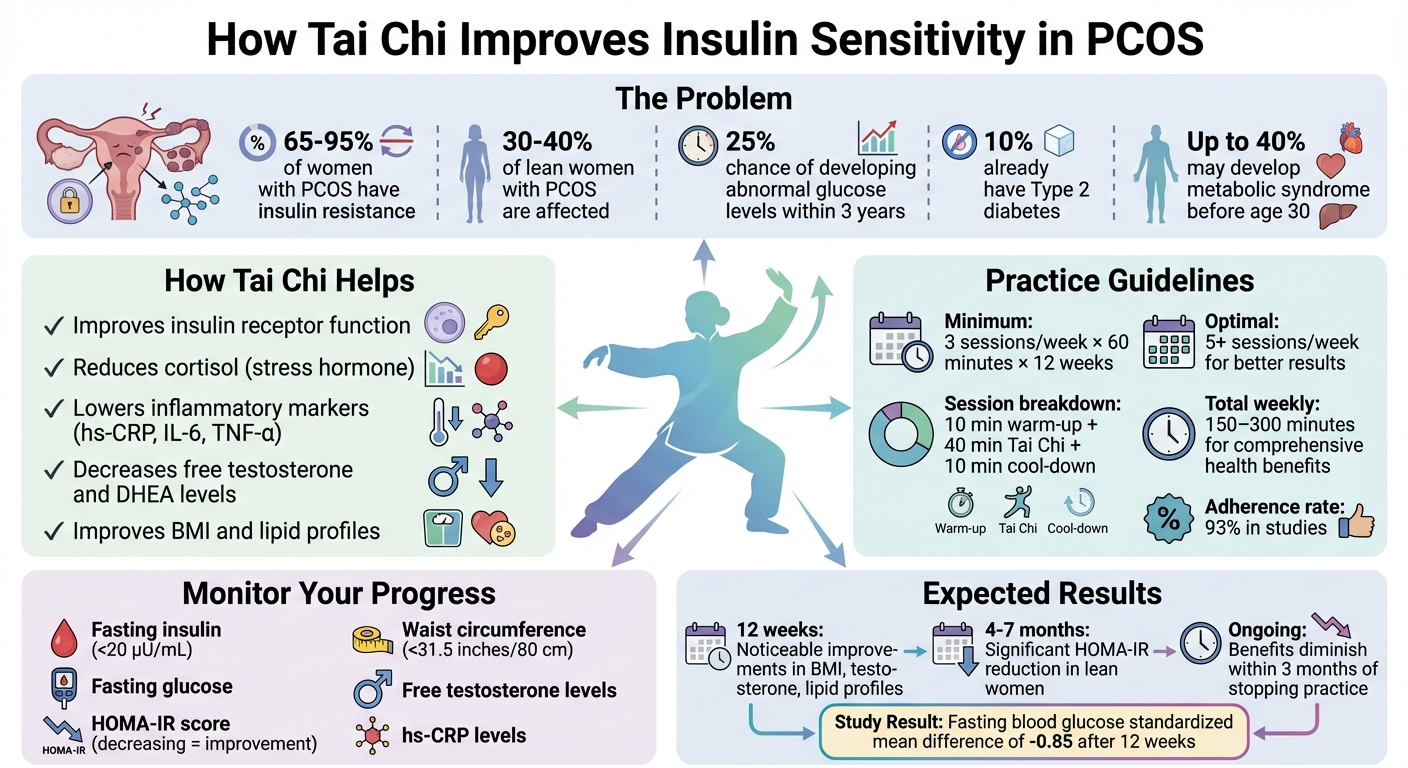
Tai Chi Benefits for PCOS and Insulin Resistance: Key Statistics and Recommended Practice
Understanding Insulin Resistance in PCOS
What is Insulin Resistance?
Insulin resistance occurs when cells in the liver, muscles, and fat tissues don’t respond effectively to insulin. As a result, the pancreas compensates by producing more insulin. While this helps regulate blood sugar, it also has unintended effects, like overstimulating the ovaries to produce more androgens and reducing the production of sex hormone-binding globulin (SHBG).
"Insulin resistance (IR) is a prominent feature of PCOS with a prevalence of 35%–80%." – Chantal Anifa Amisi, Senior Researcher, Universita Campus Bio-medico di Rome
Interestingly, in PCOS, while many tissues resist insulin’s metabolic effects, the ovaries remain highly sensitive. This sensitivity leads to continuous overstimulation and excessive androgen production.
Why Insulin Resistance Matters in PCOS
Addressing insulin resistance is key to managing PCOS effectively. Research shows that insulin resistance affects 65%–95% of women with PCOS, including 30%–40% of those who are lean. Alarmingly, women with PCOS who initially have normal glucose metabolism face a 25% chance of developing abnormal glucose levels within just three years. Additionally, about 10% of women with PCOS already have type 2 diabetes, and up to 40% may develop metabolic syndrome - often before the age of 30.
As Michael L. Traub, MD, explains, "Insulin resistance may be the first important marker of metabolic disease in PCOS women at risk for metabolic syndrome and coronary artery disease."
The effects of insulin resistance go beyond metabolic health. Elevated insulin levels, combined with luteinizing hormone (LH), disrupt ovarian follicle development. This can result in irregular menstrual cycles, anovulation, and challenges with fertility. However, improving insulin sensitivity has been shown to restore ovulation and regulate menstrual cycles. This is where practices such as Tai Chi come into play, offering potential benefits for enhancing insulin sensitivity. Understanding these connections lays the groundwork for exploring how Tai Chi can make a difference.
How Tai Chi Improves Insulin Sensitivity
The Science Behind Tai Chi and Glucose Metabolism
Tai Chi influences several metabolic processes that help the body manage glucose more effectively. By enhancing the function of insulin receptors and increasing the availability of low-affinity receptors, it helps cells respond more efficiently to insulin signals. Studies show that noticeable improvements in fasting blood glucose levels generally require at least 12 weeks of consistent practice, with a standardized mean difference of -0.85.
Additionally, Tai Chi helps to reduce chronic inflammation, which is a major factor in impaired insulin function. It has been shown to lower inflammatory markers like hs-CRP, IL-6, and TNF-α. These markers, when elevated, can damage pancreatic β-cells and worsen insulin resistance. For example, a 2020 study published in Life observed that 21 Tai Chi practitioners had lower serum insulin levels and HOMA-IR scores compared to 19 healthy controls who did not practice.
"Tai Chi significantly improves balance, coordination, and muscle strength in older adults, thereby reducing the risk of falls... it might serve as a universally applicable rehabilitation method for patients with T2DM." – Frontiers in Endocrinology
In a pilot study involving women with PCOS, 36 Tai Chi sessions over three months showed promising improvements in insulin sensitivity. For the best results in glucose regulation, experts recommend practicing Tai Chi at least five times a week, with sessions lasting 60 minutes or more.
These metabolic changes pave the way for essential hormonal adjustments.
Hormonal Regulation Through Mind-Body Practices
Beyond its physical benefits, Tai Chi has a profound effect on the body's stress response, which plays a key role in hormonal balance. The practice reduces sympathetic nervous system activity and lowers cortisol levels, a crucial factor since elevated cortisol directly impairs insulin sensitivity. This stress-reducing effect makes Tai Chi particularly effective for addressing insulin resistance, especially in conditions like PCOS.
Women with PCOS benefit significantly from Tai Chi’s hormonal effects. Research shows that mind-body practices like Tai Chi can lower levels of free testosterone and DHEA. This is important because of the intertwined relationship between insulin and androgens.
"Insulin and androgens are reported to have a reciprocal relationship in PCOS, with an elevation in either hormone stimulating an increase in the other, further perpetuating the pathogenesis of the disorder." – Journal of Osteopathic Medicine
Getting Started with Tai Chi for PCOS Management
Core Principles of Tai Chi
Tai Chi is all about slow, deliberate movements, balance, and controlled breathing - key elements that can support metabolic health. A popular choice for beginners is the simplified 24-form Tai Chi program, a modified Yang style known for its gentle flow and focus on stretching. Typically, a 60-minute session that includes a warm-up, practice, and cool-down is a great way to structure your routine.
In fact, a pilot trial showed promising results: participants practicing the simplified 24-form Tai Chi three times a week for 12 weeks experienced noticeable improvements in BMI, testosterone levels, and lipid profiles. The study also reported a high attendance rate of about 93%, showing that this practice is not only effective but also easy to stick with. Once you’re familiar with the basics, finding the right resources and guidance is the next step to starting your journey.
How to Find Resources and Instructors
To get the most out of Tai Chi - especially its potential benefits for insulin sensitivity - working with a skilled instructor is key. Familiarizing yourself with Tai Chi’s principles can help you choose the right program or teacher. Look for certifications like "Tai Chi for Beginners" or structured programs such as the "6 Easy Steps" program. Dr. Paul Lam of the Tai Chi for Health Institute emphasizes this approach:
"The '6 Easy Steps' is a gentle yet firm first step for your journey to better health and harmony."
When selecting an instructor, check their credentials to ensure they’re certified by reputable organizations like ACE or NASM.
If in-person classes aren’t an option, there are plenty of online resources to explore. Trusted YouTube channels such as Dr. Paul Lam – Tai Chi Productions and Light Yoga offer beginner-friendly videos. The NHS website also provides helpful Tai Chi resources. Additionally, instructional DVDs and beginner guides can be great tools. For the best start, consider working with an experienced instructor initially to learn proper forms and breathing techniques before transitioning to practicing on your own.
Integrating Tai Chi Into Your Routine
Recommended Practice Frequency and Duration
To get the most out of Tai Chi's metabolic benefits, consistency is key. Aim for three 60-minute sessions each week to enhance insulin sensitivity. Each session can be divided into a 10-minute warm-up, 40 minutes of Tai Chi, and a 10-minute cool-down. If dedicating a full hour feels overwhelming, break it into smaller chunks - 15 to 30 minutes spread across five days. This approach still meets the recommended 150 minutes of moderate-intensity activity weekly.
Interestingly, practicing more than five days a week has been linked to even better fasting blood glucose levels compared to less frequent sessions. Research also shows that sticking to a consistent schedule strengthens the metabolic benefits over time. Adherence to structured practices is generally high, and noticeable results often surface after at least 12 weeks of regular Tai Chi.
Overcoming Common Barriers
Time constraints often stand in the way. In one study, half of the participants who dropped out cited "time commitment" as their primary challenge. A simple solution? Practice at home. Skipping the commute means you can fit Tai Chi into your living room, bedroom, or even a small outdoor area. Online videos or telehealth resources make it even easier to follow along on your own schedule.
That said, home practice can sometimes lead to higher dropout rates. To stay motivated, consider using a heart rate monitor to ensure you're maintaining 52%–63% of your target heart rate range.
"Moderate exercise is a great way to help your body become more sensitive to insulin. But know when not to overdo it." – Dr. Nicholas D. Carricato, OB/GYN at Norton Women's Specialists
If self-discipline feels like a hurdle, try starting with a few supervised sessions before transitioning to independent practice. Alternatively, practicing with a friend can add a layer of accountability. Regular Tai Chi practice not only boosts insulin sensitivity but also fits well into a broader strategy for managing PCOS effectively.
sbb-itb-6dba428
Tracking Your Progress and Results
Key Health Metrics to Monitor
Keeping an eye on specific health metrics can provide valuable insights into your metabolic health. For starters, ask your healthcare provider to evaluate fasting insulin and glucose levels, and calculate your HOMA-IR score using the formula: (fasting insulin [mU/L] × fasting glucose [mmol/L]) / 22.5. A decreasing score over time indicates better insulin sensitivity. Be aware that a fasting insulin level above 20 μU/mL is a marker of insulin resistance.
However, relying solely on fasting tests might not capture the full picture. A 2-hour Oral Glucose Tolerance Test (OGTT) can identify up to 50% more cases of insulin resistance in young women with PCOS. Combining fasting tests with a 2-hour OGTT and the Matsuda Index provides a more comprehensive assessment of insulin sensitivity. For example, a study found that an 8-week regimen of combined resistance and endurance training led to notable reductions in fasting insulin, HOMA-IR, total cholesterol, LDL cholesterol, and total testosterone in women with PCOS.
Anthropometric measurements are another important focus. Aim to maintain a waist circumference under 31.5 inches (80 cm) to lower your risk of insulin resistance. The waist-to-height ratio (WHtR) is considered a better predictor of cardiovascular health than BMI. Interestingly, research suggests that wrist circumference might also serve as a reliable indicator of insulin resistance, regardless of body size.
Improvements in insulin sensitivity often correlate with reductions in total testosterone, the Free Androgen Index (FAI), and high-sensitivity C-reactive protein (hs-CRP) levels. A study conducted in 2021 at Lady Hardinge Medical College, Delhi, observed significant health benefits in women with PCOS who participated in a 20-week home-based aerobic exercise program. These women experienced a drop in their HOMA-IR scores (from 3.2 ± 1.5 to 1.9 ± 1.6) and hs-CRP levels (from 6.7 ± 2.7 mg/L to 4.2 ± 1.3 mg/L).
Regularly tracking these metrics can help you fine-tune your approach to PCOS management.
Working With Healthcare Providers
Once you've started monitoring these metrics, it's essential to work closely with healthcare professionals for ongoing evaluation. Leading organizations like the Androgen Excess Society, ESHRE, and ASRM recommend that all women with PCOS undergo a 2-hour OGTT, with follow-ups every one to two years depending on individual risk factors. Factors such as BMI, family history of Type 2 Diabetes, or a history of gestational diabetes may influence the frequency of these screenings.
"Early recognition and management of IR in women with PCOS would offer important preventive measures." – Chantal Anifa Amisi, MD, PhD, Universita Campus Bio-medico di Rome
Start by establishing baseline metrics for fasting insulin, fasting glucose, and BMI. Studies suggest that consistent lifestyle changes over about four months can lead to measurable improvements in markers like HOMA-IR. Regular check-ins with your healthcare provider ensure that your progress is on track and that gains in insulin sensitivity are sustained. Since the benefits of improved insulin sensitivity can diminish within three months of stopping exercise, maintaining a consistent routine and scheduling periodic reviews are crucial. At a minimum, aim for an annual metabolic assessment to monitor changes in glucose tolerance and adjust your exercise or treatment plan as needed.
For a more comprehensive approach to PCOS care, including prescription options for managing insulin resistance alongside lifestyle changes, consider services like Oana Health (https://oanahealth.com). Their telehealth platform connects you with licensed medical professionals who can order lab tests and tailor your treatment plan based on your progress.
Complementary Approaches to Enhance Tai Chi's Effects
The Role of Telehealth in PCOS Care
Pairing Tai Chi with targeted medical treatments and lifestyle changes creates a comprehensive way to manage PCOS. While Tai Chi improves insulin sensitivity, combining it with medical interventions can amplify these effects. Around 40% of women with PCOS experience insulin resistance, which is often treated with insulin sensitizers like metformin alongside lifestyle changes. For overweight women, metformin has been shown to lower HOMA-IR scores and BMI. Interestingly, in lean women, Tai Chi can achieve similar improvements over four to seven months.
"Standard PCOS treatments often involve the insulin sensitizer, metformin, coupled with lifestyle modifications. This strategy seeks to decrease androgen concentrations and bolster insulin sensitivity." – Frontiers in Medicine
Telehealth platforms such as Oana Health bring these approaches together with Tai Chi practice. Licensed professionals on these platforms can prescribe medications like Oral Metformin ER and combination therapies that work alongside Tai Chi to improve insulin sensitivity and balance androgen levels. They also provide tools to monitor key metrics, including fasting insulin, HOMA-IR, and the Free Androgen Index. When combined with these medical interventions, lifestyle changes can further amplify the benefits of Tai Chi.
Lifestyle Modifications for Better Results
While telehealth platforms streamline medical care, daily lifestyle adjustments remain essential. Weight management plays a key role in PCOS treatment. Studies show that 35% to 60% of obese women with PCOS face a direct connection between insulin resistance and the condition. Even modest weight loss or short-term hypocaloric diets can improve androgen levels, glucose regulation, and lipid metabolism.
Another important factor is vitamin D supplementation, which helps improve insulin receptor expression and reduces inflammation. This is particularly relevant because vitamin D deficiency is common in obese individuals with PCOS. These small but impactful lifestyle changes work hand-in-hand with the metabolic benefits provided by Tai Chi.
Conclusion
Tai Chi has been shown to improve insulin sensitivity in women with PCOS. A recent study found that practicing Tai Chi for 60 minutes, three times a week, over three months led to noticeable improvements in BMI, testosterone levels, and lipid profiles. The study also reported high adherence rates, making it a promising option for managing PCOS symptoms effectively.
When paired with insulin-targeting therapies, the benefits of Tai Chi can be even greater. While Tai Chi focuses on strengthening the mind-body connection and reducing stress, combining it with clinical treatments helps tackle both metabolic and hormonal imbalances. This is particularly relevant for PCOS, a condition that impacts nearly 40% of women.
"Tai chi is a mind-body approach that may be considered a therapeutic option in the multidisciplinary management of PCOS." – Yan Li et al., First Affiliated Hospital, Heilongjiang University of Chinese Medicine
For insulin-related benefits, dedicating at least 120 minutes per week to Tai Chi is recommended. However, for broader health improvements, 150–300 minutes per week is ideal. Once you’ve learned the foundational forms under the guidance of a skilled instructor, Tai Chi can easily become a sustainable, long-term practice that fits into your routine. Platforms like Oana Health make it even easier by integrating Tai Chi with medical treatments, such as Oral Metformin ER (priced at $22/month), offering a streamlined approach to managing PCOS effectively.
FAQs
How can Tai Chi help improve insulin sensitivity in women with PCOS?
Tai Chi offers a natural way to improve insulin sensitivity in women with PCOS by targeting several factors that influence how the body regulates insulin. Studies show that practicing Tai Chi regularly can lead to reductions in body mass index (BMI), lower testosterone levels, and improved lipid profiles - all of which contribute to better blood sugar control.
Beyond these physical changes, the slow, flowing movements of Tai Chi are known to ease stress and encourage hormonal balance. This combination of benefits makes it an effective tool for managing insulin sensitivity. Many women notice positive changes within just a few months of consistent practice, making it a practical and accessible option for PCOS care.
What are the best Tai Chi practices for improving insulin sensitivity in women with PCOS?
Practicing Tai Chi three times a week - totaling about 170 minutes weekly - can significantly improve insulin sensitivity and boost metabolic health in women with PCOS. Beyond that, regular practice may help lower BMI, reduce testosterone levels, and enhance lipid profiles.
Studies indicate that consistent practice, such as completing 34 sessions over three months, can lead to noticeable improvements. As a low-impact exercise, Tai Chi is a fantastic choice for managing PCOS symptoms while also encouraging relaxation and mindfulness. To see the best results, incorporate steady and deliberate practice into your weekly routine.
Can I combine Tai Chi with other treatments to better manage PCOS?
Yes, pairing Tai Chi with other treatments can play a helpful role in managing PCOS. Tai Chi is a gentle, low-impact exercise that has been linked to better insulin sensitivity, improved weight control, and more balanced hormone levels. It complements medications like metformin and works well alongside lifestyle adjustments, such as maintaining a nutritious diet and staying physically active.
In addition, traditional Chinese medicine (TCM) practices like acupuncture or herbal remedies can work alongside Tai Chi to target issues like insulin resistance and hormone imbalances. Incorporating Tai Chi into a broader treatment plan offers a well-rounded way to address PCOS symptoms while boosting overall health.