
Telehealth Prescribing: FDA and DEA Standards
Prescribing controlled substances via telehealth requires strict adherence to federal rules from the FDA and DEA. Key updates include a temporary waiver allowing providers to prescribe Schedule II–V medications without in-person exams until December 31, 2026. This extension supports patient access while permanent regulations are developed.
Key Points:
- Temporary Waiver: Providers can prescribe controlled substances via telemedicine (audio-video) without prior in-person evaluations until the end of 2026.
- DEA Registration: Practitioners must obtain DEA credentials for each state where patients reside. New registration categories introduced in 2025 streamline this process.
- Communication Standards: Real-time audio-video systems are required for most prescriptions, with limited exceptions for audio-only consultations.
- Recordkeeping: Providers must use secure systems for electronic prescriptions and comply with state Prescription Drug Monitoring Programs (PDMPs).
- State Compliance: Federal waivers do not override stricter state laws, which may still require in-person exams or additional certifications.
Prepare now for upcoming changes by ensuring compliance with federal and state rules. The current flexibility is temporary, and permanent regulations are expected to introduce stricter requirements.
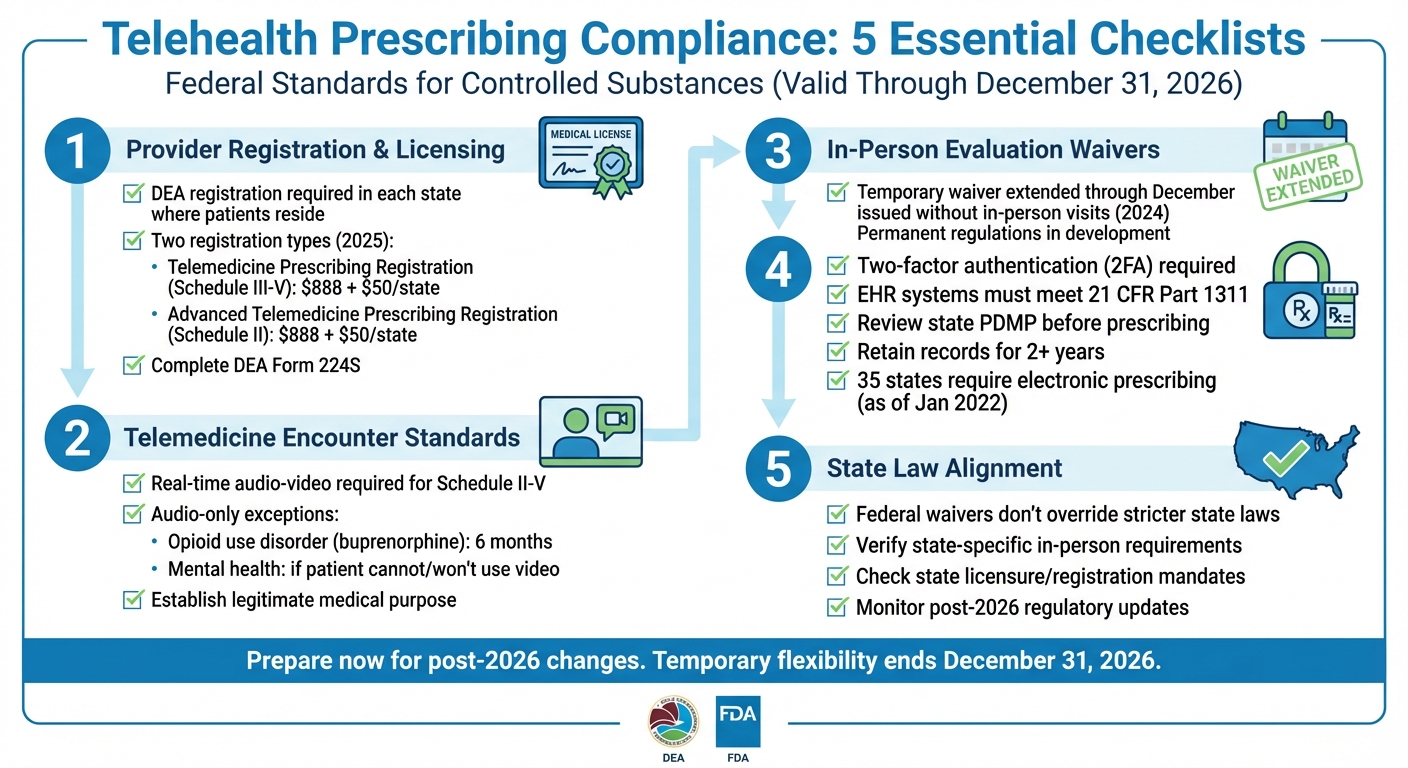
5-Step Telehealth Prescribing Compliance Checklist for Controlled Substances
Important Telehealth Update Controlled Substance Prescribing Extended
Checklist 1: Provider Registration and Licensing
Getting registration and licensing right is the first step to compliant telehealth prescribing.
Before prescribing controlled substances via telehealth, providers need to secure both federal and state credentials. Under 21 U.S.C. §823(g), a DEA registration is required. Specifically, practitioners must hold at least one standard DEA registration in a state where they have an active medical license. Without this, telemedicine prescribing isn't an option.
In 2025, the DEA introduced new registration categories to replace temporary pandemic measures. These include the Telemedicine Prescribing Registration for Schedule III–V substances, available to qualified physicians and mid-level practitioners, and the Advanced Telemedicine Prescribing Registration for Schedule II medications, designed for board-certified specialists like psychiatrists, pediatricians, and neurologists. To apply, providers must complete DEA Form 224S and pay $888 per registration type, plus $50 for each state.
"DEA's goal is to provide telehealth access for needed medications while ensuring patient safety and preventing the diversion of medications into the illicit drug market." – Anne Milgram, Administrator, DEA
Providers are required to register in every state where they practice unless a federal exemption applies. For those using the Advanced Telemedicine Prescribing Registration for Schedule II substances, there are additional rules: the practitioner must be physically present in the same state as the patient, and these prescriptions cannot exceed 50% of their total Schedule II prescriptions in a calendar month.
For opioid use disorder, providers can prescribe an initial six-month supply of buprenorphine via telemedicine - whether through audio-only or audio-video - without needing an in-person exam. VA practitioners, however, are exempt from the Special Registration requirement after conducting one in-person evaluation. Additionally, telemedicine platforms themselves must register, paying $888 per state.
With registration and licensing in place, the next step is to ensure compliance with telemedicine encounter standards.
Checklist 2: Telemedicine Encounter Standards
Once providers secure registration, they must adhere to specific telemedicine communication guidelines.
Audio-Video Communication Requirements
For prescribing Schedule II–V controlled substances, practitioners are required to use a real-time, two-way audio-video system that complies with the standards outlined in 42 CFR 410.78(a).
It's important to note that audio-only phone calls do not meet this requirement for most controlled substances. However, the DEA and HHS have extended pandemic-era allowances through December 31, 2026. This extension permits audio-video encounters to substitute for in-person evaluations when prescribing controlled medications. Providers should review and update their telemedicine systems before this deadline.
Establishing Medical Necessity
Every prescription must fulfill a legitimate medical purpose and fall within the provider's professional scope. For example, when prescribing medications like buprenorphine via telemedicine, providers must check the state's Prescription Drug Monitoring Program (PDMP) records for the prior 12 months. If the PDMP is unavailable, only a 7-day supply can be prescribed until the review is completed. Additionally, the date and time of the review must be recorded in the patient's electronic health record.
Audio-Only Exceptions
While audio-video communication is the standard, certain situations allow for audio-only consultations:
- Providers may prescribe Schedule III–V medications approved by the FDA for opioid use disorder, such as buprenorphine, through audio-only encounters for up to six months. After this period, an in-person or audio-video evaluation becomes mandatory.
"Telemedicine flexibilities authorize practitioners to prescribe... schedule III-V narcotic controlled medications approved by the Food and Drug Administration (FDA) for maintenance and withdrawal management treatment of opioid use disorder via audio-only telemedicine encounters."
– Drug Enforcement Administration
- For mental health treatment, audio-only communication is permitted if audio-video technology is available but the patient either cannot use it or does not consent to video. In such cases, the exception must be clearly documented in the medical record.
| Requirement Type | Audio‑Video Standard | Audio‑Only Exception |
|---|---|---|
| General (Sch II–V) | Required for all new prescriptions. | Not permitted. |
| Mental Health Disorders | Preferred method. | Allowed if the patient lacks video access or consent. |
| Opioid Use Disorder (Sch III–V) | Permitted. | Allowed for the first 6 months of treatment. |
These guidelines ensure compliance while addressing patient needs and set the groundwork for the upcoming discussion on in-person evaluation waivers.
Checklist 3: In-Person Evaluation Waivers and Exceptions
The Ryan Haight Act's in-person evaluation requirement has been temporarily waived under certain conditions, along with statutory exceptions, allowing providers to prescribe controlled substances via telemedicine. Below is an overview of how these waivers and exceptions are applied.
Temporary Waivers Through 2026
The DEA and HHS have issued a Fourth Temporary Extension, enabling practitioners to prescribe Schedule II–V controlled substances through audio-video telemedicine without requiring an initial in-person evaluation. This extension is valid until December 31, 2026. The goal is to avoid a "telemedicine cliff" that could disrupt patient access. In 2024, an estimated 16% of controlled substance prescriptions were issued without prior in-person evaluations, emphasizing the importance of this waiver.
"DEA supports telehealth access for patients who need medication, but not at the expense of public safety. These rules aim to protect patients, expand access to care, and close the door on diversion into the illicit drug market."
– Cheri Oz, Assistant Administrator, DEA Diversion Control Division
This waiver applies broadly to practitioner–patient relationships, allowing providers to prescribe treatments like testosterone (a Schedule III controlled substance) without requiring an initial in-person visit.
Ryan Haight Act Exceptions
The Ryan Haight Act provides seven statutory exceptions to the in-person evaluation requirement. These include:
- Treatment in DEA-registered hospitals or clinics
- Services provided by practitioners in the Department of Veterans Affairs or the Indian Health Service
- Prescriptions issued during a declared Public Health Emergency
One notable exception allows a covering practitioner to prescribe if the patient was evaluated within the prior 24 months. Additionally, two new rules - the "Expansion of Buprenorphine Treatment via Telemedicine Encounter" rule and the "Continuity of Care via Telemedicine for Veterans Affairs Patients" rule - became effective on December 31, 2025, offering permanent options for specific patient groups.
Future Permanent Regulations
As temporary measures remain in effect, the DEA is working on a Special Registration for Telemedicine system to establish a permanent framework. A proposed rule, published on January 17, 2025, outlines how providers can continue prescribing controlled substances via telemedicine without in-person visits, provided they meet specific reporting and recordkeeping requirements.
"The extension will provide time for DEA to promulgate final regulations for continued telemedicine prescribing."
– Drug Enforcement Administration
The DEA has received over 38,000 public comments on its initial proposed rules from 2023. Additional safeguards for Schedule II substances are under consideration, including requirements for prescribers to be in the same state as their patients or limitations on telemedicine prescriptions to less than 50% of a provider’s total Schedule II prescriptions. Providers are encouraged to use the extension period through December 31, 2026, to prepare for these upcoming changes and ensure compliance with future standards.
Telehealth providers, such as Oana Health, are actively monitoring these developments to maintain uninterrupted, compliant access to essential treatments for their patients.
sbb-itb-6dba428
Checklist 4: Prescription Security and Recordkeeping
Ensuring secure prescription practices and maintaining accurate records are critical for telehealth providers. The DEA has established strict requirements to protect both practitioners and patients from fraud, misuse, and unauthorized access.
DEA Prescription Security Guidelines
When prescribing controlled substances electronically, practitioners must meet the strict security standards outlined in 21 CFR Part 1311. This includes using EHR systems or electronic prescription applications that have been audited or certified by an approved third party to ensure compliance.
A key requirement is two-factor authentication (2FA) for signing controlled substance prescriptions. This involves a combination of the following: a password or PIN, a hard token that meets FIPS 140-2 Security Level 1, or biometric data. Practitioners must keep sole possession of their hard token and never share passwords or credentials with staff.
"Two-factor authentication... protects the practitioner from misuse of his/her credential by insiders as well as protecting him/her from external threats because the practitioner can retain control of a biometric or hard token."
– Drug Enforcement Administration (DEA)
Before receiving credentials, practitioners must complete identity proofing in accordance with the NIST Special Publication 800-63-1 Assurance Level 3. This can be done in person or through remote audio-visual communication. Additionally, any biometric system used for 2FA must maintain a false match rate of 0.001 or lower.
All electronic prescriptions must be transmitted directly to the pharmacy as an electronic data file. Converting them into another format, such as a fax, during transmission is not permitted. Records of electronic prescriptions and transfer documentation must be retained for at least two years.
If a hard token is lost or stolen, or if the practitioner's DEA registration expires or is revoked, access to sign prescriptions must be revoked within one business day. Practitioners are also required to notify the DEA and their internal access control coordinators within the same timeframe if their credentials are compromised or if unauthorized prescriptions are issued.
State Prescription Drug Monitoring Programs (PDMPs)
To enhance security, providers must also integrate state Prescription Drug Monitoring Programs (PDMPs) into their practices. These systems track controlled substance prescriptions and help identify patients at risk for overdose. When starting opioid therapy for acute, subacute, or chronic pain, practitioners are required to review the patient's prescription history in the state PDMP.
"Clinicians who are prescribing initial opioid therapy should first review a patient's history of controlled substance prescriptions using a state PDMP."
– CDC
Regularly reviewing the PDMP, as dictated by state guidelines, is essential. This data can uncover overlapping prescriptions from other providers and help calculate a patient's total morphine milligram equivalents (MME) per day to assess overdose risk. If the PDMP reveals that a patient is receiving controlled substances from multiple providers, practitioners should coordinate with those providers to ensure safe and effective care.
As of January 2022, 35 states require or are preparing to require electronic prescribing for controlled substances or all prescriptions. Practitioners must meet the specific training and technical requirements of the PDMP in the state where they practice or where their patients are located. Additionally, to prescribe controlled substances via telemedicine, providers must be registered with the DEA in the state where the patient resides.
FDA-Regulated Pharmacies
Choosing compliant dispensing partners is another critical step. Using FDA-regulated pharmacies ensures prescriptions are dispensed securely and in compliance with all regulations. Since August 28, 2023, the DEA has permitted a one-time transfer of an electronic prescription for Schedules II–V between retail pharmacies for the initial fill, provided the prescription stays in electronic form.
Practitioners should carefully review all prescription details before signing with 2FA. If electronic transmission fails, they must include a note on any replacement paper or oral prescription identifying the intended pharmacy. For emergency oral authorizations of Schedule II drugs, a written or electronic follow-up prescription must be provided to the pharmacy within seven days.
Telehealth providers, such as Oana Health, work exclusively with FDA-regulated pharmacies to securely dispense prescriptions for hormonal treatments like testosterone (a Schedule III controlled substance). These medications are delivered directly to patients' homes while maintaining full regulatory compliance.
Checklist 5: State Law Alignment and Restrictions
Federal telehealth flexibilities set a baseline, but state laws often impose stricter requirements. Providers must adhere to the stricter standard. Here’s how federal standards intersect with state laws.
Reconciling Federal and State Regulations
The DEA has extended its COVID-19 telemedicine flexibilities through December 31, 2026. This extension allows practitioners to prescribe Schedule II–V controlled substances without a prior in-person evaluation. However, these federal waivers don’t override state-specific rules. For example, state registration or in-person exam requirements remain in effect. Providers must verify licensure in each state or consider recognized interstate compacts.
For telehealth prescribing of hormonal treatments, it's critical to check whether your state mandates an in-person exam, even under federal waivers. Some states have simplified their processes. Indiana, for instance, will no longer require out-of-state providers to obtain separate telehealth certification starting July 1, 2024. Meanwhile, South Carolina permits telehealth for specialty care only if an in-person relationship was established in another state and services adhere to an existing treatment plan.
Providers should also confirm state-specific mandates for in-person evaluations.
State-Specific In-Person Requirements
Certain states enforce stricter in-person evaluation rules than federal standards. For example, Alabama requires at least one in-person visit within the preceding 12 months before prescribing controlled substances via telehealth. This requirement can also be met if licensed personnel, such as a nurse or physician assistant, are present with the patient during a video evaluation.
In Alaska, out-of-state physicians may only provide follow-up care via telehealth if they have an established relationship with the patient and have conducted an in-person visit. Additionally, most states prohibit relying solely on online questionnaires to establish the practitioner–patient relationship necessary for prescribing.
"A physician has the same duty to exercise reasonable care, diligence, and skill whether providing services in-person or via telehealth." – Alabama Board of Medical Examiners
States also differ in their telehealth modality requirements. While many states mandate synchronous audio-visual communication for prescribing controlled substances, Nebraska allows audio-only telehealth for behavioral health services if a provider–patient relationship is already established.
Monitoring Post-2026 Updates
As temporary federal waivers approach their expiration on December 31, 2026, providers must stay alert to regulatory changes. The DEA received a record 38,000 comments on its 2023 proposed telemedicine rules, highlighting the high level of stakeholder interest. After Medicare telehealth flexibilities expired in September 2025, fee-for-service telemedicine visits declined by 24% nationally, with some states like Florida, Washington, and New York seeing reductions of nearly 40%.
Providers should prepare for the potential return of stricter in-person evaluation requirements if waivers end. States are increasingly implementing permanent rules to balance care access and quality, moving beyond temporary pandemic-era measures. For instance, Mississippi made its private payer telehealth coverage requirement permanent in 2026, and Pennsylvania authorized initial admissions to opioid treatment programs via telehealth, aligning state practices with federal standards.
"Telehealth providers should continue to prioritize the development and integration of robust operational compliance infrastructures." – Amy F. Lerman, Audrey Davis, and Avery Schumacher, Epstein Becker & Green, P.C.
Staying informed is essential. Providers should regularly review updates from state boards, the DEA, and professional associations. Oana Health actively monitors these changes to ensure its telehealth prescribing practices for hormonal treatments comply with state-specific regulations wherever patients are located.
Conclusion
Telehealth prescribing requires strict adherence to DEA and FDA regulations to ensure patient safety while maintaining access to necessary medications. The five checklists discussed earlier - covering everything from provider registration to compliance with state laws - create a solid framework for safe telehealth operations. These measures are designed to prevent the diversion of controlled substances while ensuring patients can access essential treatments, such as hormonal therapies often classified under Schedules III–V.
With the current telemedicine flexibilities extended through December 31, 2026, providers have a valuable opportunity to strengthen their compliance systems. The overwhelming public feedback on the DEA’s proposed telemedicine rules highlights just how many patients and providers rely on these regulations.
"DEA supports telehealth access for patients who need medication, but not at the expense of public safety." – Cheri Oz, Assistant Administrator, DEA Diversion Control Division
Providers should act now to prepare for the eventual transition to permanent regulations. Stay informed by monitoring updates in the Federal Register, particularly regarding "Special Registration" pathways, and ensure compliance with any state laws that may impose stricter requirements than federal standards. Maintaining detailed, secure records is also essential. When Medicare telehealth flexibilities briefly expired on September 30, 2025, fee-for-service telemedicine visits dropped by 24% nationally, with sharp declines of nearly 40% in states like Florida and New York. These disruptions underscore the importance of staying proactive about regulatory changes.
Oana Health remains vigilant in tracking federal and state regulations to ensure its telehealth prescribing practices for hormonal treatments remain compliant across all jurisdictions. By prioritizing both legal requirements and patient safety, telehealth providers can continue delivering accessible, high-quality care well beyond 2026.
FAQs
What are the updated DEA rules for prescribing controlled substances via telehealth?
The DEA has introduced updated rules to simplify telehealth prescribing for controlled substances. Among these is the Telemedicine Prescribing Registration, which permits qualified healthcare providers to prescribe Schedule III–V controlled substances without needing an in-person evaluation.
The rules also outline additional measures to support telehealth services while prioritizing patient safety. These changes are designed to ensure that patients, especially those managing ongoing conditions like hormonal health, can access care while adhering to federal guidelines.
How do the temporary waivers impact telehealth prescribing rules through 2026?
Temporary waivers enable DEA-registered providers to prescribe Schedule II-V controlled substances through telemedicine without needing an in-person visit. These waivers remain valid until December 31, 2026, providing continuity of care as permanent regulations are developed.
The extension ensures that patients can access critical treatments for conditions such as hormonal health, weight management, and mental health via telehealth platforms.
What are the rules for prescribing controlled substances through telehealth?
Prescribing controlled substances through telehealth is tightly regulated by both federal and state laws to prioritize patient safety and legal compliance. Providers are required to perform a thorough medical evaluation, which can include a telehealth consultation. However, in many situations, an in-person assessment is necessary unless specific exceptions apply - like those introduced during the COVID-19 public health emergency.
Telehealth providers must use secure, real-time audio or video communication systems to meet regulatory standards. Additionally, practitioners prescribing controlled substances are generally required to register with the DEA. Temporary regulatory changes during the pandemic expanded telehealth prescribing privileges, but these rules are subject to updates. Staying informed about the latest federal and state requirements is essential to ensure compliance and maintain appropriate prescribing practices.